UK SRS S1 — General Disclosure Standard
UK SRS S1 is the architecture everything else stands on — how a company discloses every material sustainability topic except climate. Voluntary today; proposed comply-or-explain for listed companies from 1 January 2029 under FCA CP26/5.
This is going to take real work. Here is exactly what it asks, so none of that work is wasted.
One standard, four pillars, every topic except climate
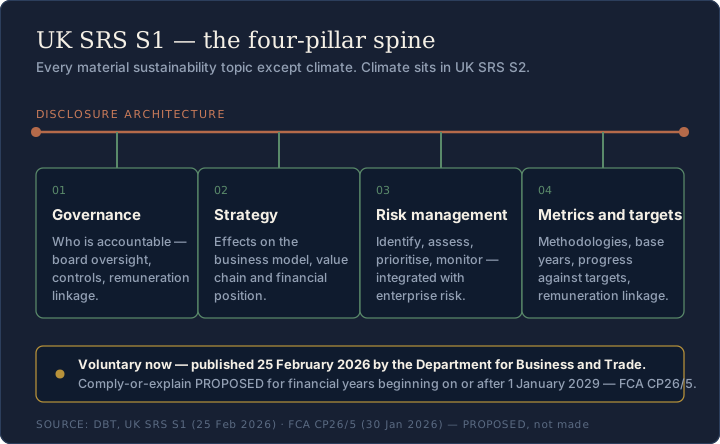
UK SRS S1 asks a company to disclose its sustainability-related risks and opportunities through four pillars — governance, strategy, risk management, metrics and targets — for every material topic except climate, which sits in UK SRS S2.

It is voluntary today, for any UK entity, since the Department for Business and Trade published the final standards on 25 February 2026.
The 2029 duty comes from FCA CP26/5 — proposed, not yet made, for UK-listed companies, for financial years beginning on or after 1 January 2029.
A baseline, adopted.
An architecture, required.
The 2029 date was never a start date
A UKLR-listed manufacturer. The finance director signs off the reporting plan: S2 climate report for FY2027, and S1 filed under 2029-someday.
Six months in, the team building the climate report hits the definitions.
Materiality, connectivity, value chain — every concept S2 stands onS2 climate disclosures apply the general architecture S1 defines: the materiality test, the connectivity principle, the value-chain boundary. FAQ 4 and FAQ 8 in the record below carry the detail. — is defined in S1.
And the assumptions in those disclosures have to reconcile with the financial statements the director is signing this year — same entity, same period, consistent assumptions.
Nobody wants a director signing something they have not understood.
~515 companies, four dates, one public statement
On the FCA’s own analysis in CP26/5 (30 January 2026), roughly 515 of the ~600 listed issuers examined would be required to comply — UK Listing Rules categories 6, 14, 15, 16 and 22.
Comply-or-explain is not a soft option. The explanation is a public statement in the annual financial report, with the company’s name on it.
And the rules the plan is currently guessing at get fixed soon — the FCA’s Policy Statement is expected autumn 2026.
What actually changed from IFRS S1
The government consulted on six proposed amendments in June 2025 — but two didn’t survive to publication, and four new provisions were added instead. Annex A of the government’s response maps what actually changed, and states no total. These are the six differences it records that matter most in practice.
The effective date was removed, not replaced
IFRS S1’s 1 January 2024 effective date is gone from UK SRS S1 entirely, not swapped for a UK date. Entities can apply the Standard whenever they choose, unless UK law, the FCA or another regulator requires otherwise.
First-year transitional relief removed
The IFRS S1 first-year-only reporting relief is removed in the UK adoption.
Climate-first relief kept, time limit removed
IFRS S1 lets entities report only climate in year one. UK SRS S1 keeps that option at ¶E3 but drops the time limit altogether — its availability is left to UK legislation or FCA rules, not fixed by the Standard. The proposed 2027/2029 phasing is the FCA’s CP26/5 proposal, not a UK SRS amendment.
SASB “shall” softened to “may”
Where IFRS S1 requires entities to apply SASB industry-based metrics, UK SRS S1 makes their use voluntary. SASB stays as a reference, not a mandate.
GICS: an ISSB change, not a UK one
UK SRS S1 no longer requires GICS for industry identification — but that’s not a UK amendment. The ISSB removed the mandatory GICS reference itself in December 2025, and the UK’s own proposed change was withdrawn as a result.
¶73A — the price of the climate-first relief
An entity that uses the climate-first relief at ¶E3 can’t assert full compliance with UK SRS S1 — ¶73A requires it to disclose that it used the provision instead. It can still assert compliance with UK SRS S2.
Amendment-by-amendment detail, against the ISSB text: the six UK amendments.
Your listing, your year-end — your sequence.
Does S1 apply to you — and when
Two answers, one toggle. The sequence below computes from your inputs — the same CP26/5 phasing, placed on your calendar.
S2 is first on the calendar. S1 is first in the work.
Whatever your dates computed to above, the order of work does not change — because the climate report you owe first runs on the architecture the general standard defines.
Governance
The body or individual responsible for oversight of sustainability-related risks and opportunities — board-level accountability, processes and controls, skills, and linkage to executive remuneration where sustainability metrics are used.
Strategy
How sustainability-related risks and opportunities affect the business model, value chain and financial position over short, medium and long-term horizons — including effects on cash flows, access to finance and cost of capital.
Risk management
The processes used to identify, assess, prioritise and monitor sustainability-related risks, and how those processes integrate with overall enterprise risk management.
Metrics and targets
How performance is measured, monitored and disclosed — methodologies, base years, progress against targets, and remuneration linkage where present.
Done properly, this is the first honest picture your board has had of how the business actually runs on these questions. The sequenced plan is the UK SRS compliance guide; the structured gap analysis is the readiness assessment.
You came for a standard.
You leave with a sequence.
UK SRS S1 is voluntary today, is proposed to become comply-or-explain for listed companies from 1 January 2029, and every S2 climate report filed before then already stands on its architecture.
UK SRS S1 in five dates
You know what S1 asks. The next question is whether the thresholds catch you — and when.
See whether the thresholds catch you Or get the S1-vs-S2 split straight first — UK SRS S1 and S2 explainedUK SRS S1 — key facts
UK SRS S1 is the general sustainability disclosure standard — the companion to UK SRS S2 (climate-specific). It sets out how companies disclose information about all material sustainability topics, not just climate.
Eight topic clusters, and one absence
S1 covers every material sustainability topic except climate. The absence is deliberate — climate has its own standard, UK SRS S2.
The test for each is materiality — a topic is disclosed because it could move the decisions of investors, lenders and other creditors, not because it appears on a list. Scope 3 value-chain emissions sit with S2 — see Scope 3 under UK SRS.
Single materiality, not double
The single most misquoted thing about UK SRS S1: it uses the financial lens, on the ISSB / IFRS S1 basis.
“Information is material if omitting, misstating or obscuring it could reasonably be expected to influence the decisions that primary users of general-purpose financial reports make on the basis of those reports.” — the IFRS S1 definition UK SRS S1 adopts. Primary users: investors, lenders and other creditors.
Single materiality
One lens: the effect of sustainability matters on the entity’s own prospects — cash flows, access to finance, cost of capital.
Double materiality
Two lenses: the financial lens plus the entity’s impact on people and environment. The EU parallel, not the UK test — see UK SRS vs CSRD and double materiality.
SASB Standards are referenced for industry-specific metrics — and under UK amendment 04 their use is voluntary. They are not the materiality basis.
Tied to the financial statements
S1 disclosures must connect to the accounts. Four tests, every year:
S1 also provides the architectural concepts — materiality, connectivity, value chain — that S2 climate disclosures rely on. That is why S2 cannot be applied in substance without S1, even though only S2 is currently proposed mandatory.
— days to 1 January 2029 — the first financial years the S1 comply-or-explain proposal would catch.
S1 versus S2
Same four pillars, same materiality basis — different subject, different dates.
General — every topic except climate
Voluntary now. Proposed comply-or-explain for listed companies from 1 January 2029. Defines the architecture — materiality, connectivity, value chain — that both standards use.
Climate — and only climate
Voluntary now. Proposed mandatory for in-scope listed companies from 1 January 2027, with Scope 3 relieved until 2028. Read UK SRS S2.
Who the proposals actually reach is a separate question — see who is in scope and the thresholds. The FCA’s role and rulemaking sit on UK SRS and the FCA; the consultation record is on the UK SRS consultation; the legal instruments on UK SRS legislation. For how S1 fits UK reporting more widely, start at UK SRS reporting or the standards overview — and for large private companies, the Modernisation of Corporate Reporting route is on UK SRS and MCR.
Frequently asked questions
UK SRS S1 covers general requirements for disclosing sustainability-related financial information across every material sustainability topic except climate. Climate sits in UK SRS S2. Topics that fall under S1 include biodiversity and natural capital, water and marine resources, workforce health and safety, supply chain labour conditions, human rights, governance and business ethics, and resource use.
No — not yet. S1 is currently voluntary for any UK entity. Under the FCA's CP26/5 proposals, in-scope listed companies move to comply-or-explain for S1 from 1 January 2029. The full mandatory timeline for the UK SRS framework — including S2 climate from 2027 and Scope 3 from 2028 — is on the UK SRS timeline.
For mandatory application: financial years beginning on or after 1 January 2029, on a comply-or-explain basis under the FCA Listing Rules — subject to the FCA Policy Statement expected autumn 2026. For voluntary application: now, since 25 February 2026 when DBT published the final standards. Early adoption is all-or-nothing — entities must produce a full statement of compliance.
S1 is the general standard covering every material sustainability topic. S2 is the climate-specific standard. S2 is proposed to become mandatory for in-scope listed issuers on 1 January 2027 (with Scope 3 excluded in year one) under FCA CP26/5, subject to the Policy Statement expected autumn 2026; S1 would follow on comply-or-explain on 1 January 2029.
UK SRS S1 uses single (financial) materiality on the ISSB / IFRS S1 basis. Information is material if omitting, misstating or obscuring it could reasonably be expected to influence the decisions that primary users — investors, lenders and other creditors — make on the basis of an entity's general-purpose financial reports. This is not the EU CSRD/ESRS double materiality concept (investor + impact).
UK SRS S1 adopts IFRS S1 with a small number of UK-specific changes. The government consulted on six proposed amendments in June 2025, but that is a count of the proposals: one was withdrawn and one replaced before publication, and four new provisions were added after the consultation closed. Annex A of the government response is the authoritative map of the final differences and it states no total. The substantive changes are: the effective date was removed (not replaced) so entities apply the Standard when they choose; the IFRS S1 first-year delayed-reporting relief was removed; the climate-first relief at ¶E3 was retained with its time limit removed, its availability left to UK legislation or FCA rules; ¶73A provides that an entity using that relief may not assert compliance with UK SRS S1; ¶73B and ¶E5 subject the Standard to UK law; and SASB references at ¶¶55(a) and 58(a) soften from “shall” to “may”.
No mandatory assurance is proposed in the initial phase. Under FCA CP26/5, in-scope companies must disclose whether they obtained third-party assurance (disclose-or-explain). UK practitioners use ISSA (UK) 5000. Mandatory assurance is under separate UK Government consultation with no fixed date.
S1 requires that sustainability disclosures and the financial statements share the same reporting entity, same reporting period, and consistent assumptions. Any differences must be explained. S1 also provides the architectural concepts — materiality, connectivity, value chain — that S2 relies on.
Today, nobody is required to apply it — UK SRS S1 has been available for voluntary use by any UK entity since 25 February 2026. Under the FCA's CP26/5 proposals, roughly 515 UK-listed companies would report under UK SRS S2 for accounting periods beginning on or after 1 January 2027, with UK SRS S1 following on a comply-or-explain basis from 1 January 2029. Both dates are proposals: the FCA Policy Statement that would confirm them was still expected in autumn 2026. Large private companies are outside the FCA's reach entirely and would need the separate Modernisation of Corporate Reporting route.
Governance, strategy, risk management, and metrics and targets. Governance covers who on the board owns sustainability oversight and how that is evidenced. Strategy covers how sustainability risks and opportunities affect the business model and financial position over short, medium and long horizons. Risk management covers the processes used to identify, assess and monitor those risks, and how they connect to enterprise risk management. Metrics and targets covers how performance is measured and disclosed, including methodologies, base years and progress. UK SRS S2 uses the same four pillars for climate, which is why the two standards read as one framework.
Not in substance. UK SRS S1 supplies the architecture the climate standard runs on — the materiality test, the connectivity requirement, and the value-chain concept. UK SRS S2 assumes all three rather than restating them. So although the proposed sequencing puts UK SRS S2 first on the calendar, in 2027, an entity preparing S2 disclosures is already making S1 judgements. That is the practical reason the 2029 date for S1 is not the date the work starts.
Fewer in one respect, broader in another. The UK removed the IFRS S1 first-year delayed-reporting relief entirely. The climate-first relief at ¶E3 was kept, but its one-year time limit was removed rather than reworked to any UK phasing — the Standard itself sets no date, and its availability is left to UK legislation or FCA rules. Under FCA CP26/5, the practical effect is the two-year gap between the proposed UK SRS S2 start in 2027 and the proposed UK SRS S1 start in 2029 — but that phasing is the FCA’s proposal, not a UK SRS relief. If you early-adopt voluntarily and rely on any relief, say which one — early adoption is all-or-nothing and requires a full statement of compliance.
The rest of the framework
UK SRS S1 and S2 explained
The complete framework — voluntary 2026 through S2 mandatory 2027 to S1 comply-or-explain 2029.
ClimateUK SRS S2
The climate-specific standard — Scope 1, 2 and 3, scenario analysis and transition plans.
AmendmentsThe six UK amendments
How UK SRS S1 and S2 differ from the ISSB baseline, amendment by amendment.
RoadmapUK SRS compliance guide
A sequenced plan for putting the S1 architecture in place before the mandatory dates.
ComparisonUK SRS vs EU CSRD
Single materiality against double, one standard against twelve.
TimelineThe full UK SRS timeline
Every date from publication through S2 in 2027 to S1 in 2029.
ScopeWho is in scope
Which entities the FCA's CP26/5 proposals actually reach.
AssuranceSustainability assurance
Disclose-or-explain, ISSA (UK) 5000 and the FRC's interim register.
ReadinessReadiness assessment
A structured gap analysis across the four pillars.
Primary sources
Every claim on this page traces to one of these. Re-verified July 2026 against the DBT government response, FCA CP26/5 and the IFRS Foundation’s IFRS S1.
The standards
UK SRS S1 final standard (DBT) ↗ GOV.UK — UK SRS guidance ↗ DBT government response ↗ IFRS S1 — the international baseline ↗Regulators
FCA CP26/5 ↗ Department for Business and Trade ↗ Financial Conduct Authority ↗ Financial Reporting Council ↗ FRC sustainability reporting FAQ ↗ ICAEW sustainability ↗You know what S1 asks. Next: whether the thresholds catch you.
See whether the thresholds catch you