Company
Apply Companies Act scope and the non-financial and sustainability information statement requirements.
The standards
Does it apply to you
Reporting under it
Start here
Dates and penalties
Doing it
What you must file
Doing it
Start here
Setting targets
Who and where
The UK duty
Doing it
The baseline
Europe
Reporting more widely
Carbon markets and trade
Packaging and net zero
Carbon accounting
Choosing
Carbon
Compliance and offsets
Software
Templates
Careers
CFD · Companies Act 2006 · in force since April 2022
For companies and LLPs in scope, the UK company-law regime requires a structured account of climate risks, opportunities, governance, resilience and performance.
Check the statutory scope, answer the eight disclosure requirements and record any permitted omissions properly. Keep this duty distinct from the FCA’s listing rules.
CFD regulations to report evidence
Use the statutory letters as the report checklist, rather than treating a generic TCFD heading as proof that the company-law requirement has been answered.
| Statutory area | Evidence to connect to the disclosure | Detailed check |
|---|---|---|
| Governance and risk processes: (a)–(c) | Who oversees climate issues, how risks are identified and managed, and how that process joins overall risk management. | Read the eight statutory items |
| Principal risks and opportunities: (d) | The principal matters identified and the time periods over which they are assessed. | Match the risk to its time horizon |
| Business effects and resilience: (e)–(f) | Business-model and strategy implications, and resilience taking different climate scenarios into account. | Check the specific omission conditions |
| Targets and indicators: (g)–(h) | Targets, performance against them, the key indicators used and the calculation basis. | Check the disclosure against its evidence |
The omission conditions for (e)–(h) do not extend to (a)–(d).
Check the separate company and LLP reporting locations and the distinction between CFD and TCFD before drafting.
The duty
The duty was made by two short statutory instruments, both laid in January 2022 and both in force on 6 April 2022.
SI 2022/31 amends the Companies Act for companies, and SI 2022/46 amends the LLP accounts regulations in the same way.
SI 2022/31 is a pure amending instrument: it creates no free-standing duty, and the law a reader needs is the amended text of sections 414CA and 414CB.
Section 414CA says who must prepare a non-financial and sustainability information statement, and section 414CB says what it contains.
Subsection (A1) of section 414CB makes the climate-related financial disclosures part of that statement, and subsection (2A) lists them.
The list follows the architecture of the TCFD framework — governance, strategy, risk management, and metrics and targets — but the statute does not label the eight by pillar, and it uses its own words throughout.
The instruments say “financial year”, while the FCA frames its listing rules by accounting period; both are right in their own text, and quoting one in the other’s language is a common slip.
The government’s guidance for companies and LLPs was published on 21 February 2022, is non-binding and has not been revised since.
The FRC records that the government has said it intends to update that guidance to reflect the UK SRS S2 route described below.
Climate and the business
Climate and the business
Climate and the business
Climate and the business
Scope
There is no single CFD test: the company and LLP instruments each create their own routes, and which one catches you decides whether turnover matters at all.
A company is caught by section 414CA(1) if at any time in the year it was a traded company, a banking company, an authorised insurance company, a company carrying on insurance market activity, or a company with securities admitted to AIM.
Otherwise it is caught only as a “high turnover company”: turnover of more than £500 million, or more than £500 million net for a group.
Both are then subject to the same exclusions: a company under the small companies regime, a company that qualifies as medium-sized, and a subsidiary covered by a qualifying group statement are out.
The headcount test sits in subsection (4) and applies to every limb: a company with no more than 500 employees, or a parent whose group has no more than 500, is outside, banks and insurers included.
For LLPs, SI 2022/46 has two routes: a traded or banking LLP with more than 500 employees, and a “large LLP” with more than 500 employees and turnover of more than £500 million.
There is no AIM route for LLPs, and the LLP instrument says in terms that the £500 million figure is adjusted proportionately for a financial year that is not a year.
The “large LLP” of SI 2022/46 is a definition made for this duty alone; it is not the ordinary Companies Act size test that size thresholds pages discuss.
The checker applies these tests and works out the filing date for the year from section 442: nine months after the year end for a private company and six for a public one.
CFD scope and dates
In scope as a "high turnover company": more than 500 employees and turnover of more than £500 million.
Where: The non-financial and sustainability information statement, in the strategic report.
CA 2006 s.414CA(1A), (2A)-(2B), (1B), (4); s.414CB(A1)
That year began on 1 January 2026: on or after 6 April 2022, so the duty applies to it.
Accounts and reports for the year are due at Companies House by 30 September 2027 (nine months after the year end).
SI 2022/31 and SI 2022/46 reg 1(2); CA 2006 s.442(2)
A reading aid, not advice.
First accounts and shortened years have their own filing rules in s.442(3)–(4); for a company whose year is not twelve months, read s.414CA on turnover.
More than headcount
More than headcount
More than headcount
More than headcount
The routes side by side
Companies and LLPs have separate statutory routes and reporting locations. Identify the legal entity before drafting.
| Route | Employees | Turnover | Where the disclosures go |
|---|---|---|---|
| Traded, banking, insurance or AIM company | More than 500 | Not tested | Non-financial and sustainability information statement, in the strategic report |
| High turnover company | More than 500 | More than £500m (group: net) | Non-financial and sustainability information statement, in the strategic report |
| Traded or banking LLP | More than 500 | Not tested | The strategic report |
| Large LLP | More than 500 | More than £500m, adjusted for a short or long year | The energy and carbon report |
| Small or medium-sized company, or a covered subsidiary | — | — | Outside the duty |
The high turnover limb is the point of the regime: a private group with thousands of staff and no listing was reached by no climate rule before April 2022.
It is also the cohort the FRC reviewed first.
A large LLP reports in the energy and carbon report, beside its SECR figures, not in a strategic report.
Yet the LLP omission clause still says the explanation goes in “the strategic report”, so read the modified section 416A before drafting.
Apply Companies Act scope and the non-financial and sustainability information statement requirements.
Apply the separate LLP regulations and the relevant energy and carbon report requirements.
The requirement
Map the report to all eight lettered requirements, including time horizons, performance and the calculation basis.
| The statute asks for | What a complete answer shows | Omission gate | |
|---|---|---|---|
| (a) | a description of the company’s governance arrangements in relation to assessing and managing climate-related risks and opportunities | The chain from board to committee to a named executive to the functions that do the work | None — must be given |
| (b) | a description of how the company identifies, assesses, and manages climate-related risks and opportunities | How a risk reaches the register, the test that makes it significant, who scores it and what is done — for opportunities as well as risks | None — must be given |
| (c) | a description of how processes for identifying, assessing, and managing climate-related risks are integrated into the company’s overall risk management process | One register, one scoring scale, one escalation route — and climate risks in the principal risks table where they are principal | None — must be given |
| (d) | a description of (i) the principal climate-related risks and opportunities arising in connection with the company’s operations, and (ii) the time periods by reference to which those risks and opportunities are assessed | Named risks and opportunities, and each horizon given in years with a reason | None — must be given |
| (e) | a description of the actual and potential impacts of the principal climate-related risks and opportunities on the company’s business model and strategy | Which products, sites, costs and customers change, today and in prospect | May be omitted in whole or part |
| (f) | an analysis of the resilience of the company’s business model and strategy, taking into consideration different climate-related scenarios | More than one scenario, the assumptions, and what the divergence does to the business | May be omitted in whole or part |
| (g) | a description of the targets used by the company to manage climate-related risks and to realise climate-related opportunities and of performance against those targets | A base year, a dated target and this year’s position against it | May be omitted in whole or part |
| (h) | a description of the key performance indicators used to assess progress against targets … and of the calculations on which those key performance indicators are based | The number with its boundary, method, factor set and restatement policy | May be omitted in whole or part |
Eight, not eleven
The TCFD framework has eleven recommended disclosures; the statute has eight.
The eight are a redrafting, not a subset, so mapping one onto the other is a drafting exercise rather than arithmetic.
The eleven themselves are on the TCFD framework page.
The clauses people skip
(d)(ii) asks for the time periods, not just the risks.
(g) asks for performance against targets, not just the targets.
(h) asks for “the calculations on which those key performance indicators are based”, so a bare number does not answer it.
Section 414CB(2A) defines “climate-related financial disclosures” as eight lettered items.
The wording below is the statute’s; the right-hand column is our reading of what each asks a reader to be able to check.
Eight statutory items
Eight statutory items
Eight statutory items
Eight statutory items
The gate
CFD is widely called comply-or-explain, and that is only half right.
The omission route in section 414CB(4A) reaches disclosures (e), (f), (g) and (h) and nothing else.
Governance, the risk process, integration and the principal risks with their time periods have no materiality filter, no directors’ belief test and no explanation route: if you are in scope, they are required.
The gate is partial — “the whole or a part” — so a company can omit one element of the scenario analysis rather than all of it.
The test is the directors’ reasonable belief about this business, so a reason that could appear in any company’s report is weak evidence that the belief is reasonable.
The explanation is itself a disclosure with a standard — “clear and reasoned” — and silence does not meet it.
The FCA’s listing rule worked differently: it was comply-or-explain across all eleven TCFD disclosures, which is one reason a listed company in both regimes could not treat them as one test.
Where the directors “reasonably believe that, having regard to the nature of the company’s business, and the manner in which it is carried on, the whole or a part of a climate-related financial disclosure required by subsection (2A)(e), (f), (g) or (h) is not necessary for an understanding of the company’s business”, they may omit it.
The statement must then “provide a clear and reasoned explanation of the directors’ reasonable belief”.
Source: CA 2006 s.414CB(4A)–(4B)
The specific omission gate does not cover these four requirements.
Whole or part may be omitted only under the directors’ reasonable-belief test and with a clear, reasoned explanation.
Before the board signs
The checklist marks each of the eight as made, made in part or left out, and tells you which gaps the statute does not allow.
For (e) to (h) it asks for the reason the directors believe the omitted information is not necessary for an understanding of the business, and writes it into a draft explanation.
If the company reports against UK SRS S2 and relies on it for these disclosures, it adds the reference to the national reporting framework that the FRC says must appear in the statement.
The draft is a starting point for the company secretary and the auditor, who reads the strategic report for consistency with the financial statements.
If the strategic report last year answered (f) with a single sentence, that is the disclosure to start on.
The eight, before the board signs
Drafting list
Nothing that the statute requires outright is missing. 1 omission relying on section 414CB(4A), each needing a reasoned explanation.
Draft wording
A drafting aid, not legal wording.
The explanation must be clear and reasoned and specific to the business (s.414CB(4B)); the UK SRS S2 route also needs the rest of s.414CB(1)–(5) met.
Nothing you type is stored or sent.
From item to evidence
From item to evidence
From item to evidence
Location
Regulation 2 of SI 2022/31 renamed the old non-financial information statement: it is now the non-financial and sustainability information statement, often shortened to NFSIS.
Section 414CB(A1) says that statement “must contain the climate-related financial disclosures of the company”.
The statement sits in the strategic report, which the board approves, so a defective climate section is a defective strategic report.
A traded or banking LLP puts the disclosures in its strategic report on the same footing, while a large LLP puts them in its energy and carbon report under the modified section 416A.
A parent tests the thresholds on the group, and the FRC’s review addressed the case of a parent presenting company-only information.
The NFSIS is also what makes the UK SRS route work, because the designation turns on a reference inside it.
The accounts and reports are then filed at Companies House, where anyone can read them.
Supply the risks, assumptions, metrics and calculations.
Review the disclosures and any permitted omission decision.
Publish in the applicable statutory reporting location.
The comparison people search for
The government’s 2022 guidance says disclosures made under the listing rules should also comply with the Regulations, so a listed company over the thresholds has always had two rulebooks to satisfy.
The framework’s history and where it still applies are on TCFD, and its 2021 guidance on metrics is the Guidance on Metrics, Targets, and Transition Plans.
| TCFD | CFD | |
|---|---|---|
| What it is | An international framework from a task force set up by the Financial Stability Board in December 2015 | UK company law: CA 2006 ss.414CA and 414CB |
| Content | Four recommendations and eleven recommended disclosures | Eight lettered disclosures |
| Legal force | None of its own; binds only where a rule adopts it | A statutory duty in the strategic report |
| Flexibility | Recommendations; materiality wording on strategy and metrics | (a)–(d) required; (e)–(h) omissible with a reasoned explanation |
| Who | Anyone who chose to use it, and those whose rules required it | Companies and LLPs over the thresholds, listed or not |
| Status in 2026 | Task Force disbanded 12 October 2023; documents frozen | In force every year; review report due before 6 April 2027 |
The same
The four-pillar shape, scenario analysis as the test of resilience, and risks paired with opportunities.
Different
Force, scope and flexibility: a company can satisfy one and fail the other.
Three acronyms
CFD is this duty; a CfD is a low-carbon electricity contract; CFDs are leveraged trading products the FCA regulates.
Framework and statute
Framework and statute
The other rulebook
Listed companies have made a TCFD-aligned statement under the listing rules on a comply-or-explain basis, separately from the Companies Act duty.
For a commercial company it is UKLR 6.6.6R(8), with parallel provisions for the other listing categories, and the FCA explains its expectations in Technical Note TN 802.3.
On 30 September 2026 the FCA published PS26/19, whose ¶1.10 reads: “These rules will replace the existing TCFD aligned disclosures.”
From accounting periods beginning on or after 1 January 2027, companies in UKLR 6, 14, 15, 16 and 22 report against UK SRS on a comply-or-explain basis, S2 included.
The consultation that preceded it, CP26/5, had proposed mandatory S2 for some categories and a signposting statement for others; the final rules took neither course.
None of that touches the Companies Act: the FCA writes listing rules and cannot amend section 414CB.
A listed company over the CFD thresholds therefore stays in CFD scope after the listing rule changes, and the duplication is handled by the UK SRS S2 route rather than by repeal.
The listing rule, provision by provision, is on TCFD UK requirements, and which rule governs which period is on TCFD reporting requirements.
UKLR 6.6.6R(8) and its twins, with TN 802.3 as guidance.
Comply or explain across S1 and S2, for accounting periods beginning on or after this date.
Unchanged by PS26/19; UK SRS S2 can discharge it.
Two legal routes
Two legal routes
Two legal routes
The 2026 change
Section 414CB(6) has always allowed a company to rely on a national, EU-based or international reporting framework when making the statement, provided it says which.
In its February 2026 consultation response, the government confirmed that “UK SRS S2 is a national reporting framework for the purposes of section 414CB(6) of the Companies Act”.
Companies reporting in accordance with UK SRS S2, it said, “do not need to duplicate their disclosures” to meet section 414CB(2A).
The FRC’s FAQ sets the conditions: the relief applies “so long as use of UK SRS S2 is clearly referenced in the NFSIS, and existing NFSIS requirements relating to climate-related financial disclosures set out in section 414CB (1)-(5) of the Companies Act 2006 are met”.
It adds: “This applies regardless of whether UK SRS is applied on a mandatory or voluntary basis.”
The obligation remains. Avoiding duplicate disclosure requires the clear reference and continuing statutory conditions described by the FRC.
A large private company in CFD scope can adopt UK SRS S2 voluntarily and write one climate report.
The government also said it “will consider the future of the section 414CB(2A) obligations” when it considers reporting requirements against UK SRS — a statement of intent with no date.
How the standards and the statute fit together, section by section, is on UK SRS legislation, and the standards themselves are described on the government’s UK SRS guidance page.
Use S2 with conditions
Use S2 with conditions
The other numbers
CFD is narrative and SECR is numeric, and they sit in different parts of the annual report.
The statute names no emissions scope at all: disclosure (h) asks for the KPIs you use and the calculations behind them.
For most companies those KPIs are the SECR figures, and the government’s environmental reporting guidelines are the method most of them follow.
The FRC’s review looked specifically at how the SECR numbers and the climate targets and KPIs fit together, and two sets of emissions figures that do not reconcile in one annual report is the kind of thing a reviewer notices.
Full Scope 3 across the value chain is a UK SRS S2 requirement, with a relief, not a CFD one — the work is set out on Scope 3 under UK SRS.
The detail of the SECR regime is on the SECR reporting guide, and the energy audit scheme that often runs beside both is on energy savings opportunity scheme.
| CFD | SECR | |
|---|---|---|
| Kind | Narrative | Numeric |
| Where | Strategic report (LLP: energy and carbon report) | Directors’ report (LLP: energy and carbon report) |
| Emissions scopes named | None | Scope 1 and 2; transport fuel for unquoted companies |
| Scope 3 in full | Not required | Not required |
Governance, risks, opportunities, resilience and related performance.
Annual energy and carbon figures, methodology, intensity and efficiency action.
The instrument
Listed companies, large private companies, AIM companies and LLPs require their own scope and reporting-location checks.
| Regulation | What it does | Effect |
|---|---|---|
| 1 | Citation and commencement | In force 6 April 2022; applies to any financial year commencing on or after that date |
| 2 | Amends s.414C | The non-financial information statement becomes the non-financial and sustainability information statement |
| 3 | Amends s.414CA | Adds AIM companies and high turnover companies to those that must prepare the statement |
| 4 | Amends s.414CB | Inserts (A1), the eight disclosures at (2A), the omission gate at (4A)–(4B) and a power to issue guidance |
| 5 | Review | The first review report must be published before 6 April 2027, then at intervals of not more than five years |
The Modernising Corporate Reporting consultation says the post-implementation review of the CFD regulations is due to be completed by spring 2027.
It says the consultation itself “does not include proposals regarding the future of the CFD requirements”.
The same consultation says the government will consider how UK SRS should be reflected in the Companies Act.
It proposes no threshold and no date for that, and the modernising corporate reporting page follows it.
The company instrument has five regulations and works entirely by amending the Companies Act.
Reading it takes ten minutes and settles most arguments.
Read the legal instruments
Read the legal instruments
Read the legal instruments
Consequences
CFD has no penalty of its own, and it does not need one.
The disclosures sit in the strategic report, the directors approve it, and the Financial Reporting Council reviews corporate reports and can ask for explanation and correction.
Section 456 lets a court order the revision of a defective strategic report.
Section 463 is a safe harbour, not a sanction: directors are liable to the company only, and only for statements made knowingly, recklessly or with dishonest concealment.
On 21 January 2025 the FRC published its thematic review of CFD by AIM and large private companies, after the first cycle of mandatory reporting.
It found that “while preparers have endeavoured to meet the CFD requirements, there was inconsistent quality among the companies selected”.
It set out examples of good practice and areas where preparers can provide “more consistent, coherent and concise disclosures” — the remedy is quality, not length.
The review is the nearest thing to a marking scheme the regime has, and it was written for exactly the cohort the high turnover route catches; ICAEW’s summary of it is a useful second read, and the FRC keeps its climate material together.
To raise the quality of the statement with outside support, see the guide to sustainability reporting consultancy sets out what a consultant does and whether you need one.
Make the report checkable
Make the report checkable
Make the report checkable
By company type
Listed companies, large private companies, AIM companies and LLPs require their own scope and reporting-location checks.
Large private groups
No listing-rule history, so (a) and (c) usually need building from scratch.
Voluntary UK SRS S2 removes future duplication.
AIM companies
Caught on headcount alone, often with smaller finance teams than the duty assumes.
The FRC review covers AIM by name.
Banks and insurers
Financed and underwritten exposures make (d) and (e) the heavy disclosures.
The PRA’s SS5/25 sets separate supervisory expectations, including on scenario analysis and disclosures.
Listed commercial companies
Two rulebooks today; the FCA’s is the one that changes in 2027.
Plan on CFD surviving, discharged through UK SRS S2.
Asset-heavy businesses
Physical risk is site-specific and quantifiable, which makes (f) answerable and an unquantified answer conspicuous.
Asset lives should drive the (d)(ii) horizons.
LLPs
A different instrument and, for a large LLP, a different home in the report.
Low direct emissions make (h) simple; (e) is where the thought goes.
Different entities, same discipline
Different entities, same discipline
Different entities, same discipline
Different entities, same discipline
Dates
The regime has two fixed dates in law: commencement on 6 April 2022 and the first review report before 6 April 2027.
Everything in between is either a filing date that follows from your own year end or a development around the regime rather than in it.
A company with a 31 December year end was first in scope for the year beginning 1 January 2023, because its 2022 year began before 6 April 2022.
A company with a 30 April year end was first in scope for the year beginning 1 May 2022.
The filing date for each year is nine months after the year end for a private company and six months for a public one, and the checker above works it out.
The wider calendar of UK duties is on the UK sustainability regulation timeline.
Laid before Parliament the next day.
Non-binding guidance; check the owner’s current publication history.
For financial years commencing on or after this date.
First review of CFD by AIM and large private companies.
DBT consultation response, Chapter 3.
Listing rules move to UK SRS; CFD unchanged.
Consultation proposals are separate from enacted CFD duties.
SI 2022/31 and SI 2022/46, reg 5.
Test yourself
Each of these turns on a single provision, and each has appeared in published guidance stated the wrong way round.
The answers cite the subsection that decides them.
The scope pair are the ones most worth getting right: the 500-employee floor applies to banks, and the turnover test applies only to companies that are not traded, banking, insurance or AIM.
Law-firm notes from the time of the regulations, such as Travers Smith’s note on the guidance, remain useful background, but the amended statute is the text to quote.
Six claims about CFD
“A bank with 400 employees must make the CFD disclosures.”
“A private company with 600 staff and £550m turnover is in scope.”
“Directors may leave out the governance disclosure if they explain why.”
“PS26/19 ends the Companies Act climate duty for listed companies.”
“A large LLP that is not traded puts its disclosures in the strategic report.”
“The CFD rules apply to every financial year beginning on or after 6 April 2022.”
6 claims.
Choose true or false for each.
Read the precise claim
Read the precise claim
Read the precise claim
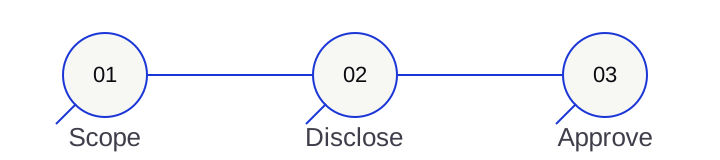
An illustrative drafting sequence
A working sequence for an entity in scope. Use the full statutory wording and applicable reporting location.
Related software
The eight disclosures in section 414CB(2A) are mostly judgement, not calculation, so software has to hold the reasoning and review trail as well as the numbers.
The climate disclosure software guide sets out what to test.
Frequently asked
In the UK, climate-related financial disclosures are eight statements that in-scope companies and LLPs must include in their annual reporting, set out in section 414CB(2A) of the Companies Act 2006 as amended by SI 2022/31, with a parallel LLP instrument, SI 2022/46.
They cover governance, risk identification and management, integration into overall risk management, principal risks and time periods, impacts on the business model, scenario resilience, targets and KPIs.
They apply to financial years commencing on or after 6 April 2022.
Every route needs more than 500 employees, counted for the group where the company is a parent.
A company is then in scope if it is traded, a bank, an authorised insurer or insurance-market company, or on AIM, or if its turnover is more than £500 million.
Small and medium-sized companies, and subsidiaries covered by a qualifying group statement, are excluded.
LLPs are in scope if they are traded or banking LLPs, or have more than £500 million of turnover.
TCFD was the Task Force on Climate-related Financial Disclosures, which published four recommendations and eleven recommended disclosures in 2017 and disbanded in 2023; its framework has no legal force of its own.
CFD is UK company law: eight disclosures written into the Companies Act, shaped by the TCFD pillars but drafted differently and enforceable through the strategic report regime.
Only in part.
Disclosures (a) to (d) — governance, risk processes, integration and principal risks with time periods — must be made.
Disclosures (e) to (h) may be omitted in whole or in part, but only where the directors reasonably believe the information is not necessary for an understanding of the business, and the statement must then give a clear and reasoned explanation of that belief.
For a company, in the non-financial and sustainability information statement, which sits in the strategic report.
For a traded or banking LLP, in the strategic report.
For any other in-scope LLP, in the energy and carbon report.
No, but it can discharge it.
The government has confirmed UK SRS S2 as a national reporting framework for section 414CB(6), so a company reporting under UK SRS S2 need not duplicate the section 414CB(2A) disclosures, provided use of UK SRS S2 is clearly referenced in the non-financial and sustainability information statement and the rest of section 414CB(1) to (5) is met.
The FRC says this applies whether UK SRS is used on a mandatory or voluntary basis.
No. PS26/19, published by the FCA on 30 September 2026, replaces the TCFD-aligned listing rule with UK SRS on a comply-or-explain basis for accounting periods beginning on or after 1 January 2027.
The FCA writes listing rules and cannot amend the Companies Act, so the CFD duty continues for every company and LLP in scope.
No. Section 414CB(2A) names no emissions scope.
Disclosure (h) asks for the KPIs used to assess progress against targets and the calculations behind them, which for many companies are their SECR figures.
Scope 1 and 2 reporting comes from SECR, and full Scope 3 is a UK SRS S2 requirement with a relief.
The statute asks for an analysis of the resilience of the business model and strategy, taking into consideration different climate-related scenarios. It names no temperature pathway, provider or method.
Disclosure (f) is one of the four that may be omitted in whole or part with a clear and reasoned explanation.
Regulation 5 of SI 2022/31 requires the first review report to be published before 6 April 2027, and the LLP instrument carries the same date.
The government’s Modernising Corporate Reporting consultation says the post-implementation review is due to be completed by spring 2027 and that the consultation itself makes no proposals on the future of the CFD requirements.
There is no CFD-specific penalty.
The disclosures are part of the strategic report, which the directors approve, and the Financial Reporting Council reviews corporate reports; section 456 of the Companies Act allows court-ordered revision of a defective strategic report.
Section 463 limits directors’ liability for statements in the report to liability to the company.
No. CFD in this sense is the Companies Act climate disclosure duty.
A CfD, with a lower-case f, is a Contract for Difference under the government’s low-carbon electricity scheme, and CFDs are also leveraged trading products.
Only the first is a reporting obligation.
Sources
Every figure, date and status on this page traces to the instrument’s owner.
Secondary commentary is never the source for a number.
The eight disclosures, the omission gate and national reporting frameworks.
The traded, banking, insurance and AIM limbs, the high turnover test and the 500-employee floor.
Commencement (reg 1(2)), the amendments (regs 2–4) and the review before 6 April 2027 (reg 5).
The amending instrument in its own right.
The traded and banking LLP route, the “large LLP” route and the energy and carbon report.
The LLP regulations SI 2022/46 amends.
Court-ordered revision, which covers a strategic report.
A safe harbour: liability to the company only.
UK SRS S2 confirmed as a national reporting framework for s.414CB(6).
The conditions: reference UK SRS S2 in the NFSIS and meet s.414CB(1)–(5).
“Inconsistent quality”; more consistent, coherent and concise disclosures.
The regulator’s thematic reviews and climate material.
Non-binding guidance, never revised; the government has said it will update it.
The 23-page guidance document itself.
No proposals on CFD; the post-implementation review due by spring 2027.
The listing rules move to UK SRS for periods beginning on or after 1 January 2027.
The FCA’s guidance on the TCFD statement, proposed for deletion.
The framework guidance the eight disclosures were drafted from.