The scheme · administration, law, cycle and record
Energy Savings Opportunity Scheme
Understand the scheme: who takes part, what is assessed and how the four-year cycle works.
The Environment Agency administers ESOS UK-wide. This guide connects its duties to the law and current regulator guidance.
- ESOSPhase 3 further progress update due5 Dec 2026
- ESOSPhase 4 qualification date31 Dec 2026
- ESOSPhase 4 notification5 Dec 2027
- ESOSPhase 4 action plan5 Dec 2028
- ESOSAgency’s announced publication date for Phase 410 Jun 2028
- SI 2026/701Phase 4 rules in force22 Jul 2026
- ESOSPhase 5 notification5 Dec 2031
At a glance
The scheme in four numbers
Sources: SI 2014/1643 reg 4 · Part 8 · GOV.UK ESOS page · EA Phase 3 data
What ESOS means
Energy Savings Opportunity Scheme, explained
The Energy Savings Opportunity Scheme is a mandatory energy assessment scheme for qualifying UK undertakings and their groups. It identifies cost-effective energy saving opportunities.
Read ESOS for the entry-level qualification check, or follow the scheme’s 2014 Regulations below.
Read the detailed requirements and references
ESOS is the UK scheme that makes large undertakings measure their energy, have it audited or certified, tell the Environment Agency, and then plan the savings they find.
ESOS stands for the Energy Savings Opportunity Scheme, the name given by the 2014 Regulations that created it.
The legal name uses “Savings”, and searches and trade writing often say “saving” or “energy saving opportunity scheme” for the same scheme.
This page covers the scheme itself; the ESOS page answers whether a particular organisation qualifies.
Energy Savings Opportunity Scheme
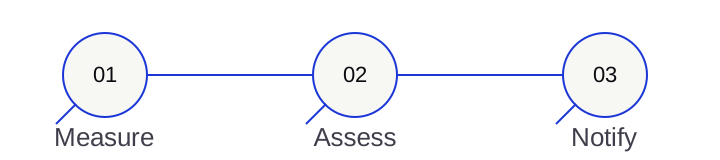
Measure
Energy Savings Opportunity Scheme
Assess
Energy Savings Opportunity Scheme
Notify
Energy Savings Opportunity Scheme
Follow through
The journey
From the qualification date to an action plan
Follow the assessment into notification and the next action-plan cycle. Each stage names its source.
- 01 / Qualify01
31 December
Test every undertaking on the qualification date: at least 250 persons, or turnover over £44m with a balance sheet over £38m. One large member brings the whole UK group in. - 02 / Measure02
total energy
The group measures its total energy consumption over a twelve-month reference period and may identify the uses making up at least 95% of it. - 03 / Audit03
or ISO 50001
An energy audit covers at least 95% of that energy, or a valid ISO 50001 certificate covers it. Since 22 July 2026 these are the only two routes. - 04 / Review04
lead assessor
A lead assessor from an approved register reviews the work, unless an exemption applies. Regulation 12 fixes PAS 51215:2014 as the competence standard. - 05 / Notify05
by 5 December
One or two responsible officers confirm the assessment and the group notifies the Environment Agency through MESOS by the compliance date. - 06 / Act06
plan and updates
An action plan covering the next compliance period follows, then progress updates. Phase 4 has three, the last due on 5 December 2031.
Where ESOS comes from
An EU audit duty, rebuilt as a UK scheme
ESOS is the UK’s answer to Article 8 of the Energy Efficiency Directive, 2012/27/EU.
Article 8(4) told Member States to ensure that enterprises that are not SMEs “are subject to an energy audit” carried out independently and cost-effectively “by 5 December 2015 and at least every four years from the date of the previous energy audit”, in the text legislation.gov.uk publishes.
Article 8(6) exempted large enterprises running a certified energy or environmental management system, provided it included an audit on the Annex VI criteria, which is the root of today’s ISO 50001 route.
The government’s own interpretative note read Article 8(4) as binding large enterprises only, with no sector excluded and a four-year maximum interval.
The Regulations did more than copy the audit: they added a notification to a single administrator, civil penalties and a register of approved lead assessors.
Phase 1’s compliance date of 5 December 2015 is the Directive’s date, and the four-year rhythm has held through every phase since.
- 25 Oct 201201
Directive 2012/27/EU
Article 8(4): enterprises that are not SMEs are audited by 5 December 2015 and at least every four years. - 17 Jul 201402
ESOS Regulations in force
SI 2014/1643 turns the audit duty into a scheme with a notification to a UK administrator. - 5 Dec 201503
- 31 Dec 202004
Thresholds in sterling
The size test is restated at £44m turnover and £38m balance sheet. - 29 Nov 202305
Phase 3 reforms
SI 2023/1182: the 95% floor, four organisational purposes, action plans and progress updates. - 22 Jul 202606
Phase 4 rules in force
SI 2026/701, made under the Energy Act 2023: two routes, savings achieved, a third progress update. - 5 Dec 202707
- 5 Dec 203108
Sources: Directive 2012/27/EU · SI 2014/1643 · SI 2023/1182 · SI 2026/701
Three texts side by side
The 2012 Directive, its 2023 recast and ESOS today
- EU 2012 · Article 8Audit every non-SMEEnterprises that are not SMEs are audited by 5 December 2015 and at least every four years, independently and cost-effectively; a certified management system on the Annex VI criteria exempts. The test is the nature of the enterprise, not how much energy it uses. ESOS is the UK’s version: SI 2014/1643 in force 17 July 2014, with the Directive’s first date as its Phase 1 compliance date.
- EU 2023 · Article 11A consumption test replaces the size testAbove 85 TJ a year, averaged over three years, a certified energy management system; above 10 TJ, an energy audit, at least every four years. The Commission’s guidelines say Article 11 replaces Article 8. ESOS has not followed: the EU’s consumption thresholds are not in SI 2014/1643.
- UK ESOS todaySize test, four-yearly cycleLarge undertakings, tested at 250 persons or £44m turnover with a £38m balance sheet, plus their UK group; measure total energy, audit at least 95% or hold ISO 50001, notify the Environment Agency, then an action plan and progress updates. Enforced by the regulator for the registered office, with five civil offences.
Sources: Directive 2012/27/EU Art 8 · Directive (EU) 2023/1791 Art 11 · Commission Recommendation (EU) 2024/2002 · SI 2014/1643 Sch 1
The EU’s recast, Directive (EU) 2023/1791, replaced the SME test with a consumption test, and the Commission’s 2024 guidelines record that Article 11 replaces Article 8.
ESOS has not followed it: its qualification test is still Schedule 1 of the 2014 Regulations, and none of the amendments since 2020 changed the thresholds.
A reader comparing ESOS with a European audit regime is therefore comparing two different tests: size here, energy consumption there.
ESOS consultations
How government has consulted on the scheme
The changes in force today began with a consultation in 2021 and end, for now, with a further one the government has promised.
- 6 Jul 202101
The government opens a consultation
The Department for Business, Energy and Industrial Strategy seeks views on “proposed changes to improve and strengthen” ESOS. - 28 Sep 202102
The consultation closes
It asked about audit reporting, net zero in audits and public disclosure of high-level recommendations; 89 responses were received. - 28 Jul 202203
The government response is published
The response set out the changes to come through Phase 3 and Phase 4. - 29 Nov 202304
Phase 3 changes in force
SI 2023/1182 brings in the 95% floor, the four purposes, action plans and progress updates. - 22 Jul 202605
Phase 4 changes in force
SI 2026/701, made under Energy Act 2023 ss.254–260 and 263, removes two routes and adds savings achieved. - Later in 202606
A further consultation is promised
The Modernising corporate reporting consultation says DESNZ intends to consult on SECR and ESOS, building on an ESOS evaluation under way.
Sources: GOV.UK, Strengthening ESOS · SI 2023/1182 · SI 2026/701 · Modernising corporate reporting
Who does what
One administrator, five regulators, one policy owner
The Phase 4 guidance is published “by the Environment Agency as the UK scheme administrator for ESOS, on behalf of all the UK regulators”.
As administrator, the Environment Agency is responsible for guidance, communications, the helpdesk and the collection of notifications across the UK.
Read the detailed requirements and references
| Registered office | Regulator | Name in reg 6 |
|---|---|---|
| England | Environment Agency | The scheme administrator (reg 5) |
| Wales | Natural Resources Wales | The Natural Resources Body for Wales |
| Scotland | Scottish Environment Protection Agency | SEPA |
| Northern Ireland | Northern Ireland Environment Agency | The Chief Inspector under the NI industrial emissions regulations |
| Wholly or mainly offshore | Secretary of State for DESNZ | The Secretary of State |
Checking compliance and enforcing it belongs to the regulator for the participant’s registered office, not the location of its sites.
The Department for Energy Security and Net Zero develops ESOS policy, so a sentence calling the guidance “DESNZ guidance” names the wrong publisher.
The helpdesk is esos@environment-agency.gov.uk, and the GOV.UK ESOS page says the Agency responds within ten working days, so a question asked in November 2027 may not be answered before the deadline.
The national regulators publish their own pages: Natural Resources Wales, SEPA and the Northern Ireland Environment Agency; the Welsh and Scottish regulators’ ESOS pages are in the library below.
Source: SI 2014/1643 reg 6 · reg 5
- 1
DESNZ
Owns ESOS policy.
- 2
Environment Agency
Administers ESOS throughout the UK and collects notifications.
- 3
Compliance bodies
Enforce by registered office: EA, NRW, SEPA or NIEA; DESNZ for wholly or mainly offshore activities.
Where the law came from
From an EU directive to the Energy Act 2023
Because ESOS began as the UK’s implementation of Article 8 of the EU Energy Efficiency Directive, its first financial thresholds were set in euros.
After the UK left the EU the thresholds were restated in sterling, at £44 million turnover and £38 million balance sheet, for qualification dates from 31 December 2020.
Read the detailed requirements and references
The government consulted on strengthening the scheme, took powers to do so in the Energy Act 2023, and made SI 2026/701 under sections 254 to 260 and 263 of that Act.
SI 2026/701 was made on 23 June 2026, laid on 1 July and brought into force on 22 July, and the Environment Agency published its Phase 4 guidance on 30 July.
A correction slip dated 3 July 2026 changed the Explanatory Note to say that no full impact assessment was produced, only a de minimis one, so there is no “SI 2026/701 impact assessment” to cite.
The Environment Agency’s Phase 3 guidance quotes the post-implementation review’s estimate of annual savings across the ESOS population: 1.65 TWh from buildings, 1.51 TWh from industrial processes and 0.52 TWh from fuel efficiency.
The same document gives the government’s estimate that the reforms from Phase 3 onwards would save a further 28 TWh across participants from 2024 to 2037, worth an estimated £1.12 billion in energy bills; both are government estimates, not measured outcomes.
The ESOS legislation page goes through each instrument, and a regulation-by-regulation reading sits beside it.
| Instrument | In force | Phase |
|---|---|---|
| SI 2014/1643 | 17 July 2014 | Phases 1 and 2 |
| SI 2018/1342 (sterling thresholds) | 31 December 2020 | From Phase 3 qualification |
| SI 2023/1182 | 29 November 2023 | Phase 3 reforms |
| SI 2026/701 | 22 July 2026 | Phase 4 reforms |
- 17 July 2014
The original scheme
- 31 December 2020
Sterling size thresholds
- 29 November 2023
Phase 3 reforms
- 22 July 2026
Phase 4 reforms
The cycle
Five compliance periods, overlapping by design
ESOS uses a four-year compliance rhythm. Follow-up reporting from one assessment runs inside the next period, so two phases can have live duties at once.
Phase 4 runs from 6 December 2023 to 5 December 2027. The Phase 3 deadline extension did not shift the start of that period. ESOS phases explains each cycle.
Read the detailed requirements and references
| Phase | Qualification date | Compliance period | Compliance date |
|---|---|---|---|
| 1 | 31 December 2014 | 17 July 2014 – 5 December 2015 | 5 December 2015 |
| 2 | 31 December 2018 | 6 December 2015 – 5 December 2019 | 5 December 2019 |
| 3 | 31 December 2022 | 6 December 2019 – 5 December 2023 | 5 June 2024 (extended) |
| 4 | 31 December 2026 | 6 December 2023 – 5 December 2027 | 5 December 2027 |
| 5 | 31 December 2030 | 6 December 2027 – 5 December 2031 | 5 December 2031 |
- 5 Dec 2015Phase 1 notificationThe first ESOS compliance date, qualification having been tested on 31 December 2014.SI 2014/1643 reg 4(4)(b)
- 5 Dec 2019Phase 2 notificationQualification on 31 December 2018.reg 4(4)(b)
- 5 Jun 2024Phase 3 notificationExtended by six months from 5 December 2023: the only compliance date that has moved.EA Phase 4 guidance §3.1
- 5 Dec 2024Phase 3 action planThe first action plan.reg 34A(7)(a)
- 5 Dec 2025Phase 3 first progress updatePublished as open data with the Phase 3 action plans.reg 34B(1)(a)
- 5 Dec 2026Phase 3 further progress updateFalls the same year as Phase 4 qualification, on 31 December 2026.reg 34B(1)(b)
- 5 Dec 2027Phase 4 notificationQualification is tested on 31 December 2026; notification is made through MESOS.reg 4(4)(b), reg 29
- 5 Dec 2028Phase 4 action planCovers 6 December 2027 to 5 December 2031; savings stated in kWh.reg 34A(7)(b), (10); Bible [860]
- 5 Dec 2029Phase 4 initial progress updateThe first of three Phase 4 progress updates.reg 34B(1)(a)
- 5 Dec 2030Phase 4 further progress updateThe second Phase 4 update.reg 34B(1)(b)
- 5 Dec 2031Phase 5 notification and final updateThe Phase 5 notification and the third Phase 4 progress update fall on the same day.reg 4(4)(b); reg 34B(1)(c)
- 5 Dec 2035Phase 4 evidence pack kept to at least this dateRegulation 28 requires it for two further compliance periods after the one it relates to.reg 28(2)(b); Bible [859]
Sources: SI 2014/1643 reg 4 · Part 6A · reg 28 · EA Phase 4 guidance §3.1
Why phases overlap
Since Phase 3, each notification is followed by an action plan covering the next compliance period, so one phase’s reporting runs inside the next phase’s period.
A Phase 3 participant owes its second progress update on 5 December 2026 while Phase 4 qualification falls on 31 December 2026.
See ESOS Phase 3 and ESOS phases.
The one date that moved
Phase 3’s compliance date was extended by six months to 5 June 2024, while the fourth period still began on 6 December 2023.
No other compliance date has moved, and SI 2026/701 left regulation 4 untouched.
Every date is on the ESOS deadlines page, and the next period on ESOS Phase 5.
- 1
Complete one assessment
Notify compliance for the period just assessed.
- 2
Plan the next period
The action plan and progress updates run inside the following compliance period.
- 3
Review at the next assessment
The new assessment checks savings achieved and reviews the earlier plan.
Where the scheme is today
Two phases live at once, by design
On 9 October 2026 the scheme is in its fourth compliance period, and its third has one duty left to run.
That overlap is built in: since Phase 3 each notification is followed by an action plan and updates that run across the whole of the next period.
Read the detailed requirements and references
A participant in both phases owes its Phase 3 further progress update by 5 December 2026, is tested for Phase 4 on 31 December 2026, and notifies Phase 4 by 5 December 2027.
The same pattern repeats at the end of Phase 4, when the final Phase 4 progress update and the Phase 5 notification both fall on 5 December 2031.
The dates beside this text separate the remaining Phase 3 update from Phase 4 qualification and notification. See ESOS deadlines for the full calendar.
- 5 December 2026
Phase 3 progress update
Update the existing action plan, with board-level sign-off, through MESOS. - 31 December 2026
Phase 4 qualification
Check the undertaking and group against the statutory size test. - 5 December 2027
Phase 4 notification
Complete the applicable assessment, approvals and compliance notification.
Who takes part
Participants, not just companies
ESOS duties fall on a participant, which is either a single undertaking or a group complying as one, and the person who carries them out is the responsible undertaking.
A corporate group is defined by the Companies Act 2006, and the Phase 4 guidance says that if one UK member qualifies, the group’s entire UK operation takes part.
Read the detailed requirements and references
The highest UK parent, the undertaking with no parent or only overseas parents, acts by default as the responsible undertaking for itself and its subsidiaries.
Another group member can take that role if every undertaking in the group agrees in writing and the agreement is kept in the evidence pack.
Subsidiaries may disaggregate and file on their own, but each resulting participant must then do the whole job itself, including covering at least 95% of its own energy.
Without a written agreement, liability stays with the responsible undertaking of the participant that contains the highest UK parent.
An undertaking that leaves a qualifying group after 31 December 2026 still complies, with its old group, its new group or on its own; one bought from a non-qualifying seller in that window need not be counted.
Public bodies are outside under regulation 16, whose current definition uses the Procurement Act 2023 public-authority test with the exclusions specified there; devolved Scottish authorities have a separate Public Contracts (Scotland) Regulations 2015 limb. The Phase 4 guidance still describes the older Public Contracts Regulations test, so the current instrument decides the boundary.
Higher education institutions are in scope where they declare themselves private sector, and the guidance treats public-body status in that sector as case by case.
| Structure | How it takes part |
|---|---|
| UK group with one large member | The whole UK group, by default one participant under its highest UK parent |
| Group with an overseas parent | Each highest UK parent group takes part, separately by default; they may aggregate by agreement |
| Subsidiaries wanting their own filing | May disaggregate by written agreement with the highest parent; each new participant complies in full |
| Joint venture no investor controls | Assesses its own qualification and takes part in its own right |
| Franchisor and franchisees | Not grouped unless the franchisor is also the parent; may comply together by agreement |
| Assets held in trust | Fall in where the party holding the energy supply agreement qualifies |
| Private equity portfolio | Grouped under Companies Act ss 1158–1162 like any other undertaking |
The UK participant
Undertaking
The UK participant
UK group
The UK participant
Parent
How size is measured
Counting heads, turnover and balance sheet
The test is applied to each undertaking, not to the group’s consolidated figures, so a group that reports on a consolidated basis still has to check whether any single member is large in its own right.
The figures come from the accounts for the financial year ending on the qualification date or in the twelve months before it, which for a March year end means the year to 31 March 2026.
Read the detailed requirements and references
“Employed” covers employees, owners or managers, and partners; an employee is anyone on a contract of service, whatever their hours.
Workers on a contract for services are not employees, and the Phase 4 guidance says agency workers usually are not either, though it advises checking their contracts.
A UK undertaking counts the people it employs directly overseas; an overseas undertaking with a UK establishment counts only UK employees eligible to pay UK income tax.
The count is a monthly average: the number employed in each month of the financial year, added up and divided by the number of months.
Turnover is income from goods and services in the ordinary course of business, after trade discounts, VAT and other sales taxes.
The balance sheet total is the gross figure, the sum of the assets before any liabilities are deducted.
A UK undertaking includes overseas activities it runs directly, but not the figures of overseas subsidiaries it owns.
Investment companies with no turnover and fewer than 250 staff are outside in their own right, but they come in with a group that contains a large trading member.
| Month range | Staff | Months | Staff × months |
|---|---|---|---|
| April – June 2025 | 240 | 3 | 720 |
| July 2025 – March 2026 | 260 | 9 | 2,340 |
| Average for the year | 12 | 3,060 ÷ 12 = 255 |
- 1
People
Monthly average of persons employed; at least 250 satisfies this limb.
- 2
Financial test
Turnover in excess of £44m AND balance sheet total in excess of £38m.
- 3
History
Apply the accounts timing and look-back rules when crossing the boundary.
The edges of the scheme
Zero energy, small energy, and volunteers
A qualifying participant still notifies; regulation 33A provides the deemed-compliance treatment. Assessment continues, with the lead-assessor exemption and two responsible officers.
Read the detailed requirements and references
Zero energy
A large undertaking with no energy at all, for example one that passes the money limbs but holds no premises, vehicles or staff using energy, is still a participant.
It owes a notification confirming that, although it qualifies, it has no energy responsibility, and the guidance asks two directors to confirm it.
Regulation 33A, inserted in 2026, then deems it to have done the assessment, the audit, the report, the evidence pack and the whole of Part 6A, so it owes no action plan.
Under 40,000 kWh
A participant using less than 40,000 kWh a year still audits but needs no lead assessor, and two responsible officers confirm instead of one.
Volunteers
An organisation that does not qualify may still carry out an ESOS-style assessment, but MESOS does not accept submissions from voluntary participants, so the guidance suggests publishing the results in its own reports or website.
The same applies to the voluntary net zero assessment under the 2025 parts of PAS 51215: it can be done, but it cannot be notified.
- 1
Zero energy
A qualifying participant still notifies; regulation 33A provides the deemed-compliance treatment.
- 2
Below 40,000 kWh
Assessment continues, with the lead-assessor exemption and two responsible officers.
- 3
Voluntary assessment
Non-qualifying organisations can assess energy use, but cannot submit voluntarily through MESOS.
What the scheme asks
An assessment, a notification, then a plan
A large undertaking, tested under Schedule 1, takes part with every UK undertaking in its group; the ESOS qualification page covers the test.
The group measures its total energy consumption, may identify the uses making up at least 95% of it, and covers them with an energy audit, ISO 50001 certification, or both; see ESOS assessment, ESOS energy audit and ISO 50001 and ESOS.
Read the detailed requirements and references
A lead assessor from an approved register reviews the work unless an exemption applies, and regulation 12 fixes PAS 51215:2014 as the competence standard; see ESOS lead assessor and ESOS consultants and assessors.
One or two responsible officers confirm the assessment and the group notifies through MESOS; see ESOS notification, ESOS reporting and ESOS online.
An action plan and progress updates follow, set out on the ESOS action plan and ESOS progress report pages, with working structures on ESOS templates.
The duties, one by one with their regulations, are on the Phase 4 compliance guide, the checklist on ESOS requirements, and the official guidance compared on ESOS compliance guidance.
Membership of a Climate Change Agreement or the UK ETS does not count as ESOS compliance, although its data may feed the assessment; who falls outside altogether is on ESOS exemptions.
Association of Energy Engineers · CIBSE · Elmhurst Energy Systems · Energy Institute · Energy Managers Association · Institute of Sustainability and Environmental Professionals · Quidos.
The Institution of Chemical Engineers was removed on 16 February 2026 and Stroma Certification on 20 February 2025.
Source: GOV.UK ESOS page and change log
Assessment to action
Consumption
Assessment to action
Assessment
Assessment to action
Approval
Assessment to action
Follow-up
Routes to compliance
Two routes now, and what each one discharges
For its first three phases ESOS had four routes: an energy audit, ISO 50001, Display Energy Certificates and Green Deal Assessments.
SI 2026/701 regulation 26 omitted the regulation that allowed the last two, and regulation 3(b) removed their definitions, so since 22 July 2026 there are two.
Read the detailed requirements and references
The Environment Agency’s stated reason is that the removed routes gave more limited and less tailored recommendations than an energy audit.
Their data survives: the guidance lets DEC floor areas support a buildings intensity ratio and lets past DEC and GDA work be referred to when estimating savings achieved.
The same instrument widened ISO 50001: a certificate over all of total or all of significant consumption now stands in for the lead assessor, the audit and the ESOS report, not just the audit.
Part 6 of the Regulations was renamed from “Alternative routes to compliance” to “Deemed compliance with Scheme requirements”, which is the more accurate legal description.
Two edge cases sit beside the routes: a participant with zero consumption is deemed to have done almost everything except notify, and one below 40,000 kWh needs no lead assessor.
The panel beside this text works out, route by route, which duties remain and how many responsible officers must confirm.
Your route, duty by duty · Phase 4
Total energy consumption over the reference period
ISO 50001 certification, valid on 5 December 2027
Is the lead assessor independent of the participant?
Not independent if, in the last 12 months, they were an employee, director, person exercising management control or shareholder, or the spouse or civil partner of one (reg 30(4)).
- Measure total energy consumption (the ESOS assessment, reg 20)Requiredreg 20; Part 4 Ch 2
- Appoint a lead assessorRequiredreg 21(1)
- Carry out an ESOS energy auditRequiredreg 26; Part 4 Ch 3
- Produce the ESOS reportRequiredreg 27A
- Keep an evidence packRequiredreg 28
- Notify compliance through MESOS by 5 December 2027Requiredreg 29(1)
- Responsible officers who confirm1reg 30(3)–(4)
- Action plan and three progress updatesRequiredregs 34A, 34B
SI 2014/1643 regs 20, 21, 26–30, 33, 33A and Part 6A, as amended by SI 2026/701.
An orientation aid, not advice.
Two assessment routes
Audit
Two assessment routes
ISO 50001
Two assessment routes
Combination
Four routes to two
What SI 2026/701 did to the routes
Sources: SI 2026/701 reg 26 · EA Phase 4 guidance
What an audit produces
From meter data to a programme of measures
An ESOS energy audit is defined by what it must produce, not by a method: the guidance names ISO 50002 and BS EN 16247 as good practice but mandates neither.
The analysis should use energy consumption profiles where that is appropriate and practicable, and where it does not, the participant must say so in the notification and record the alternative method.
Read the detailed requirements and references
A measure becomes an “energy saving opportunity” only once the audit recommends it as reasonably practicable and cost-effective, judged on an estimate of both its cost and its saving.
Each opportunity is tied to one organisational purpose and one of six savings categories, and the notification reports the potential savings broken down that way rather than listing every opportunity.
Costs should be based on life cycle cost analysis wherever practicable, and the payback period is the cost of implementing a measure divided by its estimated annual energy cost saving.
The audit must also flag considerations that affect implementation, including the Minimum Energy Efficiency Standards for rented buildings and any public funding that could help.
Finally it recommends a programme, and the guidance suggests tying each measure to a natural moment such as a lease renewal or the end of an asset’s life.
The guidance is explicit that an ESOS report cannot stand in for a surveyor’s report for MEES purposes, so the two duties stay separate even when the same building is involved.
| The audit must, so far as reasonably practicable | Guidance |
|---|---|
| Rest on verifiable data over twelve months | §8.3 |
| Visit a representative selection of sites | §8.4 |
| Analyse consumption, using energy profiles where appropriate | §8.5 |
| Identify measures, and recommend the cost-effective ones | §8.6 |
| Give each one purpose and one savings category | §8.7 |
| Estimate costs, benefits, kWh and £ saved, and payback | §8.8 |
| Flag implementation points such as MEES and funding | §8.9 |
| Recommend a programme for implementing them | §8.10 |
From meter to measure
Data
From meter to measure
Analysis
From meter to measure
Programme
How energy is analysed
Four purposes, four kinds of intensity ratio
The Regulations divide energy use into four organisational purposes: transport, industrial processes, buildings, and any other purpose not within the first three.
Regulation 25C, inserted for Phase 3, requires at least one energy intensity ratio for each purpose that uses energy, and none for a purpose whose consumption is zero.
Read the detailed requirements and references
A ratio is the kWh used for that purpose divided by an indicator of activity over the same twelve months, and since 22 July 2026 the indicator must rest on verifiable data where reasonably practicable, or on a reasonable estimate.
The Environment Agency recommends indicators but lets participants choose others, and expects the same ratios to be reported in later phases so performance can be compared.
A group with both freight and passenger transport may report one transport ratio or several, but the several must together cover all its transport energy.
Where one site’s output is another’s input, only the final output counts, so a brewer that also bottles counts crates once rather than beer twice.
SECR asks for a single intensity ratio with no prescribed denominator, so the two regimes’ ratios are not interchangeable even when they draw on the same energy data.
| Organisational purpose | Recommended indicator | Ratio unit |
|---|---|---|
| Buildings | Gross internal floor area | kWh/m² |
| Transport | Person miles (passengers) or tonne miles (freight) | kWh per person or tonne mile |
| Industrial processes | Unit of final industrial output | kWh per tonne, litre or unit |
| Any other purpose | A quantifiable output of that activity | kWh per unit chosen |
Four energy purposes
Buildings
Four energy purposes
Transport
Four energy purposes
Other
The profession
Seven registers, one competence standard
A lead assessor must be on a register the scheme administrator has approved, and regulation 12 defines an approved register as one of people who meet the PAS 51215 competence requirements.
The GOV.UK ESOS page lists seven, re-counted when it was rewritten on 2 September 2026, and each listing names a specific register rather than the whole professional body.
Read the detailed requirements and references
CIBSE’s, for example, is the ESOS lead assessor subset of its low carbon consultant register, so membership of a body is not the same as being on its ESOS register.
The list changes: the Institution of Chemical Engineers was removed on 16 February 2026 and Stroma Certification on 20 February 2025, so older lists of eight or nine are out of date.
Individuals cannot apply to the Environment Agency; they join a register, and each body sets out its own application process on its site.
The competence standard is PAS 51215:2014, which BSI now lists as withdrawn; the regulation still incorporates it, and the GOV.UK page confirms it remains the ESOS standard.
The 2025 parts of PAS 51215 combine an energy assessment with a decarbonisation assessment and may be used voluntarily, but they are not the ESOS competence standard and MESOS cannot accept the result.
The duty to check that an appointed assessor is accredited rests on the undertaking, and a complaint about an assessor goes to the body that keeps their register.
Competence and approval
Approved register
Competence and approval
Statutory standard
Competence and approval
Voluntary add-on
How the scheme has changed
Phase by phase, and the three duties Phase 4 added
ESOS has been amended twice in substance, and each amendment landed at the start of a phase.
SI 2023/1182, in force on 29 November 2023, gave Phase 3 the 95% floor, the four organisational purposes with their ratios, the ESOS report, and the action plan and progress update duties.
Read the detailed requirements and references
SI 2026/701 then gave Phase 4 three duties Phase 3 did not have, alongside the removal of two routes.
Savings actually achieved. The report and notification must estimate the savings achieved during the period in kWh, measure by measure, each with one of six savings categories; only the combined figure is published.
A review of the last plan. The report must list the Phase 3 action plan measures that were not, and will not be, implemented, and say why; the review is notified but not published.
A third progress update. Phase 4 action plans are followed by three updates, the last due on 5 December 2031.
A fourth change is a personal duty rather than a participant’s one: the lead assessor must notify their own approval body within seven days of completing the review.
The comparison beside this text can be filtered by topic, or to show only what changed between Phase 3 and Phase 4.
ESOS phase by phase
- Qualification date
- Phase 2
- 31 December 2018
- Phase 3
- 31 December 2022
- Phase 4
- 31 December 2026
- Compliance period
- Phase 2
- 6 Dec 2015 – 5 Dec 2019
- Phase 3
- 6 Dec 2019 – 5 Dec 2023
- Phase 4
- 6 Dec 2023 – 5 Dec 2027
- Notification of compliance by
- Phase 2
- 5 December 2019
- Phase 3
- 5 June 2024 (extended)
- Phase 4
- 5 December 2027
- Online system
- Phase 2
- Smart Survey
- Phase 3
- MESOS, from April 2024
- Phase 4
- MESOS
- Money limbs of the size test
- Phase 2
- Turnover over €50m and balance sheet over €43m
- Phase 3
- Turnover over £44m and balance sheet over £38m
- Phase 4
- Unchanged from Phase 3
- Employee limb
- Phase 2
- At least 250 persons
- Phase 3
- At least 250 persons
- Phase 4
- At least 250 persons
- Insolvency exclusion
- Phase 2
- Insolvency on the qualification date
- Phase 3
- Insolvency on the qualification date
- Phase 4
- Insolvency at any point from qualification to compliance date; wider group limb
- Compliance routes
- Phase 2
- Audit, ISO 50001, DECs, Green Deal Assessments
- Phase 3
- Audit, ISO 50001, DECs, Green Deal Assessments
- Phase 4
- Audit and ISO 50001 only
- ISO 50001 trigger
- Phase 2
- Total energy consumption
- Phase 3
- Total energy consumption
- Phase 4
- Total or significant energy consumption
- What ISO 50001 stands in for
- Phase 2
- The audit
- Phase 3
- The audit
- Phase 4
- The lead assessor, the audit and the ESOS report
- Lead assessor’s own notice
- Phase 2
- None
- Phase 3
- None
- Phase 4
- Notify the approval body within seven days
- Significant energy consumption
- Phase 2
- At least 90% of total
- Phase 3
- At least 95% of total
- Phase 4
- At least 95% of total
- Energy intensity ratios
- Phase 2
- None
- Phase 3
- One per organisational purpose
- Phase 4
- One per purpose, on verifiable data or a reasonable estimate
- ESOS report
- Phase 2
- Not required
- Phase 3
- Required
- Phase 4
- Required, with savings achieved and an action plan review
- Unit for estimates
- Phase 2
- Energy measurement units
- Phase 3
- Energy measurement units
- Phase 4
- kWh
- Savings achieved
- Phase 2
- —
- Phase 3
- Since the previous compliance date (reg 27B)
- Phase 4
- Per measure and per purpose, in kWh (reg 27D)
- Action plan
- Phase 2
- None
- Phase 3
- By 5 December 2024
- Phase 4
- By 5 December 2028
- Progress updates
- Phase 2
- None
- Phase 3
- Two: 2025 and 2026
- Phase 4
- Three: 2029, 2030 and 2031
- Review of the previous plan
- Phase 2
- None
- Phase 3
- None
- Phase 4
- Unimplemented measures and the reasons (reg 27E)
SI 2014/1643 as made and as amended by SI 2023/1182 (in force 29 November 2023) and SI 2026/701 (in force 22 July 2026); compliance dates from the Environment Agency’s period table.
- 1
Savings achieved
Report the measures and achieved savings in kWh; only the combined saving is published.
- 2
Review the earlier plan
Identify measures not implemented and explain why; the review is not published.
- 3
Third progress update
The Phase 4 action-plan cycle adds a final update due by 5 December 2031.
What the public sees
What is published, and when
Regulation 10 makes the scheme administrator publish specified notification information, every action plan and every progress update.
Schedule 3 decides field by field what is notified and what is published, and SI 2026/701 rewrote it, so Phase 4 publishes more than Phase 3 did, not less.
Read the detailed requirements and references
The published data is a record of what was notified: the GOV.UK page says it contains no amendments unless requested or needed to remove personal data, and has not been verified for compliance.
The clock is six months from the relevant deadline or from the filing, whichever is later, and the Phase 4 guidance gives 10 June 2028 as the publication date for the fourth compliance period.
Read literally, six months beginning with 5 December 2027 ends on 4 June 2028, six days before the date the Agency has announced; the announced date is the one to plan around.
Later and revised submissions are published within six months of receipt, and some members of a group may not be identifiable because a UK parent’s notification covers them.
| Schedule 3 table | Phase 4 change | Published? |
|---|---|---|
| Table G | Rows 2 and 4 flip from not published to published | More than before |
| Table H | Loses rows 4 and 5 | — |
| Table I | Re-headed to reg 33(2); adds ISO certificate number and validity dates | As before |
| Table J (new) | Savings achieved and the action plan review, 8 rows | Row 1 only: the combined kWh saving |
| Table K (new) | The reg 33(3) ISO 50001 route, 7 rows | None |
- 1
Notification
Submit the applicable information through MESOS.
- 2
Publication
Schedule 3 identifies which fields become public.
- 3
Limits
The public record is not a regulator verification of compliance.
The published record
What 7,062 Phase 3 action plans show
Regulation 10 makes the Environment Agency publish action plans and progress updates.
Its Phase 3 files, the 5 June 2026 data cut, say what the scheme produces rather than what it asks for.
The figures are computed from the action-plan and first-progress-update workbooks in the Environment Agency’s Phase 3 dataset, listed on data.gov.uk on 6 August 2026.
Of the 7,301 measures marked implemented, 896, about one in eight, went in later than the date the filer’s own plan had set.
Of 3,011 implemented measures whose estimate came from the action plan, 436 reported the plan’s four-year figure unchanged as the twelve-month figure; the median ratio was 0.250, a quarter, which is what dividing by four looks like.
One caution in reading the file: the estimation-method column is blank on about half the measure rows, and the blanks track the rows marked not implemented, so a method count must use the implemented rows only.
Regulation 10(2) sets the publication clock at six months from the relevant deadline or from the filing, whichever is later.
The Phase 3 files cannot predict what Phase 4 will publish, because SI 2026/701 rewrote Schedule 3: two rows of Table G become published, and the new Table J publishes only the combined kWh saving.
Turning an action plan into installed measures is a different job from the audit, and the guide to choosing a decarbonisation consultant sets out what one does.
ESOS, SECR and UK SRS
Three regimes that touch the same energy data
Sources: ESOS Sch 1 · SI 2008/410 Sch 7 · FCA PS26/19 · UK SRS
Read the detailed requirements and references
| Regime | Answer | Provision |
|---|---|---|
| ESOS | Large undertakings, tested on at least 250 persons or turnover over £44m with a balance sheet over £38m, plus their UK group. | SI 2014/1643 Sch 1 |
| SECR | Quoted companies, and large unquoted companies and LLPs that exceed at least two of £36m turnover, £18m balance sheet and 250 employees. | SI 2008/410 Sch 7 ¶20B(2); ADR-079 |
| UK SRS | Voluntary for any UK entity. Listed companies in UKLR 6, 14, 15, 16 and 22 report on comply or explain for periods beginning on or after 1 January 2027. | FCA PS26/19 ¶¶3.6, 3.12 |
| Regime | Answer | Provision |
|---|---|---|
| ESOS | An energy audit or ISO 50001 over the group’s energy, a notification to the Environment Agency, an action plan and progress updates, with savings stated in kWh. | SI 2014/1643 Parts 4–6A |
| SECR | Energy use and associated greenhouse gas emissions, an intensity ratio and energy efficiency action, in the directors’ report. | SI 2008/410 Sch 7 Parts 7, 7A |
| UK SRS | IFRS S2-based climate disclosures including Scope 1, 2 and 3 emissions under the GHG Protocol, with the FCA’s Scope 3 relief. | UK SRS S2 ¶29; PS26/19 ¶3.14 |
| Regime | Answer | Provision |
|---|---|---|
| ESOS | Every four years, with action plan and progress updates running across the next period. | reg 4; Part 6A |
| SECR | Every financial year, with the directors’ report. | SI 2008/410 Sch 7 |
| UK SRS | Every annual reporting period. First FCA-rule period begins on or after 1 January 2027, with first reports in 2028. | PS26/19 ¶3.12 |
| Regime | Answer | Provision |
|---|---|---|
| ESOS | The regulator for the registered office, through compliance, enforcement and penalty notices; five offences with published penalties. | regs 6, 35–47 |
| SECR | A duty inside the directors’ report, which companies file at Companies House with their accounts. | SI 2008/410 Sch 7 |
| UK SRS | For listed companies the FCA, through UKLR 6.6.6R. The standards themselves carry no penalty. | PS26/19 Appendix 1 |
| Regime | Answer | Provision |
|---|---|---|
| ESOS gives | UK energy in kWh by organisational purpose and intensity ratios. It counts UK energy only. | EA Phase 4 guidance §4.1; reg 25C |
| SECR needs | The same energy figures turned into emissions, plus the intensity ratio. ESOS does not discharge it, and it does not discharge ESOS. | EA Phase 4 guidance §4.5 |
| UK SRS needs | Emissions in tonnes of CO2e on the GHG Protocol. ESOS does not ask for emissions, so the kWh must be converted and the boundary checked. | UK SRS S2 ¶29(a) |
ESOS, SECR and UK SRS each ask about energy, and none of them discharges another.
DESNZ’s post-implementation review of SECR, published on 26 May 2026, recommends retaining SECR with amendments rather than replacing it.
For listed companies, the FCA’s PS26/19 brings UK SRS reporting on a comply-or-explain basis for periods beginning on or after 1 January 2027, while UK SRS S2 asks for emissions in tonnes of CO2e, not ESOS’s kWh.
The practical consequence is one energy dataset collected once and used three ways: see ESOS and SECR and ESOS and UK SRS.
- 1
ESOS
Energy assessment, notification, action plan and progress updates.
- 2
SECR
Annual energy and emissions disclosure under its separate scope test.
- 3
UK SRS
Sustainability and climate disclosures; the applicable reporting route decides the duty.
How ESOS fits with other schemes
One energy dataset, several regimes
The Environment Agency’s guidance says participation in UK ETS, a Climate Change Agreement, SECR or the old DEC and Green Deal routes “does not automatically count as ESOS compliance”.
What those schemes do give is data: ESOS lets a participant set its reference period to line up with another scheme’s year, so energy already measured once does not have to be measured again.
Read the detailed requirements and references
A Climate Change Agreement operates site by site, so a participant using its milestone data still has to extend its data collection to the energy and sites outside the target unit.
SECR is wider in geography than ESOS in some respects and narrower in others, and the information gathered for one can supply much of the other, which the ESOS and SECR comparison sets out.
An ISO 14001 environmental management system can host ESOS work, with energy objectives, documented energy data and audits run as part of the internal audit programme, but it is not a compliance route.
Only ISO 50001 is, and only for the energy its certificate covers.
The Climate Change Agreements and UK ETS pages cover those schemes in their own right.
| Scheme | What it shares with ESOS | What it does not do |
|---|---|---|
| Climate Change Agreements | Milestone data; a CCA audit can count if a lead assessor conducted, verified or reviewed it | Cover sites and energy outside the CCA target unit |
| UK ETS | Installation data, with the reference period aligned to the ETS year | Cover sites and activities outside the installation |
| SECR | UK energy use for buildings, processes and transport | Replace the audit, the lead assessor or the notification |
| Environmental permits | Energy consumed or generated under the permit | Cover the rest of the group’s energy |
| ISO 14001 | An EMS can host the audit programme and the data | Count as a deemed compliance route |
| ISO 50001 | The only certification that is a route | Discharge the notification or the measurement |
Reuse the records
Common data
Reuse the records
Complete boundary
Reuse the records
Separate duty
What the scheme is worth
Government estimates, labelled as estimates
Every figure in this row is a government estimate or a reported potential, not a measured outcome.
The Environment Agency’s Appendix C puts the scheme’s net benefit at £1.6 billion on a net present value basis for 2015 to 2030, drawn from the final-stage impact assessment.
The same appendix repeats the estimate that the reforms from Phase 3 onwards add 28 TWh of savings over 2024 to 2037, about £1.12 billion in energy bills.
The 2025 review records 47 TWh of potential annual savings identified through Phase 3 audits; identified is not delivered, which is the gap the Phase 4 savings-achieved duty is meant to measure.
The review also says the Phase 3 compliance data is provisional, so its 87% notification rate is notifications against the Agency’s own estimate of who qualified, not a measured non-compliance rate.
After the notification
Compliance checks, corrections and records
A notification is not the end of a participant’s exposure: after the compliance date a regulator may select it for a check and ask for evidence of how it complied.
That is what the evidence pack is for, and the Phase 4 guidance says in section 12.3 that an inaccurate submission is corrected by emailing the helpdesk.
The stepper beside this text gives the provision for each step, and the ESOS notification page covers what is filed in the first place.
Enforcement in practice
The maximum is not the penalty
Part 8 sets five civil offences, and each carries a publication penalty naming the undertaking, the breach and the amount.
The Environment Agency sets an actual penalty in four steps, and its own ESOS example ends far below the statutory maximum.
The top of that example’s range, £67,500, circulates as “the highest recorded ESOS penalty”; it is a calculation band in a published illustration, and a 2022 penalty notice gave the same band as £12,600 to £67,000.
In that 2022 case the Agency imposed £57,375 and the First-tier Tribunal substituted £28,688, finding the Agency’s approach unreasonable.
For a new entrant in its first compliance period, the Agency will normally cap the initial penalty for failing to audit at £5,000.
The Agency publishes no ESOS-specific penalty total: ESOS sits inside a wider climate change civil penalties dataset, and the GOV.UK page says the published summary covers England.
No offence attaches to a missed action plan; trade-body reproductions of the Agency’s emailed newsletter, such as the EMA’s and esosregister.com, are not the Agency’s own publication and do not change that.
The ESOS penalties page covers each offence and the appeal route.
| Annex 2 worked example | Amount |
|---|---|
| Step 1 · statutory maximum (£50,000 + £500 × 80) | £90,000 |
| Step 2 · initial penalty amount | £90,000 |
| Step 3 · starting point (large, negligent) | £27,000 |
| Step 3 · range | £12,600 to £67,500 |
| Step 4 · final penalty | £47,250 |
Part 8 on one scale
The five ceilings, and what was actually imposed
The first set of bars is the statutory ceiling at the 80 working days where the daily limb stops; the second is what the published record shows, which is not a ceiling.
Part 8 of SI 2014/1643 · statutory maxima
Maximum so far: £5,000
Fixed £5,000 + 0 working days × £500 = £0 · statutory ceiling £45,000
The notification of compliance under regulation 29 was not made by the compliance date.
Every Part 8 penalty also carries publication: the regulator names the undertaking, the requirement breached and the amount.
An indicative reading of SI 2014/1643 regs 41 and 43–47, and the Environment Agency’s enforcement policy Annex 2.
The regulator sets the actual amount; nothing here is advice.
Reading the sources
Where the official record runs behind
On this scheme the out-of-date source is often an official one, and each ESOS claim about what a government page says needs the date it was read.
legislation.gov.uk applies amendments provision by provision, and its effects register shows which SI 2026/701 changes are done.
- legislation.gov.ukThe consolidated textOn 6 September 2026 it served an unamended regulation 34B beside an amended Part 6A. The effects register shows which SI 2026/701 amendments are applied; cite the 2014 provision with the amending regulation.
- EA guidanceProgress updatesThe Phase 4 guidance describes two progress updates in some passages and three in others. The Regulations say three, due by 5 December 2029, 2030 and 2031 (regulation 34B).
- GOV.UK ESOS pageThe hub pageUntil 2 September 2026 it carried Phase 3 text, including a “100% of your energy supplies” ISO 50001 rule. It was rewritten as a Phase 4 page, and still describes sign-off by “one board level director”, where regulation 30 can require two responsible officers.
- EA guidanceSmall slipsThe audit-data section says “third compliance period”, and the enforcement section says the deadline “was revised by the 2026 amendment”. Both mean Phase 4, and SI 2026/701 does not touch regulation 4; the guidance also asks for estimates “in energy measurement units” where the Regulations now say kWh.
None of this makes the guidance unreliable in general; it makes the instrument the tie-breaker wherever the two disagree.
The safe practice is to cite the 2014 provision together with the SI 2026/701 regulation that amends it.
Three months to the qualification date
What to settle before 31 December 2026
| In order | Why now | Where it is covered |
|---|---|---|
| 1 · Settle the group | Every UK undertaking and UK establishment of an overseas parent is listed; one large member brings the rest in | ESOS qualification |
| 2 · Run both limbs | Monthly-average headcount against at least 250; turnover and balance sheet against in excess of £44m and £38m, over two accounting periods if close | The size check |
| 3 · Choose the route | An ISO 50001 certificate valid on 5 December 2027 over total or significant consumption changes everything that follows | ISO 50001 and ESOS |
| 4 · Line up the assessor | Seven registers serve every participant working to the same date; checking the register is your duty | ESOS lead assessor |
| 5 · Open the Phase 3 plan | Its second update is due on 5 December 2026, and the Phase 4 report must review it | ESOS Phase 3 |
Everything in Phase 4 follows from what is true on 31 December 2026, so the work worth doing first is the work that settles whether and how the group is in.
Near the line, the guidance’s section 1.6 explains how far back to look: as far as it takes to find two consecutive accounting periods at the same size.
The Agency’s helpdesk answers within ten working days, and its contacts for each nation are in Appendix D.
Corrections
Nine things repeated that are wrong
Each of these is still published somewhere, and in several cases the source still saying it was an official page within the last year.
Most came from text written before SI 2026/701, and two came from reading the size test as if it were the Companies Act’s two-of-three rule.
One is a number: the £67,500 that circulates as the largest ESOS fine is the top of a worked-example range, and that example’s own final figure is £47,250.
One is a promise nobody made: the change to align ESOS qualification with SECR did not go ahead for Phase 4, and no Phase 5 commitment to it has been published.
The test beside this text names the provision behind each answer, so the claim can be checked at source rather than taken from here.
Nine claims · true or false?
01There are three or four routes to ESOS compliance.
02ISO 50001 must cover 100% of energy supplies.
03Phase 4 has two progress updates.
04ESOS covers buildings, transport and industrial processes only.
05An undertaking qualifies with “over 250 employees” or “£44m or more” turnover.
06Regulation 27B was repealed with nothing in its place.
07Phase 4 estimates are given in kWh.
08A missed action plan carries a fine.
09The highest recorded ESOS penalty is £67,500.
9 statements.
Pick an answer to see the provision behind it.
Answers rest on the provisions named beside each one.
Nothing you pick is saved.
What is open
Phase 5, net zero and a promised consultation
Phase 5’s dates are published: qualification on 31 December 2030 and compliance by 5 December 2031, which is also the last day of the Phase 4 final progress update.
SI 2026/701 left the qualification thresholds unchanged, and no commitment to align ESOS and SECR size tests has been published for Phase 5; see ESOS and SECR, SECR and SECR requirements.
Since 2 September 2026 participants may voluntarily include net zero considerations using PAS 51215-1:2025 and PAS 51215-2:2025, but MESOS does not allow a voluntary decarbonisation assessment to be reported.
The Modernising corporate reporting consultation says DESNZ intends to consult on SECR and ESOS later in 2026, building on an ESOS evaluation that is under way.
ESOS energy data also feeds climate disclosure: UK SRS S2 and UK SRS S1 and S2 set out the standards, TCFD the framework they replace for listed companies, and ESOS and UK SRS where one dataset serves both.
The UK sustainability regulation timeline places ESOS among the other regimes, and changes are reported on the news page.
The record
The scheme in key facts
| Fact | Value | Source |
|---|---|---|
| Law | SI 2014/1643, amended by SI 2023/1182 and SI 2026/701 | legislation.gov.uk |
| Current power | Energy Act 2023, ss 254–260 and 263 | SI 2026/701 |
| Administrator | The Environment Agency, for the whole UK | reg 5 |
| Regulators | EA, Natural Resources Wales, SEPA, NIEA; the Secretary of State offshore | reg 6 |
| Policy owner | The Department for Energy Security and Net Zero | EA guidance |
| Cycle | Four years, 6 December to 5 December | reg 4(2) |
| Phase 4 | Qualify 31 December 2026; notify by 5 December 2027 | reg 4(3)–(4) |
| Size test | At least 250 persons, or turnover over £44m and balance sheet over £38m | Sch 1 ¶¶1, 1A |
| Routes | Energy audit and ISO 50001 only | SI 2026/701 regs 24, 26 |
| Organisational purposes | Four, each with an intensity ratio | regs 2(1), 25C |
| Approved registers | Seven | GOV.UK, 2 September 2026 |
| Competence standard | PAS 51215:2014 | reg 12 |
| After notifying | An action plan and three progress updates | Part 6A |
| Publication | Within six months; 10 June 2028 for Phase 4 | reg 10(2); EA guidance |
| Penalties | Five offences; maxima £45,000 and £90,000 with daily limbs | Part 8 |
| Last review | “Keep”, July 2025; evaluation to report in 2026 | PIR 2025 |
The library
The scheme’s documents, by owner
The instruments
- legislation.gov.ukSI 2014/1643 — table of contents
- legislation.gov.ukSchedule 1 — large undertakings
- legislation.gov.ukRegulation 4 — compliance periods
- legislation.gov.ukRegulation 12 — approved registers
- legislation.gov.ukRegulation 12 as originally made
- legislation.gov.ukRegulation 22 — the reference period
- legislation.gov.ukRegulation 25 — significant energy consumption
- legislation.gov.ukRegulation 25 as originally made (the 90% floor)
- legislation.gov.ukRegulation 25C — energy intensity ratios
- legislation.gov.ukRegulation 33A — zero energy consumption
- legislation.gov.ukPart 6A — action plans and progress updates
- legislation.gov.ukRegulation 34A — the action plan
- legislation.gov.ukRegulation 34B — progress updates
- legislation.gov.ukEffects register — which 2026 amendments are consolidated
The 2026 and 2023 amendments
- legislation.gov.ukSI 2026/701 — landing page
- legislation.gov.ukSI 2026/701, regulation 25 — inserts regulation 33A
- legislation.gov.ukSI 2026/701, regulation 26 — omits DECs and GDAs
- legislation.gov.ukSI 2026/701, regulation 28 — the final progress update
- legislation.gov.ukSI 2026/701 — Explanatory Note (as corrected)
- legislation.gov.ukSI 2026/701 — Explanatory Memorandum
- legislation.gov.ukSI 2023/1182 — table of contents
- GOV.UKStrengthening the Energy Savings Opportunity Scheme — consultation
The regulators and the government
- GOV.UKEnvironment Agency
- GOV.UKDepartment for Energy Security and Net Zero
- GOV.UKDepartment for Business and Trade
- Natural Resources WalesESOS in Wales
- SEPAEnergy Savings Opportunities Scheme — regulation in Scotland
- NetRegsESOS guidance for Scotland and Northern Ireland
- Environment AgencyComply with ESOS — publication page
- Environment AgencyComply with ESOS phase 4 — publication page
- Environment AgencyAppendix D: useful contacts
- Environment AgencyAppendix B: notification fields (earlier edition, ODT)
- Environment AgencyEnforcement and sanctions policy
- Environment Agency (data.gov.uk)Climate change civil penalties dataset
- Environment AgencyManage your ESOS reporting (MESOS)
- Environment AgencyMESOS — landing page
Policy, research and energy efficiency
- DESNZESOS post-implementation review, 2025 (PDF)
- GOV.UKEnergy audits and reporting research, including ESOS
- GOV.UKEnergy efficiency strategy — collection
- GOV.UKClimate change, energy and energy efficiency — topic
- European CommissionThe Energy Efficiency Directive
- GOV.UKUK Sustainability Reporting Standards — guidance
- LinklatersUK: Preparing for ESOS Phase 4 (commentary)
Standards and the lead assessor registers
- BSIPAS 51215:2014 — competence of a lead energy assessor
- BSIPAS 51215-1:2025 — energy and decarbonisation assessment, process
- BSIPAS 51215-2:2025 — competencies of lead assessors and assessment teams
- ISOISO 50001:2018
- UKASValidation and verification accreditation
- Association of Energy EngineersAEE — home
- Association of Energy EngineersAEE ESOS lead assessor register (UK)
- CIBSECIBSE — home
- CIBSE CertificationOnline register
- Elmhurst EnergyElmhurst — home
- Elmhurst EnergyFind an assessor
- Energy InstituteEnergy Institute — home
- Energy InstituteESOS
- Energy Managers AssociationEMA — home
- Energy Managers AssociationBecoming an EMA ESOS lead assessor
- ISEPESOS lead assessor register
- QuidosQuidos — home
This site is an independent reference, not a regulator or an assessor; the privacy policy and terms of service say how it handles data and what it can be relied on for.
From findings to evidence
An opportunity identified, a saving evidenced
An audit estimate is not proof that a measure has been installed or that its savings have been achieved. Phase 4 connects the next assessment back to the previous action plan.
The report and notification include savings achieved and a review of unimplemented measures. Only the combined achieved saving is published; the action-plan review is not.
Environment Agency: Phase 4 changes · ESOS action plan · ESOS progress report
- 1
Opportunity
The audit identifies the measure and its estimated savings.
- 2
Action plan
The participant records the planned implementation and expected savings.
- 3
Progress
Report what was implemented and the savings achieved over the relevant period.
- 4
Next assessment
Review the earlier plan, identify unimplemented measures and explain why.
Frequently asked
The scheme, answered
What does ESOS stand for?
ESOS stands for the Energy Savings Opportunity Scheme, the UK scheme created by the Energy Savings Opportunity Scheme Regulations 2014.
The word “opportunity” is literal: the audit at its heart must identify the energy saving opportunities that are cost-effective to carry out.
Where does ESOS come from?
From Article 8 of Directive 2012/27/EU, which required Member States to ensure that enterprises that are not SMEs are audited by 5 December 2015 and at least every four years.
The UK implemented it through SI 2014/1643, in force on 17 July 2014, and kept the scheme after leaving the EU, amending it in 2023 and 2026.
Has the EU changed its energy audit rules, and does that change ESOS?
The EU recast the Directive as Directive (EU) 2023/1791, whose Article 11 replaced Article 8 and moved from an SME test to energy consumption: a certified management system above 85 TJ a year and an audit above 10 TJ.
ESOS did not follow.
Its size test remains Schedule 1 of SI 2014/1643, and SI 2026/701 left the thresholds unchanged.
How is ESOS different from SECR?
ESOS is a four-yearly audit and notification to the Environment Agency, followed by an action plan; SECR is an annual disclosure of energy use and emissions in the directors’ report.
Their size tests differ too: ESOS tests at least 250 persons or £44m turnover with £38m balance sheet, while SECR tests whether a company exceeds at least two of £36m, £18m and 250.
Neither discharges the other.
Was there an ESOS consultation?
Yes.
The government consulted on strengthening the scheme, took powers to make changes in the Energy Act 2023, and made SI 2026/701 under it.
The Modernising corporate reporting consultation says DESNZ intends to consult on SECR and ESOS later in 2026, and DESNZ’s 26 May 2026 SECR review recommends keeping SECR with amendments.
What is the Energy Savings Opportunity Scheme?
A mandatory UK energy assessment scheme for large undertakings and their groups, created by the Energy Savings Opportunity Scheme Regulations 2014 and administered by the Environment Agency.
Every four years a qualifying group assesses its energy use, identifies savings opportunities and notifies the regulator; since Phase 3 it also publishes an action plan and progress updates.
When did the ESOS consultation run, and what did it ask?
The government’s consultation on strengthening ESOS opened on 6 July 2021 and closed on 28 September 2021, and the government response was published on 28 July 2022.
It asked about standardising audit reporting, putting net zero into audits and publicly disclosing high-level recommendations, and drew 89 responses.
SI 2023/1182 and SI 2026/701 followed.
What are the routes to ESOS compliance in Phase 4?
Two: an energy audit, and ISO 50001.
SI 2026/701 removed Display Energy Certificates and Green Deal Assessments as routes from 22 July 2026, and widened ISO 50001 so that a certificate over all of total or all of significant consumption stands in for the lead assessor, the audit and the ESOS report.
Who runs ESOS?
The Environment Agency is the UK scheme administrator: it publishes the guidance, runs the helpdesk and collects notifications for the whole UK.
Enforcement sits with the regulator for the registered office: the Environment Agency in England, Natural Resources Wales, the Scottish Environment Protection Agency, the Northern Ireland Environment Agency, and the Secretary of State for DESNZ where activities are wholly or mainly offshore.
DESNZ is responsible for ESOS policy.
What law is ESOS made under?
The Energy Savings Opportunity Scheme Regulations 2014 (SI 2014/1643), first made to implement Article 8 of the EU Energy Efficiency Directive.
They have been amended by SI 2023/1182 for Phase 3 and SI 2026/701 for Phase 4; the 2026 amendments were made under the Energy Act 2023, sections 254 to 260 and 263.
How often does ESOS happen?
Every four years.
Regulation 4 sets compliance periods running from 6 December to 5 December four years later, with the qualification date on the 31 December before the compliance date.
Phase 4 runs from 6 December 2023 to 5 December 2027 and Phase 5 from 6 December 2027 to 5 December 2031.
Does the Environment Agency publish ESOS information?
Yes.
Regulation 10 requires the scheme administrator to publish specified notification information, every action plan and every progress update, each within six months of the relevant deadline or of the filing, whichever is later.
The Phase 3 action plans, first progress updates and notifications are published as open data on data.gov.uk.
What does the published Phase 3 record show?
Of 7,062 published action plans, 5,609 were followed by a first progress update, so 1,453 organisations, 20.6%, filed a plan and then no update.
Of 5,549 updates with a readable submission date, 80.6% were filed in the final 30 days and 11.2% after the 5 December 2025 deadline.
Across 30,481 measure rows, 24.0% were marked implemented.
What is the highest ESOS penalty?
The statutory maxima are £45,000 for failing to notify and £90,000 for failing to carry out an assessment, each counting the full daily penalty of £500 for 80 working days.
The £67,500 figure often quoted is the top of a calculation range in the Environment Agency’s published worked example, not a penalty anyone was ordered to pay.
The Agency does not publish an ESOS-specific penalty total.
Can an ESOS penalty be appealed?
Yes.
In one reported case the Environment Agency imposed £57,375 for failure to undertake an ESOS assessment, and the First-tier Tribunal found the Agency unreasonable, allowed the appeal and substituted £28,688.
How do groups, joint ventures and franchises take part in ESOS?
If any UK undertaking in a corporate group qualifies, the whole UK group takes part, by default as one participant led by its highest UK parent.
Undertakings may disaggregate, or separate highest UK parent groups may aggregate, by written agreement kept in the evidence pack.
The Environment Agency’s guidance says a joint venture that no investor controls assesses its own qualification, and franchisors are not grouped with franchisees unless they are also their parent.
What are the four ESOS organisational purposes?
Transport, industrial processes, buildings, and any other purpose not within those three.
Regulation 25C requires at least one energy intensity ratio for each purpose that uses energy, expressed in kWh per unit of an activity indicator such as floor area for buildings or tonne miles for freight.
How many approved ESOS lead assessor registers are there?
Seven: the Association of Energy Engineers, CIBSE, Elmhurst Energy Systems, the Energy Institute, the Energy Managers Association, the Institute of Sustainability and Environmental Professionals, and Quidos.
The Institution of Chemical Engineers was removed on 16 February 2026 and Stroma Certification on 20 February 2025.
What is PAS 51215?
PAS 51215:2014 is the BSI specification for the competence of a lead energy assessor, and regulation 12 of the ESOS Regulations names it as the standard approved registers apply.
BSI lists the 2014 PAS as withdrawn since 7 February 2025, but the regulation still governs for ESOS.
PAS 51215-1 and -2:2025 cover a combined energy and decarbonisation assessment and are voluntary.
When will the Phase 4 ESOS data be published?
Regulation 10(2) requires publication within six months of the compliance date or of the filing, whichever is later.
The Environment Agency’s Phase 4 guidance gives 10 June 2028 as the publication date for the fourth compliance period.
Phase 4 publishes the combined kWh saving achieved, but not per-measure savings or the action plan review.
What did the 2025 ESOS review conclude?
The second post-implementation review, dated 18 July 2025, recommended “Keep” and no major changes, citing an incomplete evidence base, with a commissioned evaluation to report in 2026.
It recorded provisional Phase 3 data: 9,871 groups believed to qualify, 8,581 notifications and 5,403 action plans.
Who audits ESOS compliance?
The regulator for the participant’s registered office: the Environment Agency in England, Natural Resources Wales, SEPA, the Northern Ireland Environment Agency, or the Secretary of State for offshore activities.
After the compliance date a regulator may select a participant for a compliance check and ask for evidence of how it complied, which is why the evidence pack must be kept.
Do agency workers count as employees for ESOS?
Usually not.
The Environment Agency’s Phase 4 guidance counts employees, owners or managers and partners, defines an employee as someone on a contract of service whatever their hours, and says agency workers usually do not count, while advising that their contracts be checked.
Can an ESOS notification be corrected?
Yes.
The Environment Agency’s Phase 4 guidance says that if you later discover the information you submitted was inaccurate, you must email esos@environment-agency.gov.uk for advice on how to correct it.
Revised submissions are published within six months of receipt.
Does ESOS apply in Scotland and Northern Ireland?
Yes.
ESOS applies across England, Wales, Scotland and Northern Ireland, and SI 2026/701 extends to all four.
The regulator follows the registered office: SEPA in Scotland and the Northern Ireland Environment Agency in Northern Ireland, while the Environment Agency administers the scheme UK-wide.
Can a company that does not qualify do ESOS voluntarily?
It can carry out an assessment on ESOS lines, but MESOS does not accept submissions from voluntary participants.
The Environment Agency’s guidance suggests publishing the results in the organisation’s own reports or website instead.
Is ESOS still based on EU law?
ESOS began as the UK’s implementation of Article 8 of the EU Energy Efficiency Directive, which is why its first financial thresholds were in euros.
The thresholds were restated in sterling for qualification dates from 31 December 2020, and the 2026 amendments were made under the Energy Act 2023, which is the current power.
Will ESOS change for Phase 5?
Nothing has been legislated.
The Phase 5 dates are published: qualification on 31 December 2030 and compliance by 5 December 2031.
The government says DESNZ intends to consult on SECR and ESOS later in 2026.
Participants may already include net zero considerations voluntarily using PAS 51215-1 and -2:2025, though MESOS cannot accept a voluntary decarbonisation assessment.
Sources
Primary sources
Every figure, date and status on this page traces to the instrument’s owner.
Secondary commentary is never the source for a number.
- legislation.gov.ukThe Energy Savings Opportunity Scheme Regulations 2014 (SI 2014/1643)
The scheme’s law; regs 5 and 6 name the administrator and the compliance bodies.
- legislation.gov.ukSI 2014/1643, regulation 6 — the compliance bodies
The statutory names of the four national regulators and the offshore regulator.
- legislation.gov.ukSI 2014/1643, regulation 10 — publication of information
What the scheme administrator must publish, and within six months of when.
- legislation.gov.ukSI 2014/1643, Part 8 — civil penalties
The five offences, their maxima and the publication penalty.
- legislation.gov.ukThe Energy Savings Opportunity Scheme (Amendment) Regulations 2026 (SI 2026/701)
Made 23 June 2026 under the Energy Act 2023, in force 22 July 2026.
- legislation.gov.ukSI 2026/701 correction slip, 3 July 2026 (PDF)
Corrects the Explanatory Note: no full impact assessment was produced.
- legislation.gov.ukThe Energy Savings Opportunity Scheme (Amendment) Regulations 2023 (SI 2023/1182)
The Phase 3 reforms: Part 6A action plans and the 95% floor.
- Environment AgencyHow to comply with the Energy Savings Opportunity Scheme (ESOS) phase 4
Who publishes the guidance and why, the compliance-period table, and CCA and UK ETS treatment.
- Environment AgencyComply with the Energy Savings Opportunity Scheme (ESOS): phase 3
The scheme’s estimated savings and the estimated effect of the Phase 3 reforms (§1).
- GOV.UK (Environment Agency)Energy savings opportunity scheme (ESOS): find out if you qualify and how to comply
Rewritten 2 September 2026: the approved registers, the helpdesk and the voluntary net zero option.
- Environment Agency (data.gov.uk)Energy Savings Opportunity Scheme — published Phase 3 data
Action plans, first progress updates and notifications: the 5 June 2026 data cut.
- Environment AgencyAnnex 2: Climate change schemes — civil penalties
The four-step calculation and the ESOS worked example.
- First-tier Tribunal (General Regulatory Chamber)UKFTT/GRC/2022/507
An ESOS penalty of £57,375 reduced on appeal to £28,688.
- Department for Business and TradeModernising corporate reporting — consultation, paragraph 150
DESNZ intends to consult on SECR and ESOS later in 2026.
- legislation.gov.ukSI 2014/1643, Schedule 3 — information notified and published
The tables that decide which notified fields are published; rewritten by SI 2026/701 reg 31.
- legislation.gov.ukSI 2014/1643, regulation 25C — energy intensity ratios
At least one ratio for each organisational purpose, and since 2026 a basis in verifiable data or a reasonable estimate.
- legislation.gov.ukSI 2014/1643, regulation 12 — approved registers
Fixes PAS 51215:2014 as the lead assessor competence standard.
- Department for Energy Security and Net ZeroThe ESOS Regulations 2014 — second post-implementation review (July 2025)
Recommendation “Keep”; the Phase 3 compliance figures, which are provisional.
- Environment AgencyAppendix C: advice for complying with ESOS
The scheme’s estimated net benefit, staggered audit timetables, and how CCA and UK ETS data can feed an assessment.
- EUR-LexDirective 2012/27/EU on energy efficiency, Article 8
Article 8(4): energy audits for enterprises that are not SMEs by 5 December 2015 and at least every four years; Article 8(6): the management system exemption.
- legislation.gov.ukDirective 2012/27/EU, Article 8, as it stood at the end of the transition period
The UK-published text of the Article ESOS implemented.
- GOV.UK (BIS and DECC)Interpretative note on Article 8 of the Energy Efficiency Directive (draft, 26 March 2013)
How the UK read Article 8(4): large enterprises only, no sector excluded, a four-year maximum interval.
- EUR-LexDirective (EU) 2023/1791, Article 11
The EU recast: energy management systems above 85 TJ, energy audits above 10 TJ, by average annual consumption.
- EUR-LexCommission Recommendation (EU) 2024/2002
Guidelines on Article 11; states that it replaces Article 8 of Directive 2012/27/EU.
- DESNZ2026 post-implementation review of the SECR Regulations 2018
Published 26 May 2026; recommends retaining SECR with amendments.
See also: MEES.