Significant consumption
If this route is selected, the identified areas must total at least 95% of total consumption.
Ask direct questions about your own reporting — your thresholds, your dates, what you file and when.
Sign up free →The standards
Does it apply to you
Reporting under it
WHY REGISTER
Ask these pages about your own company.
Free · no card
Everything on this site stays open without an account.
Start here
Dates and penalties
Doing it
WHY REGISTER
Ask these pages about your own company.
Free · no card
Everything on this site stays open without an account.
What you must file
Doing it
WHY REGISTER
Ask these pages about your own company.
Free · no card
Everything on this site stays open without an account.
The UK duty
Doing it
WHY REGISTER
Ask these pages about your own company.
Free · no card
Everything on this site stays open without an account.
The baseline
Europe
Reporting more widely
WHY REGISTER
Ask these pages about your own company.
Free · no card
Everything on this site stays open without an account.
Carbon markets and trade
Packaging and net zero
Carbon accounting
WHY REGISTER
Ask these pages about your own company.
Free · no card
Everything on this site stays open without an account.
Choosing
Carbon
Compliance and offsets
WHY REGISTER
Ask these pages about your own company.
Free · no card
Everything on this site stays open without an account.
Software
Templates
Careers
WHY REGISTER
Ask these pages about your own company.
Free · no card
Everything on this site stays open without an account.
ASK ABOUT YOUR OWN REPORTING
Ask direct questions about your own reporting — your thresholds, your dates, what you file and when.
Sign up freeFree · one email · already registered? Log in
Everything on this site stays open without an account.
ESOS · the Energy Savings Opportunity Scheme
The Energy Savings Opportunity Scheme requires qualifying UK undertakings and groups to assess energy use and identify savings opportunities.
Start with qualification, then follow the assessment, review, notification and action-plan duties. Finding a saving is different from delivering it.
ESOS in one breath
The cycle comes from one formula in regulation 4, and the Phase 4 qualification date is 31 December 2026.
Meaning
ESOS stands for the Energy Savings Opportunity Scheme.
It requires every large undertaking in the UK, and the group it belongs to, to carry out an energy assessment once in each four-year compliance period.
The assessment measures how much energy the group uses, finds where it could use less, and puts those findings in front of a director.
ESOS is an audit duty, not a disclosure regime, and it sets no reduction target.
Since Phase 3 it also requires a published action plan saying which measures the organisation intends to take, followed by progress updates against it; a plan may say that no measure is proposed.
The scheme covers England, Wales, Scotland and Northern Ireland, and the Environment Agency runs the guidance, the helpdesk and the notification system for all four.
In one line: ESOS is a four-yearly, UK-wide energy audit duty on large undertakings and their groups, notified to the Environment Agency through MESOS and followed by a published action plan.
How the scheme is organised, and what its published record shows, is on the Energy Savings Opportunity Scheme page.
| Stands for | Energy Savings Opportunity Scheme |
| The law | SI 2014/1643, amended by SI 2023/1182 and SI 2026/701 |
| Runs it | The Environment Agency, as UK scheme administrator |
| Enforces it | The regulator for your registered office: EA, Natural Resources Wales, SEPA or NIEA; DESNZ for offshore |
| Owns the policy | The Department for Energy Security and Net Zero |
| Who is in | Large undertakings, and every UK undertaking in their groups |
| What it asks | An energy assessment every four years, a notification, then an action plan and progress updates |
| What it does not ask | Any energy saving to be made |
Module 01 / 04
Module 04 / 04
ESOS in numbers
Each figure is a number in the Regulations, not a rule of thumb.
The dates themselves are in ESOS deadlines, and the way the four-year cycle runs is in ESOS phases.
Sources: SI 2014/1643 Sch 1 · reg 4 · reg 21 · Part 6A · Part 8 · SI 2023/1182
Do we qualify?
The test is in Schedule 1 to the 2014 Regulations: at least 250 persons employed, or an annual turnover in excess of £44 million together with an annual balance sheet total in excess of £38 million.
The drafting is uneven on purpose: exactly 250 people qualifies, but exactly £44 million of turnover does not.
Both money limbs must be exceeded together, so a company with £60 million of turnover, a £30 million balance sheet and 200 staff is outside ESOS.
ESOS has no two-of-three rule; the Companies Act size test that many finance teams know does not apply here.
Headcount is a monthly average over the accounting period used for the accounts figures, and it counts employees, owner managers and partners.
The GOV.UK ESOS page adds that an employee’s contracted hours and full-time or part-time status are irrelevant, so a part-time employee counts as one person.
Turnover and balance sheet come from the accounts for the financial year ending on, or in the twelve months before, the qualification date.
Run the test for each UK undertaking in the group, because one large member brings every other UK undertaking in its group into the scheme.
An undertaking that was large stays large until it has been below the test for two consecutive accounting periods, so a recent shrink may not take it out.
The Environment Agency’s guidance excludes public bodies, and SI 2026/701 widened the exclusion for undertakings in insolvency proceedings; the ESOS exemptions and ESOS qualification pages go through the edge cases.
A check reads the figures you give it and nothing else; you can put a harder case to the member agent after creating a free account, or book a free 15-minute call.
Schedule 1 test · one UK undertaking at a time
Enter the three figures to see a provisional position.
A provisional reading of SI 2014/1643 Schedule 1 and regulation 15, not advice.
Insolvency, public-body status and group structure can change the answer.
Module 01 / 04
Module 03 / 04
A route through the rules
The size calculator above tests the numbers; this walk-through tests everything around them: public bodies, insolvency, groups and earlier phases.
Sources: reg 15 · reg 16 · Sch 1 · GOV.UK ESOS page.
A reading aid, not advice on any one undertaking.
Which describes you?
ESOS applies to large undertakings and their corporate groups, and the GOV.UK page says it mainly affects businesses but can also reach not-for-profit bodies and other non-public-sector undertakings large enough to meet the test.
A corporate group qualifies if at least one UK member meets the definition, and the whole UK group then complies together, normally as one participant led by its highest UK parent.
A UK registered establishment of an overseas company must take part, whatever its own size, if any other part of the global group’s UK activities meets the qualifying criteria.
Public sector organisations do not usually need to comply, and since 22 July 2026 an undertaking in insolvency proceedings at any point between the qualification date and the compliance date is excluded.
An organisation that qualified in an earlier phase, or has been contacted by its regulator, but does not qualify for Phase 4 needs to tell its regulator it does not qualify.
Status is fixed on the qualification date: a change in size after 31 December 2026 does not take an organisation out of Phase 4, and the guidance says so in terms.
The panel beside this text sets out what applies to four common situations, each with the next page to read.
Which describes you?
Sources: SI 2014/1643 Sch 1 ¶11, regs 15, 33; GOV.UK ESOS page (2 September 2026).
Module 01 / 04
Module 02 / 04
Module 04 / 04
The cycle
Sources: SI 2014/1643 reg 4 · Environment Agency Phase 4 guidance §3.1
Every date above follows from that formula except the Phase 3 compliance date, which was extended by six months to 5 June 2024.
The phases overlap: Phase 4 began on 6 December 2023, six months before the extended Phase 3 notification date, and the last Phase 3 progress update is due on 5 December 2026.
Many groups are therefore finishing one phase while starting the next, and the guide to the ESOS phases sets out what changed at each step since 2014.
Regulation 4 defines each compliance period as beginning on the 6 December after the previous one ends and ending on 5 December four years later, with the qualification date on the 31 December before the compliance date.
A dated snapshot, with accounting and group rules.
A compliance period with its own reference and audit-data windows.
The action plan and updates continue into the following period.
Phase 4
The fixed dates below are distinct from the audit-data window and the assessor’s review-triggered seven-day notice. Keep all three clocks in your work plan.
| By | Duty | Who | Where it comes from |
|---|---|---|---|
| 31 Dec 2026 | Test every UK group member against the large undertaking definition | Responsible undertaking | Sch 1; reg 15 |
| Before the audit | Fix a 12-month reference period that begins no more than 12 months before 31 Dec 2026 and ends on or before 5 Dec 2027; the Environment Agency’s guidance adds that it must include 31 Dec 2026 | Responsible undertaking | reg 22(5); EA guidance §4.4 |
| Before the audit | Appoint a lead assessor, unless exempt | Responsible undertaking | reg 21(1) |
| During the audit | Use audit data from 12 months starting no earlier than 6 Dec 2022 and no earlier than 24 months before the audit | Responsible undertaking and assessor | GOV.UK step 5; EA guidance §8.3 |
| After the review | Tell the responsible undertaking whether the assessment meets the Regulations | Lead assessor | reg 21(2)(b) |
| 7 days after that | Notify their approval body, with two contacts including the responsible officer | Lead assessor | reg 21(2A) |
| Before 5 Dec 2027 | Produce the ESOS report, with savings achieved and the action plan review | Responsible undertaking | regs 27A, 27D, 27E |
| 5 Dec 2027 | Responsible officer confirmation and notification of compliance through MESOS | Responsible officer | regs 29, 30 |
| 6 Dec 2027 – 5 Dec 2028 | Notify the Phase 4 action plan | Responsible undertaking | reg 34A |
| 5 Dec 2029, 2030, 2031 | Initial, further and final progress updates | Responsible undertaking | reg 34B |
Leave the audit until late 2027 and the 24-month limit on audit data closes before the 6 December 2022 floor does, so older data stops counting.
The Phase 4 compliance guide turns these dates into a working plan, and ESOS deadlines has every date back to 2014.
The duties that apply to an organisation that qualifies on 31 December 2026.
Later deadlines are the last day of a statutory window, and the two lead assessor rows run on a clock the review itself starts.
The mechanism
Sources: SI 2014/1643 · SI 2026/701 · Environment Agency Phase 4 guidance
Eight steps, in the order they block each other.
Select a step to see what it hands on and the provision behind it.
Defines consumption and the applicable compliance route.
Identifies opportunities and prepares the required report.
Assessor and officers perform the applicable review and confirmation.
The undertaking submits the required compliance information.
Plan, implement, record and report progress.
What you do
Most summaries say ESOS covers buildings, transport and industrial processes; the Regulations add a fourth, catch-all purpose for anything else, and a ratio is needed for each purpose that applies.
Total energy consumption is all the energy the participant is supplied with and consumes in the UK, whichever group member holds the asset, and the guidance lets it be measured in kWh or in pounds of energy spend, but never in tonnes of carbon dioxide.
| Step | In plain terms |
|---|---|
| 1. Qualify | Test each UK group member on 31 December 2026. |
| 2. Measure | Add up all energy used across the group over a 12-month reference period, in kWh; the Environment Agency’s guidance says the period must include 31 December 2026. |
| 3. Focus | Optionally pick out the uses that make up at least 95% of the total, and work out an energy intensity ratio for each of the four organisational purposes. |
| 4. Choose a route | An ESOS energy audit, ISO 50001 certification, or both. |
| 5. Audit | Visit sites, analyse the data and list savings opportunities, each with an estimate in kWh. |
| 6. Report | Write the ESOS report, including savings achieved and a review of your last action plan. |
| 7. Confirm and notify | One or two responsible officers confirm; notify through MESOS by 5 December 2027. |
| 8. Keep the evidence | Hold the working behind every figure in an evidence pack. |
Significant energy consumption is the assets and activities making up not less than 95% of the total, a floor raised from 90% by SI 2023/1182; identifying it is optional, and an undertaking that does not do so must cover its total consumption.
For transport, the guidance tests who is supplied with the fuel: company cars and personal cars on business use are in, while train journeys, flights and taxis you do not operate are out.
The audit is covered on the ESOS energy audit page, the choice of route on ISO 50001 and ESOS, and the assessor on ESOS lead assessor.
The order matters, because each step feeds the next.
The Phase 4 compliance guide reads each step against its regulation.
Module 01 / 04
Module 03 / 04
Module 04 / 04
The 95% line
On a total of 1,000,000 kWh the significant group must make up at least 950,000 kWh, so no more than 50,000 kWh can be left outside it.
An undertaking that does not identify significant consumption must instead cover its total consumption, so the choice is between auditing everything and proving where the 95% sits.
Either way a ratio is needed for each organisational purpose that has consumption, and the working belongs in the evidence pack.
Identifying significant energy consumption is optional, and the line is 95% of the total.
The figures below are invented round numbers for one imaginary undertaking, there to show the arithmetic and nothing else.
If this route is selected, the identified areas must total at least 95% of total consumption.
The remaining share is not automatically excluded from total consumption or all other reporting duties.
How to comply
Sources: SI 2014/1643 · SI 2026/701 · Environment Agency Phase 4 guidance · GOV.UK ESOS page.
The eight steps again as a walk-through you can tick off.
It is a reading aid held in your browser only, not a compliance record.
Module 01 / 04
Module 02 / 04
Module 03 / 04
Module 04 / 04
The ESOS energy audit
An ESOS energy audit is the core of the assessment, and the people searching for “ESOS audit” usually want to know what it must contain.
The GOV.UK ESOS page lists five criteria: verifiable data over twelve months, analysis of consumption and efficiency, identification of energy saving opportunities, site visits, and a data window starting no earlier than 6 December 2022.
ESOS does not mandate a method; the guidance points to ISO 50002 and BS EN 16247 as good practice and lets an in-house method be used if it meets the ESOS minimum requirements.
Site visits are where the cost sits: the sites visited must be ones the undertaking considers representative, and a compliance audit will look for a well-reasoned, documented justification of the sampling.
Data must still be collected and analysed for every area of significant consumption, however few sites are visited.
Audits already done for other purposes can count if they were not relied on in a previous phase and meet the minimum requirements, which is how a Climate Change Agreement audit can feed an ESOS assessment.
The audit need not happen all at once: the guidance’s Appendix C lets audit work be staggered across the four years so long as it is finished by the compliance date.
| Minimum requirement | Source |
|---|---|
| Verifiable consumption data, so far as reasonably practicable, over 12 months | GOV.UK step 5; reg 22 |
| Analysis of energy consumption and energy efficiency | GOV.UK step 5 |
| Identification of energy saving opportunities, with estimated savings | reg 27 |
| Site visits to representative sites, with the sampling justified | EA guidance §8.4 |
| Review by a lead assessor, unless exempt | reg 21 |
Module 02 / 04
Module 04 / 04
Routes to compliance
Since 22 July 2026 there are two routes: ESOS energy audits and ISO 50001 certification, alone or combined.
Display Energy Certificates and Green Deal Assessments were removed by SI 2026/701; data gathered for them can still feed an intensity ratio, but it cannot replace an audit.
Where an ISO 50001 certificate covers all of total or all of significant consumption, the participant is treated as having appointed a lead assessor, carried out the audit and produced the ESOS report.
The certificate must have been issued on or after 6 December 2023 and be valid on 5 December 2027, and a certificate covering only part of the consumption covers only that part, with the rest audited.
ISO 50001 does three things less than people assume: it does not remove the duty to notify compliance through MESOS, it does not remove the duty to measure consumption, and the Regulations recognise only the 2011 and 2018 editions.
A participant with zero energy consumption is deemed to have done the assessment and owes no action plan, but still notifies; one below 40,000 kWh needs no lead assessor but still audits.
Use compliant audits for the required energy coverage.
Use valid certification over total or significant consumption, with the applicable remaining duties.
The ESOS report
The ESOS report is the written record that regulation 27A requires for each assessment, produced before the compliance date.
It is not sent to the Environment Agency; it sits in the evidence pack, the notification draws on it, and a lead assessor reviews it.
Where ISO 50001 covers total or significant consumption, no ESOS report is needed for Phase 4.
Under regulation 27D, inserted by SI 2026/701, the report estimates the energy savings achieved between 6 December 2023 and 5 December 2027 in kWh, split by organisational purpose and listed measure by measure.
Savings are those that can be attributed to efficiency measures; the guidance excludes falls in consumption from selling assets or producing less.
Each measure is put in one of six categories: energy management practices, behaviour change, training, controls improvements, capital investments, or other measures.
The guidance offers estimation methods rather than prescribing one; its rated-power example replaces a 100W fitting with a 40W one and estimates about 525.6 kWh a year per fitting.
Regulation 27E requires a written review of the Phase 3 action plan: every measure it proposed that has not been, and will not be, implemented by the end of Phase 4, and why.
That review is what reads the last plan back to the board, which is why a plan full of optimistic measures becomes awkward four years later.
A report a lead assessor can sign off quickly shows its arithmetic: kWh by site and by purpose, the source of each figure, what was left out as de minimis, and each opportunity with its estimated saving.
| When | What the report holds |
|---|---|
| Always | Total consumption; significant consumption in kWh and as a share, if identified; an intensity ratio for each organisational purpose |
| New in Phase 4 | Savings achieved in the period, in kWh, per measure and per purpose; the action plan review |
| Where audits were used | What each audit covered and how, the analysis, the opportunities and their estimated savings |
| Where ISO 50001 covers part | Which assets and activities it covers, and the share of total consumption |
| Schedule 3 tables | Participant and group details, and lead assessor details where one was required |
Module 01 / 04
Module 04 / 04
People
An ESOS lead assessor carries out or reviews the assessment and confirms whether it meets the Regulations.
They must be on one of the seven approved registers named on the GOV.UK ESOS page: the Association of Energy Engineers, CIBSE, Elmhurst Energy Systems, the Energy Institute, the Energy Managers Association, the Institute of Sustainability and Environmental Professionals, and Quidos.
Individuals cannot apply to the Environment Agency directly, and checking that an appointed assessor is on a register is the undertaking’s job.
The competence standard is still PAS 51215:2014, which regulation 12 names, even though BSI lists it as withdrawn since February 2025; the 2025 parts may be used voluntarily to add a decarbonisation assessment, which MESOS cannot accept.
No lead assessor is needed where total consumption is below 40,000 kWh, or where ISO 50001 covers total or significant consumption.
Sign-off is where published summaries slip most: the GOV.UK page refers to one board-level director, but regulation 30 asks for one responsible officer where the lead assessor is independent of the participant, and two in any other case.
Independence is tested strictly: someone who in the last twelve months was an employee, director or shareholder of the participant is not independent, even if they now work for a consultancy.
New in Phase 4, regulation 21(2A) gives the lead assessor seven days, beginning with the day after they tell the undertaking the outcome of their review, to notify their own approval body, naming at least two contacts, one of them the responsible officer.
The guidance asks undertakings to choose someone with auditing experience in their sector and familiarity with its technology, and the ESOS lead assessor guide covers appointment and independence in full.
| Situation | Who confirms |
|---|---|
| Independent lead assessor | One responsible officer |
| Lead assessor not independent of the participant | Two responsible officers |
| Total consumption under 40,000 kWh, so no assessor | Two responsible officers |
| Zero energy consumption | Two, to confirm there is no energy responsibility |
Module 01 / 04
Module 02 / 04
Module 03 / 04
Module 04 / 04
Is ESOS a legal requirement?
ESOS is statutory, and a qualifying undertaking has no choice about taking part.
The 2014 Regulations were first made to implement Article 8 of the EU Energy Efficiency Directive; the 2026 amendments were made under the Energy Act 2023, sections 254 to 260 and 263, which is the current legal basis.
Enforcement follows the registered office: the Environment Agency for England, Natural Resources Wales, the Northern Ireland Environment Agency and SEPA, with the Secretary of State for activities wholly or mainly offshore.
The Department for Energy Security and Net Zero owns ESOS policy; the Environment Agency writes the guidance.
Part 8 of the Regulations sets the penalties: up to £5,000 plus £500 a working day for failing to notify, and £50,000 plus the same daily penalty for failing to carry out an assessment, each capped at 80 working days and each with publication.
How the Environment Agency sets an actual figure is in Annex 2 of its enforcement policy, which also says a new entrant will normally face an initial penalty of no more than £5,000 for failing to audit in its first period.
There is no penalty for a missed action plan or progress update; the failure is published instead, and the ESOS penalties page covers enforcement in full.
A provision-by-provision reading of the instruments is on its own page.
| Instrument | In force | What it did |
|---|---|---|
| SI 2014/1643 | 17 July 2014 | Created ESOS: qualification, the cycle, audits, lead assessors, notification and penalties |
| SI 2023/1182 | 29 November 2023 | Phase 3: the 95% floor, intensity ratios, the ESOS report, action plans and progress updates |
| SI 2026/701 | 22 July 2026 | Phase 4: DECs and GDAs removed, a wider ISO 50001 route, savings achieved, the action plan review, a third update |
Module 04 / 04
Enforcement
The statutory ceilings are therefore £45,000 for failing to notify and £90,000 for failing to carry out an assessment.
The Environment Agency’s worked ESOS example in Annex 2 gives a range of £12,600 to £67,500 for a large, negligent organisation that failed to audit, and a final figure of £47,250; that is a calculation band, not a record of fines.
| 43 | Failure to notify compliance | £5,000, plus £500 per working day up to 80 working days | £45,000 |
| 44 | Failure to keep records | £5,000, plus the cost of checking compliance; no daily penalty | £5,000 + costs |
| 45 | Failure to carry out an ESOS assessment | £50,000, plus £500 per working day up to 80 working days | £90,000 |
| 46 | Failure to comply with a compliance, enforcement or penalty notice | £5,000, plus £500 per working day up to 80 working days | £45,000 |
| 47 | False or misleading statement | £50,000; no daily penalty | £50,000 |
5 of 5 rows
Source: SI 2014/1643 Part 8; every breach also carries publication: the regulator names the undertaking, the breach and the amount.
Module 01 / 04
Module 02 / 04
Module 03 / 04
Module 04 / 04
What ESOS costs
What an ESOS assessment costs an organisation depends on how many sites it has, how good its metering is and how much of the 95% it audits.
Existing valid evidence can reduce duplicated work: ISO 50001 already held over total or significant consumption, or audit data that already sits inside its window.
Sources: SI 2014/1643 Part 8 · Environment Agency Phase 4 guidance · Annex 2
A penalty is not the price of skipping the work, because the duty to assess remains after a penalty is paid and every breach is published.
The statutory figures are fixed in the Regulations and the guidance.
The cost of the audit itself is not, and the cited sources do not establish a consultancy price schedule.
Module 01 / 04
Module 02 / 04
Module 03 / 04
Module 04 / 04
ESOS reporting and the login
ESOS reporting has three layers: the ESOS report, which stays in the evidence pack; the notification of compliance, which goes to the regulator; and the action plan and progress updates that follow.
The responsible undertaking, normally the highest UK parent, files for the whole group and must share relevant findings from the report with group members.
Filings go through MESOS, which the Environment Agency launched in April 2024 to replace the survey system used in the first two phases; the GOV.UK ESOS page says users sign in with GOV.UK One Login and can save a notification part-complete.
That is the “ESOS login” people search for; the Regulations call it the Notification System, and the ESOS online and software page covers the tools around it.
Phase 4 publishes more than Phase 3 did: the combined kWh saving is published, while the per-measure figures and the action plan review are notified but withheld.
The Environment Agency already publishes Phase 3 notifications, action plans and first progress updates as open data on data.gov.uk.
The ESOS reporting page sets out what the notification asks for field by field.
| Item | Submitted | Published |
|---|---|---|
| Most notification of compliance content | Yes | Yes, except personal and commercially sensitive details |
| Combined energy savings achieved, in kWh | Yes | Yes |
| Savings per measure, and the action plan review | Yes | No |
| Action plans and progress updates | Yes | Yes |
The internal report and assessment records.
The undertaking files applicable information through MESOS.
Subsequent filings track the relevant measures and savings.
After the assessment
Since Phase 3, a notification of compliance is followed by an ESOS action plan under Part 6A of the 2014 Regulations, inserted by SI 2023/1182.
The plan lists each energy efficiency measure the participant proposes to implement in the next compliance period, the date, and the expected savings in kWh; it may instead state that no measure is proposed, and either way it must be notified.
For Phase 4 the plan window runs from 6 December 2027 to 5 December 2028, and progress updates then fall due by 5 December 2029, 2030 and 2031, the third inserted by SI 2026/701 regulation 28.
Phase 3 is not finished: its first progress update was due by 5 December 2025 and the further update is due by 5 December 2026.
The ESOS action plan guide explains how to write a plan you can report against, and the ESOS progress report page what each update must contain.
Module 04 / 04
What changed
The Phase 4 changes are targeted rather than a rebuild, and Burges Salmon’s summary describes the new guidance as addressing discrete amendments.
The thresholds did not change, and ESOS and SECR still use different size tests and do different jobs; the ESOS and SECR comparison shows where the data can be shared.
Sources: SI 2026/701 · Explanatory Note; the table below sets out the same changes in words.
| Area | Phase 3 | Phase 4 |
|---|---|---|
| Compliance routes | Audit, ISO 50001, DECs, Green Deal Assessments | Audit and ISO 50001 only |
| ISO 50001 coverage | Total energy consumption | Total or significant energy consumption |
| ISO 50001 relieves | The audit | Lead assessor, audit and ESOS report |
| Savings reporting | Savings since the previous compliance date | Savings achieved per measure, in kWh, with a category |
| Action plan review | None | Unimplemented measures and the reasons |
| Progress updates | Two | Three |
| Lead assessor | No personal notification duty | Must notify their approval body within seven days |
Module 02 / 04
ESOS review and consultation
ESOS is reviewed every five years under regulation 3, and the second post-implementation review, dated 18 July 2025, recommended “Keep”.
It recommended no major changes at present because of an incomplete evidence base, and said a commissioned evaluation of the policy would first report in 2026.
The review records that the Environment Agency believed 9,871 corporate groups met the Phase 3 criteria and that 8,581 had notified, 87% of that estimate, on provisional data published in February 2025.
It also records 5,403 action plans from notifying groups and 47 TWh of potential annual savings identified through Phase 3 audits, against about 900 TWh consumed; those are savings identified, not savings delivered.
The government’s Modernising corporate reporting consultation, paragraph 150, says DESNZ intends to hold a consultation on SECR and ESOS later in 2026, building on that evaluation.
The owner sources checked on 10 October 2026 did not establish publication of that further consultation, and nothing in the corporate reporting consultation changes ESOS; Phase 4 applies as the 2026 Regulations set it.
Module 01 / 04
Module 02 / 04
Module 04 / 04
What ESOS delivers
ESOS makes no one save energy; what it produces is a list of opportunities and a published plan.
These are DESNZ’s own figures for Phase 3, set out as a funnel and one ratio.
The practical benefits are therefore the audit’s findings, a kWh estimate against each opportunity and a dated plan the organisation can be held to.
The review itself is cautious about outcomes: it recommended “Keep” with no major changes, citing an incomplete evidence base.
Check your understanding
Most ESOS errors are not exotic: they come from the wrong connective in the size test, an old summary that predates SI 2026/701, or the assumption that another scheme already covers the duty.
The test beside this text gives each answer with the provision it rests on.
Five mistakes recur in Phase 4 planning, and each has a provision that settles it.
Testing only the parent. One large UK subsidiary brings the whole UK group in, including its small members.
Reading two of three. ESOS is employees, or both money limbs; the Companies Act two-of-three test does not apply.
Counting heads on the day. Employees are the monthly average over the accounting period used for turnover.
Relying on a CCA or the UK ETS. Neither counts automatically; their data helps, and the audit duty remains.
Planning two progress updates. Phase 4 has three, the last due by 5 December 2031.
Membership of a Climate Change Agreement, the UK ETS or SECR does not automatically count as ESOS compliance.
The Environment Agency’s Appendix C lets their data feed the ESOS calculation, and an audit done for a CCA can count if a lead assessor conducted, verified or reviewed it and it meets the ESOS minimum standards.
SECR is a separate annual disclosure: see SECR and ESOS and SECR.
True or false?
01ESOS applies only to organisations with 250 or more employees.
02A company with £60 million turnover, a £30 million balance sheet and 200 staff qualifies.
03An undertaking with exactly 250 employees qualifies.
04ISO 50001 over all our energy means we do not have to notify.
05Display Energy Certificates are still a Phase 4 route.
06Phase 4 carries three progress updates after the action plan.
07A missed action plan carries its own fixed fine.
08The lead assessor, not the company, notifies their approval body after the review.
8 statements.
Pick an answer to see the provision behind it.
Answers rest on the provisions named beside each one.
Nothing you pick is saved.
Module 01 / 04
Module 02 / 04
Module 03 / 04
Module 04 / 04
Things that do not count
Sources: Environment Agency Appendix C · SI 2026/701 · reg 33
Select a node to stop the orbit and read what it is; each answer names the provision or guidance it rests on.
A documented participant, boundary and route.
The required assessment, report and review.
Officer confirmation and notification, followed by applicable plan duties.
Timeline
On 30 September 2026 the Phase 4 qualification date is three months away and the notification of compliance just over fourteen months away.
The law is settled: SI 2026/701 has been in force since 22 July 2026 and the guidance was published on 30 July.
What is not yet open is the Phase 4 notification itself; the guidance says further information will be provided on submitting it through MESOS, and that there is no charge for submitting.
The work that can be done now is the group map, the reference period, the choice of route and the appointment of a lead assessor.
The Phase 4 amendments take effect.
The Environment Agency publishes how to comply.
The ESOS page becomes a Phase 4 page.
The last Phase 3 duty.
Size tested for Phase 4.
Notification through MESOS.
Covering 6 Dec 2027 to 5 Dec 2031.
The third is new for Phase 4.
Module 02 / 04
Module 04 / 04
Terms
| Term | Meaning | Provision |
|---|---|---|
| Large undertaking | At least 250 employees, or turnover in excess of £44m and a balance sheet total in excess of £38m | Sch 1 ¶1 |
| Participant | Whoever complies: a single undertaking, or a highest parent group complying as one | reg 17 |
| Responsible undertaking | The group member, normally the highest UK parent, that carries out the duties for the participant | reg 17 |
| Responsible officer | A director or person exercising management control who confirms the assessment and later filings | reg 30 |
| Total energy consumption | All energy supplied to and consumed by the participant over the 12-month reference period, in kWh or by spend | Part 4 Ch 2 |
| Significant energy consumption | The assets and activities that together make up at least 95% of the total | reg 25 |
| Organisational purpose | Transport, industrial process, buildings, or any other purpose; a ratio for each that applies | reg 2(1) |
| Lead assessor | A person on an approved register who carries out or reviews the assessment | reg 21 |
| ESOS report | The written record of the assessment, kept in the evidence pack | reg 27A |
| Evidence pack | The records of how the participant complied, kept for two further compliance periods | reg 28 |
| Notification System (MESOS) | The statutory name for the Environment Agency’s online reporting service | reg 8 |
The documents
The instrument, provision by provision
Standards, data and commentary
Further reading from the authorities
Everything below is published by the body that owns it.
Read the provision before any summary of it.
More of the Regulations
The regulators, and how the scheme was shaped
Standards and the other regulators
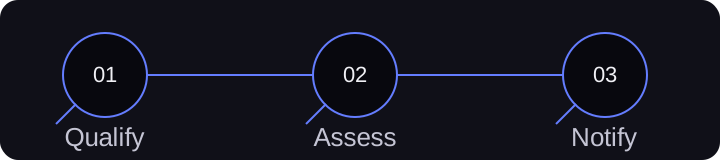
An illustrative working sequence
Assign ownership at every handover. These are work stages; the statutory deadlines and data windows still govern.
Frequently asked
ESOS stands for the Energy Savings Opportunity Scheme.
It is the UK’s mandatory energy assessment scheme for large undertakings and their corporate groups, set up by the Energy Savings Opportunity Scheme Regulations 2014 (SI 2014/1643) and administered by the Environment Agency.
Once every four years, a large organisation measures all the energy it uses, has the significant part of it audited for ways to save energy, has a director confirm the work, and tells the regulator it has done so.
Since Phase 3 it also publishes an action plan and reports progress against it.
ESOS sets no reduction target and does not require any saving to be made.
Yes.
ESOS is a statutory duty under the Energy Savings Opportunity Scheme Regulations 2014, as amended by SI 2023/1182 and SI 2026/701.
An undertaking that meets the large undertaking test on the qualification date must carry out an ESOS assessment and notify compliance, and failures are civil offences with financial penalties and publication.
A UK undertaking that on the qualification date employs at least 250 persons, or has both an annual turnover in excess of £44 million and an annual balance sheet total in excess of £38 million.
If any UK undertaking in a group is large, every UK undertaking in that group takes part with it.
Public bodies are generally excluded.
Yes.
Regulation 4 sets four-year compliance periods, each beginning on 6 December and ending on 5 December four years later.
Phase 4 runs from 6 December 2023 to 5 December 2027, and Phase 5 from 6 December 2027 to 5 December 2031.
Since Phase 3, organisations also submit an action plan and progress updates between assessments.
31 December 2026.
An organisation that meets the large undertaking test on that date is in Phase 4 and must notify compliance by 5 December 2027.
An ESOS assessment measures the participant’s total energy consumption across transport, industrial processes, buildings and any other purpose, may identify the areas making up at least 95% of it, and covers them with an ESOS energy audit, ISO 50001 certification, or both.
A lead assessor reviews it unless an exemption applies, and one or two responsible officers confirm it.
An ESOS energy audit analyses the energy used by the assets and activities it covers, based so far as reasonably practicable on verifiable data measured over 12 months, identifies cost-effective energy saving opportunities with estimated savings, and includes site visits.
The Regulations do not prescribe a method; the audit must meet the ESOS minimum requirements and be reviewed by a lead assessor unless an exemption applies.
The ESOS login is MESOS, Manage your Energy Savings Opportunity Scheme reporting, the Environment Agency’s online system, launched in April 2024.
The GOV.UK ESOS page links to it and says users sign in with GOV.UK One Login and can save a notification part-complete.
The Regulations call it the Notification System.
The ESOS report records the assessment: total energy consumption, significant consumption if identified, an intensity ratio for each organisational purpose, what each audit covered and found, the savings opportunities, any ISO 50001 certification relied on, and, from Phase 4, the energy savings achieved during the period in kWh and a review of the previous action plan.
It is kept in the evidence pack and is not required where ISO 50001 covers total or significant consumption.
The regulator follows the registered office of the responsible undertaking: the Environment Agency for England, Natural Resources Wales, the Scottish Environment Protection Agency and the Northern Ireland Environment Agency, with the Secretary of State for activities wholly or mainly offshore.
The Environment Agency is also the UK scheme administrator, and the Department for Energy Security and Net Zero owns the policy.
No. The Environment Agency’s Phase 4 guidance says participation in those schemes does not automatically count as ESOS compliance.
Their data can feed the ESOS calculation of total energy consumption, and an audit done for a Climate Change Agreement can count as an ESOS audit if a lead assessor conducted, verified or reviewed it and it meets the ESOS minimum standards.
Not directly.
Part 8 of the Regulations names no penalty for the action plan or progress update duties, and the Environment Agency’s Phase 4 guidance says regulators will not take enforcement action or issue a penalty for their non-submission, although the failure is published.
Failing to comply with an enforcement notice is penalised.
Part 8 sets five: failing to notify (£5,000 plus £500 a working day for up to 80 working days), failing to keep records (£5,000 plus the cost of checking), failing to carry out an assessment (£50,000 plus the same daily amount), failing to comply with a notice (£5,000 plus the daily amount) and a false or misleading statement (£50,000). Each also carries publication.
The second post-implementation review, published by DESNZ in July 2025, recommended keeping the Regulations and making no major changes on what it called an incomplete evidence base, with a commissioned evaluation to report in 2026.
The Modernising corporate reporting consultation of September 2026 says DESNZ intends to consult on SECR and ESOS later in 2026; as at 30 September 2026 that consultation had not been published.
Their UK parts may.
The GOV.UK ESOS page says a UK registered establishment of an overseas company must take part, whatever its own size, if any other part of the global group’s UK activities meets the qualifying criteria.
Energy used outside the UK is not counted.
Tell your regulator.
The GOV.UK ESOS page says an organisation that qualified for a previous phase, or has been contacted by its regulator, but does not qualify for Phase 4 needs to tell its regulator it does not qualify.
Remember that large status only ends after two consecutive accounting periods below the test.
Test every UK group member against the large undertaking definition on the qualification date, fix a 12-month reference period and add up total energy consumption in kWh, choose an energy audit, ISO 50001 or both, appoint a lead assessor unless exempt, have the work confirmed by one or two responsible officers and notify through MESOS by the compliance date.
For Phase 4 the notification is due by 5 December 2027, and an action plan follows by 5 December 2028.
Submitting the notification carries no fee, and the Environment Agency’s Phase 4 guidance says so.
The cost of compliance is the cost of the work: the energy measurement, the audit with its site visits, and the lead assessor’s review.
No regulator publishes a schedule of those costs, and they depend on how many sites and how much energy are involved.
Ignoring the duty is the expensive option: the statutory ceilings are £45,000 for failing to notify and £90,000 for failing to carry out an assessment.
ESOS requires no saving to be made, so the benefit is information.
The audit identifies cost-effective energy saving opportunities with estimated savings in kWh, and the action plan turns the ones an organisation chooses into dated commitments.
The DESNZ post-implementation review of July 2025 records 47 TWh of potential annual savings identified through Phase 3 audits against about 900 TWh consumed; those are savings identified, not savings delivered.
It is the 12 consecutive months over which total energy consumption is measured.
Regulation 22(5) says the period begins no more than 12 months before the qualification date and ends on or before the compliance date.
The Environment Agency’s guidance, section 4.4, adds that the period must include the qualification date, which for Phase 4 is 31 December 2026; that requirement is the guidance, not the regulation.
A person on one of the seven approved registers named on the GOV.UK ESOS page.
Individuals cannot apply to the Environment Agency directly, and checking that an appointed assessor is on a register is the undertaking’s job.
The competence standard the Regulations name is PAS 51215:2014.
Phase 4.
Its compliance period runs from 6 December 2023 to 5 December 2027, the qualification date is 31 December 2026 and notification is due on 5 December 2027.
Phase 3 is still finishing, because its last progress update is due by 5 December 2026.
No. ESOS is a four-yearly energy audit notified to a regulator; SECR is an annual energy and carbon disclosure in the company’s report, with its own size test.
The same energy data can serve both, but neither satisfies the other.
Sources
Every figure, date and status on this page traces to the instrument’s owner.
Secondary commentary is never the source for a number.
The instrument that creates ESOS, in force since 17 July 2014.
The size test the qualification check runs, and how headcount and accounts are read.
Why ESOS runs every four years and why the dates fall on 31 December and 5 December.
The review duty, the 40,000 kWh exemption and, since 22 July 2026, the assessor’s seven-day notice.
What the report records, the savings achieved and the review of the previous plan.
The Phase 3 reforms: action plans, progress updates and the 95% floor.
The Phase 4 reforms, in force 22 July 2026.
The current power under which ESOS is amended.
The five offences and their maxima.
The regulator’s detailed guidance, published 30 July 2026: the audit data rules, the lead assessor’s role, the savings estimate and sign-off.
How Climate Change Agreement and UK ETS data may be used, and why membership is not compliance.
Rewritten for Phase 4 on 2 September 2026; MESOS sign-in, the approved registers and overseas establishments.
How an actual penalty is set, and the new-entrant approach.
The action plans and first progress updates behind the follow-through figures.
The “Keep” recommendation and the Phase 3 compliance figures.
The stated intention to consult on SECR and ESOS later in 2026.