The two standards · as documents
UK SRS S1 and S2: compared
UK SRS S1 and S2 are the UK’s two sustainability reporting standards: S1 sets the general requirements for sustainability-related financial information, and S2 the requirements for climate.
Both were issued on 25 February 2026 as the UK’s endorsed versions of the ISSB’s IFRS S1 and IFRS S2, and both are voluntary for any entity.
For listed companies the FCA’s final rules apply both on a comply-or-explain basis from accounting periods beginning on or after 1 January 2027.
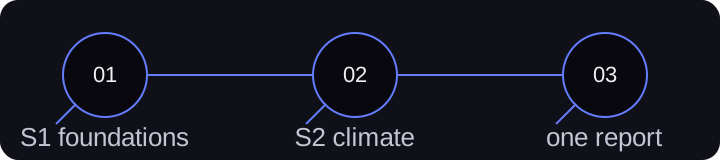
Side by side
What each standard is for
The simplest way to hold the pair in mind is that UK SRS S1 is the grammar and UK SRS S2 is the climate chapter written in it.
Read the provisions and qualifications
UK SRS S1 ¶3 asks for information about all sustainability-related risks and opportunities that could reasonably be expected to affect an entity’s cash flows, its access to finance or cost of capital over the short, medium or long term.
That test reaches climate as much as anything else; S1 does not stop at the edge of climate.
What UK SRS S2 adds is the climate-specific detail: the emissions metrics, the scenario analysis behind a resilience assessment, and what to say about a transition plan if there is one.
Both standards are the same length, 45 pages, and both organise disclosure into the four content areas familiar from TCFD.
Module 01 / 04
The pair
Module 02 / 04
Financial effects
Module 03 / 04
Climate in S1
Module 04 / 04
S2 detail
Tables and tools
| UK SRS S1 | UK SRS S2 | |
|---|---|---|
| Title | General Requirements for Disclosure of Sustainability-related Financial Information | Climate-related Disclosures |
| Covers | All sustainability-related risks and opportunities, climate included | Climate-related risks and opportunities, specifically |
| Built on | IFRS S1 (June 2023) | IFRS S2 as amended in December 2025 |
| Core content | Governance, strategy, risk management, metrics and targets (¶25) | The same four areas, for climate (¶¶5–37) |
| Distinctive content | Materiality, connected information, reporting entity, compliance statement | Scope 1, 2 and 3 emissions, scenario analysis, transition plans |
| Closing appendix | E — Application and transition | C — Application and transition |
| FCA relief | Two years’ non-disclosure beyond climate | One year’s non-disclosure of Scope 3 |
Paragraph maps
How each document is laid out
Cite a paragraph with its standard: the closing appendices were renumbered in the UK text, so a bare “¶C4” or “¶E3” means different things in the IFRS and UK versions.
UK SRS S1
| Part | Paragraphs |
|---|---|
| Objective | 1–4 |
| Scope | 5–9 |
| Conceptual foundations: fair presentation, materiality, reporting entity, connected information | 10–24 |
| Core content: governance · strategy · risk management · metrics and targets | 25 · 26–27 · 28–42 · 43–44 · 45–53 |
| General requirements: sources of guidance, location, timing, comparatives, compliance statement | 54–73B |
| Judgements · measurement uncertainty · errors | 74–76 · 77–82 · 83–86 |
| Appendices | A defined terms · B application guidance · C sources of guidance · D qualitative characteristics · E application and transition |
UK SRS S2
| Part | Paragraphs |
|---|---|
| Objective | 1–2 |
| Scope | 3–4 |
| Governance | 5–7 |
| Strategy, including resilience and scenario analysis | 8–23 |
| Risk management | 24–26 |
| Metrics and targets, including greenhouse gases | 27–37, with 29A–29C |
| Appendices | A defined terms · B application guidance (with the UK’s B59A) · C application and transition |
Applied together
Why S2 cannot be applied without S1
UK SRS S1 Appendix E keeps the rule that an entity applies UK SRS S2 at the same time as UK SRS S1.
Read the provisions and qualifications
¶E3 is the exception: an entity may disclose only climate-related information, applying S1 only insofar as it relates to climate.
Even then the climate disclosures rest on S1’s conceptual foundations — fair presentation, materiality, the reporting entity and connected information in ¶¶10–24.
The FCA says the same in its made rules: UKLR 6.6.6A G reminds a listed company making climate disclosures to apply S1 insofar as it relates to climate, and lists ¶¶10–24, 31, 49, 50, 52, 53 and 60–71 as parts that may be relevant.
That list is guidance, status G, not a rule.
So a climate report under UK SRS S2 already carries S1 judgements, which is why the UK SRS reporting checklist treats them as one exercise.
Module 01 / 04
Apply together
Module 02 / 04
Climate only
Module 03 / 04
Foundations
Module 04 / 04
FCA rule
Tables and tools
An entity using the climate-only provision in UK SRS S1 ¶E3 “is not permitted to assert compliance with UK SRS S1” and discloses its use instead.
It is not prevented from asserting compliance with UK SRS S2, provided it discloses the reliefs alongside that statement.
Source: UK SRS S1 ¶73A
The shared machinery
The parts of S1 a climate report always uses
The FCA’s guidance at UKLR 6.6.6A G names the parts of UK SRS S1 that may be relevant to climate disclosures made under UK SRS S2.
It is guidance, not rule, and it reads as a map of where the two standards meet.
| UKLR 6.6.6A G item | UK SRS S1 paragraphs | What they do for a climate report |
|---|---|---|
| (1) | ¶¶10–24, conceptual foundations | Fair presentation, materiality, the reporting entity and connected information |
| (2) | ¶¶31, 49, 50, 52, 53 | Time horizons; the source of any metric; entity-developed metrics; consistency and labelling of metrics and targets |
| (3) | ¶¶60–71, general requirements | Location, timing, comparatives and sources of guidance |
| (4) | ¶¶72–73B, statement of compliance | When a company may say it complies, and what it discloses about reliefs |
| (5) | ¶¶74–86 | Judgements, measurement uncertainty and errors |
| (6)–(8) | Appendices A, B and D | Defined terms, application guidance and the qualitative characteristics of useful information |
Read as a list, UKLR 6.6.6A G is most of UK SRS S1 except its core-content paragraphs on topics beyond climate.
That is the practical meaning of “applied together”: a listed company in its climate-first years still uses S1’s definitions, its materiality judgement, its location and timing rules and its compliance-statement rule.
What it defers under the relief is the S1 disclosure of other sustainability topics, not the S1 machinery.
¶64 is the one that most changes practice for companies used to TCFD reporting: the disclosures are published at the same time as the financial statements and cover the same period.
¶20 fixes the reporting entity as the same as for the financial statements, so a group reports its UK SRS disclosures for the group it consolidates.
¶¶21–24 are the connected-information paragraphs: the climate disclosures have to be consistent with the accounts, use the same presentation currency and say which financial statements they relate to.
Compliance statements
What each relief does to the compliance claim
The compliance statement lives in UK SRS S1, at ¶72: an entity whose sustainability-related financial disclosures meet all the requirements of UK SRS makes an explicit and unreserved statement of compliance.
Read the provisions and qualifications
UK SRS S2 has no compliance-statement paragraph of its own; its ¶C5 asks for the reliefs used to be disclosed, and points back to S1.
¶73A, one of the UK’s additions, is the hinge between the two standards.
An entity that uses the climate-only provision may not assert compliance with UK SRS S1 and discloses that it has used it.
It is not prevented from asserting compliance with UK SRS S2 while using the S2 reliefs, provided it discloses them alongside the statement.
The FCA’s draft guidance adds the listing-rule layer: a company that explains against part of a standard cannot also make an explicit and unreserved statement of compliance with that standard.
Explanations the standards themselves provide for, such as UK SRS S2 ¶21 on financial effects that cannot be quantified, do not break the statement.
Module 01 / 04
S1 statement
Module 02 / 04
S2 reference
Module 03 / 04
UK addition
Module 04 / 04
Climate-only claim
Tables and tools
| Reliefs used | Assert compliance with S1? | Assert compliance with S2? |
|---|---|---|
| None | Yes, if every requirement is met | Yes, if every requirement is met |
| S2 ¶C3 (method) or ¶C4 (Scope 3) | Not affected by these reliefs | Yes, disclosing the reliefs alongside |
| S1 ¶E3 (climate only) | No | Yes, disclosing the reliefs alongside |
| An explanation under the FCA’s rules | Not with the standard explained against | Not with the standard explained against |
Annex A
Where the UK text departs from IFRS
Annex A of the government’s consultation response maps every difference and says: “Where requirements in the standards are not included in the table, there are no differences between the two.” It gives no total, so neither do we.
| Standard | IFRS paragraph → UK paragraph | What changed |
|---|---|---|
| S1 | 55(a), 58(a) | SASB Standards: “shall” refer to and consider becomes “may”. |
| S1 | new → 73A, 73B | 73A: using the climate-only relief bars a claim of compliance with S1, not with S2. 73B: application is subject to UK law and FCA rules. |
| S1 | E1, E2 → E2 | Effective date removed; the rule that S2 is applied at the same time as S1 is kept. |
| S1 | E4 → not applicable | The relief to publish sustainability disclosures after the financial statements in year one is removed. |
| S1 | E5 → E3, E5, 73A | Climate-first relief kept without a time limit; its availability is left to legislation or regulation. |
| S2 | 12, 23, 32 | Industry-based guidance: “shall” becomes “may”. ¶37 and ¶B65(d) keep “shall”. |
| S2 | new → B59A | An entity that finds financed emissions impracticable to estimate must explain why — the one place the UK is stricter. |
| S2 | C1, C2 → C2 | Effective date removed. |
| S2 | C4 → C3, C4, C6 | GHG methodology relief limited to the first year (C3); Scope 3 relief left without a time limit (C4); both subject to UK law (C6). |
Annex A, filtered
Filter the differences by standard and by kind
The panel holds the same Annex A rows with the effect of each spelled out, and lets you cut them by standard and by the kind of change.
Filter to “Stricter than IFRS” and one row is left: ¶B59A on financed emissions.
Filter to “Relief or timing” and you see why the FCA had to set the relief periods itself: every relief that carried a first-year limit in the IFRS text either kept it (the greenhouse gas method relief) or lost it (the Scope 3 and climate-only reliefs).
Filter to “Removed” and the UK’s two structural decisions stand out: no effective date, and no first-year permission to publish sustainability disclosures after the accounts.
The “shall” to “may” rows are the ones that change most in practice, because they make the SASB-derived industry material optional in both standards.
For listed companies the timing rows are now overlaid by PS26/19: one year for Scope 3 and two years beyond climate, from initial application.
Annex A, row by row
Showing 16 of 16 rows
- IFRS S1 ¶¶55(a), 58(a) → UK SRS S1 ¶¶55(a), 58(a)SASB Standards: “shall” became “may”.
An entity may refer to and consider the SASB Standards when identifying risks, opportunities and metrics, rather than being required to.
- No equivalent → UK SRS S1 ¶73AA statement-of-compliance rule for the reliefs.
An entity using the climate-only relief (¶E3) may not assert compliance with UK SRS S1 and must disclose its use of the relief; it may still assert compliance with UK SRS S2 if it discloses the reliefs used.
- No equivalent → UK SRS S1 ¶73BA UK-law override.
Applying UK SRS S1 is subject to anything set by the Companies Act, the FCA or another UK body able to make reporting requirements.
- IFRS S1 ¶¶E1, E2 → UK SRS S1 ¶E2The effective date was removed.
An entity applies the standard when it chooses, unless UK law or regulation requires it; the rule that S1 and S2 are applied at the same time was kept, at ¶E2.
- IFRS S1 ¶E3 → UK SRS S1 ¶E1No comparatives in the first year, kept.
The reference to the date of initial application was removed; the no-comparatives limb survives as ¶E1.
- IFRS S1 ¶E4 → Not applicableReporting after the accounts in year one, removed.
IFRS S1 let an entity publish its first sustainability disclosures after its financial statements; UK SRS S1 does not, so the disclosures travel with the accounts from the first report.
- IFRS S1 ¶E5 → UK SRS S1 ¶¶E3, E5, 73AThe climate-only relief lost its time limit.
The reference to the first annual reporting period was removed and availability left to legislation or regulation; for listed companies PS26/19 ¶3.14 now sets it at two years from initial application.
- IFRS S1 ¶E6 → UK SRS S1 ¶E4Comparatives after the climate-only relief.
Comparative non-climate information is needed only in the second annual period after the entity stops using the ¶E3 relief (¶E4(b)).
- IFRS S2 ¶¶12, 23, 32 → UK SRS S2 ¶¶12, 23, 32Industry-based guidance: “shall” became “may”.
An entity may refer to and consider the ISSB’s Industry-based Guidance on Implementing IFRS S2; ¶37 and ¶B65(d) keep “shall”.
- No equivalent → UK SRS S2 ¶B59AFinanced emissions: explain if you cannot estimate them for the same period.
Where an entity finds it impracticable to estimate financed emissions for the same period as the accounts, it must say why, give its measurement approach, inputs and assumptions, and its plan and timeline to catch up.
- IFRS S2 ¶¶C1, C2 → UK SRS S2 ¶C2The effective date was removed.
The ISSB’s December 2025 amendments were built into UK SRS S2 from the start, so IFRS S2’s ¶¶C1A, C1B and C6 are not needed.
- IFRS S2 ¶C3 → UK SRS S2 ¶C1No comparatives in the first year, kept.
The date-of-initial-application reference was removed; the no-comparatives limb survives as ¶C1.
- IFRS S2 ¶C4(a) → UK SRS S2 ¶C3The GHG measurement-method relief kept its limit.
An entity may keep a non-GHG-Protocol method it used immediately before, for the first annual reporting period only.
- IFRS S2 ¶C4(b) → UK SRS S2 ¶C4The Scope 3 relief lost its time limit.
The reference to the first annual reporting period was removed; for listed companies PS26/19 ¶3.14 now sets it at one year from initial application.
- No equivalent → UK SRS S2 ¶C6A UK-law override for the reliefs.
The ¶C3 and ¶C4 reliefs are subject to the Companies Act, FCA rules or another UK authority — the machinery the FCA used in PS26/19.
- IFRS S2 ¶C5 → UK SRS S2 ¶C5Say which reliefs you used.
Same substance as IFRS S2, plus a pointer to ¶73A of UK SRS S1: disclose use of the reliefs alongside the statement of compliance.
Source: DBT consultation response, Annex A (25 February 2026).
Where a requirement is not in Annex A there is no difference from IFRS S1 or S2.
Annex A gives no count of differences.
Misattributed
Three changes that are not the UK’s
The government consulted on six proposed amendments in June 2025, and “six” has been repeated as if it described the final standards.
Read the provisions and qualifications
It does not: the GICS amendment was withdrawn, the proposed two-year climate-first relief was replaced by removing the time limit altogether, and ¶¶73A, 73B, B59A and E5 were added afterwards.
Question 1 of the government response records that 68% of those answering it (125 of 184) agreed with the four amendments the TAC recommended.
The removal of the GICS classification requirement for financed emissions is the ISSB’s own change of December 2025, not a UK amendment.
So are the other December 2025 amendments to IFRS S2 that UK SRS S2 carries, including ¶¶29A–29C; Annex A lists them as the ISSB’s.
And “connectivity” is not an Annex A difference at all: connected information is inherited from IFRS S1 at ¶¶21–24.
The UK Sustainability Disclosure Technical Advisory Committee assessed the international standards before endorsement, and the UK SRS consultation page tells that story.
Module 01 / 04
ISSB changes
Module 02 / 04
Timing
Module 03 / 04
UK text
Module 04 / 04
Version
The documents
Where to read the standards, and what they are not
The two standards are free PDFs on the GOV.UK publication page, published on 25 February 2026: UK SRS S1 and UK SRS S2.
Read the provisions and qualifications
The same page carries the government’s response to the consultation, whose Annex A is the only authoritative map of the UK differences.
The department that published them has since been renamed the Department for Business, Innovation, Science and Trade, from 20 July 2026; the documents are still the Department for Business and Trade’s February publications.
The international originals are on the IFRS Foundation’s site as HTML, with paragraph anchors: IFRS S1 and IFRS S2.
Neither standard is a reporting template: they say what to disclose and where it may sit, not how a page should look.
UK SRS S1 ¶60 makes the disclosures part of the general purpose financial reports without prescribing a layout, and ¶63 with ¶¶B45–B47 allows cross-reference to another report.
The nearest thing to a template is the paragraph structure itself, which is why the UK SRS reporting checklist is keyed to paragraphs.
Greenhouse gases under UK SRS S2 are measured to the GHG Protocol Corporate Standard, which the standard names; it is a separate document and is not reproduced in UK SRS.
Module 01 / 04
Published text
Module 02 / 04
Definitions
Module 03 / 04
Appendices
Test the split
S1 or S2? Seven statements
Most errors about the pair come from treating S1 as “everything except climate” and S2 as self-contained.
Neither is right: S1 reaches climate as much as anything else, and S2 leans on S1 for materiality, location, timing and the compliance statement.
The statements on the panel test that split, and each answer names the paragraph or rule that settles it.
The quickest rule of thumb: if it is a climate disclosure requirement, it is in S2; if it is about how any disclosure is judged, placed, timed or claimed, it is in S1.
UK SRS S1 or S2: true or false?
Scope 3 emissions are a UK SRS S1 disclosure.
The materiality test used for climate disclosures is in UK SRS S1.
An entity reporting on climate only can still assert compliance with UK SRS S1.
Workforce and supply-chain risks are disclosed under UK SRS S1, not S2.
The UK made UK SRS S2 stricter than IFRS S2 in several places.
The reliefs’ one-year and two-year limits are written in the standards.
UK SRS S1 and UK SRS S2 each have their own comply-or-explain limb in the FCA’s rules.
0 of 7 answered.
Nothing you choose is stored or sent.
Status
Voluntary for all, comply or explain for some
The government’s guidance says the standards are available for voluntary use by any entity that chooses to do so.
Read the provisions and qualifications
The FCA’s final rules then require listed companies in five categories to report against both, or explain, for accounting periods beginning on or after 1 January 2027.
CP26/5 had proposed making UK SRS S2 mandatory; the final rules adopt comply or explain across all categories of disclosure, as the consultation had proposed only for S1 and Scope 3.
The reliefs are the FCA’s, not the standards’: the government told the FCA it would take the time limits out of the standards and leave them to regulation.
The FRC’s FAQs draw the consequence for voluntary reporters: they can use the reliefs without time limits.
Which companies are caught is on who is in scope; what the FCA requires, limb by limb, on the FCA and UK SRS; and every date on the dated UK SRS register.
Module 01 / 04
Voluntary use
Module 02 / 04
Listing rules
Module 03 / 04
Final approach
Module 04 / 04
Reliefs
Tables and tools
| Who | UK SRS S1 | UK SRS S2 |
|---|---|---|
| Any entity | Voluntary | Voluntary |
| UKLR 6, 14, 15, 16, 22 | Comply or explain · 2-year relief beyond climate | Comply or explain · 1-year Scope 3 relief |
| Everyone else | No duty | No duty (the CA 2006 climate duty may be met with S2) |
Other regimes
How the pair sits beside TCFD, SECR and the PRA
PS26/19 ¶1.10 says the new rules replace the existing TCFD-aligned listing-rule disclosures; TCFD and UK SRS maps one onto the other.
Read the provisions and qualifications
For large companies outside the listing rules, UK SRS S2 is confirmed as a national reporting framework under section 414CB(6) of the Companies Act, so a company can meet the climate disclosure duty with it; the confirmation covers S2, not S1.
SECR is untouched and continues beside both standards; the SECR reporting guide covers the directors’ report disclosure.
Banks and insurers also answer to the PRA, whose supervisory statement SS5/25 on managing climate-related risks is a risk-management expectation, not a disclosure standard.
Two open government consultations touch the pair without changing it: climate-related transition plan requirements, still awaiting a response, and assurance of sustainability reporting, answered with a voluntary oversight regime.
Assurance is covered on sustainability assurance, Scope 3 on UK SRS Scope 3 reporting, and groups that also report in the EU on CSRD and UK SRS.
Module 01 / 04
TCFD
Module 02 / 04
SECR
Module 03 / 04
PRA
Module 04 / 04
Different duties
Next
Where to go from the pair
If you are deciding what to do before 2027, the UK SRS compliance page sets out what an explanation must say, and the readiness assessment tests where you stand.
The originals are on the IFRS Foundation’s navigator: IFRS S1 and IFRS S2, and the UK consultation that produced the pair is on GOV.UK.
Questions and corrections to hello@uksrs.org.uk; the privacy policy and terms of service govern this site.
A reading and preparation sequence
UK SRS s1 and s2: from the question to the evidence
- Step 0101
S1 and S2
The simplest way to hold the pair in mind is that UK SRS S1 is the grammar and UK SRS S2 is the climate chapter written in it.Read the detail. - Step 0202
One report
UK SRS S1 Appendix E keeps the rule that an entity applies UK SRS S2 at the same time as UK SRS S1.Read the detail. - Step 0303
Compliance claim
The compliance statement lives in UK SRS S1, at ¶72: an entity whose sustainability-related financial disclosures meet all the requirements of UK SRS makes an explicit and unreserved statement of compliance.Read the detail. - Step 0404
International changes
The government consulted on six proposed amendments in June 2025, and “six” has been repeated as if it described the final standards.Read the detail. - Step 0505
Source documents
The two standards are free PDFs on the GOV.UK publication page, published on 25 February 2026: UK SRS S1and UK SRS S2.Read the detail. - Step 0606
Standards and rules
The government’s guidancesays the standards are available for voluntary use by any entity that chooses to do so.Read the detail. - Step 0707
Reporting neighbours
PS26/19 ¶1.10 says the new rules replace the existing TCFD-aligned listing-rule disclosures; TCFD and UK SRSmaps one onto the other.Read the detail.
Dates, with their status
The relevant dates, drawn in order
- 25 February 202601
UK SRS published
S1 and S2 are published for voluntary use. The standards themselves do not decide which companies must report. - 30 September 202602
FCA final rules
PS26/19 sets a comply-or-explain reporting obligation for the five in-scope listing categories. It replaces the consultation proposals. - 28 October 202603
Draft guidance comments close
Technical Note 803.1 is proposed guidance on the explanations and compliance statements. Keep its draft status clear. - Periods from 1 January 202704
New listed-company regime
The first eligible accounting periods begin. Optional reliefs cover Scope 3 for one year and wider S1 sustainability information for two years. - 2028 reporting season05
First annual reports
The FCA identifies 2028 as the first reporting year. An issuer’s actual publication deadline follows its annual financial report rules and year end. - Periods from 1 January 202906
Transitional reliefs end
The Scope 3 and climate-first transitional reliefs have expired. The comply-or-explain reporting obligation continues.
Continue your research
Related reporting guides, one question at a time
Frequently asked
UK SRS S1 and S2, answered
What are UK SRS S1 and S2?
They are the UK Sustainability Reporting Standards.
UK SRS S1 sets the general requirements for disclosing sustainability-related financial information; UK SRS S2 sets the requirements for climate-related disclosures.
Both were issued by the Secretary of State for Business and Trade on 25 February 2026 and are the UK’s endorsed versions of the ISSB’s IFRS S1 and IFRS S2.
What is the difference between UK SRS S1 and S2?
UK SRS S1 is the general standard: the materiality test, the four content areas, connected information, the reporting entity and the rules on location, timing and the compliance statement. It applies to every sustainability-related risk and opportunity, climate included.
UK SRS S2 adds the specific climate requirements: greenhouse gas emissions, scenario analysis, transition plans and climate metrics.
Do you apply UK SRS S1 and S2 together?
Yes.
Appendix E of UK SRS S1 keeps the requirement that an entity applies UK SRS S2 at the same time as UK SRS S1.
Paragraph E3 then permits an exception: disclosing only climate-related information.
An entity that uses it may not assert compliance with UK SRS S1, but may still assert compliance with UK SRS S2.
Are UK SRS S1 and S2 mandatory?
No. They are available for voluntary use by any entity.
The FCA’s final rules, PS26/19, require companies listed in UKLR 6, 14, 15, 16 and 22 to report against both on a comply-or-explain basis for accounting periods beginning on or after 1 January 2027.
Comply or explain applies to UK SRS S2 as well as S1.
How many UK amendments are there to IFRS S1 and S2?
No authoritative count exists.
The government consulted on six proposed amendments in June 2025, but one was withdrawn and one replaced, and further UK provisions were added.
Annex A of the government response maps every final difference paragraph by paragraph and gives no total.
Is UK SRS S2 the same as IFRS S2?
Almost.
UK SRS S2 is IFRS S2 as amended by the ISSB in December 2025, with UK changes: the effective date removed, the Scope 3 relief left without a time limit, references to the industry-based guidance softened from shall to may at paragraphs 12, 23 and 32, and a new paragraph B59A requiring an explanation where financed emissions cannot be estimated.
Does UK SRS replace TCFD reporting?
For listed companies, yes: PS26/19 says the new rules replace the existing TCFD-aligned listing-rule disclosures.
For large companies under the Companies Act climate duty, UK SRS S2 is a national reporting framework they may use to meet it.
The TCFD itself was disbanded in October 2023.
Where can I download UK SRS S1 and S2?
From the GOV.UK publication page for UK Sustainability Reporting Standards UK SRS S1 and UK SRS S2, published on 25 February 2026. Each standard is a free PDF of 45 pages.
The same page carries the government’s response to the consultation, including Annex A, which maps the UK differences from IFRS S1 and S2.
Is there a UK SRS S1 and S2 template?
No template is part of the standards.
They specify what to disclose, make the disclosures part of the general purpose financial reports without prescribing a layout, and permit cross-reference under UK SRS S1 paragraphs B45 to B47.
The paragraph structure of each standard is the practical outline for a report.
Who issued UK SRS S1 and S2?
The Secretary of State for Business and Trade, through the Department for Business and Trade, on 25 February 2026.
They were not issued by the FRC or the FCA.
The department has been called the Department for Business, Innovation, Science and Trade since 20 July 2026.
Which parts of UK SRS S1 apply to a climate-only report?
The FCA’s guidance at UKLR 6.6.6A G lists them: paragraphs 10 to 24, paragraphs 31, 49, 50, 52 and 53, paragraphs 60 to 71, paragraphs 72 to 73B, paragraphs 74 to 86, and Appendices A, B and D. It is guidance, not a rule, and CP26/5 had drafted it as a rule.
Do UK SRS S1 and S2 use the same materiality test?
Yes.
Materiality is defined once, in UK SRS S1 paragraph 18: information is material if omitting, misstating or obscuring it could reasonably be expected to influence the decisions of primary users of general purpose financial reports.
UK SRS S2 relies on it.
Neither standard sets a numerical threshold.
Can a company comply with UK SRS S2 but not S1?
It can assert compliance with UK SRS S2 while using the climate-only provision in UK SRS S1 paragraph E3, provided it discloses the reliefs it uses.
It may not then assert compliance with UK SRS S1, under paragraph 73A.
When were UK SRS S1 and S2 published?
On 25 February 2026, after the exposure-draft consultation that ran from 25 June to 17 September 2025.
They carry no effective date.
The FCA’s rules apply them to listed companies for accounting periods beginning on or after 1 January 2027.
Can a company use only part of UK SRS?
It can apply the standards voluntarily in whatever way suits it, but it may describe its disclosures as complying with UK SRS only if they meet all the requirements, under UK SRS S1 paragraph 72, and it must disclose any reliefs it uses alongside its statement of compliance.
Sources
Primary sources
Every figure, date and status on this page traces to the instrument’s owner.
Secondary commentary is never the source for a number.
- Department for Business and TradeUK SRS S1 and UK SRS S2 — publication page
Published 25 February 2026; both standards 45 pages.
- Department for Business and TradeUK SRS S1, General Requirements (PDF) — ¶¶3, 10–24, 25, 72–73B, Appendix E
The paragraph map, the materiality test, the compliance statement and the application and transition appendix.
- Department for Business and TradeUK SRS S2, Climate-related Disclosures (PDF) — ¶¶12, 23, 32, B59A, Appendix C
The climate standard, its financed-emissions addition and its reliefs.
- Department for Business and TradeGovernment response to the consultation on UK SRS — web version
¶1.17: 68% of respondents to Question 1 agreed with the TAC’s amendments; Chapter 3 on s.414CB(6).
- Department for Business and TradeConsultation response (PDF), Annex A
The paragraph-by-paragraph map of the UK differences, which carries no count.
- Department for Business and TradeUK Sustainability Reporting Standards — guidance
Available for voluntary use by any entity.
- Department for Business and TradeLetter to the FCA, 5 January 2026 (PDF)
The decision to remove the relief time limits from the standards.
- Financial Conduct AuthorityPS26/19: Aligning listed issuers' sustainability disclosures with international standards
The FCA’s final rules of 30 September 2026.
- Financial Conduct AuthorityPS26/19 (PDF), ¶¶1.7, 3.14 and Appendix 1 (UKLR 6.6.6A G)
Comply or explain for both standards; the reliefs; the S1 paragraphs the FCA points climate reporters to.
- IFRS FoundationIFRS S1 General Requirements
The international standard UK SRS S1 endorses.
- IFRS FoundationIFRS S2 Climate-related Disclosures (December 2025 text, HTML)
The amended text UK SRS S2 is built on, and its paragraph structure.
- legislation.gov.ukCompanies Act 2006, section 414CB(6)
UK SRS S2 is a national reporting framework for the climate disclosure duty.
- Financial Conduct AuthorityDraft Technical Note TN 803.1 (September 2026, for consultation)
The compliance-statement table in Annex 1; proposed guidance.
- IFRS FoundationIFRS S1, full text (HTML)
The paragraph-numbered original of UK SRS S1.
- GHG ProtocolCorporate Accounting and Reporting Standard
The measurement basis UK SRS S2 names.
- Financial Reporting CouncilSustainability reporting developments — FAQs
Voluntary reporters can use the reliefs without time limits.