
UK SRS timeline — S1 + S2 roadmap
Two standards, one roadmap. UK SRS S1 general requirements and UK SRS S2 climate disclosures — published by DBT on 25 February 2026. Voluntary today; proposed mandatory for UK-listed companies from 1 January 2027 under FCA CP26/5, with the final Policy Statement expected autumn 2026.
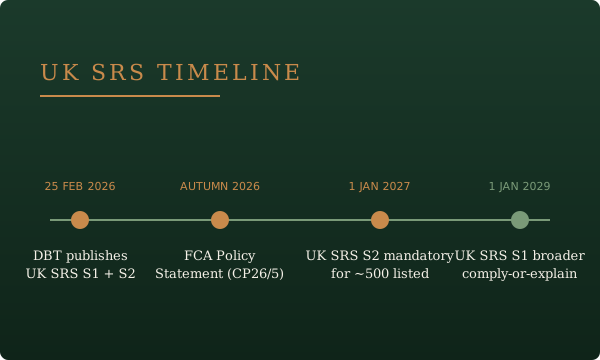
UK SRS timeline — four anchor dates from 2026 to 2029
The UK SRS timeline runs from DBT publication of the standards on 25 February 2026, through the FCA Policy Statement in autumn 2026, mandatory UK SRS S2 from 1 January 2027, to broader UK SRS S1 comply-or-explain from 1 January 2029 (proposed).
The UK SRS timeline is the four-anchor calendar that governs UK adoption of the Sustainability Reporting Standards. Anchor one: 25 February 2026, 1 DBT publishes UK SRS S1 and S2 as the UK endorsement of IFRS S1 and S2 with six UK-specific amendments. Anchor two: autumn 2026, expected 3 FCA Policy Statement following CP26/5 confirming the mandatory regime. Anchor three: 1 January 2027, proposed mandatory start for UK SRS S2 for around 500 UKLR 6/16/22 listed companies. Anchor four: 1 January 2029, proposed broader UK SRS S1 comply-or-explain extension per 1 DBT guidance.
For the single-date question see UK SRS deadline; for who the timeline catches see UK SRS who is in scope; for the regulatory mechanics see UK SRS regulations.
- UK SRS timeline — 25 February 2026 DBT publication
- Department for Business & Trade publishes final UK SRS S1 and UK SRS S2 as the UK endorsement of IFRS S1 and S2 with six UK-specific amendments. Voluntary early adoption available from this date.
- UK SRS timeline — autumn 2026 FCA Policy Statement
- Expected publication of the FCA Policy Statement on UK SRS, confirming the final mandatory rule, transitional reliefs, in-scope UKLR categories and the first applicable accounting period.
- UK SRS timeline — 1 January 2027 Mandatory S2 start
- Proposed mandatory start of UK SRS S2 climate disclosure for around 500 UK-listed companies in UKLR 6, 16 and 22 under FCA CP26/5. First reports land in 2028.
- UK SRS timeline — 1 January 2029 Broader S1 scope
- Proposed broader extension of UK SRS S1 on a comply-or-explain basis. Subject to further DBT consultation; would capture large private UK companies meeting size criteria broadly analogous to EU CSRD thresholds.
Two standards published 25 Feb 2026
DBT publication of UK SRS S1 and S2 built on IFRS S1 and S2 with six UK-specific amendments. Voluntary today; proposed mandatory for ~500 listed companies via FCA CP26/5.
UK SRS S1 and UK SRS S2 represent the foundational framework for sustainability disclosure in the UK capital market. The 1 Department for Business and Trade published both standards on 25 February 2026 as the UK endorsement of the ISSB’s 2 IFRS S1 and S2 baseline.
The standards build directly on the 2 ISSB international baseline with six UK-specific amendments reflecting domestic regulatory priorities. The UK government’s stated preference was to preserve international interoperability: the six amendments are targeted and purposeful, not a wholesale rewrite. Implementation follows a phased approach, with UK SRS S2 climate disclosures proposed mandatory from 1 January 2027 and UK SRS S1 general requirements on a comply-or-explain basis from 1 January 2029.
The phasing reflects the relative maturity of climate data infrastructure. Most large listed companies already collect Scope 1 and 2 emissions data under the FCA’s existing TCFD-aligned Listing Rules. UK SRS S2 builds on that foundation, while UK SRS S1’s broader sustainability topics — biodiversity, water, workforce, supply chain — require more extensive data system development, justifying the later 2029 date confirmed in 3 FCA CP26/5.
Key dates and milestones — UK SRS roadmap
From DBT publication through to S1 comply-or-explain in 2029. The five milestones that anchor every UK SRS implementation conversation.
- 25 FEB 2026DBT publishes S1 + S2
- 20 MAR 2026FCA CP26/5 consultation closed
- AUTUMN 2026FCA Policy Statement
- 1 JAN 2027S2 climate proposed mandatory
- 1 JAN 2029S1 broader topics comply-or-explain
S1 — general requirements
Foundational framework for non-climate sustainability topics. The architectural concepts (materiality, connectivity, value-chain) that S2 cannot be applied without.
UK SRS S1 establishes the overarching architectural requirements for all sustainability-related financial disclosures beyond climate topics, as specified in 1 UK SRS S1 paragraphs 1–15. S1 provides the conceptual framework for materiality assessment, connectivity principles, and disclosure requirements across governance, strategy, risk management, and metrics.
The materiality approach follows single (enterprise-value) materiality — the same investor-focused lens as financial reporting. This is consistent with the 4 SASB materiality guidance and the 2 IFRS S1 global baseline. UK SRS S1 does not require impact materiality assessment — only where mandated by other UK regulatory requirements.
The scope of UK SRS S1 covers all sustainability-related risks and opportunities that could reasonably affect an entity’s cash flows, access to finance, and cost of capital. This includes biodiversity, water scarcity, workforce conditions, supply chain labour, governance ethics, and human rights. The key conceptual foundations apply immediately when implementing UK SRS S2 climate disclosures, because S2 cannot be applied without S1 architectural elements per 1 UK SRS S2 paragraph 3.
S1 Proposed Comply-or-Explain
Broader sustainability topics beyond climate move to comply-or-explain basis for listed companies
The six UK-specific amendments to the IFRS S1 baseline are targeted rather than a wholesale rewrite. The most significant for preparers is the removal of the ISSB’s first-year transitional relief — UK SRS reporters face a more demanding first-year requirement than IFRS S1 reporters elsewhere. Climate-first phasing is reworked to match the UK’s own 2029 date under 3 CP26/5 para 3.52. See the UK-specific amendments guide for the full annotation of all six changes.
S2 — climate-related disclosures
Enhanced TCFD framework. The standard that drives the 1 January 2027 proposed mandatory date for ~500 listed companies under FCA CP26/5.
UK SRS S2 provides comprehensive climate-related financial disclosure requirements with proposed mandatory implementation from 1 January 2027 for listed companies under 3 FCA CP26/5 paragraph 3.45. S2 builds on the four-pillar TCFD architecture while incorporating substantially enhanced requirements including prescriptive 7 GHG Protocol emissions measurement, mandatory scenario analysis under paragraph 22, and climate transition planning disclosures.
The four pillars — Governance, Strategy, Risk Management, and Metrics & Targets — follow the architecture established by the 6 TCFD recommendations (2017), now superseded by the 9IFRS S2 baseline that UK SRS S2 adopts. Under the Metrics & Targets pillar, paragraph 29(a) requires absolute gross GHG emissions in metric tonnes of CO₂ equivalent, classified by Scope 1, Scope 2, and Scope 3, measured under the GHG Protocol Corporate Standard (2004).
S2 Proposed Mandatory
Climate disclosures required from January 2027 with Scope 1 & 2 emissions from day one
The Scope 3 disclosure requirement applies on a comply-or-explain basis from 1 January 2028 under the 3 CP26/5 paragraph 3.67. Comprehensive value chain emissions coverage across all 8 15 GHG Protocol Scope 3 categories is required where material. Implementation planning for Scope 3 requires systematic capability development — supplier engagement, product-level data collection, and systems integration typically take 12–18 months. Companies that begin building Scope 3 infrastructure in 2026 will be better positioned for the 2028 deadline. See the Scope 3 reporting guide for the full 15-category value chain methodology.
The UK SRS S2 climate framework also connects to the broader UK sustainability reporting landscape and aligns with FRC assurance requirements. No mandatory assurance is proposed in the initial phase, but in-scope companies must disclose whether they have obtained third-party assurance on their UK SRS S2 disclosures.
Are you in scope for UK SRS?
Interactive decision tree to determine implementation pathway based on company characteristics, listing status and FCA CP26/5 scope.
Scope is determined primarily by listing status. Under the 3 FCA CP26/5 proposals, mandatory UK SRS S2 reporting applies to issuers with equity shares or certificates representing equity shares in UKLR 6, non-equity shares in UKLR 16, and transition category issuers in UKLR 22. That is approximately 515 primary-listed commercial companies.
Excluded from the initial mandatory scope are closed-ended investment funds, shell companies, debt securities issuers, and securitised derivatives issuers. Commercial companies listed on AIM and other markets not covered by UKLR 6, 16, or 22 are also not proposed for mandatory inclusion in the initial phase. Large private companies are not in scope for mandatory reporting at present — the 1 DBT’s Modernising Corporate Reporting programme is expected to consult during 2026 on extending UK SRS to large private entities. Any UK entity may adopt UK SRS voluntarily with immediate effect, provided it makes a full statement of compliance. Use the UK SRS scope checker to confirm applicability.
How ready is the market?
Benchmark across governance, data systems, materiality assessment and disclosure preparation against FCA CP26/5’s proposed timeline.
Market preparation varies significantly across listed companies, with larger entities generally more advanced in TCFD implementation but requiring significant enhancement for full UK SRS S2 compliance. Common readiness gaps include Scope 3 measurement capability, climate scenario assessment sophistication, and the integration of sustainability disclosures with financial statements — a core discipline of the UK SRS framework required by 3 CP26/5 proposed timeline.
Benchmark your organisation’s UK SRS readiness across key capability areas — governance arrangements, data systems, materiality assessment, and disclosure preparation — against the proposed January 2027 mandatory start date. Companies that have not started data gap analysis and governance uplift by mid-2026 face a compressed preparation window. The 1 DBT guidance encourages all entities to begin voluntary adoption now as a readiness measure.
Why S1 and S2 should be planned together
S1 architectural concepts (materiality, connectivity, value-chain) are prerequisites for S2 climate disclosure. Treating S2 alone misses requirements that flow from S1.
UK SRS S1 and S2 are interconnected standards requiring a coordinated rather than standalone implementation approach. S1 provides the architectural foundation — materiality assessment, connectivity to financial statements, value chain principles — that S2 climate disclosures rely on. Companies cannot apply UK SRS S2 in isolation without understanding UK SRS S1 principles. This relationship is explicit in 1 UK SRS S2 paragraph 3, which states that S2 relies on S1 for its governance and strategy disclosure requirements.
In practice, S2 climate focus provides a practical foundation for broader S1 sustainability topics. Building governance structures, data pipelines, and materiality processes for UK SRS S2 creates infrastructure that can be extended for UK SRS S1 topics from 2029. Implementation planning through the integrated compliance roadmap should address both standards together — covering governance, data systems, and reporting capabilities in one coordinated programme.
Board oversight arrangements must accommodate both climate-specific governance under S2 and the broader sustainability governance framework under S1, with clear accountability structures and reporting lines. Combined data system architecture should support both climate measurement under S2 — GHG emissions across all three scopes, climate scenario assessment capabilities — and broader sustainability KPI tracking under S1, with integration with financial reporting systems for the connectivity requirements in the 2 ISSB baseline. See the comprehensive capability assessment for a structured gap analysis framework.
Regulatory milestones into 2027
FCA Policy Statement autumn 2026, final rules publication, transitional guidance development, and market readiness support.
Implementation timeline is subject to completion of the 9 FCA regulatory process following the CP26/5 consultation that closed 20 March 2026. Key regulatory milestones include the FCA Policy Statement expected autumn 2026, final rules publication, and transitional guidance development through industry engagement.
The autumn 2026 Policy Statement is the critical milestone for in-scope companies. The period between Policy Statement publication and the 1 January 2027 mandatory start will be short — companies that have not started data gap analysis and governance uplift by mid-2026 face a compressed preparation window. The 1 DBT guidance confirms all entities may begin voluntary adoption now as a readiness measure, before any mandatory rules take effect.
Listed companies should begin comprehensive preparation programmes immediately given the proposed January 2027 S2 effective date. Governance establishment typically requires 6–12 month lead times, and data system implementation for full Scope 1, 2, and 3 capability typically requires 12–18 months. Preparation priorities include board sustainability governance arrangements, emissions measurement capability, climate scenario assessment, value chain mapping and supplier engagement, and integration between sustainability and financial reporting teams. Use the systematic implementation planning guide for a structured workstream breakdown.
Where the gaps are
Scope 3 measurement capability, climate scenario sophistication, value-chain mapping completeness, and the integration between sustainability and financial reporting processes.
Market preparation varies significantly across listed companies. Larger entities are generally more advanced in TCFD implementation, but TCFD compliance does not equal UK SRS S2 compliance — the gap analysis focuses on where UK SRS S2 goes further. The original TCFD recommendations published in 2017 were voluntary and principles-based; UK SRS S2 replaces that principles-based guidance with prescriptive requirements, as confirmed in 1 the final standards published by DBT.
Common readiness gaps identified across the in-scope listed company population include: Scope 3 measurement capability across all 8 15 GHG Protocol categories; climate scenario assessment sophistication beyond qualitative narrative; value chain mapping completeness; and the integration between sustainability and financial reporting processes required for the connectivity disclosures in the 2 ISSB baseline.
Readiness assessment should cover both standards together through the comprehensive evaluation framework, identifying priority areas for development and resource allocation. For companies with existing TCFD reporting, the starting point is a gap analysis against UK SRS S2’s enhanced requirements — particularly scenario analysis under paragraph 22, Scope 3 measurement, and the financial-effects connectivity to the balance sheet and income statement.
UK SRS timeline — frequently asked
When does mandatory implementation begin, what are the key dates, how much preparation time is allowed, can companies adopt early, and what happens to TCFD.
When does the UK SRS timeline start for mandatory implementation?
The UK SRS timeline begins with S2 climate disclosures proposed mandatory from 1 January 2027 under 3 FCA CP26/5. S1 general requirements move to comply-or-explain from 1 January 2029. Both standards are available for voluntary adoption from 1 their publication date of 25 February 2026.
What are the key dates in the UK SRS timeline?
Key UK SRS timeline milestones: 25 February 2026 — standards published by 1 DBT; 20 March 2026 — CP26/5 consultation closed; autumn 2026 — FCA Policy Statement expected; 1 January 2027 — S2 mandatory (proposed); 1 January 2028 — Scope 3 comply-or-explain period ends; 1 January 2029 — S1 comply-or-explain.
How much preparation time does the UK SRS timeline allow?
The UK SRS timeline provides approximately 10 months from the expected FCA Policy Statement (Q4 2026) to mandatory S2 implementation (1 January 2027). However, governance establishment typically requires 6–12 months and data systems for Scope 3 typically require 12–18 months — companies should begin preparation immediately, as confirmed in the 1 DBT guidance.
Can companies adopt UK SRS ahead of the proposed mandatory timeline?
Yes, both UK SRS S1 and S2 are available for voluntary adoption immediately from 25 February 2026 under the 1 DBT publication. Early adoption allows readiness testing ahead of the FCA's proposed mandatory application from 1 January 2027 (subject to the autumn 2026 Policy Statement). Full statement of compliance is required — partial adoption is not permitted.
What happens to TCFD under the UK SRS timeline?
TCFD requirements are superseded by UK SRS S2 from 1 January 2027 under the UK SRS timeline. Companies currently reporting under the FCA’s TCFD-aligned Listing Rules will transition to the enhanced UK SRS S2 framework with additional requirements for 8 Scope 3 emissions and quantified financial effects. The TCFD framework was formally disbanded in October 2023, with the 9 ISSB taking over responsibility for climate-related disclosure standard setting.
Related guides & references
UK SRS S1 — General Requirements for Sustainability Disclosure
Foundational framework for non-climate sustainability topics
UK SRS S2 — Climate-Related Financial Disclosures
Enhanced TCFD framework with mandatory climate disclosures
UK SRS Compliance Guide
Step-by-step implementation roadmap with phased approach
UK SRS Implementation Timeline
Complete regulatory timeline through 2029
Primary references
DBT standards, FCA CP26/5, ISSB baseline, GHG Protocol, TCFD — underlying every claim on this page.
Related guides & references
UK SRS S1 — General Requirements for Sustainability Disclosure
Foundational framework for non-climate sustainability topics
UK SRS S2 — Climate-Related Financial Disclosures
Enhanced TCFD framework with mandatory climate disclosures
UK SRS Compliance Guide
Step-by-step implementation roadmap with phased approach
UK SRS Implementation Timeline
Complete regulatory timeline through 2029