Carbon offsetting consultancy · the adviser’s job and the rules
Carbon offset consultancy: the rules
Carbon offset consultancy helps you buy credits that will stand up, and make only the claims that will survive scrutiny.
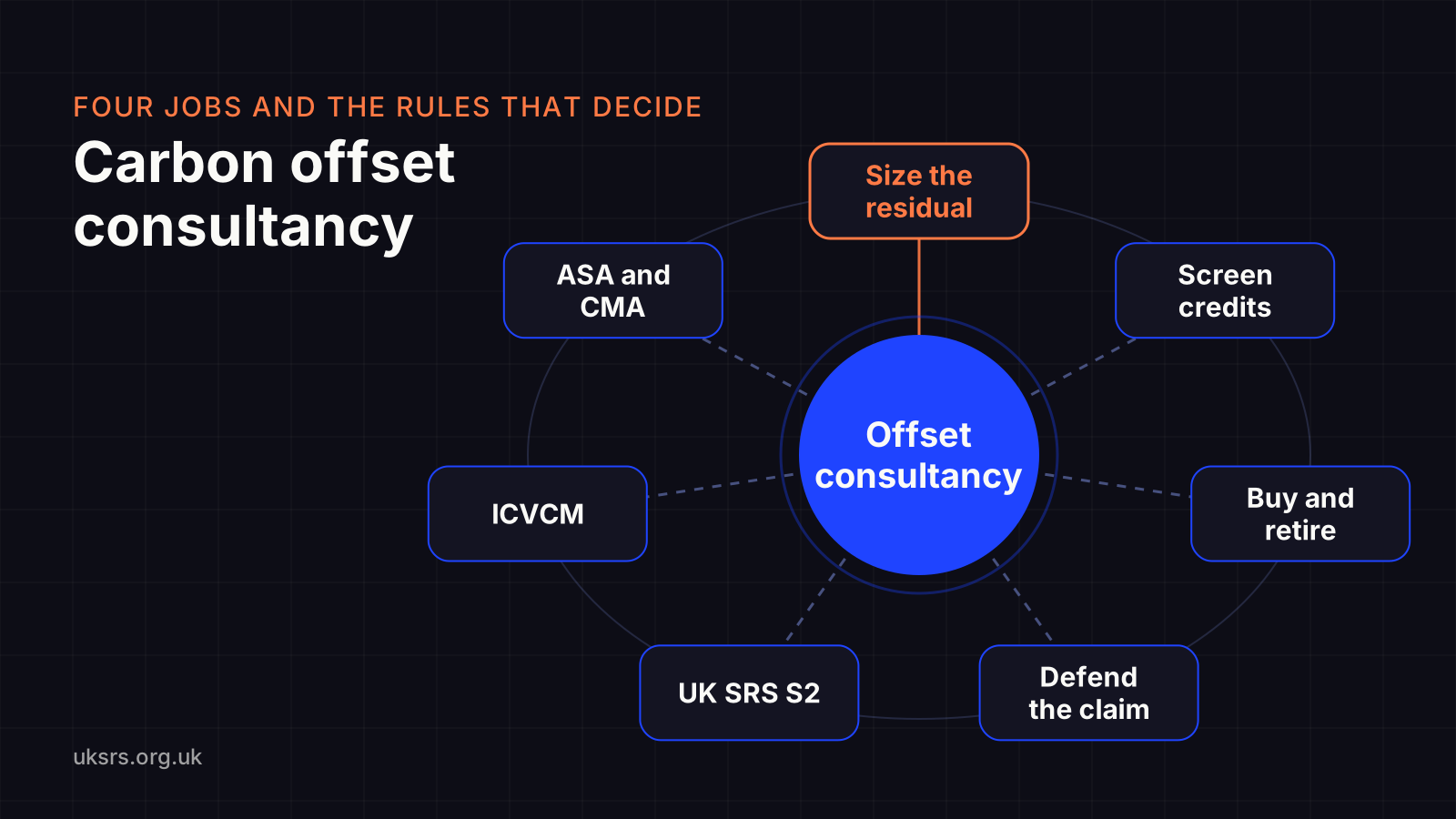
The rules that decide are spread across standards and regulators: UK SRS S2 on reporting, the ICVCM on credit quality, the ASA and the CMA on UK claims, and an EU directive applied from 27 September 2026.
This guide explains the work and the rules; it names no credit seller, ranks no adviser and quotes no price.
The role
Carbon offset consultancy is four jobs: size, screen, buy and defend
A credible carbon offset consultancy engagement starts from the mitigation hierarchy: measure your footprint, reduce what you can, and use credits only for what remains.
The first job is sizing that residual, which needs an inventory; carbon accounting explains the measurement.
The second is screening credits against quality tests: additionality, permanence, robust quantification and no double counting.
The third is buying and retiring them on a registry, with the evidence kept.
The fourth is the claim: what you say in public, and whether it survives the ASA, the CMA and, for EU consumers, EU law.
A carbon offset consultancy that skips the first job and starts at the third is selling credits, not advice.
Planning how credits fit a target over several years is a separate brief, set out on carbon offset strategy consultancy.
Measurement and reduction sit with carbon consultancy; targets and plans with net zero advisers.
Credits never reduce the gross Scope 1, 2 and 3 figures you report under SECR or UK SRS S2.
They are disclosed separately, if at all.
Any adviser who suggests otherwise is a red flag.
Reporting
Credits and reporting: gross, then separately
UK SRS S2 ¶29(a) asks for absolute gross greenhouse gas emissions, by scope, and ¶36(c) requires a net target to be accompanied by its gross target.
SECR contains no netting-off provision, so there is no legal basis for a post-offset SECR figure.
The GHG Protocol Corporate Standard keeps inventory accounting separate from offset projects.
Under ¶36(e), a company with a net emissions target discloses its planned use of credits: how far the target relies on them, which third-party scheme will verify or certify them, their type, and anything else bearing on their credibility.
Only planned use is required; reporting credits already retired is optional context.
A company with no net target has no ¶36(e) disclosure, which is a gap worth knowing about.
The government declined to add UK-specific carbon credit requirements, preferring that any amendment come from the ISSB, according to its consultation response.
The value-chain side is covered on UK SRS Scope 3 reporting and the standard on UK SRS S2; SECR on the SECR reporting guide.
Credit quality
The quality tests, and the trap in the labels
| Test | The question | Where it is set out |
|---|---|---|
| Additionality | Would the reduction or removal have happened without the credit revenue? | ICVCM Core Carbon Principles |
| Permanence | How long is the carbon kept out, and what covers a reversal? | ICVCM; programme rules |
| Robust quantification | Is the baseline credible and the amount conservatively counted? | ICVCM; the methodology |
| No double counting | Is the tonne claimed once only? | ICVCM; the registry |
| Type | Reduction or removal, nature-based or technological? | UK SRS S2 ¶36(e)(iii) |
The ICVCM’s label has two gates: a programme becomes CCP-eligible, and a methodology or category becomes CCP-approved.
So “issued under an eligible programme” says nothing on its own about a particular credit; the methodology is what has to be approved.
Verra’s older REDD+ methodologies were never submitted for assessment, and credits from them cannot carry the label even though Verra is an eligible programme.
In August 2024 the ICVCM rejected eight renewable energy methodologies as insufficiently rigorous in assessing whether projects would have gone ahead without credit revenue.
Other programmes, such as Gold Standard, have their own methodologies to check in the same way.
For UK projects, the Woodland Carbon Code and the Peatland Code share the UK Land Carbon Registry; a Pending Issuance Unit is a promise of a future unit and is not guaranteed.
Ratings agencies publish opinions on individual credits; they are private opinions with no legal effect, and an “AAA” from two providers means two different things.
Independent carbon credit analysis is the subject of a sister reference in this family.
Check your plan
Which rules does your plan engage?
Answer six questions about how you intend to use credits; the panel lists the rules each answer engages, with the provision.
Two apply to everyone: reported emissions stay gross, and the neutrality standards have changed.
The rest depend on whether you report under UK SRS, have a net target, advertise to UK consumers, sell to EU consumers, are FCA-authorised, or have an SBTi target.
The FCA’s anti-greenwashing rule is the one most often misapplied: it reaches authorised firms’ communications about their products and services, not a company’s carbon neutral marketing.
Before you buy credits or make a claim
Credits never reduce the emissions you report.
UK SRS S2 asks for absolute gross Scope 1, 2 and 3 emissions, and SECR has no provision for netting off.
UK SRS S2 ¶29(a), ¶36(c); SI 2008/410 Sch 7
PAS 2060 is withdrawn, and ISO 14068-1:2023 was withdrawn by ISO on 11 September 2026; ISO 14068:2026 replaces it and puts reductions within the value chain ahead of offsetting.
BSI; ISO catalogue records
An ICVCM Core Carbon Principles label attaches to a programme or a methodology, not to an individual credit’s performance.
Check the methodology, not only the registry.
ICVCM
The ASA treats an unqualified “carbon neutral” claim as likely to mislead: CAP Code rule 11.1 says the basis of an environmental claim must be clear.
Say what was measured, what was reduced and what was offset, and with which credits.
The CMA Green Claims Code sets the same expectation.
CAP Code 11.1; CMA Green Claims Code
Not you: ESG 4.3.1R reaches FCA-authorised firms’ communications about products and services, not a company’s own carbon neutral marketing.
FCA Handbook ESG 4.3.1R
A map of the rules, not legal advice.
Nothing you choose is stored or sent.
Claims
Carbon neutral, net zero and what you can say
The ASA’s settled position is that an unqualified “carbon neutral” claim is likely to mislead; CAP Code rule 11.1 says the basis of an environmental claim must be clear.
The CMA’s Green Claims Code sets out six principles, including that claims are truthful, clear, complete and substantiated; it is the CMA’s view of the law, and consumer law has been directly enforceable by the CMA since 6 April 2025.
In the EU, Directive 2024/825 adds to the blacklist a claim, based on offsetting, that a product has a neutral, reduced or positive greenhouse gas impact; Member States were to apply it from 27 September 2026.
The UK has no equivalent blacklist entry, so a pan-European campaign needs two sets of wording.
The neutrality standards have both gone: PAS 2060 is withdrawn, and ISO 14068-1:2023 was withdrawn on 11 September 2026, replaced by ISO 14068:2026, which puts reductions in the value chain ahead of offsetting.
The detail is on PAS 2060 and ISO 14068.
The VCMI Claims Code offers Silver, Gold and Platinum claims after four foundational criteria, and says credits behind them are not counted as internal reductions.
The UK government’s six principles for voluntary carbon and nature markets, published on 15 November 2024, are guidance: use credits in addition to value-chain action, use high-integrity credits, disclose planned use, plan ahead, claim accurately and co-operate.
For targets, the SBTi’s Corporate Net-Zero Standard V2.0, effective 1 February 2027, accounts for market instruments separately from the inventory.
Choosing an adviser
What to ask a carbon offset consultancy
What have we done to reduce, and is the residual we are offsetting stated in tonnes?
For each credit: which programme, which methodology, which vintage, which registry, and is the methodology itself CCP-approved?
Do you earn anything from the credits you recommend, beyond your fee?
What exactly will we be able to say in public, in which markets, and under which standard?
How will our reported emissions stay gross, with credits shown separately?
The broader process of buying from any adviser, not only a carbon offset consultant, is in how to choose a sustainability consultant.
This page names no adviser or seller, quotes no price, and has assessed no one; for an independent reference on the wider subject, the uksrs.org.uk home page is the place to start, or you can book a free 15-minute call.
Test yourself
Six offsetting claims, true or false
Each statement is one a buyer is likely to hear from a seller, and each answer names its source.
The theme of the false ones is a label read as a guarantee: a programme’s eligibility, a withdrawn standard, a VCMI tier.
Offsetting rules: true or false?
Retired credits can reduce the Scope 1 figure in a SECR disclosure.
A Verra-issued credit carries the ICVCM CCP label because Verra is CCP-eligible.
UK SRS S2 requires every company to disclose the credits it bought last year.
The UK government’s voluntary carbon market principles are binding.
PAS 2060 certification can still be obtained.
VCMI’s Platinum claim is the same as a carbon neutral claim.
0 of 6 answered.
Nothing you choose is stored or sent.
Frequently asked
Carbon offset consultants, answered
What does a carbon offset consultant do?
A carbon offset consultant helps an organisation work out which residual emissions it intends to address with credits, screen credits against quality tests, buy and retire them, and document any claim so it survives the ASA, the CMA and, for EU consumers, Directive 2024/825.
The good ones start by asking what you have done to reduce first.
Do UK reporting rules require carbon offsets?
No. SECR and UK SRS S2 ask for gross emissions, and credits cannot be netted against them.
UK SRS S2 asks a company with a net emissions target to disclose its planned use of credits; a company with no net target has no credit disclosure under ¶36(e).
Do carbon offsets really work?
It depends on the credit.
The tests are additionality, permanence, robust quantification and no double counting.
The ICVCM rejected eight renewable energy methodologies in 2024 as insufficiently rigorous on additionality, and Verra’s older REDD+ methodologies were never put forward for its label.
Check the methodology, not just the registry.
How much does carbon offsetting cost in the UK?
This site quotes no credit prices and no adviser fees.
Prices are set by sellers and vary with the type and quality of credit; ask any seller for the project, methodology, vintage and registry of each credit before comparing prices.
Can we call ourselves carbon neutral?
Only with care.
The ASA treats unqualified carbon neutral claims as likely to mislead; say what was measured, reduced and offset.
PAS 2060 is withdrawn and ISO 14068-1:2023 was withdrawn on 11 September 2026 in favour of ISO 14068:2026.
For product claims to EU consumers based on offsetting, Directive 2024/825 applies from 27 September 2026.
Does the FCA anti-greenwashing rule apply to our carbon neutral claim?
Only if you are an FCA-authorised firm describing your financial products or services.
ESG 4.3.1R does not reach an ordinary company’s marketing; the CMA, under consumer law, and the ASA do.
Which carbon offset standards matter in the UK?
For UK projects, the Woodland Carbon Code and the Peatland Code, which share the UK Land Carbon Registry.
Internationally, programmes such as Gold Standard and Verra.
The ICVCM’s Core Carbon Principles label programmes and methodologies, not individual credits.
What is the leading carbon offset company in the UK?
This site does not rank credit sellers or consultants.
Ratings agencies publish opinions on individual credits, and those opinions have no legal effect; two agencies’ grades do not mean the same thing.
Should I hire an offset consultant or a broader carbon consultancy?
If offsetting is part of a net zero plan, a consultancy covering measurement and reduction usually sees the whole picture.
A specialist makes sense for a large one-off purchase or a claims question.
Either way, ask whether the adviser earns anything from the credits it recommends.
Sources
Primary sources
Every figure, date and status on this page traces to the instrument’s owner.
Secondary commentary is never the source for a number.
- Department for Business and TradeUK SRS S2 (PDF), ¶¶29(a), 36(c), 36(e), B70–B71
Gross emissions, and the planned use of carbon credits for a net target.
- Department for Business and TradeUK SRS consultation response (PDF), §1.45
The government declined UK-specific carbon credit requirements.
- Greenhouse Gas ProtocolCorporate Standard
Inventory accounting, kept separate from offset projects.
- legislation.gov.ukSI 2008/410 Schedule 7 (SECR)
No netting-off provision.
- ICVCMThe Core Carbon Principles
Ten principles; programme eligibility and methodology approval.
- VCMIClaims Code of Practice (April 2025, v3.0)
Silver, Gold and Platinum claims and their foundational criteria.
- Department for Energy Security and Net ZeroPrinciples for voluntary carbon and nature market integrity
Six non-binding principles, 15 November 2024.
- Competition and Markets AuthorityGreen Claims Code
Six principles; the CMA’s view of the law.
- ASA / CAPCAP Code section 11, environmental claims
Rule 11.1: the basis of an environmental claim must be clear.
- EUR-LexDirective (EU) 2024/825, Annex I point 4c
Offset-based product neutrality claims blacklisted; applied from 27 September 2026.
- Financial Conduct AuthorityFCA Handbook ESG 4.3 — the anti-greenwashing rule
Applies to authorised firms’ communications about products and services.
- Science Based Targets initiativeCorporate Net-Zero Standard V2.0 release
Market instruments accounted for separately; effective 1 February 2027.
- BSI KnowledgePAS 2060 product record
Withdrawn.
- ISOISO 14068:2026 (Carbon neutrality)
Replaces ISO 14068-1:2023, withdrawn 11 September 2026.
- Woodland Carbon CodeWoodland Carbon Code
UK woodland removals; Pending Issuance Units are promises, not guarantees.
- Gold StandardGold Standard
An international crediting programme.
- VerraVerra (Verified Carbon Standard)
An international crediting programme; legacy REDD+ methodologies were not put forward for CCP assessment.
Continue reading
Read next
PAS 2060 and ISO 14068
The neutrality standards and what replaced them.
Carbon footprint consultants
Measure before you offset.
Net zero consultants
Targets, plans and where credits fit.
Carbon offset strategy consultancy
Whether, when and how much to offset.
Sustainability consulting firms
Selection criteria tied to the law, and an unranked A–Z directory.