Set the boundary and method once, then run the inventory each year to the GHG Protocol or ISO 14064-1.
Refresh conversion factors annually: DESNZ sets each year’s factors for activity data that falls mostly within that year.
Ask direct questions about your own reporting — your thresholds, your dates, what you file and when.
Sign up free →The standards
Does it apply to you
Reporting under it
WHY REGISTER
Ask these pages about your own company.
Free · no card
Everything on this site stays open without an account.
Start here
Dates and penalties
Doing it
WHY REGISTER
Ask these pages about your own company.
Free · no card
Everything on this site stays open without an account.
What you must file
Doing it
WHY REGISTER
Ask these pages about your own company.
Free · no card
Everything on this site stays open without an account.
The UK duty
Doing it
WHY REGISTER
Ask these pages about your own company.
Free · no card
Everything on this site stays open without an account.
The baseline
Europe
Reporting more widely
WHY REGISTER
Ask these pages about your own company.
Free · no card
Everything on this site stays open without an account.
Carbon markets and trade
Packaging and net zero
Carbon accounting
WHY REGISTER
Ask these pages about your own company.
Free · no card
Everything on this site stays open without an account.
Choosing
Carbon
Compliance and offsets
WHY REGISTER
Ask these pages about your own company.
Free · no card
Everything on this site stays open without an account.
Software
Templates
Careers
WHY REGISTER
Ask these pages about your own company.
Free · no card
Everything on this site stays open without an account.
ASK ABOUT YOUR OWN REPORTING
Ask direct questions about your own reporting — your thresholds, your dates, what you file and when.
Sign up freeFree · one email · already registered? Log in
Everything on this site stays open without an account.
Carbon management · the cycle, the owner, the data
Make carbon management a repeatable operating cycle. Connect the inventory to targets, funded actions, reporting and a handover your own team can maintain.
UK SRS is an independent reference site. We have assessed no consultancy and publish no consultancy prices or rankings.
The job
Carbon management consultancy is about the process, not one output: the method, the data, the people and the dates that let the inventory and the plan repeat.
A carbon management consultant designs that process, runs it alongside you for a first cycle, and hands it over.
The deliverables are a method statement, a map of who supplies which data, the controls on it, a reporting calendar and readiness for an independent check.
The measure of success is that next year’s cycle runs without the consultancy.
A carbon footprint is one inventory for one year.
A carbon reduction plan is the projects that cut it.
Carbon management is the machine that does both every year, with an owner, a method and a calendar.
Module 01 / 04
Module 02 / 04
Module 03 / 04
Module 04 / 04
Which service
Footprint: Establish the measured emissions boundary. Reduction: Develop and deliver practical measures.
| Service | What it delivers | Time frame | Read |
|---|---|---|---|
| Carbon footprint consultancy | One Scope 1, 2 and 3 inventory with a documented boundary and method | One reporting period | Carbon footprint consultants |
| Carbon reduction consultancy | A plan and projects that cut emissions against a baseline | A plan horizon, often years | Carbon reduction consultants |
| Carbon management consultancy | The system: owner, method, data flows, controls, calendar and verification readiness | Every year, indefinitely | This page |
| Carbon offset strategy | Whether, when and how much to use credits, and what you can claim | Alongside the plan | Offset strategy |
If you need a first number, you want a footprint; if you need projects, you want reduction advice.
If you have both and the second year looks as hard as the first, the gap is management, and that is what this page is about.
Broader compliance work is covered on carbon consultancy.
Module 01 / 04
Module 02 / 04
Module 03 / 04
Module 04 / 04
The loop
Data: Close and check the source records. Inventory: Calculate and reconcile the emissions.
Set the boundary and method once, then run the inventory each year to the GHG Protocol or ISO 14064-1.
Refresh conversion factors annually: DESNZ sets each year’s factors for activity data that falls mostly within that year.
3 scopes in a gross inventory
A target turns the inventory into a direction, and tracking it is where the yearly work lives.
Under the applicable V1.3.1 absolute-contraction method, minimum near-term ambition is 4.2% a year for Scope 1 and 2 and 2.5% for Scope 3. These are method-specific rates, not a universal pathway for every company or target route.
4.2% SBTi minimum near-term rate a year, Scope 1 and 2
Reductions happen in sites, fleets and purchasing, so their owners sit in operations, not in the reporting team.
Carbon management connects them: each project is tied to a line of the inventory so next year’s figure shows whether it worked.
The same inventory feeds SECR in the directors’ report, a Carbon Reduction Plan for public contracts and, for listed companies, UK SRS from 2027.
Reported emissions are gross under UK SRS S2, so credits never reduce the figure.
Verification to ISO 14064-3 or assurance to ISSA 5000 tests whether the figures can be traced to evidence.
It is optional for SECR and UK SRS, and required for a UK ETS installation.
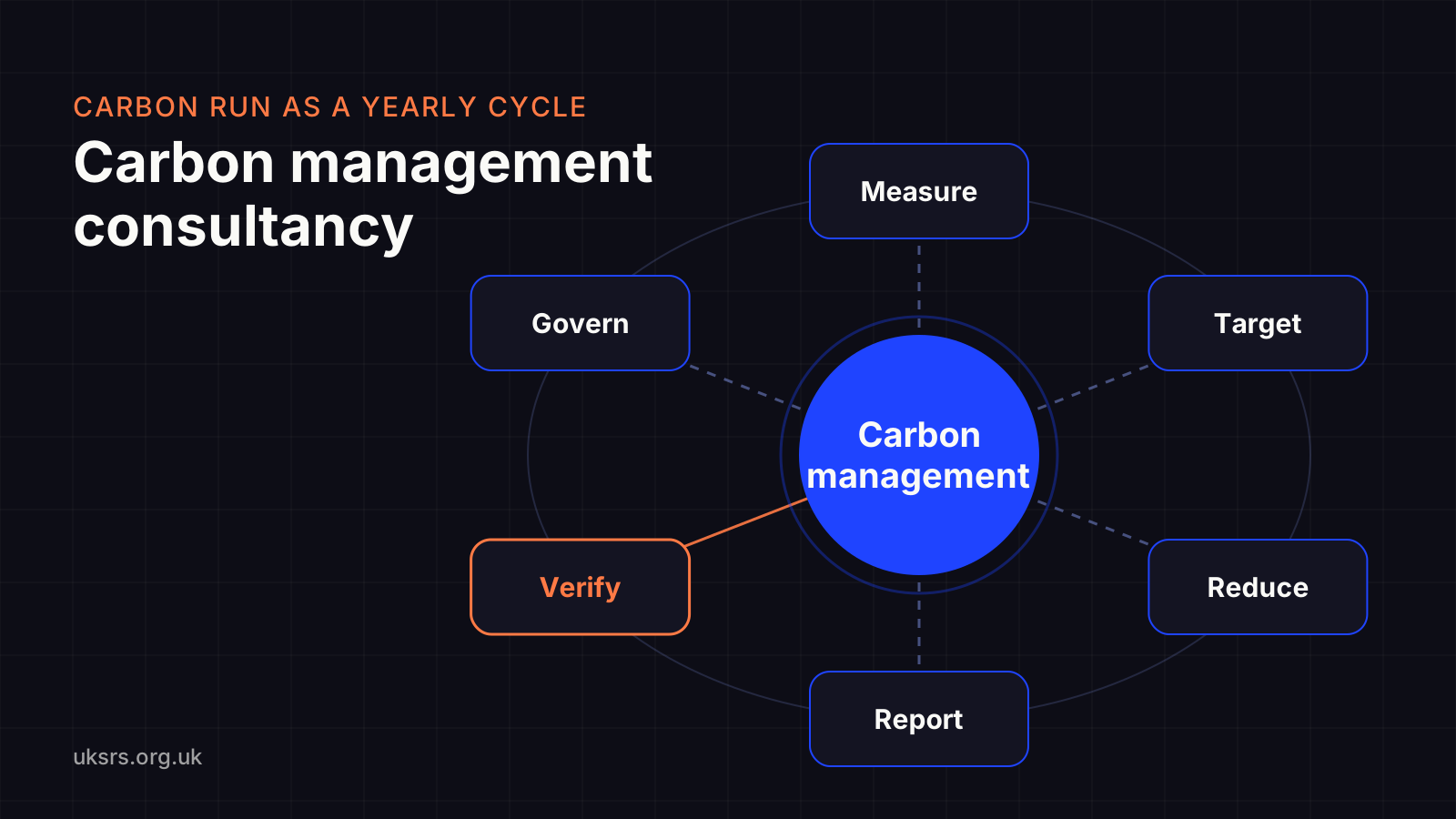
Each stage feeds the next, and the loop closes when next year’s inventory shows whether this year’s projects worked.
Close and check the source records.
Calculate and reconcile the emissions.
Review progress and update priorities.
Publish the applicable disclosures.
Ownership
Name one owner for the cycle, and a data owner for each source: energy bills, fuel cards, refrigerants, travel and the spend lines behind Scope 3.
SECR sits in the directors’ report under Schedule 7, so the board owns the words even where an adviser drafts them.
For listed companies in UKLR 6, 14, 15, 16 and 22, PS26/19 makes UK SRS comply or explain for periods beginning on or after 1 January 2027, and an explanation is itself a governance decision.
A Carbon Reduction Plan for a public contract above £5 million a year covers Scope 1, Scope 2 and five Scope 3 categories, so its owner needs those lines every year.
Write the calendar down: when data is collected, when factors are refreshed, who reviews, who signs and when the report is filed.
The in-house roles that usually own this are described on ESG manager and head of sustainability.
Module 01 / 04
Module 02 / 04
Module 03 / 04
Module 04 / 04
Systems
Boundary: Keep entities and activities consistent. Records: Name each source and owner.
| Option | Who calculates | Audit trail | Fits when |
|---|---|---|---|
| Spreadsheet | Your team | As good as your version control and notes | One entity, a handful of sources, a named owner |
| Carbon accounting software | Your team, in the tool | Built in, if evidence is attached at entry | Many sites or entities, or verification planned |
| Consultant-run model | The adviser | Theirs unless the contract hands it over | A first cycle, or a one-off rebuild of the method |
Whichever you choose, the test is the same: could someone outside the team trace a reported figure back to its source document?
Factors change every year: the 2026 conversion factors were published on 11 June 2026, and the next set is due in June 2027.
Ask any adviser who owns the model and the files at the end, because a consultant-run model you cannot open is a recurring fee.
Tools are compared on carbon accounting software and carbon reporting software, and data controls on ESG data management.
Module 01 / 04
Module 02 / 04
Module 03 / 04
Module 04 / 04
What reporting changes
The government’s own evaluation of SECR shows the gap between reporting carbon and managing it.
79% of compliers published data they otherwise would not have, but only 25% said SECR led them to use less energy.
The same evaluation measured 19,900 organisations in scope and a mean ongoing compliance cost of £7,100 a year, including 94 hours of internal staff time.
Closing the gap between those bars is the work a carbon management consultancy is hired to do: turning a disclosure into decisions that change next year’s number.
What SECR asks for is on the SECR reporting guide.
Module 01 / 04
Module 02 / 04
Module 03 / 04
Module 04 / 04
Independent check
ISO 14064-1:2018 covers how an organisation quantifies and reports its emissions, is programme neutral, and is marked by ISO as both confirmed in 2024 and to be revised.
ISO 14064-3:2019 covers verification and validation of a GHG statement, and ISO 14065:2020 sets requirements for the bodies that do it.
The IAASB’s ISSA 5000 applies to periods beginning on or after 15 December 2026, and the withdrawal of ISAE 3410 takes effect from the same date.
The FRC issued ISSA (UK) 5000 on 12 November 2025 for voluntary use.
Under ISSA (UK) 5000, a limited assurance conclusion says only that nothing came to the practitioner’s attention, which is not a statement that the figures are right.
For SECR there is no statutory requirement to have the information audited, according to the Environmental Reporting Guidelines, and PS26/19 ¶2.45 does not require UK SRS assurance either.
A UK ETS installation is the exception: its verifier must be accredited by UKAS to ISO 14065, and UKAS accredits bodies, never consultants.
The standards side by side are on GHG verification standards, the method on the GHG Protocol and assurance on sustainability assurance.
Module 01 / 04
Module 02 / 04
Module 03 / 04
Module 04 / 04
Buy or build
Tell the planner which duties apply, who owns carbon today, where the data lives and whether you will seek assurance.
For each stage of the cycle it suggests whether to build the capability, buy a first cycle and hand over, or keep the work independent, with the provision behind it.
The rule underneath is simple: buy what ends and build what repeats.
The one stage you should never buy from the same firm that built your inventory is the independent check, because the IESBA standards restrict self-review.
Plan your operating model
Run it in-house, and refresh the conversion factors each year: DESNZ sets them for activity data that falls entirely or mostly within that year.
DESNZ 2026 conversion factors methodology ¶1.10
Target-setting happens once and is revisited rarely, so it is a good use of an adviser; but if the target is to be science-based, only SBTi Services validates it.
SBTi Corporate Net-Zero Standard V1.3.1
Reductions are made by the people who run sites, fleets and purchasing, so ownership sits inside the business; buy technical appraisal of specific projects.
Your own operations
SECR goes in the directors’ report, so the words are the directors’, and the format repeats from year to year.
SI 2008/410 Sch 7
There is no statutory requirement to have SECR information audited or assured, and no UK SRS assurance duty either; it is a choice.
Environmental Reporting Guidelines Ch. 1; FCA PS26/19 ¶2.45
Rules of thumb built from the provisions named, not advice on your case.
Nothing you choose is stored or sent.
Module 01 / 04
Module 02 / 04
Module 03 / 04
Module 04 / 04
Calendar
Close: Collect the period's final records. Calculate: Complete and reconcile the inventory.
A managed cycle has fixed dates, and several of the standards it rests on change over the next two years.
Module 01 / 04
Module 02 / 04
Module 03 / 04
Module 04 / 04
Before you call anyone
Brief a carbon management consultancy for a system, not a report: name the duties, the entities and the year you want to run unaided.
Ask for the deliverables by name: method statement, data owner map, controls, calendar and a handover plan.
Ask for days by grade and for year two priced in the same proposal, so you can see the handover in the numbers.
Ask who owns the model and files at the end, and whether the firm will also offer to assure the figures it builds.
The government’s £7,100 is the only independent cost benchmark here, and it is for SECR alone; this site quotes no price of its own and ranks no firm.
The wider buying process is in how to choose a sustainability consultant, or you can book a free 15-minute call.
Module 01 / 04
Module 02 / 04
Module 03 / 04
Module 04 / 04
Illustrative brief · no consultancy assessed
Make repeatability part of this year’s engagement. A new preparer should be able to understand the boundary, source records, calculation changes and action register.
For the detailed requirements, see carbon footprint consultancy.
Named source owners and a complete evidence index.
Editable calculations and versioned assumptions.
The next close, review and reporting responsibilities.
Each date has a different meaning
Check who the date applies to and whether it is publication, application, submission or a planned milestone.
A suggested delivery sequence
This is an editorial buying and preparation sequence, not a statutory timetable or a promise about how long the engagement takes.
Frequently asked
Carbon management is running greenhouse gas emissions as a managed system rather than a one-off report: measuring each year, setting and tracking targets, delivering reductions, reporting where required and, if you choose, having the figures verified.
It needs an owner, a method, data that can be traced and a calendar.
A carbon management consultant helps build that system: the boundary and method, the data flows and controls, the target and its tracking, the reporting calendar and readiness for verification.
The good ones design for handover, so that next year’s cycle runs without them.
No. A carbon footprint is one inventory for one period.
Carbon management is the process that produces that inventory every year and acts on it, including targets, reductions, reporting and verification.
Not always.
A spreadsheet can work for one entity with a handful of sources; software helps when there are many sites or entities, when you need a clear audit trail for verification, or when conversion factors must be refreshed across many lines each year.
Mostly not.
There is no statutory requirement to audit or assure SECR information, and the FCA does not require assurance of UK SRS disclosures.
A UK ETS installation is different: its emissions report must be verified by a verifier accredited by UKAS to ISO 14065.
ISO 14064-1:2018 specifies how an organisation quantifies and reports its greenhouse gas emissions and removals, and it is programme neutral.
It was confirmed in 2024 and is also marked by ISO as to be revised, with a successor under development.
ISO 14064-3:2019 covers verification and validation.
This site gives no price of its own.
The only independent figure is the government’s: its 2026 evaluation measured a mean ongoing SECR compliance cost of £7,100 a year, internal and external together.
Buy what ends and hire what repeats.
A consultant suits the first boundary and method, a target, a system choice or an explanation under comply or explain; the annual cycle itself is repeat work that an in-house owner usually runs better.
They should not.
The ethics standards for sustainability assurance bar an assurer from taking management responsibility for a client and generally prohibit self-review services for public interest entities.
Choose the assurer separately.
Sources
Every figure, date and status on this page traces to the instrument’s owner.
Secondary commentary is never the source for a number.
The inventory method UK SRS S2 points to.
Consultation estimated Q2 2027; revised standard estimated Q4 2028.
Organisation-level quantification; programme neutral; current and under revision.
Verification and validation of GHG statements.
Requirements for bodies that validate and verify environmental information.
Absolute gross Scope 1, 2 and 3 emissions.
Comply or explain across UK SRS for periods from 1 January 2027.
Assurance not required; if obtained, the provider is named.
Energy and carbon content of the directors’ report.
19,900 in scope; £7,100 mean ongoing cost; what reporting changed.
No statutory requirement to audit or assure environmental information.
Published 11 June 2026.
Use the set for the year the activity data falls in.
Effective for periods beginning on or after 15 December 2026.
Takes effect from ISSA 5000’s effective date.
Reasonable and limited assurance conclusions.
ISSA (UK) 5000 issued for voluntary use.
Management responsibility and self-review.
Verifier accredited by UKAS to ISO 14065.
Scope 1, Scope 2 and five Scope 3 categories; contracts above £5 million a year.
Minimum near-term rates of 4.2% (Scope 1 and 2) and 2.5% (Scope 3) a year.
Continue reading
One inventory, done properly.
Plans and projects that cut emissions.
ISO 14064-3, ISSA 5000 and who can verify.
Energy efficiency, heat, electrification, fleet and renewable power.
Selection criteria tied to the law, and an unranked A–Z directory.