Streamlined Energy and Carbon Reporting · buying help
SECR consultancy UK
Establish whether SECR applies before buying support. Then build the energy and emissions working, narrative disclosures and approval trail for the annual report.
UK SRS is an independent reference site. We have assessed no consultancy and publish no consultancy prices or rankings.
The work
What an SECR consultancy actually does
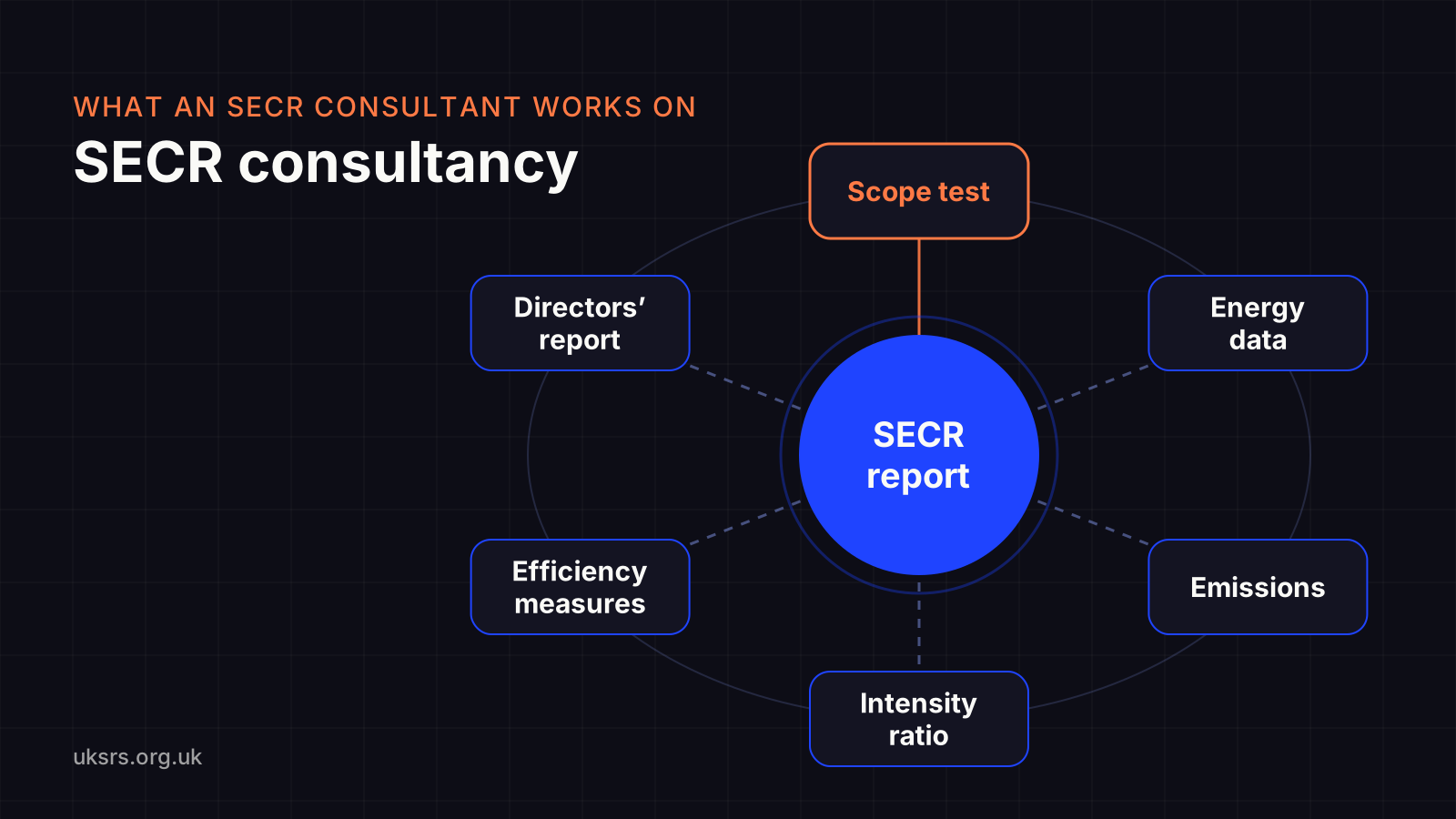
An SECR consultant runs the scope test, gathers meter and fuel data, applies the government conversion factors and calculates the emissions.
The consultant then proposes an intensity ratio, drafts the methodology statement and the energy efficiency wording, and lays out last year’s comparatives.
Read the detailed guidance and references
Good SECR consultancy ends with a working file you keep, so next year can be repeated by anyone.
Whatever the badge on the proposal, SECR reporting consultancy is the same job, and it can be judged against the same paragraphs.
The disclosure itself is explained line by line in the SECR reporting guide.
The board approves the directors’ report, and the duty stays with the company whoever prepared the figures.
Source: CA 2006 s.419(1)
Module 01 / 04
Scope note
Module 02 / 04
Calculation
Module 03 / 04
Narrative
Module 04 / 04
Handover
Do you need one?
Outside help, software or your finance team
The law names no credential for SECR, and the 2019 guidelines say there is no statutory requirement to have the figures assured.
The government’s 2026 evaluation found a mean ongoing cost of £7,100 a year, and 56% of complying organisations had external costs on top of staff time.
Read the detailed guidance and references
So many companies do it themselves, often on a platform compared in SECR reporting software.
An SECR consultancy is most useful in the first year, for a group with many subsidiaries, or where the method will be read closely.
If you are also caught by ESOS, the same meter data feeds both, and the overlap is set out in ESOS versus SECR.
Module 01 / 04
Applicability
Module 02 / 04
Data
Module 03 / 04
Calculation
Module 04 / 04
Reporting
The scope test
The test, run over two years
A quoted company reports at any size, and a company traded only on AIM is unquoted.
An unquoted company is exempt if it meets two or more of: turnover not more than £36 million, balance sheet not more than £18 million, not more than 250 employees (paragraph 20B).
Read the detailed guidance and references
After the first year, one year across the line changes nothing: status moves only when the new position holds for two consecutive years.
An SECR consultancy that tests one year alone will get every company near the line wrong.
Employees are the monthly average of persons employed, not full-time equivalents, and the balance sheet total is gross assets.
A parent tests its group on £36 million net or £43.2 million gross turnover and £18 million net or £21.6 million gross balance sheet (paragraph 20C).
The Companies Act size limits rose in April 2025, but the amending regulations left SECR’s own table alone.
The SECR scope test · two years, not one
This year the figures meet 1 of the three conditions: balance sheet not more than £18m.
One year over the limits does not bring an exempt company into scope: it stays exempt this year and comes in only if next year is over the limits too.
Two of the three conditions are enough for the exemption, and a figure exactly at a limit meets it.
SI 2008/410 Sch 7 ¶20B(1)–(2)
Employees are the monthly average of persons employed, not full-time equivalents.
A reading of the test, not legal advice.
Nothing you enter leaves your browser.
Module 01 / 04
Quoted company
Module 02 / 04
Unquoted company
Module 03 / 04
Group
Module 04 / 04
Energy relief
The figures
Four numbers in the instrument
Activity: Fuel, electricity and required transport inputs. Factors: Source, year and conversion units.
Read the detailed guidance and references
Meeting two of the first three is enough for an unquoted company to be exempt.
Module 01 / 04
Activity
Module 02 / 04
Factors
Module 03 / 04
Calculation
Module 04 / 04
Intensity
The disclosure
What the report must contain
Energy: Disclose the relevant consumption. Emissions: Report the required emissions lines.
Read the detailed guidance and references
| Item | Quoted company | Unquoted company | LLP |
|---|---|---|---|
| Emissions | Fuel combustion and facilities; purchased electricity, heat, steam and cooling | Gas combustion and transport fuel; purchased electricity | As for unquoted companies |
| Energy | Total kWh, with the UK and offshore share | UK energy in kWh | UK energy in kWh |
| Intensity ratio | At least one (¶17) | At least one (¶20G) | At least one |
| Methodology | Stated (¶16) | Stated (¶20F) | Stated |
| Efficiency measures | Principal measures, if any were taken (¶15(3D)) | Principal measures, if any were taken (¶20D(4)) | As for unquoted companies |
| Where it goes | Directors’ report | Directors’ report | A separate energy and carbon report |
Each year after the first also shows last year’s figures as they were disclosed.
Where some information is not practical to obtain, an unquoted company may leave it out, but the report must say what is missing and why.
The directors may move SECR matters into the strategic report under section 414C(11).
SECR asks for no target, no transition plan and no Scope 3 beyond transport fuel for unquoted companies.
A worked layout is on the SECR report template.
The content depends on which of the three populations you are in, and a consultant who sends one template for all three has not read the Schedule.
Module 01 / 04
Energy
Module 02 / 04
Emissions
Module 03 / 04
Method
Module 04 / 04
Action
The low-energy relief
40,000 kWh: a relief with a condition
A company that used 40,000 kWh of energy or less may omit the energy and emissions figures, but only if the report states that this is why.
For unquoted companies and LLPs the energy is UK energy; for quoted companies the paragraph has no UK qualifier.
Read the detailed guidance and references
It is relief from disclosure, not from SECR, so silence is not compliance.
The test runs on all energy consumed, which is wider than the energy an unquoted company has to report.
The provisions are summarised on the SECR overview.
Module 01 / 04
Low energy
Module 02 / 04
Impracticability
Module 03 / 04
Group
Module 04 / 04
Record
Timing
Your filing date is your deadline
SECR has no deadline of its own, because it sits in the directors’ report filed with the accounts.
A private company files nine months after its year end and a public company six months after, under section 442.
Read the detailed guidance and references
Companies House says a deadline falling on a weekend or bank holiday does not move.
The 2026 conversion factors were published on 11 June 2026, so a December year end has them in hand well before drafting starts.
Brief an SECR consultant early enough for the board to read a draft, not on the eve of approval.
- Year endThe reporting period closesThe energy and emissions period normally matches the financial year, and the report says so if it does not.Sch 7 ¶20I
- Before filingThe board approves the directors’ reportA director or the company secretary signs it on the board’s behalf.CA 2006 s.419(1)
- + 6 monthsPublic company filing deadlineThe SECR figures go to Companies House with the annual report.CA 2006 s.442(2)
- + 9 monthsPrivate company and LLP filing deadlineIt does not move for a weekend or a bank holiday.CA 2006 s.442(2); Companies House
Module 01 / 04
Collect
Module 02 / 04
Calculate
Module 03 / 04
Review
Module 04 / 04
Approve
How the figures travel
From meter to Companies House
Inputs: Invoices, meters and relevant activity data. Working: Factors, conversions and calculations.
Read the detailed guidance and references
- kWh
- factor applied
- tonnes
- ratio stated
- approved report
Gas, electricity and transport fuel for an unquoted company; a quoted company covers fuel, facilities and purchased electricity, heat, steam and cooling.
The 2019 guidelines prefer dual reporting of electricity emissions and encourage the location-based method for anyone not doing both.
Credits play no part in the figures, which stay gross.
Every SECR figure takes the same route, and each step has a provision behind it.
- 1
Inputs
Invoices, meters and relevant activity data.
- 2
Working
Factors, conversions and calculations.
- 3
Review
Checks, changes and approval records.
- 4
Report
The required annual-report disclosures.
Before you call anyone
Briefing an SECR consultancy
Give the figures the test uses for this year and last, and the group structure if there is one.
List the sites, the energy suppliers and the fleet arrangements, because transport fuel is where data goes missing.
Read the detailed guidance and references
Name the year end, the filing date and the date the board will approve the report.
Attach last year’s disclosure, so the comparatives and the ratio carry over.
Ask for the deliverable in writing: the table, the methodology, the efficiency wording and the working file.
Ask for days by grade, and whether the same people will do year two.
For several duties at once, start from carbon compliance consultancy instead.
Module 01 / 04
Boundary
Module 02 / 04
Data
Module 03 / 04
Deliverable
Module 04 / 04
Handover
Before you sign
Seven checks on the draft
Whoever prepares the figures, the board signs them, so these checks are worth running on any draft.
Each one is a point where published reports go wrong, and each names the paragraph that settles it.
Read the detailed guidance and references
Tick them as you go; nothing is saved or sent.
Two or more “not more than” conditions exempt the company, and one year across the line changes nothing after the first year.
A quoted company, an unquoted company and an LLP each report a different set of figures under a different provision.
The 2026 factors are for activity data falling entirely or mostly within 2026.
The law asks for emissions against a quantifiable factor, so an energy-per-employee figure alone does not meet it.
The comparative is last year’s figure as published, and a restated figure can sit beside it but not replace it.
The low-energy relief and the practicality relief each work only if the report states what was left out and why.
Next year’s comparatives and any FRC question will need the calculation, not just the published table.
Module 01 / 04
Size
Module 02 / 04
Energy
Module 03 / 04
Transport
Module 04 / 04
Assurance
Enforcement and change
Who checks, and what may change
The FRC is the body authorised to apply to court over a defective directors’ report.
Its operating procedures say every case to date has been resolved voluntarily, without a court order.
Read the detailed guidance and references
The government’s 2026 review recommends keeping SECR with amendments, and plans a consultation on streamlining that has decided nothing yet.
The instrument behind it all is SI 2018/1155, in force since 1 April 2019.
If an energy assessment is also due, the ESOS lead assessor is a separate appointment with a named credential, covered in choosing an ESOS assessor.
Module 01 / 04
Directors
Module 02 / 04
Consultant
Module 03 / 04
Evidence
Module 04 / 04
Review
Illustrative brief · no consultancy assessed
A worked brief: a company has just changed accounting size
Do not assume the accounting-size change resolves SECR applicability. The SECR test has its own thresholds and combinations; record that assessment before buying reporting work.
For the detailed requirements, see SECR requirements.
View the workflow diagram
- 1
Scope
Apply the self-contained SECR exemption test.
- 2
Working
Use the correct reporting boundary and energy records.
- 3
Disclosure
Approve required figures and explanations.
Each date has a different meaning
The relevant dates, in order
Check who the date applies to and whether it is publication, application, submission or a planned milestone.
- Periods from 1 April 201901
- Periods from 6 April 202502
Accounting thresholds change; SECR does not
The accounting-size uplift leaves SECR’s own £36m/£18m/250 exemption test unchanged. - Activity year 202603
Select the matching factor set
A later filing date does not change which activity year was measured. - Your annual-report timetable04
A suggested delivery sequence
From the brief to the handover
This is an editorial buying and preparation sequence, not a statutory timetable or a promise about how long the engagement takes.
- 01 / Scope01
Scope
Record applicability and any exemption decision. - 02 / Inputs02
Inputs
Collect the required energy and activity records. - 03 / Working03
Working
Calculate emissions, intensity and comparatives. - 04 / Draft04
Draft
Prepare methodology and efficiency disclosures. - 05 / Approval05
Approval
Review, approve and retain the annual-report working.
Frequently asked
SECR consultants, answered
What does an SECR consultant do?
An SECR consultant runs the scope test, gathers energy and fuel data, applies the government conversion factors, calculates emissions, proposes an intensity ratio, drafts the methodology and energy efficiency wording, and hands over the working file.
The directors still approve the report and remain responsible for it.
Do I need an SECR consultant?
Not by law.
No credential is required to prepare a SECR disclosure, and the figures need not be assured.
Many companies use software or their finance team, and buy outside help in the first year, for a group, or when the method needs a second pair of eyes.
Who has to comply with SECR?
Quoted companies at any size, and unquoted companies and LLPs that do not meet two or more of these conditions: turnover not more than £36 million, balance sheet not more than £18 million, not more than 250 employees.
After the first year, status changes only when the new position holds for two consecutive years.
Did the 2025 company size changes move the SECR thresholds?
No. The Companies Act size limits rose for financial years beginning on or after 6 April 2025, but SECR has its own table in Schedule 7, which the change did not touch.
A company can now be medium-sized for its accounts and still in SECR scope.
Is there a SECR exemption below 40,000 kWh?
There is a disclosure relief, not an exemption.
A company that used 40,000 kWh of energy or less may leave out the figures, but only if the report says that is why.
For unquoted companies and LLPs the energy counted is UK energy.
When is the SECR report due?
With the annual report, because SECR sits in the directors’ report.
A private company files nine months after its year end and a public company six months after.
The deadline does not move for a weekend or bank holiday.
Does SECR have to be audited or assured?
No. There is no statutory requirement to have SECR figures assured; the 2019 guidelines recommend it as good practice.
The auditor reports only on whether the directors’ report is consistent with the accounts and prepared in line with the law.
How much does SECR consultancy cost?
This site publishes no prices and does not estimate fees.
The government’s 2026 evaluation measured a mean ongoing compliance cost of £7,100 a year, internal and external together, and found that 56% of complying organisations had external costs.
What is the penalty for not complying with SECR?
SECR has no penalty of its own.
For companies, a non-compliant directors’ report is caught by the Companies Act offences for approving it, and the FRC can apply to court for a revised report, though it says no such application has ever been needed.
LLPs have offences attached to the energy and carbon report itself.
Sources
Primary sources
Every figure, date and status on this page traces to the instrument’s owner.
Secondary commentary is never the source for a number.
- legislation.gov.ukSI 2008/410 Schedule 7, Parts 7 and 7A
What quoted and unquoted companies must report, and the low-energy reliefs.
- legislation.gov.ukSI 2008/410 Schedule 7 paragraph 20B
The exemption test, the two-year rule and how each limb is measured.
- legislation.gov.ukSI 2008/410 Schedule 7 paragraph 20C
The group test, on net or gross figures.
- legislation.gov.ukSI 2008/410 Schedule 7 Part 7A
The unquoted company disclosures, the practicality relief and the comparatives.
- legislation.gov.ukSI 2008/1911 regulation 12B
The LLP energy and carbon report and its thresholds.
- legislation.gov.ukSI 2018/1155 — the instrument that created SECR
In force from 1 April 2019.
- legislation.gov.ukSI 2024/1303 regulation 5
The 2025 size uplift omitted Parts 3 and 4 of Schedule 7, not Part 7A.
- legislation.gov.ukCompanies Act 2006, section 414C
SECR matters may sit in the strategic report.
- legislation.gov.ukCompanies Act 2006, section 442
Nine months for private companies, six for public companies.
- Companies HouseLate filing penalties
A weekend or bank holiday deadline does not move.
- Defra / BEISEnvironmental Reporting Guidelines including SECR guidance (2019)
No statutory requirement for assurance; dual Scope 2 reporting preferred.
- Department for Energy Security and Net ZeroGreenhouse gas reporting: conversion factors 2026
Published 11 June 2026, with SECR kWh factors.
- Department for Energy Security and Net Zero2026 conversion factors methodology paper, ¶1.10
Factors are for activity data falling entirely or mostly within 2026.
- Department for Energy Security and Net ZeroIndependent evaluation of SECR (2026)
19,900 in scope; mean ongoing cost of £7,100 a year.
- Department for Energy Security and Net Zero2026 Post-Implementation Review of the SECR Regulations 2018
Retain with amendments; a consultation on streamlining is planned.
- FRCCorporate Reporting Review operating procedures
All cases resolved without a court order to date.
Continue reading
Read next
The reporting guide
The disclosure, line by line.
A worked template
A layout to adapt for your directors’ report.
All six duties
Which obligations apply, and who may do each.
ESOS consultants
The approved registers and the independence test for sign-off.
ISO 14001 consultant
What a consultant does, and what the certification body must not.
Sustainability consulting firms
Selection criteria tied to the law, and an unranked A–Z directory.