Carbon footprint consultants · the work, the rules, the checks
Carbon footprint consultancy UK
Decide whether you need an organisation, product or project footprint. Ask for the boundary, method, calculation file and assumptions before comparing consultancy proposals.
UK SRS is an independent reference site. We have assessed no consultancy and publish no consultancy prices or rankings.
The deliverable
What carbon footprint consultancy delivers: one number and its file
The output of carbon footprint consultancy is a greenhouse gas inventory: your emissions for one year, in tonnes of CO2 equivalent.
It is split into Scope 1, the fuel you burn and the gases you release; Scope 2, the energy you buy; and Scope 3, everything else in your value chain, which the Scope 3 Standard divides into fifteen categories.
Read the detailed guidance and references
The total is the small part of what you are buying.
The part that lasts is the calculation file: the boundary decisions, the emission factors, the data trail and the written method that a verifier will work back through.
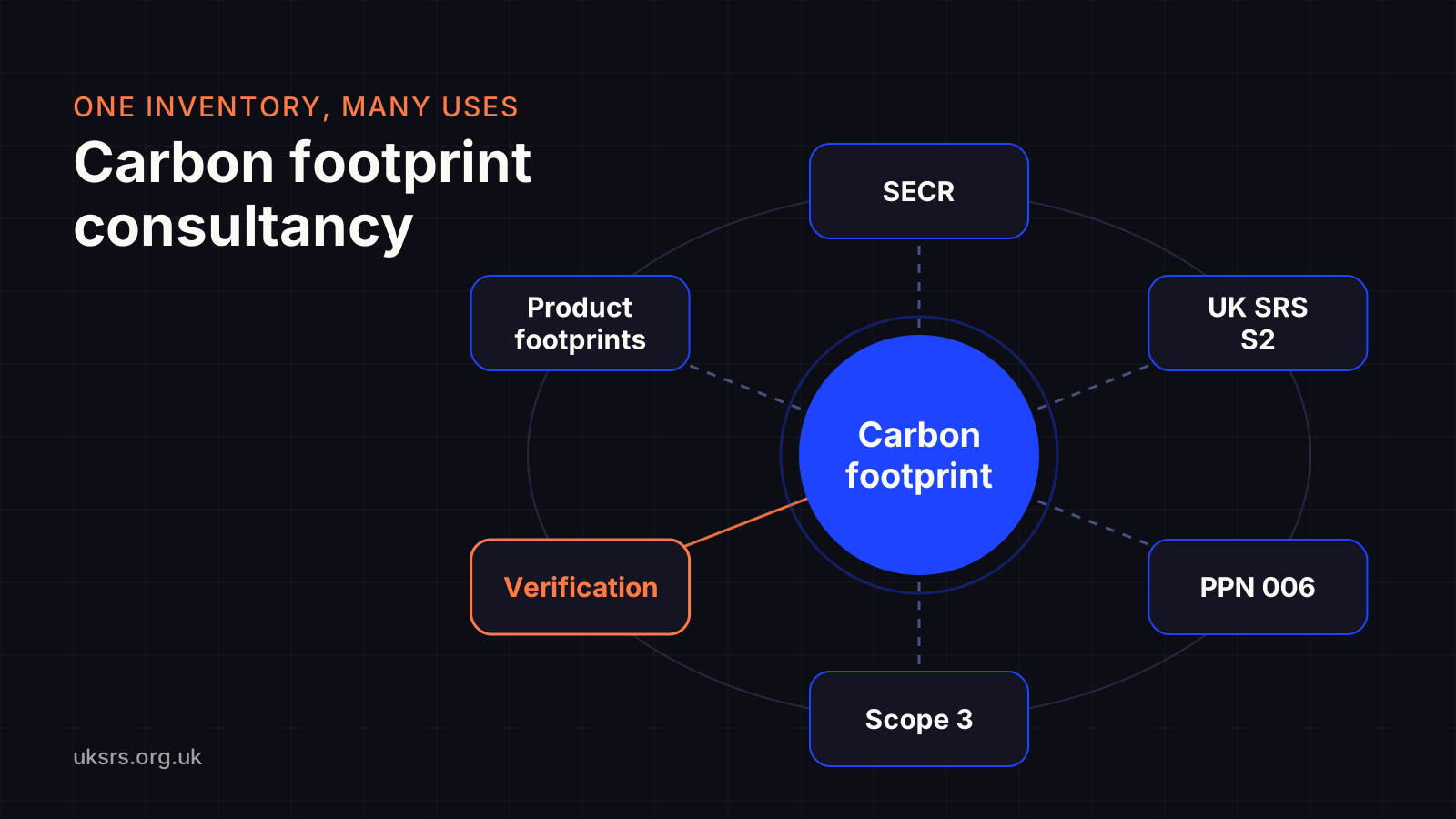
That file is reused every year, by a SECR disclosure, by UK SRS S2 climate metrics, by a CDP response and by any target you set.
A boundary or factor choice made badly in year one therefore resurfaces as a restatement later.
This is also why the question “what do we own at the end?” matters more than the price of the first year.
If the file stays in a provider’s system, you have bought a subscription rather than an inventory.
Measurement is one discipline in a wider market: the carbon consultancy guide covers reduction and compliance work, and the net zero consultancy guide covers targets and transition plans.
The inventory for a named year, in tonnes of CO2 equivalent, by scope.
A written boundary: which entities, sites and activities are in, and why.
The methodology, the emission factor release used for each line, and the data sources.
The calculation file itself, in a form another provider could pick up next year.
Module 01 / 04
Boundary
Module 02 / 04
Period
Module 03 / 04
Method
Module 04 / 04
Working
Standards in motion
The methodology underneath is moving
Three things a footprint rests on changed in 2026, and a proposal written before them can be out of date.
The first is carbon neutrality: BSI stopped delivering the PAS 2060 scheme from 1 January 2025, the last opinions were issued by the end of 2025, and ISO then withdrew ISO 14068-1:2023 on 11 September 2026 with the successor ISO 14068 still under publication as checked on 10 October 2026.
Read the detailed guidance and references
BSI’s own record of the UK adoption, BS ISO 14068-1:2023, is where the 24-month PAS 2060 transition was set out; check any neutrality proposal against the ISO record, which now shows the 2023 edition withdrawn.
The second is the GHG Protocol itself, which on 29 July 2026 set out a development plan to publish a single co-branded corporate standard with ISO, with an integrated public consultation planned for Q2 2027.
No revised standard exists yet, and the 2004 Corporate Standard and 2011 Scope 3 Standard stay in effect until one does.
The third is the emission factors: DESNZ published the 2026 conversion factors on 11 June 2026 and corrected values in the flat file on 31 July 2026.
DESNZ says each year’s factors are for activity data that falls entirely or mostly within that year, so a 2026 inventory uses the 2026 set.
Ask any provider which factor release each line uses, and how the file will be restated when the combined GHG Protocol and ISO standard is published.
Targets moved too: the SBTi published its Corporate Net-Zero Standard V2.0 on 11 June 2026, general corporate validation opens 1 February 2027; the V2.0 guide sets out the transition.
- 1 Jan 2025BSI stops delivering PAS 2060
Opinions could still be completed until the end of 2025.
- 11 Jun 2026SBTi Corporate Net-Zero Standard V2.0 published
General corporate V2.0 validation opens 1 February 2027; V1.3.1 submissions remain open until 31 January 2028.
- 11 Jun 2026UK conversion factors 2026 published
Flat file corrected on 31 July 2026.
- 29 Jul 2026GHG Protocol and ISO plan one corporate standard
Integrated public consultation planned for Q2 2027.
- 11 Sep 2026ISO 14068-1:2023 withdrawn
The successor ISO 14068, Carbon neutrality, remains under publication.
- 1 Jan 2027UK SRS reporting periods begin
Listed companies in scope, comply or explain.
Module 01 / 04
Accounting
Module 02 / 04
Factors
Module 03 / 04
Targets
Module 04 / 04
Change
What the rules ask for
Which footprint do you need?
There is no single UK “carbon footprint” duty, and the regimes that touch emissions each ask for something different.
SECR is the oldest: a quoted company reports global Scope 1 and 2 emissions and energy use, and a large unquoted company or LLP reports UK energy use, Scope 1 and 2 and the transport fuel element of Scope 3, under Schedule 7 of SI 2008/410.
Read the detailed guidance and references
A company that used 40,000 kWh of energy or less may leave the figures out, but only by saying in the report that this is why.
The SECR reporting guide covers the disclosure in full, and SECR covers who is in scope.
For listed companies, the FCA’s final rules in PS26/19 require reporting against UK SRS on a comply-or-explain basis for accounting periods beginning on or after 1 January 2027, with first reports in 2028.
They replace the consultation, CP26/5, which had proposed UK SRS S2 as mandatory; the final rules put all of UK SRS on comply or explain.
UK SRS S2 ¶29(a) asks for absolute gross Scope 1, 2 and 3 emissions, measured in accordance with the GHG Protocol Corporate Standard.
In the first year a company may use the Scope 3 relief, and if it does it says so and need explain no further.
Whether a company is caught at all depends on its listing category, not its size, as UK SRS thresholds explains; the two standards are set out on UK SRS S1 and S2.
Government procurement asks for a third shape: PPN 006 asks bidders for in-scope contracts worth more than £5 million a year for a Carbon Reduction Plan covering Scope 1 and 2 and five named Scope 3 categories.
That is a condition of participation set by the contracting authority, not a legal duty on the company.
ESOS is about energy rather than carbon, but it runs on the same meter data; the ESOS Phase 4 guide and ESOS compliance guidance cover it.
Which footprint do you need?
UK energy use and the related Scope 1 and 2 emissions, plus the transport-fuel element of Scope 3, an intensity ratio and an efficiency narrative.
The 40,000 kWh-or-less relief applies to UK energy and only if the report states it.
Verification: No legal assurance requirement.
SI 2008/410 Sch 7 Part 7A, ¶20D(7)(a)
A map of what the rules ask, not legal advice.
Nothing you tick is stored or sent.
Module 01 / 04
Organisation
Module 02 / 04
Product
Module 03 / 04
Building
Module 04 / 04
Finance
Scope 3
The fifteen categories, and where quotes differ
Screen: Assess the relevant value-chain categories. Collect: Choose data appropriate to each activity.
Read the detailed guidance and references
| No. | Category | Note |
|---|---|---|
| 1 | Purchased goods and services | Often estimated from spend at first and refined with supplier data later. |
| 2 | Capital goods | Lumpy from year to year, which is why the baseline year matters. |
| 3 | Fuel- and energy-related activities | The upstream of the fuel and electricity in Scopes 1 and 2. |
| 4 | Upstream transportation and distribution | Inbound logistics; one of the five PPN 006 categories. |
| 5 | Waste generated in operations | One of the five PPN 006 categories. |
| 6 | Business travel | One of the five PPN 006 categories. |
| 7 | Employee commuting | One of the five PPN 006 categories. |
| 8 | Upstream leased assets | Only where not already counted in Scope 1 or 2. |
| 9 | Downstream transportation and distribution | Outbound logistics you do not pay for; one of the five PPN 006 categories. |
| 10 | Processing of sold products | Intermediate goods only. |
| 11 | Use of sold products | Material for anything that uses energy in use. |
| 12 | End-of-life treatment of sold products | Rests on stated assumptions about disposal. |
| 13 | Downstream leased assets | Assets you own and lease to others. |
| 14 | Franchises | Reported by the franchisor. |
| 15 | Investments | For financial institutions, financed emissions, usually measured with the PCAF standard. |
Assessing all fifteen and explaining why some are not relevant is the defensible position.
Counting the easy categories and saying nothing about the rest is the weak one, and a verifier will notice the silence.
UK SRS gives a listed company a year’s relief on Scope 3, which is time to build the data rather than a reason to defer it.
Supplier data is where most Scope 3 effort goes, and a consultant can design the method and the model but cannot make suppliers answer.
The GHG Protocol guide covers the standards themselves.
Two quotes for “a carbon footprint” usually differ because they cover different Scope 3 categories.
Ask each provider which of the fifteen it will assess, and which it expects to treat as not relevant and why.
Module 01 / 04
Screen
Module 02 / 04
Collect
Module 03 / 04
Estimate
Module 04 / 04
Improve
Credentials
“Accredited to ISO 14064” is not a thing anyone can be
The commonest claim in this market describes nothing, because accreditation and certification are different acts.
A consultancy is not accredited to a standard; it works to one.
Read the detailed guidance and references
What can be accredited is a body: in the UK, UKAS accredits validation and verification bodies against ISO/IEC 17029, with ISO 14065 as the greenhouse gas scheme.
Bodies accredited only to the old ISO 14065:2013 route had to move to ISO/IEC 17029 by 30 June 2024.
So “ISO 14064 accredited” means one of three things: the firm builds inventories to ISO 14064-1, which is a method and not a credential; an accredited body verified a client’s statement, which is the client’s credential; or nothing at all.
The check takes a minute: ask for the verification body’s UKAS schedule number, look it up, and read what the schedule covers.
A schedule names its standards and scope, and a body accredited for corporate inventories is not thereby accredited for product footprints.
The same discipline applies to badges: a CDP Accredited Solutions Provider is accredited by CDP for its own programme, and SBTi Services, which validates targets, says it does not offer consultation services.
What were you actually told?
Choose the words a provider used about itself.
Nothing selected yet.
Nothing you choose is stored or sent.
Module 01 / 04
Gross inventory
Module 02 / 04
Reduction
Module 03 / 04
Credits
Module 04 / 04
Public wording
Verification
The firm that builds it should not verify it
Verification is a separate engagement, with a separate supplier, and most buyers learn this after paying for the inventory.
The verifier does not re-run your calculation; it tests whether the boundary is defensible, the method consistent, the factors the right release and the data trail sufficient.
Read the detailed guidance and references
Independence is the reason to separate the two: for sustainability assurance, the IESBA standards prohibit a practitioner from assuming management responsibility for a client in any way, and generally prohibit a non-assurance service that creates a self-review threat for a public interest entity.
For any other client the standards require the threat to be evaluated and safeguarded, so the right question is not “are you allowed to?” but “what threats does this create, and what safeguards apply?”.
The standards are changing too: the IAASB’s ISSA 5000 applies to periods beginning on or after 15 December 2026, and ISAE 3410 is withdrawn from that date.
The FRC issued ISSA (UK) 5000 on 12 November 2025 for voluntary use, with the same effective date.
Competence is specified as well: ISO 14066 sets competence requirements for validation and verification teams.
None of this is compulsory for SECR: the government’s environmental reporting guidelines say there is no legislative requirement for the figures to be independently assured, and recommend it as good practice.
For a listed company the FCA does not require assurance either, but if it is obtained the report names the provider, the disclosures assured and the standards used; sustainability assurance covers the detail.
The verification standard itself is ISO 14064-3, whose 2019 edition reversed its title to “verification and validation”, which matters when matching old citations.
| Level | What the opinion says |
|---|---|
| Limited assurance | Negative form: nothing has come to the practitioner’s attention suggesting a material misstatement. |
| Reasonable assurance | Positive form: in the practitioner’s opinion the information is fairly stated. |
| None | A legitimate choice for a first baseline year, if it is described as unverified. |
Module 01 / 04
Criteria
Module 02 / 04
Scope
Module 03 / 04
Evidence
Module 04 / 04
Conclusion
What it costs
What UK companies spend, measured by the government
No firm on this page publishes a price for carbon footprint consultancy, and this site does not estimate one.
The closest independent measure is the government’s own evaluation of SECR, which surveyed the companies that comply.
Read the detailed guidance and references
The 2026 post-implementation review puts the mean ongoing cost at £7,100 a year, internal and external together.
The underlying evaluation report records about 94 hours of internal staff time, roughly £2,500, and that 56% of compliers incur external costs.
The 2018 impact assessment had forecast £2,300, and the review attributes part of the gap to an error in that assessment’s own costing.
It also found 19,900 organisations in scope against a forecast of 11,300; the review document sets out both.
SECR is not the whole of a carbon footprint, but it is the one measurement of what UK companies pay that does not come from someone selling the service.
Public bodies can buy through the Government Commercial Agency’s Management Consultancy Framework Four, whose Lot 9 covers environment and sustainability and runs to 28 July 2027; its rates are visible to buyers only, so none are repeated here.
When comparing quotes, ask for days by grade and the year-two price in the same proposal.
Module 01 / 04
Boundary
Module 02 / 04
Data
Module 03 / 04
Method
Module 04 / 04
Handover
Product footprints
Product life cycles are a different engagement
A corporate footprint counts an organisation for a year; a product footprint counts one product across its life, from materials to disposal.
That makes it a life cycle assessment, with primary data from suppliers who have no obligation to provide it.
Read the detailed guidance and references
The standards are ISO 14067:2018, which ISO has marked to be revised, and PAS 2050:2011, published by BSI on 30 September 2011.
Verification is separate again, and a body accredited for corporate inventories is not thereby accredited for products.
A firm strong on one kind of footprint is not automatically competent at the other, so ask for an example of the kind you need.
Module 01 / 04
Unit
Module 02 / 04
Boundary
Module 03 / 04
Data
Module 04 / 04
Comparison
Buildings
Whole life carbon and environmental product declarations
Construction has its own discipline: a whole life carbon assessment totals a building’s embodied carbon, from materials and construction, with its operational and end-of-life impacts.
The RICS professional statement, Whole life carbon assessment, 2nd edition, has been mandatory for RICS members since 1 July 2024, and departures must be recorded in the assessment.
Read the detailed guidance and references
It binds RICS members as a professional obligation; there is no legal requirement in England to assess or limit the whole-life carbon of a building, and the industry’s “Part Z” is a proposal, not law.
The product data underneath is an environmental product declaration built to BS EN 15804, the core rules for construction products.
This work is usually bought from a building consultancy or a construction life cycle specialist rather than from a corporate inventory provider.
Module 01 / 04
Materials
Module 02 / 04
Operation
Module 03 / 04
End of life
Module 04 / 04
Working
Method
GHG Protocol or ISO 14064-1, and why the answer is converging
Both are accepted in the UK, and many providers compute under both.
The GHG Protocol Corporate Standard is the basis UK SRS S2 names, and CDP and the SBTi build on it.
Read the detailed guidance and references
ISO 14064-1:2018 is the standard verification attaches to most directly, and ISO has marked it to be revised.
The British adoption carries a different year: ISO 14064-1:2018 is published by BSI as BS EN ISO 14064-1:2019.
The GHG Protocol’s announcement of 29 July 2026 means the two will become one co-branded standard, with consultation planned for Q2 2027 and the revised standard estimated for Q4 2028.
The practical point for 2026 is to ask, in the proposal, how the file will be restated against that standard.
Module 01 / 04
Activity
Module 02 / 04
Factor
Module 03 / 04
Calculation
Module 04 / 04
Review
Financial firms
Financed emissions and the FCA’s data rule
For a bank, insurer or asset manager the largest part of the footprint is Scope 3 category 15, investments, usually measured with the PCAF standard.
That is a larger exercise than an operational footprint, and the green finance guide covers it.
Read the detailed guidance and references
The FCA’s product-level rules changed on 25 September 2026: FCA 2026/59 removed the product report’s five metrics, including weighted average carbon intensity, from ESG 2.3.
In-scope asset managers and owners keep the entity-level TCFD report and must now provide Scope 1, 2 and 3 data on request under ESG 2.3.5AR, once a year per product.
Portfolio carbon intensity is therefore reported by the firm itself, if at all, rather than bought from a footprint consultant.
Module 01 / 04
Portfolio
Module 02 / 04
Attribution
Module 03 / 04
Data quality
Module 04 / 04
Disclosure
Build or buy
When you may not need a consultant at all
Many organisations build their own Scope 1 and 2 inventory on a carbon accounting platform, with no consultancy engagement.
The tools are compared in the carbon reporting software guide and the carbon accounting software guide.
Read the detailed guidance and references
A consultant earns its fee when the boundary spans several entities, Scope 3 categories are material and hard to measure, the numbers will be verified, or a method choice will be scrutinised by someone who is not on your side.
A common pattern is a consultant-built baseline year, then in-house delivery on a platform, with outside review when something material changes: an acquisition, a disposal or a new factor release.
The DESNZ figures support the point that in-house time is real work: 94 hours a year on average for SECR alone.
Professional bodies publish technical material for in-house teams, including the ICAEW and ACCA.
Module 01 / 04
Data owners
Module 02 / 04
Consultant
Module 03 / 04
Reviewer
Module 04 / 04
Handover
Before you sign
The questions that separate proposals
Send every provider on your shortlist the same written questions; the differences in the answers tell you more than the differences in price.
Which standard and edition, and how will the file be restated when the GHG Protocol and ISO publish their combined standard?
Read the detailed guidance and references
Which conversion factor release, for which year of activity data?
Which of the fifteen Scope 3 categories, and why are any left out?
Who verifies, under whose accreditation, or is no verification included?
What do we own at the end, and in what format?
What does year two cost, in this proposal?
The panel turns your answers into a draft brief you can copy, and the guide to choosing a consultant covers the rest of the process.
If the driver is ESOS, the lead assessor is a separately registered role; the ESOS consultants and assessors guide explains how to check one.
Write the brief
A starting draft, not advice. It names no provider.
Nothing you choose or type is stored or sent.
Module 01 / 04
Purpose
Module 02 / 04
Boundary
Module 03 / 04
Output
Module 04 / 04
Acceptance
Who offers the work
Carbon footprint consultancy firms, A to Z
The panel lists, alphabetically, firms whose own sites describe carbon footprint consultancy or carbon accounting work.
Each is described only from its own site as read on 1 October 2026.
Read the detailed guidance and references
This site has assessed none of them, takes no fee for listing, and has no commercial relationship with any.
Some are consultancies, some are software platforms with advisers, and one says it is now part of another group; read each firm’s own description before shortlisting.
Commercial studies such as Verdantix’s Green Quadrant on sustainability consulting assess firms against their authors’ own criteria; they are not reproduced here.
The wider market, including firms with no carbon specialism, is mapped in the sustainability consultancy guide, and governance and social scope sits with an ESG consultant.
Firms, in alphabetical order
11 of 11 firms shown.
Alphabetical; the order means nothing.
- Achilles
In its own words, summarised: Supply chain risk management: supplier risk, contractor and site compliance and carbon impact, using verified data, monitoring and independent assurance.
- Anthesis Group
In its own words, summarised: A sustainability consulting group that describes guiding clients through an end-to-end sustainability journey.
- Carbon Trust
In its own words, summarised: Climate transition work with businesses, governments, financial institutions and philanthropies, across and within sectors.
- ClimatePartner
In its own words, summarised: A platform for carbon accounting across Scopes 1 to 3, reports for SBTi and CSRD, climate projects and climate labels, with advisory support.
- EcoAct (now SE Advisory Services)
In its own words, summarised: EcoAct’s site says it is now SE Advisory Services, Schneider Electric’s global consulting practice, covering climate strategy and decarbonisation.
- ERM
In its own words, summarised: Sustainability consulting and advisory: corporate sustainability, net zero and climate change, and renewable energy.
- Greenly
In its own words, summarised: A platform to measure, report and reduce a company’s and its products’ carbon footprint, including greenhouse gas assessments and life cycle assessment.
- Inspired
In its own words, summarised: Energy buying and management alongside sustainability reporting and compliance support.
- Normative
In its own words, summarised: A carbon accounting platform for Scope 1, 2 and 3 emissions, with a named climate strategy adviser on each account.
- Plan A
In its own words, summarised: Carbon accounting software to measure, report and reduce a corporate carbon footprint.
- South Pole
In its own words, summarised: Climate consulting, carbon credits and project development: reporting, net zero planning, renewable procurement and Scope 3 work.
Each description was read on the firm’s own site on 1 October 2026.
This site has assessed none of these firms, has no commercial relationship with any of them, and lists them in no order of merit.
Module 01 / 04
Relevant work
Module 02 / 04
Method
Module 03 / 04
Evidence
Module 04 / 04
Independence
Neighbouring work
What sits outside the inventory
Buying credits and making a neutrality claim is a different purchase from a carbon footprint consultant, with different diligence, covered in the carbon offset consultant guide.
The standards for neutrality claims, and why PAS 2060 has gone, are set out on PAS 2060 and ISO 14068.
Read the detailed guidance and references
Forward-looking work — targets, transition plans and capital allocation — takes the footprint as an input and does not produce one.
Many firms sell both, which can be convenient, but price the footprint separately: it is the one part of the programme with an objective standard behind it.
If you are not sure you have to report at all, start with UK SRS thresholds and SECR before you pay anyone to measure.
To talk the question through, you can book a free 15-minute call.
Module 01 / 04
Reporting
Module 02 / 04
Reduction
Module 03 / 04
Targets
Module 04 / 04
Management
Illustrative brief · no consultancy assessed
A worked brief: a manufacturer needs a company and a product footprint
Write two boundaries in the brief. The organisational inventory and product life-cycle study answer different questions and need their own units, data and assumptions.
For the detailed requirements, see life cycle assessment.
View the workflow diagram
- 1
Organisation
Entities, activity year and inventory boundary.
- 2
Product
Functional unit and life-cycle stages.
- 3
Handover
Separate calculation files and method notes.
Each date has a different meaning
The relevant dates, in order
Check who the date applies to and whether it is publication, application, submission or a planned milestone.
- 11 June 202601
- 31 July 202602
Flat-file correction
Unavailable values were restored to blanks; do not read them as zero. - Q2 2027 / planned03
GHG Protocol consultation drafts
The development plan is an estimated work programme, not an operative standard. - Q4 2028 / planned04
Final revised standards
Timing may change; do not adopt draft methods as current requirements.
A suggested delivery sequence
From the brief to the handover
This is an editorial buying and preparation sequence, not a statutory timetable or a promise about how long the engagement takes.
- 01 / Boundary01
Boundary
Agree the subject, period, units and exclusions. - 02 / Inputs02
Inputs
Collect activity records and identify missing information. - 03 / Calculation03
Calculation
Document factors, methods and assumptions. - 04 / Review04
Review
Check the working and explain uncertainty. - 05 / Handover05
Handover
Retain the inventory and editable calculation evidence.
Frequently asked
Carbon footprint consultants, answered
What does a carbon footprint consultant do?
A carbon footprint consultant builds a greenhouse gas inventory: an organisation’s emissions for one year, in tonnes of CO2 equivalent, split into Scope 1, Scope 2 and the categories of Scope 3.
The part worth paying for is the file behind the number — the boundary, the methodology, the emission factors and the data trail — because SECR, UK SRS S2, CDP and target-setting all reuse it.
Is a carbon footprint a legal requirement in the UK?
For some organisations, part of one is.
SECR requires quoted companies and large unquoted companies and LLPs to report energy use and Scope 1 and 2 emissions in their annual reports.
Listed companies in scope of the FCA’s final rules report against UK SRS S2, including Scope 3, on a comply-or-explain basis for periods beginning on or after 1 January 2027.
Bidders for central government contracts above £5 million a year are asked for a Carbon Reduction Plan.
How much does a carbon footprint cost in the UK?
No provider’s price is reproduced here, and none of the firms listed publishes one.
The best independent figure is the government’s: its 2026 review of SECR found a mean ongoing compliance cost of £7,100 a year, internal and external together, with 94 hours of internal staff time and 56% of compliers paying for outside help.
Ask every shortlisted provider for a written, scoped quote with year two priced in.
Can a consultancy be accredited to ISO 14064?
No. ISO 14064-1 is the method an inventory is built to.
In the UK, UKAS accredits verification bodies against ISO/IEC 17029 with ISO 14065 as the greenhouse gas scheme.
A firm that says it is ISO 14064 accredited either means it works to the standard, or that a client’s statement was verified by an accredited body.
Can the consultant who builds my footprint also verify it?
They should not, and independence rules exist to stop it.
For sustainability assurance, the IESBA standards bar a practitioner from assuming management responsibility for a client and generally prohibit a self-review service for a public interest entity.
Choose the verifier separately, and check its UKAS schedule covers the work.
Is PAS 2060 still valid?
No new PAS 2060 opinions can be issued.
BSI stopped delivering the scheme from 1 January 2025 and the last opinions were issued by the end of 2025.
An older opinion remains valid for the period it covered.
Its successor, ISO 14068-1:2023, was itself withdrawn by ISO on 11 September 2026 and is being replaced by ISO 14068:2026.
When does Scope 3 reporting become mandatory for UK companies?
Under the FCA’s final rules it does not become mandatory: listed companies in scope report against UK SRS, Scope 3 included, on a comply-or-explain basis for periods beginning on or after 1 January 2027, and may use a one-year Scope 3 relief by saying so.
SECR’s only Scope 3 element is the transport fuel limb for large unquoted companies and LLPs.
GHG Protocol or ISO 14064-1 — which should a UK footprint use?
Both are accepted, and UK SRS S2 asks for emissions measured in accordance with the GHG Protocol Corporate Standard (2004).
The two are converging: the GHG Protocol and ISO plan a single co-branded corporate standard, with public consultation planned for Q2 2027.
Until a revised standard is published the 2004 Corporate Standard and the 2011 Scope 3 Standard stay in effect.
Who verifies a product carbon footprint to ISO 14067?
A verification body whose UKAS schedule covers product footprints.
Accreditation for corporate inventories does not extend to products, so read the schedule rather than the firm’s description of itself.
Which certification body offers SECR support?
None, because SECR has no certification or accreditation scheme.
The company reports in its own directors’ report, and the law does not require the figures to be independently assured; the government’s guidance recommends assurance as good practice.
Do I need a consultant, or can we build a footprint in-house?
Many organisations build their own with carbon accounting software, particularly for Scope 1 and 2.
A consultant earns its fee where the boundary covers several entities, Scope 3 categories are material and hard to measure, the numbers will be verified, or a methodology choice will be scrutinised by someone who is not on your side.
Sources
Primary sources
Every figure, date and status on this page traces to the instrument’s owner.
Secondary commentary is never the source for a number.
- Financial Conduct AuthorityPS26/19 final rules (PDF)
The final listed-company reporting rules, including the required UK SRS disclosures and explanations.
- SBTi ServicesSBTi Services operational transition guide, Table 1
General corporate validation: V2.0 opens 1 February 2027; V1.3.1 closes 31 January 2028; new V2.0 submissions from 1 February 2028.
- legislation.gov.ukSI 2008/410 Schedule 7, Parts 7 and 7A (SECR)
What quoted and large unquoted companies report, and the 40,000 kWh-or-less disclosure relief.
- Department for Energy Security and Net Zero2026 Post-Implementation Review of the SECR Regulations 2018
The £7,100 mean ongoing cost, 19,900 organisations in scope and the recommendation to keep SECR.
- Department for Energy Security and Net ZeroIndependent evaluation of SECR (2026), report
The 94 hours of internal time and the 56% of compliers who incur external costs.
- Financial Conduct AuthorityPS26/19: Aligning listed issuers’ sustainability disclosures with international standards
Comply or explain across UK SRS for periods beginning on or after 1 January 2027, and the one-year Scope 3 relief.
- Department for Business and TradeUK SRS S2 Climate-related Disclosures, ¶29(a)
Absolute gross Scope 1, 2 and 3 emissions measured in accordance with the GHG Protocol Corporate Standard.
- Greenhouse Gas ProtocolCorporate Value Chain (Scope 3) Standard
The fifteen Scope 3 categories.
- Greenhouse Gas ProtocolCorporate Standard v3.0 Standard Development Plan, 29 July 2026
The single standard with ISO, consultation planned for Q2 2027.
- Department for Energy Security and Net ZeroGreenhouse gas reporting: conversion factors 2026
Published 11 June 2026; flat file corrected 31 July 2026.
- UKASFind an accredited organisation
Where a verification body’s schedule and scope can be checked.
- BSI KnowledgePAS 2060 — Specification for the demonstration of carbon neutrality
Withdrawn; verification ceased 1 January 2025.
- ISOISO 14068-1:2023 catalogue record
Withdrawn 11 September 2026; successor ISO 14068 is under publication as checked on 10 October 2026.
- BSI KnowledgeBS EN ISO 14064-1:2019 (ISO 14064-1:2018)
Organisation-level quantification and reporting.
- BSI KnowledgeBS EN ISO 14064-3:2019
Verification and validation of greenhouse gas statements.
- BSI KnowledgeBS EN ISO 14067:2018 — carbon footprint of products
Product footprints; ISO marks it to be revised.
- BSI KnowledgePAS 2050:2011
Life cycle greenhouse gas emissions of goods and services, published 30 September 2011.
- BSI KnowledgeISO 14066 — competence of validation and verification teams
What a verification team must be competent in.
- BSI KnowledgeBS EN 15804:2012+A2:2019
Core rules for construction product environmental product declarations.
- RICSWhole life carbon assessment, 2nd edition, in full effect
Mandatory for RICS members from 1 July 2024.
- IAASBISSA 5000 — General Requirements for Sustainability Assurance Engagements
Deals with both limited and reasonable assurance.
- IESBAIESSA Technical Overview (January 2025)
The bar on assuming management responsibility, and the public interest entity self-review rule.
- Cabinet OfficePPN 006 — Carbon Reduction Plans in major government contracts
Scope 1, 2 and five Scope 3 categories above £5 million a year.
- Financial Conduct AuthorityFCA Handbook, ESG 2.3 (product-level reporting)
ESG 2.3.5AR: Scope 1, 2 and 3 data on request, from 25 September 2026.
- Science Based Targets initiativeCorporate Net-Zero Standard V2.0 release
Published 11 June 2026.
- Government Commercial AgencyManagement Consultancy Framework Four (RM6309)
Lot 9, environment and sustainability, to 28 July 2027.
Continue reading
Read next
Carbon offset consultants
Credits, claims and the rules that apply to each.
The SECR reporting guide
What goes in the directors’ report, line by line.
Carbon reporting software
The platforms a footprint is often built in.
Carbon reduction consultancy
From reduction plans to targets, and why cuts come before offsets.
Carbon management consultancy
Carbon run as a yearly cycle, with an in-house handover.
Decarbonisation consultancy
Energy efficiency, heat, electrification, fleet and renewable power.
Sustainability consulting firms
Selection criteria tied to the law, and an unranked A–Z directory.