Name each obligation, its status and the date the strategy has to support.
For a listed company in UKLR 6, 14, 15, 16 or 22, UK SRS is comply or explain for periods from 1 January 2027; for everyone else it is voluntary.
Ask direct questions about your own reporting — your thresholds, your dates, what you file and when.
Sign up free →The standards
Does it apply to you
Reporting under it
WHY REGISTER
Ask these pages about your own company.
Free · no card
Everything on this site stays open without an account.
Start here
Dates and penalties
Doing it
WHY REGISTER
Ask these pages about your own company.
Free · no card
Everything on this site stays open without an account.
What you must file
Doing it
WHY REGISTER
Ask these pages about your own company.
Free · no card
Everything on this site stays open without an account.
The UK duty
Doing it
WHY REGISTER
Ask these pages about your own company.
Free · no card
Everything on this site stays open without an account.
The baseline
Europe
Reporting more widely
WHY REGISTER
Ask these pages about your own company.
Free · no card
Everything on this site stays open without an account.
Carbon markets and trade
Packaging and net zero
Carbon accounting
WHY REGISTER
Ask these pages about your own company.
Free · no card
Everything on this site stays open without an account.
Choosing
Carbon
Compliance and offsets
WHY REGISTER
Ask these pages about your own company.
Free · no card
Everything on this site stays open without an account.
Software
Templates
Careers
WHY REGISTER
Ask these pages about your own company.
Free · no card
Everything on this site stays open without an account.
ASK ABOUT YOUR OWN REPORTING
Ask direct questions about your own reporting — your thresholds, your dates, what you file and when.
Sign up freeFree · one email · already registered? Log in
Everything on this site stays open without an account.
Sustainability strategy consulting · phases and briefs
Build the strategy around material issues and decisions. Turn priorities into targets, funded actions and governance that can track what actually changes.
UK SRS is an independent reference site. We have assessed no consultancy and publish no consultancy prices or rankings.
The work
Issues: Identify what matters to the organisation. Priorities: Choose where to act and why.
| Building block | What you end up with | Where it is read |
|---|---|---|
| Materiality | The topics that matter, with method and evidence | UK SRS S1 ¶¶3, 18; ESRS 1 for groups in CSRD scope |
| Ambition and targets | Targets with gases, scopes, base year and gross or net | UK SRS S2 ¶¶33–36 |
| Transition plan | Actions, resources and dependencies against each target | UK SRS S2 ¶14(a)(iv); UKLR 6.6.6R(8)(e) |
| Governance | A named body with oversight, terms of reference and controls | UK SRS S1 ¶27; UK Corporate Governance Code 2024 |
| Disclosure link | A map from each strategy decision to the paragraph that reports it | UK SRS S1 ¶25 |
Good sustainability strategy consultancy leaves you with decisions the board has taken, not a document the consultant has written.
UK SRS S1 ¶25 organises disclosure around governance, strategy, risk management, and metrics and targets, which is a useful checklist for what a strategy has to settle.
No UK law requires a company to have a sustainability strategy, so the value of the work lies in what it lets the company decide and say.
A sustainability strategy consultant is different from a firm that produces a single report or footprint: the deliverable is a set of choices, with the evidence behind them.
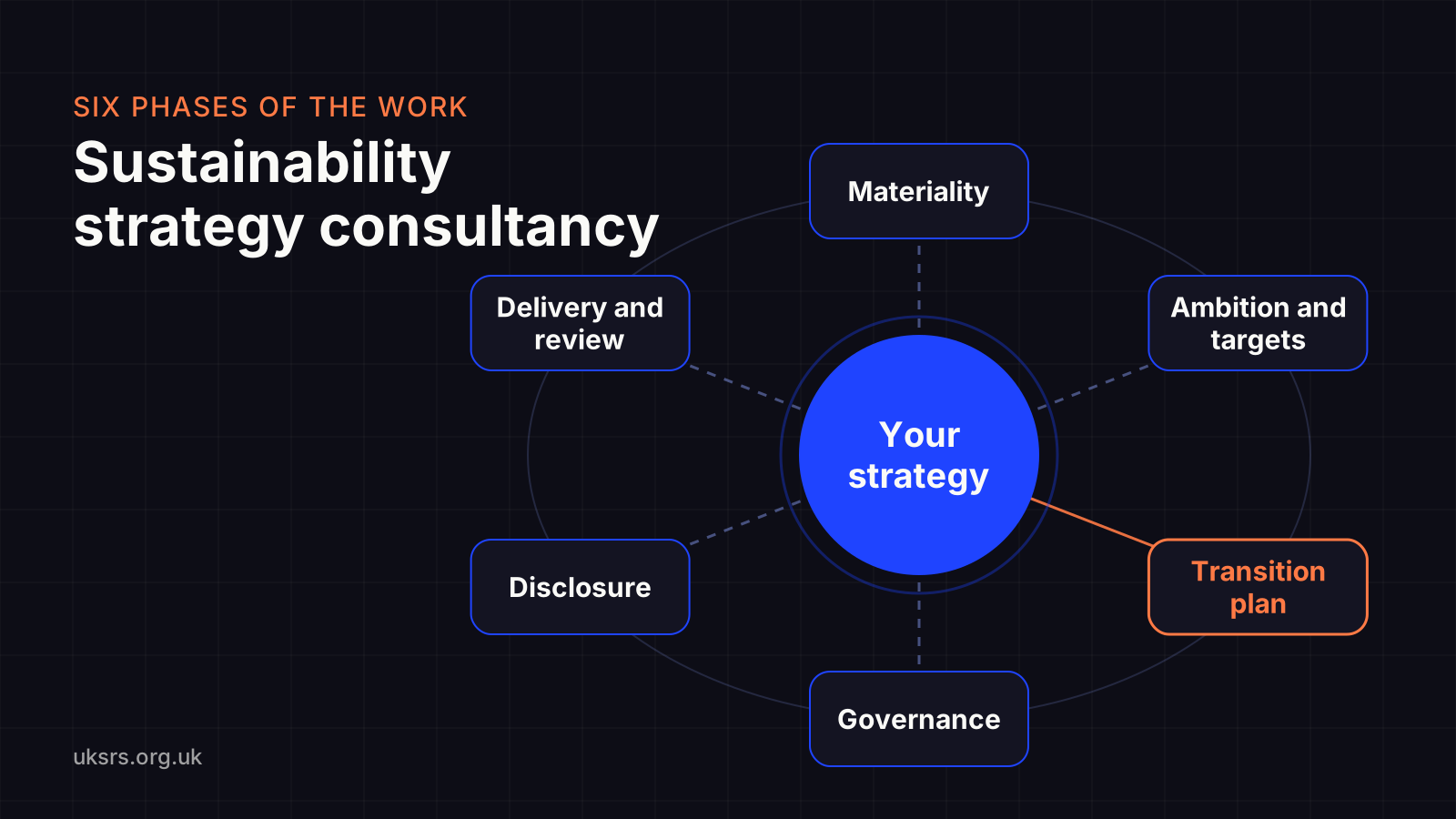
A strategy engagement produces five things a board can approve, and each one is read by a different part of the reporting rules.
Module 01 / 04
Module 02 / 04
Module 03 / 04
Module 04 / 04
Phase by phase
Assess: Understand the business and material issues. Decide: Agree priorities and objectives.
Name each obligation, its status and the date the strategy has to support.
For a listed company in UKLR 6, 14, 15, 16 or 22, UK SRS is comply or explain for periods from 1 January 2027; for everyone else it is voluntary.
Assess which topics could affect cash flows, access to finance or cost of capital, and add impacts if ESRS applies to the group.
The board or a committee approves the result.
Each emissions target states its gases, its scopes and whether it is gross or net, counting from a baseline inventory.
The board decides the level of ambition and whether to seek third-party validation.
Set out the actions, resources and dependencies behind each target.
No UK law requires a plan, but UK SRS S2 asks a reporting company about any plan it has.
Name the body responsible, write it into terms of reference and decide how often it is informed.
The controls behind the reported figures belong here too.
Map each decision to the paragraph that reports it, and reassess materiality at each reporting date.
A listed company in UKLR 6, 16 or 22 also states whether it has published a transition plan, where, or why not.
Not every engagement needs all six: a company with a current inventory and a recent materiality assessment can start at targets.
That is why a sustainability strategy consultancy proposal should price each phase separately, so you can drop what you already have.
Scroll through the six phases most sustainability strategy consultancy engagements run; each ends with a decision only the company can take.
Module 01 / 04
Module 02 / 04
Module 03 / 04
Module 04 / 04
Planner
Answer six questions about what already exists, and the panel returns the phases you need, in order.
Each phase shows its deliverable, the decision it asks of you and the provision behind it.
The last question changes the disclosure phase, because only companies listed in UKLR 6, 16 or 22 make the transition-plan statement.
Copy the brief into an invitation so every consultant prices the same phases.
Plan the phases
Do you have a greenhouse gas inventory for a recent, stated year?
Have you assessed which sustainability topics are material in the last year?
Do you have targets with a base year and named owners?
Is board oversight of sustainability written into terms of reference?
Do you have a transition plan with actions and resources against each target?
Is the company listed in UKLR 6, 16 or 22?
8 phases, in order
Phase 1: Diagnose and scope
Deliverable: A written scope naming each obligation, its status and the date the strategy has to support.
Your decision: The board agrees what the strategy is for: compliance, a customer requirement, finance or its own ambition.
FCA PS26/19 ¶3.6; DBT, UK SRS S1 and S2
Phase 2: Baseline
Deliverable: An inventory for a stated year, with boundary and method written down, so targets have something to count from.
Your decision: Management approves the boundary and the base year.
GHG Protocol Corporate Standard
Phase 3: Materiality
Deliverable: The topics that could affect cash flows, access to finance or cost of capital, with impacts added if ESRS applies to your group.
Your decision: The board or a committee approves the list of material topics.
UK SRS S1 ¶¶3, 18; ESRS 1 Chapter 3
Phase 4: Ambition and targets
Deliverable: Targets stating gases, scopes, gross or net, base year, and whether a third party has validated them.
Your decision: The board sets the level of ambition and decides whether to seek SBTi validation.
UK SRS S2 ¶¶33–36; SBTi Corporate Net-Zero Standard
Phase 5: Transition plan
Deliverable: Actions, resources and dependencies against each target, with dates and owners.
Your decision: The board decides whether to adopt and publish a plan, since no UK law requires one.
UK SRS S2 ¶14(a)(iv); FCA PS26/19 ¶2.36
Phase 6: Governance
Deliverable: Terms of reference, reporting lines, a reporting calendar and the controls behind the figures.
Your decision: The board allocates oversight to itself or a named committee.
UK SRS S1 ¶27; UK Corporate Governance Code 2024, Provision 29
Phase 7: Link to disclosure
Deliverable: A decision on whether to report against UK SRS voluntarily, and how the strategy will be described to lenders and customers.
Your decision: The board decides what to publish and in which document.
DBT, UK SRS S1 and S2 (voluntary for unlisted companies)
Phase 8: Delivery and review
Deliverable: A yearly cycle that reports progress against each target and reassesses materiality at each reporting date.
Your decision: The board reviews progress and changes targets only with a recorded reason.
UK SRS S1 ¶B28; UK SRS S2 ¶35
A starting brief, not advice, that names no provider and prices nothing.
Nothing you choose is stored or sent.
Module 01 / 04
Module 02 / 04
Module 03 / 04
Module 04 / 04
Materiality
Every later phase rests on the materiality result, so it is the phase to get right rather than the phase to rush.
Under UK SRS S1, the test is financial, and the standard sets no threshold (¶B19), so the reasoning is the deliverable.
A group in CSRD scope under Directive (EU) 2026/470 needs a double materiality assessment under the revised standards in Delegated Regulation (EU) 2026/1563.
The method and scoring are in the double materiality assessment guide.
UK SRS S1 asks what could affect cash flows, access to finance or cost of capital.
ESRS adds the company’s impact on people and the environment.
CSRD reaches groups above both 1,000 employees and €450 million turnover.
Module 01 / 04
Module 02 / 04
Module 03 / 04
Module 04 / 04
Ambition and targets
A target the company cannot describe in its reporting is a target it will have to rewrite.
UK SRS S2 ¶36 asks, for each emissions target, which gases and scopes it covers and whether it is gross or net; a net target is disclosed with its gross target.
¶34 asks whether a third party has validated the target, which is a question, not a requirement to seek validation.
If you do seek validation, the SBTi’s Corporate Net-Zero Standard V2.0 was published on 11 June 2026 and opens for general corporate validation on 1 February 2027; V1.3.1 submissions remain open until 31 January 2028, with V2.0 mandatory for new general corporate submissions from 1 February 2028.
Targets count from an inventory built under the GHG Protocol Corporate Standard, so the baseline phase comes first.
The SBTi route is explained on science-based targets and the steps on how to set science-based targets.
Module 01 / 04
Module 02 / 04
Module 03 / 04
Module 04 / 04
Transition planning
A transition plan is the part of the strategy that turns targets into dated actions, and no UK entity is legally required to have one.
The FCA says in PS26/19 ¶2.36 that UK SRS S2 does not require a climate-related transition plan, but a company that has one must disclose certain information about it.
Companies listed in UKLR 6, 16 and 22 state whether they have published a plan, where, or why not; secondary listings and depositary receipts are outside that statement.
The government’s consultation on transition plan requirements closed on 17 September 2025 and had no published outcome when this page was checked.
The archived TPT Disclosure Framework is voluntary guidance, still widely used to structure a plan.
What a listed company must say is set out on UK SRS transition plans, and the building blocks on the climate transition plan guide.
Module 01 / 04
Module 02 / 04
Module 03 / 04
Module 04 / 04
Governance
A strategy without an owner on the board is a document, and the governance phase is where it gets one.
Directors already owe the section 172 duty, which asks them to have regard to long-term consequences and to the company’s impact on the community and the environment.
UK SRS S1 ¶27 asks a reporting company to name the body responsible for oversight and to describe how that responsibility appears in its terms of reference.
For companies applying the UK Corporate Governance Code 2024, Provision 29 extends the board’s controls declaration to narrative and ESG reporting, for financial years from 1 January 2026.
The governance side is covered on ESG governance.
Module 01 / 04
Module 02 / 04
Module 03 / 04
Module 04 / 04
Disclosure
Governance: Who oversees and manages the issues? Strategy: How do risks and opportunities affect decisions?
UK SRS S1 and S2 were published on 25 February 2026 for voluntary use, so an unlisted company can report against them by choice.
For listed companies in scope, the FCA’s final rules make UK SRS comply or explain for periods from 1 January 2027, with first reports in 2028.
The standards themselves are set out on UK SRS S1 and S2.
Each strategy decision lands in one part of the disclosure, so map it while you make it.
Module 01 / 04
Module 02 / 04
Module 03 / 04
Module 04 / 04
Briefing and evaluating
Evidence: Scope the assessment and inputs. Decisions: Name workshops and approval responsibilities.
Put proposals side by side on the same phases, and discard any that cannot say what decision each phase produces.
Strategic sustainability consulting is judged on whether the board can act on it, so ask how the firm handles a board that rejects a proposed target.
The general buying process for any sustainability consultancy is in how to choose a sustainability consultant.
Module 01 / 04
Module 02 / 04
Module 03 / 04
Module 04 / 04
Which page you need
This page covers sustainability strategy consultancy: building the strategy with outside help, phase by phase.
What UK rules ask a company to show about its strategy, without a consultant in the picture, is on ESG strategy.
The full list of separate services you can buy, from carbon accounting to assurance readiness, is on ESG consulting services.
Targets and plans focused on net zero are covered on the net zero consultant guide.
To talk through which kind of help fits, you can book a free 15-minute call.
Module 01 / 04
Module 02 / 04
Module 03 / 04
Module 04 / 04
Illustrative brief · no consultancy assessed
Turn each priority into a decision, an owner and a reviewable measure. The deliverable should connect material issues to investment and delivery, rather than stop at a statement of ambition.
For the detailed requirements, see ESG strategy.
Evidence explaining why the issue matters.
A funded measure with dependencies and an owner.
Metrics, milestones and a repeatable governance cycle.
Each date has a different meaning
Check who the date applies to and whether it is publication, application, submission or a planned milestone.
A suggested delivery sequence
This is an editorial buying and preparation sequence, not a statutory timetable or a promise about how long the engagement takes.
Frequently asked
A sustainability strategy consultant helps a company decide which sustainability topics matter to it, set targets, plan how to meet them, put oversight in place and describe all of that in its reporting.
The work usually runs in phases: scope, baseline, materiality, ambition and targets, transition plan, governance and the link to disclosure.
It is another name for the same work: advice on where sustainability affects the business and what to do about it, as opposed to producing a single report or footprint.
On this site the term covers materiality, targets, transition planning and governance.
No. The FCA says in PS26/19 that UK SRS S2 does not require a company to have a transition plan, but a company that has one discloses information about it.
Companies listed in UKLR 6, 16 and 22 must state whether they have published a plan, where, or why not, for periods from 1 January 2027.
The government consulted on transition plan requirements in 2025 and had published no outcome when this page was checked.
Not as such.
UK SRS S1 asks for disclosures about governance, strategy, risk management, and metrics and targets, which is easier with a strategy in place.
The standards are voluntary for most companies and comply or explain for companies listed in UKLR 6, 14, 15, 16 and 22 from 2027.
This site publishes no prices and does not estimate them.
Ask for days by grade for each phase, the names of the people doing the work, and confirmation that you own every file and model at the end.
No rule sets a length, and this site does not estimate one.
The main variable is what already exists: a company with a current inventory and a recent materiality assessment skips two phases.
No UK rule requires it.
UK SRS S2 asks whether a third party has validated the target, not that one has.
If you seek validation, note that the SBTi’s Corporate Net-Zero Standard V2.0 was published on 11 June 2026 and opens for general corporate validation on 1 February 2027; V1.3.1 submissions remain open until 31 January 2028, with V2.0 mandatory for new general corporate submissions from 1 February 2028.
In practice the terms overlap.
This site’s ESG strategy page sets out what UK rules ask a company to show about its strategy; this page covers how a consultant helps build one, phase by phase.
UK SRS S1 uses a single, financial test: whether a topic could affect cash flows, access to finance or cost of capital.
Double materiality, which adds the company’s impact on people and the environment, is what the European standards require for groups in CSRD scope.
Sources
Every figure, date and status on this page traces to the instrument’s owner.
Secondary commentary is never the source for a number.
General corporate validation: V2.0 opens 1 February 2027; V1.3.1 closes 31 January 2028; new V2.0 submissions from 1 February 2028.
The materiality test, the four core-content areas, governance disclosures and reassessment at each reporting date.
Disclosure about any transition plan the entity has, and what each emissions target must state.
Published 25 February 2026, available for voluntary use.
Comply or explain from 2027; no duty to have a transition plan; the whether-where-or-why-not statement.
Published 30 September 2026.
Ran 25 June to 17 September 2025; no outcome published.
Does not require an entity to have or publish a transition plan.
Five elements; the principles of Ambition, Action and Accountability.
Published 11 June 2026; general corporate validation opens 1 February 2027.
Provision 29 covers controls over narrative and ESG reporting from 1 January 2026.
Directors’ duty: long-term consequences, the community and the environment.
CSRD scope of 1,000 employees and €450 million; Article 22 of the CSDDD deleted.
Impact and financial materiality.
The inventory a target counts from.
Continue reading
Section 172, UK SRS S2 and targets.
A statement, not a duty to have one.
The brief, the shortlist and the questions.
Which framework applies, then data, drafting and assurance readiness.
Start from the obligation, then credentials, assurance and a brief.
Each service itemised, from materiality to assurance.
Selection criteria tied to the law, and an unranked A–Z directory.