Offsetting strategy · whether, when and how much
Carbon offset strategy consultancy UK
Keep your gross footprint, reduction programme and credit records separate. Decide the purpose of any credit purchase before choosing projects or drafting a public claim.
UK SRS is an independent reference site. We have assessed no consultancy and publish no consultancy prices or rankings.
The decision
What a carbon offset strategy consultancy decides
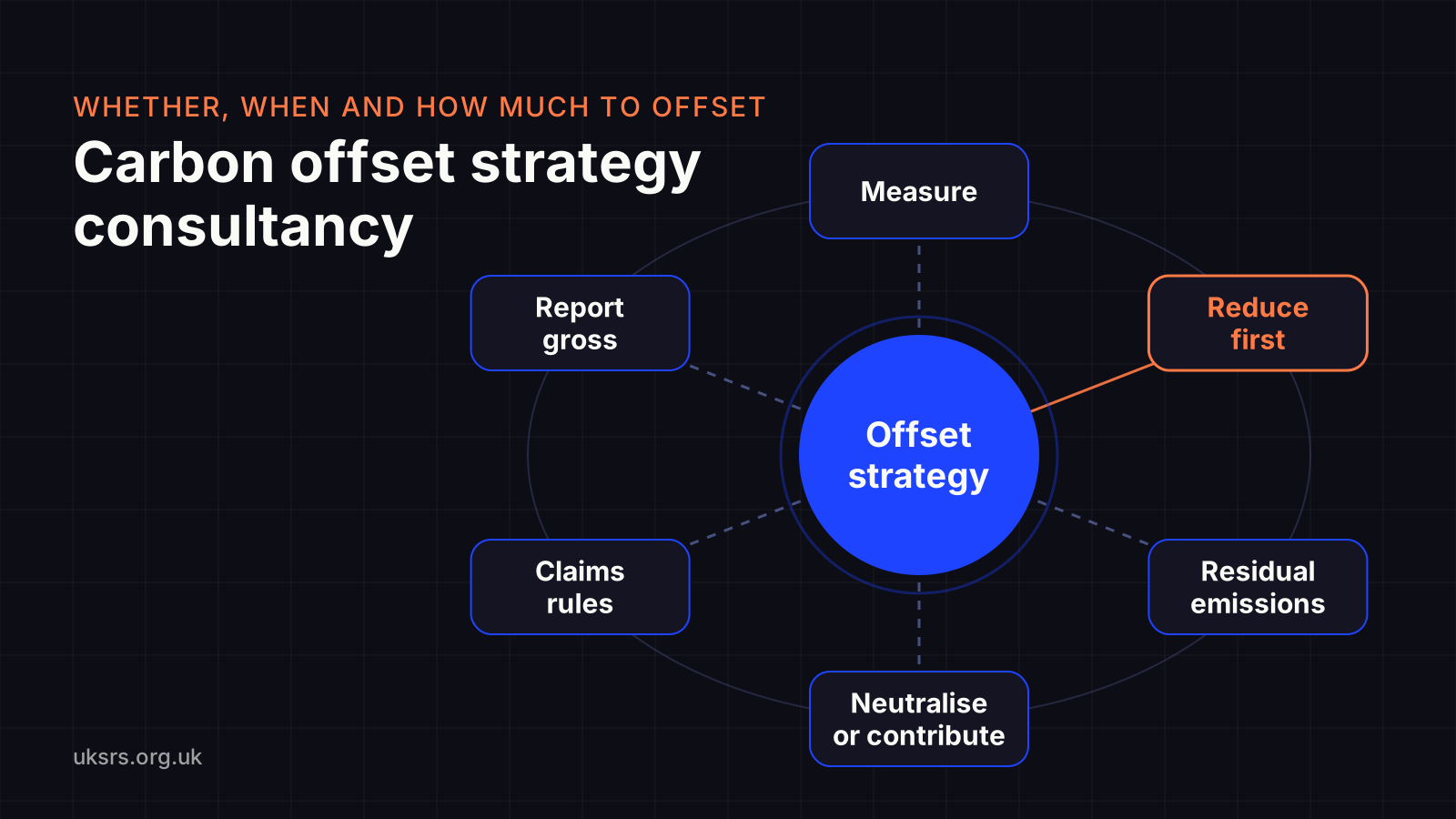
Carbon offset strategy consultancy answers four questions before anyone buys a credit.
Should we use credits at all, given what we have reduced and what we can still reduce?
Read the detailed guidance and references
What are the credits for: neutralising a residual at a net zero date, funding mitigation beyond our value chain, or backing a claim about this year?
How many, of which kind, and on what timetable?
And what can we then say in our reports, our advertising and our tenders?
A good carbon offset strategy consultant will spend most of the first meeting on your reduction plan, because that sets every answer after it.
Strategy decides the role, size and claim; procurement decides which credits.
If you already know what you need and want to buy well, the guide to offset consultants is the page you want.
Module 01 / 04
Footprint
Module 02 / 04
Reduction
Module 03 / 04
Credits
Module 04 / 04
Claim
Order of work
Reduce first: the mitigation hierarchy
Avoid: Remove unnecessary emissions-producing activity. Reduce: Improve processes, energy and materials.
Read the detailed guidance and references
- sized by
- leaves
- addressed by
- disclosed as
The UK government’s six principles start in the same place: use credits in addition to ambitious value-chain action.
The principles are guidance, published by DESNZ on 15 November 2024, and the formal government response to the 2025 consultation that followed had still not appeared by the end of September 2026.
This is the order a carbon offset strategy consultancy works in, and a proposal that starts at the fourth stage has skipped the strategy.
Measuring comes first, and that work is set out on carbon footprint consultancy; cutting comes second, on carbon reduction consultancy.
Every standard that touches offsetting puts credits after measurement and reduction; the order is the strategy.
- 1
Avoid
Remove unnecessary emissions-producing activity.
- 2
Reduce
Improve processes, energy and materials.
- 3
Residual
Define what remains after the measures.
- 4
Credit
Assess a separate purpose and eligible units.
Sizing
Residual emissions: what is left to address
Residual emissions are what remains after the reductions you can make, and they are the honest base for sizing credits in a net zero plan.
SBTi’s Net-Zero Standard V1.3.1 says that for many companies a long-term target is equivalent to at least a 90% absolute reduction, by 2050 or sooner.
Read the detailed guidance and references
Its criterion C12 says credits must not be counted as reductions towards near-term or long-term science-based targets.
V2.0 was published on 11 June 2026 and opens for validation on 1 February 2027; its criterion C5.4 has market instruments accounted for and reported separately from the physical inventory.
So a strategy sized at today’s footprint is a different thing from one sized at a residual, and a carbon offset strategy consultancy should show you both numbers.
The detail of V2.0 is on the SBTi Corporate Net-Zero Standard V2 page, and target-setting on how to set science-based targets.
Module 01 / 04
Boundary
Module 02 / 04
Action
Module 03 / 04
Constraint
Module 04 / 04
Review
Purpose
Neutralise or contribute: two uses for credits
Contribution: Support mitigation beyond the inventory. Target: Check the relevant target-setting criteria.
Read the detailed guidance and references
| Use | What it means | When | Where it is set out |
|---|---|---|---|
| Neutralisation | Counterbalancing residual emissions left at the net zero target date | At and after the target date | SBTi Criteria V1.3.1, C14 |
| Beyond value chain mitigation | Mitigation action or investment outside your value chain, alongside your own reductions | Any time, in addition to reducing | SBTi, beyond value chain mitigation; C12 |
| Compensation for a neutrality claim | Credits retired against a period’s emissions to support a carbon neutral claim | Each claim period | ISO 14068:2026; CAP Code 11.1 |
| Contribution claim tiers | Credits covering 10%, 50% or 100% or more of remaining emissions | After four foundational criteria are met | VCMI Claims Code v3.1 |
SBTi describes beyond value chain mitigation as action that falls outside a company’s value chain, and says it is not a substitute for reducing emissions within it.
VCMI’s Claims Code sets its tiers at 10% to under 50% for Silver, 50% to under 100% for Gold and 100% or more for Platinum, and says the credits are not counted as internal emission reductions.
A VCMI Platinum claim is therefore not a carbon neutral claim, and an offsetting strategy should say which of the uses above it is pursuing.
Module 01 / 04
Contribution
Module 02 / 04
Target
Module 03 / 04
Neutrality
Module 04 / 04
Procurement
Try it
Build an offset strategy and test its claims
Enter your own footprint and planned cut, and choose what the credits are for, what kind you would use and what you would say.
The panel sizes the credit volume from your numbers and lists the rules each choice engages, with the provision.
Read the detailed guidance and references
It quotes no prices and names no seller, because volume and claim are strategy decisions and price is a procurement one.
Move the reduction slider and watch the residual: it is the single number that changes most about a credible offsetting strategy.
Build an offsetting strategy
The starting figure is an example; enter your own.
About 2,500 tCO2e a year: 25% of your 10,000 tCO2e of remaining emissions.
Your own figures; no credit price is given here
Whatever you buy, the emissions you report stay gross: UK SRS S2 asks for absolute gross Scope 1, 2 and 3 emissions, and SECR has no netting-off provision.
UK SRS S2 ¶29(a), ¶36(c); SI 2008/410 Sch 7
SBTi allows credits to finance additional mitigation beyond a company’s science-based targets, which it calls beyond value chain mitigation, and says it is not a substitute for cutting emissions in your own value chain.
SBTi Criteria V1.3.1, C12; SBTi, beyond value chain mitigation
25% of remaining emissions is Silver (10% to under 50%) under the VCMI Claims Code, but only after four foundational criteria are met, and VCMI says the credits are not counted as internal emission reductions.
VCMI Claims Code of Practice v3.1
An ICVCM label attaches to a programme (CCP-Eligible) and to a methodology (CCP-Approved), so ask which methodology and version sit behind each credit, not just which registry.
ICVCM Core Carbon Principles; assessment status
Offset-based claims are lawful in the UK if they are not misleading, but CAP guidance says avoid unqualified “carbon neutral” or “net zero” claims and say what was reduced, what was offset and with which scheme.
CAP Code 11.1; CAP AdviceOnline, 17 June 2026; DMCC Act 2024 s.226
Without a net target reported under UK SRS S2, ¶36(e) asks nothing about credits; set one and it will.
UK SRS S2 ¶36(e)
A map of the rules, not legal advice.
Nothing you enter is stored or sent.
Module 01 / 04
Purpose
Module 02 / 04
Unit
Module 03 / 04
Due diligence
Module 04 / 04
Retirement
Claims
The claims rules that decide a strategy
No UK law bans offset-based claims: Schedule 20 of the Digital Markets, Competition and Consumers Act 2024 has 32 paragraphs and none about carbon.
What binds is the general rule against misleading actions and omissions, in force since 6 April 2025 and enforceable directly by the CMA.
Read the detailed guidance and references
The CMA’s Green Claims Code sets six principles, including that claims are truthful, clear, complete and substantiated.
The ASA’s CAP Code rule 11.1 says the basis of an environmental claim must be clear, and its advice of 17 June 2026 says avoid unqualified “carbon neutral” or “net zero” claims.
The same advice asks marketers to say whether a claim rests on offsetting or on cutting emissions, and to give information about any offsetting scheme used.
In the EU, Directive 2024/825 blacklists offset-based claims that a product has a neutral, reduced or positive greenhouse gas impact, applied from 27 September 2026.
The FCA’s anti-greenwashing rule reaches authorised firms’ communications about their products and services, not an ordinary company’s marketing.
Module 01 / 04
Boundary
Module 02 / 04
Period
Module 03 / 04
Reduction
Module 04 / 04
Credits
Reporting
Gross figures, and credits disclosed apart
UK SRS S2 ¶29(a) asks for absolute gross emissions, and ¶36(c) requires a net target to be shown with its gross target.
Under ¶36(e), a company with a net target discloses its planned use of credits: how far the target relies on them, the verifying scheme, their type and anything bearing on their credibility.
Read the detailed guidance and references
Paragraph B71 confirms only planned use is required, so a company with no net target has no credit disclosure under ¶36(e).
SECR has no netting-off provision, and the GHG Protocol Corporate Standard says it should not be used to quantify reductions from projects used as offsets.
The government declined to add UK-specific credit rules, preferring amendments from the ISSB, in its consultation response.
The standard itself is on UK SRS S2, and where credits sit in a published plan on climate transition plans.
Module 01 / 04
Inventory
Module 02 / 04
Targets
Module 03 / 04
Credits
Module 04 / 04
Evidence
Neutrality standards
PAS 2060 went, then ISO 14068-1 went too
BSI stopped delivering its PAS 2060 scheme from 1 January 2025, and the last opinions were issued by the end of 2025.
The market moved to ISO 14068-1:2023, which ISO withdrew on 11 September 2026; it is being replaced by ISO 14068:2026, Carbon neutrality.
Read the detailed guidance and references
The successor catalogue describes a hierarchy that prioritises value-chain reductions and removals over offsetting. It remains under publication as checked on 10 October 2026; a consultancy should name the edition, criteria and status it proposes to use.
A strategy written around a “PAS 2060 certified” claim needs rewriting, though an opinion issued for a past period still describes that period.
The full story is on PAS 2060 and ISO 14068.
Module 01 / 04
Old edition
Module 02 / 04
Successor
Module 03 / 04
Claim
Module 04 / 04
Contract
Credit integrity
Integrity frameworks: ICVCM and VCMI
The ICVCM sets the supply side: its Core Carbon Principles label a programme as CCP-Eligible and a methodology as CCP-Approved.
The label never attaches to a credit’s actual performance, and approval is version by version, so the methodology and its version are what to check.
Read the detailed guidance and references
In August 2024 the ICVCM rejected eight renewable energy methodologies as insufficiently rigorous on additionality, and Verra’s older REDD+ methodologies were never put forward.
VCMI sets the demand side: what a company can claim about the credits it retires, and only after foundational criteria on inventory, targets, progress and advocacy.
For strategy, the point is that quality screening is a separate step with its own expertise; the offset consultant guide walks through it.
Module 01 / 04
Project
Module 02 / 04
Registry
Module 03 / 04
Quality
Module 04 / 04
Claim
UK removals
Woodland and Peatland Codes: removals at home
The UK has two government-backed codes for domestic removals: the Woodland Carbon Code, since 2011, and the Peatland Code, since 2015.
The Woodland Carbon Code is delivered by Scottish Forestry on behalf of all four UK governments, and both codes use the UK Land Carbon Registry.
Read the detailed guidance and references
Each Woodland Carbon Unit represents one tonne of carbon dioxide equivalent removed.
A Pending Issuance Unit is a promise of a future unit and is not guaranteed, so a plan that counts one today as a tonne removed is counting a forecast.
That makes UK codes a timing decision in a strategy: suited to a neutralisation plan for a future date, less suited to a claim about this year.
Module 01 / 04
Project
Module 02 / 04
Pending units
Module 03 / 04
Issued units
Module 04 / 04
Retirement
Timeline
The dates that move the plan
Standard: Publication and withdrawal status. Claim rule: Commencement and jurisdiction.
Read the detailed guidance and references
- 6 August 2024ICVCM rejects eight renewable energy methodologiesInsufficiently rigorous on whether projects would have gone ahead without credit revenue.ICVCM
- 6 April 2025DMCC consumer provisions in forceMisleading claims enforceable directly by the CMA.DMCC Act 2024
- 17 June 2026CAP advice on offsetting claimsAvoid unqualified carbon neutral or net zero claims.CAP AdviceOnline
- 11 September 2026ISO 14068-1:2023 withdrawnThe successor ISO 14068 is under publication, not confirmed published.ISO
- 27 September 2026EU blacklist appliesOffset-based product neutrality claims to EU consumers.Directive (EU) 2024/825
- 1 February 2027SBTi V2.0 validations openMarket instruments accounted for separately from the inventory.SBTi
- 31 January 2028SBTi V1.3.1 closesV2.0 applies to new general corporate submissions from 1 February 2028; check other routes separately.SBTi
Most of the rules above changed in the last two years, and two more dates are still ahead.
Module 01 / 04
Standard
Module 02 / 04
Claim rule
Module 03 / 04
Target route
Module 04 / 04
Project
Buying advice
Briefing an offset strategy consultant
Give a carbon offset strategy consultancy your gross inventory, your reduction plan and any target you have published or intend to.
Ask them to size credits against the residual and against today’s footprint, and to say which use each figure serves.
Read the detailed guidance and references
Ask which claims you could make, in which markets, and with what qualifying words.
Ask whether they earn anything from credits they recommend, beyond their fee.
This site names no adviser, ranks none and quotes no price; if the wider plan is the question, read what a net zero consultant does or the carbon management consultancy guide, or book a free 15-minute call.
Module 01 / 04
Inventory
Module 02 / 04
Purpose
Module 03 / 04
Assessment
Module 04 / 04
Handover
Illustrative brief · no consultancy assessed
A worked brief: an organisation wants to fund a credit purchase
Agree the purpose before drafting any public wording. Keep gross emissions and reductions visible, then assess the units and retain retirement evidence for that purpose.
For the detailed requirements, see PAS 2060 and ISO 14068.
View the workflow diagram
- 1
Purpose
Contribution, target treatment or a defined claim.
- 2
Assessment
Project, methodology, vintage and relevant risks.
- 3
Record
Registry identifiers, retirement and supporting wording.
Each date has a different meaning
The relevant dates, in order
Check who the date applies to and whether it is publication, application, submission or a planned milestone.
- September 202101
CMA Green Claims Code
Substantiate the environmental claim and consider its full meaning. - 11 September 202602
ISO 14068-1:2023 withdrawn
A dated engagement must identify the edition and status. - 10 October 2026 / status checked03
ISO 14068 under publication
The catalogue has not yet confirmed final publication. - 1 February 202704
SBTi corporate V2.0 validation opens
Keep validation criteria distinct from a neutrality claim.
A suggested delivery sequence
From the brief to the handover
This is an editorial buying and preparation sequence, not a statutory timetable or a promise about how long the engagement takes.
- 01 / Inventory01
Inventory
Keep gross emissions and the reduction plan visible. - 02 / Purpose02
Purpose
Decide whether the purchase is contribution or a claim. - 03 / Assessment03
Assessment
Check unit eligibility, evidence and risks. - 04 / Retirement04
Retirement
Retain serial numbers and retirement records. - 05 / Wording05
Wording
Review the exact claim, boundary and supporting evidence.
Frequently asked
Offsetting questions, answered
What is a carbon offset strategy?
A carbon offset strategy decides whether an organisation uses carbon credits at all, for what purpose, in what volume and with what public claim.
It comes after measurement and reduction, and it sizes credits against residual emissions or a chosen contribution rather than against the whole footprint.
What does a carbon offset strategy consultancy do?
It helps you decide the role of credits in a climate plan: how far to reduce first, whether credits neutralise residual emissions or fund mitigation beyond your value chain, which kinds of credit fit, and what you can then say in reports and advertising.
Buying and screening the credits is a separate job.
Should a company offset before reducing emissions?
The standards say reduce first.
ISO 14068:2026 puts reductions and removals within the value chain ahead of offsetting, SBTi does not count credits as reductions towards its targets, and the UK government’s principles say credits should be used in addition to value-chain action.
What is the difference between neutralisation and beyond value chain mitigation?
Neutralisation, in SBTi’s Net-Zero Standard, deals with the residual emissions left at the net zero target date.
Beyond value chain mitigation is mitigation action or investment outside a company’s value chain, which SBTi says is not a substitute for reducing emissions within it.
Can carbon offsets reduce our reported emissions?
No. UK SRS S2 asks for absolute gross emissions, a net target must be shown with its gross target, and SECR has no netting-off provision.
Credits are disclosed separately, and under UK SRS S2 only where there is a net target.
Can we still claim carbon neutral in the UK?
Offset-based claims remain lawful in the UK if they are not misleading, but CAP guidance says avoid unqualified carbon neutral or net zero claims and explain what was reduced and what was offset.
PAS 2060 is withdrawn, and ISO 14068-1:2023 was withdrawn on 11 September 2026.
Do EU rules ban carbon neutral claims based on offsets?
For products sold to EU consumers, Directive 2024/825 blacklists a claim, based on offsetting, that a product has a neutral, reduced or positive greenhouse gas impact, applied from 27 September 2026.
The UK has no equivalent blacklist entry.
Are UK woodland carbon credits better than international ones?
They are different rather than ranked.
The Woodland Carbon Code and the Peatland Code are UK government-backed codes for domestic removals, and a Pending Issuance Unit is a promise of a future unit, not a verified tonne.
International credits are judged by programme and methodology.
How much does an offset strategy cost?
This site quotes no adviser fees and no credit prices.
Ask any adviser for a written scope, and ask whether they earn anything from the credits they recommend.
Sources
Primary sources
Every figure, date and status on this page traces to the instrument’s owner.
Secondary commentary is never the source for a number.
- SBTi ServicesSBTi Services operational transition guide, Table 1
General corporate validation: V2.0 opens 1 February 2027; V1.3.1 closes 31 January 2028; new V2.0 submissions from 1 February 2028.
- Department for Business and TradeUK SRS S2 (PDF), ¶¶29(a), 36(c), 36(e), B71
Gross emissions; a net target carries its gross target; planned use of credits only.
- Department for Business and TradeUK SRS consultation response (PDF), §1.45
No UK-specific carbon credit requirements; amendments preferred from the ISSB.
- Greenhouse Gas ProtocolCorporate Standard
Not for quantifying reductions from mitigation projects used as offsets.
- legislation.gov.ukSI 2008/410 Schedule 7 (SECR)
No netting-off provision.
- Science Based Targets initiativeNet-Zero Standard Criteria V1.3.1, C12 and C14
Credits are not reductions; neutralise only residual emissions at the net zero date.
- Science Based Targets initiativeBeyond value chain mitigation
Mitigation outside the value chain; not a substitute for reducing within it.
- Science Based Targets initiativeCorporate Net-Zero Standard V2.0 Criteria, C5.4
Market instruments accounted for separately from the physical inventory; validations from 1 February 2027.
- ICVCMThe Core Carbon Principles
Ten principles in three groups.
- ICVCMAssessment status
44 CCP-Approved methodologies as at 12 August 2026; approval is by methodology and version.
- VCMIClaims Code of Practice v3.1 (15 August 2025)
Silver, Gold and Platinum thresholds and the four foundational criteria.
- Department for Energy Security and Net ZeroPrinciples for voluntary carbon and nature market integrity
Six non-binding principles, 15 November 2024.
- Competition and Markets AuthorityGreen Claims Code (CMA146)
Six principles; the CMA’s view of the law.
- legislation.gov.ukDigital Markets, Competition and Consumers Act 2024, Part 4 and Schedule 20
Misleading actions and omissions; the blacklist says nothing about carbon.
- ASA / CAPCAP Code section 11, environmental claims
Rule 11.1: the basis of an environmental claim must be clear.
- ASA / CAPAdviceOnline: carbon offsetting and carbon neutral (17 June 2026)
Avoid unqualified “carbon neutral” or “net zero” claims.
- EUR-LexDirective (EU) 2024/825, Annex I point 4c and Article 4(1)
Offset-based product neutrality claims blacklisted, applied from 27 September 2026.
- ISOISO 14068 (Carbon neutrality), catalogue record
Reductions and removals within the value chain take priority over offsetting.
- ISOISO 14068-1:2023, catalogue record
Withdrawn 11 September 2026.
- BSI KnowledgeBS ISO 14068-1:2023 product record
The 24-month period before PAS 2060:2014 was withdrawn.
- Woodland Carbon CodeWoodland Carbon Code V3.0 (January 2026)
Pending Issuance Units are promises, not guarantees.
- IUCN UK Peatland ProgrammeThe Peatland Code
Launched 2015; shares the UK Land Carbon Registry.
Continue reading
Read next
Carbon offset consultants
Screening, buying and retiring credits.
PAS 2060 and ISO 14068
The neutrality standards and what replaced them.
Net zero consultants
Targets, plans and where credits fit.
Carbon reduction consultancy
From reduction plans to targets, and why cuts come before offsets.
Sustainability consulting firms
Selection criteria tied to the law, and an unranked A–Z directory.