Nothing can be shown to fall until it has been measured once, on a boundary you will keep.
Carbon reduction consultants · plans, targets and measures
Carbon reduction consultancy UK
Turn a measured baseline into practical reductions. Separate a procurement Carbon Reduction Plan from target validation, engineering delivery and corporate reporting duties.
UK SRS is an independent reference site. We have assessed no consultancy and publish no consultancy prices or rankings.
The deliverables
What a carbon reduction consultant delivers
Baseline: Agree boundary, year and evidence. Options: Size feasible reductions and dependencies.
Read the detailed guidance and references
Stage 1 of 6
Baseline
Every target is measured against a baseline year, so the work starts by confirming the inventory and its boundary, or by building one.
Good carbon reduction consultancy is judged on the measures, because targets and plans only describe what the measures will do.
If you have no inventory yet, that is a different purchase, covered on carbon footprint consultancy.
If the measures are mostly energy, heat, vehicles and power, the delivery side is decarbonisation consultancy, which this page links to rather than repeats.
A carbon reduction consultant starts where the footprint ends: the inventory says how much, and this work says what falls, by how much and by when.
From baseline to actionExplore
Module 01 / 04
Baseline
Agree boundary, year and evidence.
Module 02 / 04
Options
Size feasible reductions and dependencies.
Module 03 / 04
Plan
Assign funding, owners and milestones.
Module 04 / 04
Review
Track results and explain changes.
The mitigation hierarchy
Reduce first, offset only the residual
Avoid: Remove unnecessary activity. Efficiency: Use less energy and material for the same output.
Read the detailed guidance and references
- Step 1 of 5
Know the baseline
- Step 2 of 5
Avoid the activity
The cheapest tonne is the one never emitted: the journey not made, the space not heated, the product not shipped twice.
The top of every mitigation hierarchy
- Step 3 of 5
Use less for the same output
Efficiency in buildings, processes and vehicles cuts energy before anything is replaced.
The operational detail is on the decarbonisation page
- Step 4 of 5
Switch to a cleaner source
Fuel, heat source, vehicles and suppliers change once demand has been cut, so the replacement is sized to the smaller load.
Scope 1 and 2 first, then the Scope 3 categories you can influence
- Step 5 of 5
Neutralise only what is left
Under the SBTi’s net zero criteria, credits neutralise residual emissions at the target date and never count as reductions.
The SBTi’s near-term criteria say credits must not be counted as emission reductions towards a science-based target (C11).
ISO 14068-1:2023 was withdrawn on 11 September 2026 and is being replaced by ISO 14068:2026, which puts reductions and removals within the value chain ahead of offsetting.
The government’s voluntary market principles say the same in guidance: use credits in addition to ambitious value-chain action, not instead of it.
Reported emissions stay gross: a net target in a UK SRS S2 report must carry its gross target beside it (¶36(c)).
Credits themselves are a separate engagement, set out on carbon offset consultants.
The frameworks cited on this page order the work the same way: measure, avoid, reduce, switch, and only then neutralise what cannot be cut.
- 1
Avoid
Remove unnecessary activity.
- 2
Efficiency
Use less energy and material for the same output.
- 3
Substitution
Assess lower-emission processes and energy.
- 4
Residual
Explain remaining emissions separately.
Central government bids
Carbon Reduction Plans under PPN 006
PPN 006 is procurement policy that binds buyers, not a legal duty on companies to hold a plan.
A bidder needs a plan only where every condition holds: a central government department, executive agency or non-departmental public body, a contract above £5 million a year including VAT, and a procurement started on or after 24 February 2025.
Read the detailed guidance and references
The value is averaged over the life of the contract, so £21 million over four years is in scope even if year one is under £5 million.
The Technical Standard asks for Scope 1 and 2 in full and only five Scope 3 categories, which leaves out purchased goods and services.
The plan commits to net zero in the UK by 2050 at the latest, is signed off by the board or equivalent, and is published on your website.
The NHS runs its own instrument, which accepts a plan built to PPN 006.
The template, the edge cases and a worked plan are on the full PPN 006 Carbon Reduction Plan guide.
A defined procurement conditionExplore
Module 01 / 04
Authority
Check the central-government procurement scope.
Module 02 / 04
Contract
Apply the annual-value test including VAT.
Module 03 / 04
Plan
Prepare the required emissions and commitment.
Module 04 / 04
Approval
Use the specified publication and sign-off route.
The calendar
Eight dates that shape the work
Procurement: Check the bid and plan-update requirements. Reporting: Use the applicable financial period.
Read the detailed guidance and references
- 24 February 2025PPN 006 appliesTo procurements commenced on or after this date; earlier ones stay under PPN 06/21.Cabinet Office, PPN 006
- 10 July 2025PPN 006 FAQ publishedConfirms the threshold is per contract and includes VAT.Cabinet Office
- 11 December 2025NHS England requirements, version 3A separate instrument that accepts a plan built to PPN 006.NHS England
- 14 April 2026SBTi criteria V5.3.1 and V1.3.1 in effectThe near-term and net zero criteria in use today.SBTi
- 1 January 2027UK SRS periods begin for listed companies in scopeComply or explain, including the target disclosures in UK SRS S2.FCA PS26/19
- 1 February 2027Validations under V2.0 openCompanies choose V1.3.1 or V2.0 for a year.SBTi Services, Table 1
- 31 January 2028V1.3.1 closesV2.0 becomes mandatory for submissions from 1 February 2028.SBTi Services, Table 1
Two clocks run at once: government buyers’ procurement rules, and the SBTi’s move from one standard version to the next.
Do not confuse the calendarsExplore
Module 01 / 04
Procurement
Check the bid and plan-update requirements.
Module 02 / 04
Reporting
Use the applicable financial period.
Module 03 / 04
Targets
Apply the operational validation transition.
Module 04 / 04
Delivery
Use a funded, organisation-specific timetable.
Science-based targets
Science-based targets, and what validation means
The SBTi sets the criteria and validates targets through SBTi Services; a consultant prepares a target and cannot validate it.
A near-term target covers five to ten years from submission, with a base year no earlier than 2015 (C13).
Read the detailed guidance and references
Relevant Scope 3 of 40% or more of the total means Scope 3 must be in the target (C4), which is why the baseline’s Scope 3 work matters here.
Net zero under the net zero criteria means cutting to a residual level consistent with 1.5°C pathways, then neutralising that residual (C14).
Version 2.0 says companies shall separately account for market instruments not reflected in the physical inventory, “where applicable” and in line with GHG accounting standards “where available” (C5.4).
The process is set out on how to set science-based targets, and version 2.0 on the Net-Zero Standard V2.0 page.
Preparation and validation differExplore
Module 01 / 04
Inventory
Prepare an evidenced baseline.
Module 02 / 04
Criteria
Choose the applicable company and sector route.
Module 03 / 04
Submission
Check the eligible standard version.
Module 04 / 04
Validation
SBTi Services assesses the targets.
Listed companies
Targets in a UK SRS S2 report
UK SRS S2 does not require a company to set targets; it asks about the targets a company has.
Under the FCA’s PS26/19, companies listed in UKLR 6, 14, 15, 16 and 22 report against UK SRS on a comply-or-explain basis for periods beginning on or after 1 January 2027.
Read the detailed guidance and references
Nothing in S2 requires a target to be SBTi-validated: ¶34(a) asks only whether a third party validated it.
The FCA’s own words are that UK SRS S2 does not require entities to have a climate-related transition plan, though one that exists must be described.
The full standard is on UK SRS S2.
| UK SRS S2 | What the report says |
|---|---|
| ¶33(b) | The objective of each target |
| ¶34(a) | Whether a third party validated it |
| ¶35 | Performance against it, and the trend |
| ¶36(a)–(c) | Gases, scopes, and gross or net |
| ¶36(e) | Planned use of credits for a net target |
The inventory stays grossExplore
Module 01 / 04
Scopes
Report the relevant gross emissions.
Module 02 / 04
Methods
Explain calculation inputs and assumptions.
Module 03 / 04
Targets
Disclose the target and progress information.
Module 04 / 04
Credits
Explain planned use separately where applicable.
The measures
Measures are the part that cuts emissions
A measure is a change with an owner, a date, a cost and an estimated saving in tonnes or kWh.
For a large organisation the energy measures are usually already listed in its ESOS audit, and the ESOS action plan records which it will implement.
Read the detailed guidance and references
Scope 3 measures work through suppliers and customers, so they are slower and less certain than measures on your own sites.
Ask how each estimated saving was calculated, because a plan whose savings cannot be traced cannot be tracked either.
Size an action before approving itExplore
Module 01 / 04
Reduction
Estimate the change in emissions.
Module 02 / 04
Feasibility
Assess technology and operational constraints.
Module 03 / 04
Investment
Identify cost, funding and dependencies.
Module 04 / 04
Owner
Agree milestones and the review method.
Before you call anyone
How to brief a carbon reduction consultancy
Brief a carbon reduction consultancy on the reason you are buying, because a government bid, a validated target and a listed company’s report each need different outputs.
Tick the reasons that apply, and the panel lists what the work should deliver, with the rule behind each line.
Read the detailed guidance and references
Give the figures the rules use, such as the contract’s annual value including VAT, so nobody bills you to discover them.
Ask for days by grade, who signs each output, and who owns the files at the end.
Scope the work before you call anyone
What the consultant should deliver (3)
- A baseline footprint first
Every target and every plan is measured against a baseline year, so a reduction engagement without one starts by building it.
GHG Protocol Corporate Standard
- Reduction measures with an owner, a date and an estimated saving
This is the part of the work that cuts emissions; targets and plans only describe it.
Mitigation hierarchy; ISO 14068 successor catalogue describes value-chain reductions ahead of offsetting; currently under publication
- A Carbon Reduction Plan to the PPN 006 template
Scope 1 and 2 in full, five Scope 3 categories only, a net zero commitment for the UK by 2050 at the latest, board sign-off, publication on your website and a refresh within six months of your financial year-end.
PPN 006 and its Technical Standard
Send every firm on the shortlist
- Which baseline year and boundary will every target and plan rest on?
- Which of the measures you propose have an owner, a date and an estimated saving?
- How will our reported emissions stay gross, with any credits shown separately?
- Who validates or signs each output, and is that anyone in your firm?
- How many days, at which grades, and who owns the files at the end?
A scoping aid, not legal advice.
Nothing you choose is stored or sent.
Different kinds of supportExplore
Module 01 / 04
Measurement
Establish the inventory and evidence.
Module 02 / 04
Strategy
Select priorities and target criteria.
Module 03 / 04
Engineering
Design and deliver technical changes.
Module 04 / 04
Reporting
Prepare the applicable disclosure or plan.
Due diligence
What to check before you sign
Law: Which duty reaches your organisation? Procurement: Which bid condition applies?
Read the detailed guidance and references
| What you might hear | What to check | Source |
|---|---|---|
| “We will certify your Carbon Reduction Plan” | PPN 006 is a pass or fail condition of participation; no one certifies a plan. | PPN 006 |
| “Your plan will cover Scope 3” | Five categories only, unless you choose to go further. | Technical Standard ¶15 |
| “We will validate your target” | Validation is done through SBTi Services, not by a consultant. | SBTi criteria |
| “Offsets will get you to your target” | Credits never count as reductions towards a science-based target. | C11 |
| “UK SRS is mandatory from 2027” | Comply or explain for listed companies in scope; voluntary for everyone else. | FCA PS26/19 |
| “The law says you need a transition plan” | No UK rule requires one; the government’s consultation has no published response. | DESNZ |
Ask whether the carbon reduction consultancy earns anything from products, software or credits it recommends, beyond its fee.
The wider buying process is in how to choose a sustainability consultant.
Most weak proposals overstate what a rule requires or what the consultant can certify.
Check the claim's destinationExplore
Module 01 / 04
Law
Which duty reaches your organisation?
Module 02 / 04
Procurement
Which bid condition applies?
Module 03 / 04
Target
Which validation criteria are being used?
Module 04 / 04
Claim
What evidence supports the public wording?
Which kind of help
Reduction, footprint, decarbonisation or net zero?
Footprint: Measure emissions within a defined boundary. Reduction: Develop and deliver actions.
Read the detailed guidance and references
| The question | The work | Main output |
|---|---|---|
| How much do we emit? | Footprint consultancy | An inventory and its method file |
| How will we cut it, and by when? | Carbon reduction consultancy (this page) | Measures, targets and a plan such as PPN 006 |
| What changes on our sites? | Decarbonisation consultancy | Energy, heat, fleet and power projects |
| What does net zero mean for us? | A net zero consultant | A long-term target and residual strategy |
| What about what is left? | Offset consultancy | Screened credits and defensible claims |
One firm or several
Many firms sell all five, and buying them together can work if each output is named in the scope.
The risk is paying for a programme when a single plan was the need.
The labels overlap in the market, so name the question you need answered rather than the job title.
Keep the briefs distinctExplore
Module 01 / 04
Footprint
Measure emissions within a defined boundary.
Module 02 / 04
Reduction
Develop and deliver actions.
Module 03 / 04
Decarbonisation
Evaluate technical changes and dependencies.
Module 04 / 04
Management
Maintain the recurring annual cycle.
Illustrative brief · no consultancy assessed
A worked brief: a bidder also wants a reduction programme
Assume the procurement condition applies to the bid. Ask for the required Carbon Reduction Plan as one output and a separately scoped programme of practical actions.
For the detailed requirements, see Carbon Reduction Plan PPN 006.
View the workflow diagram
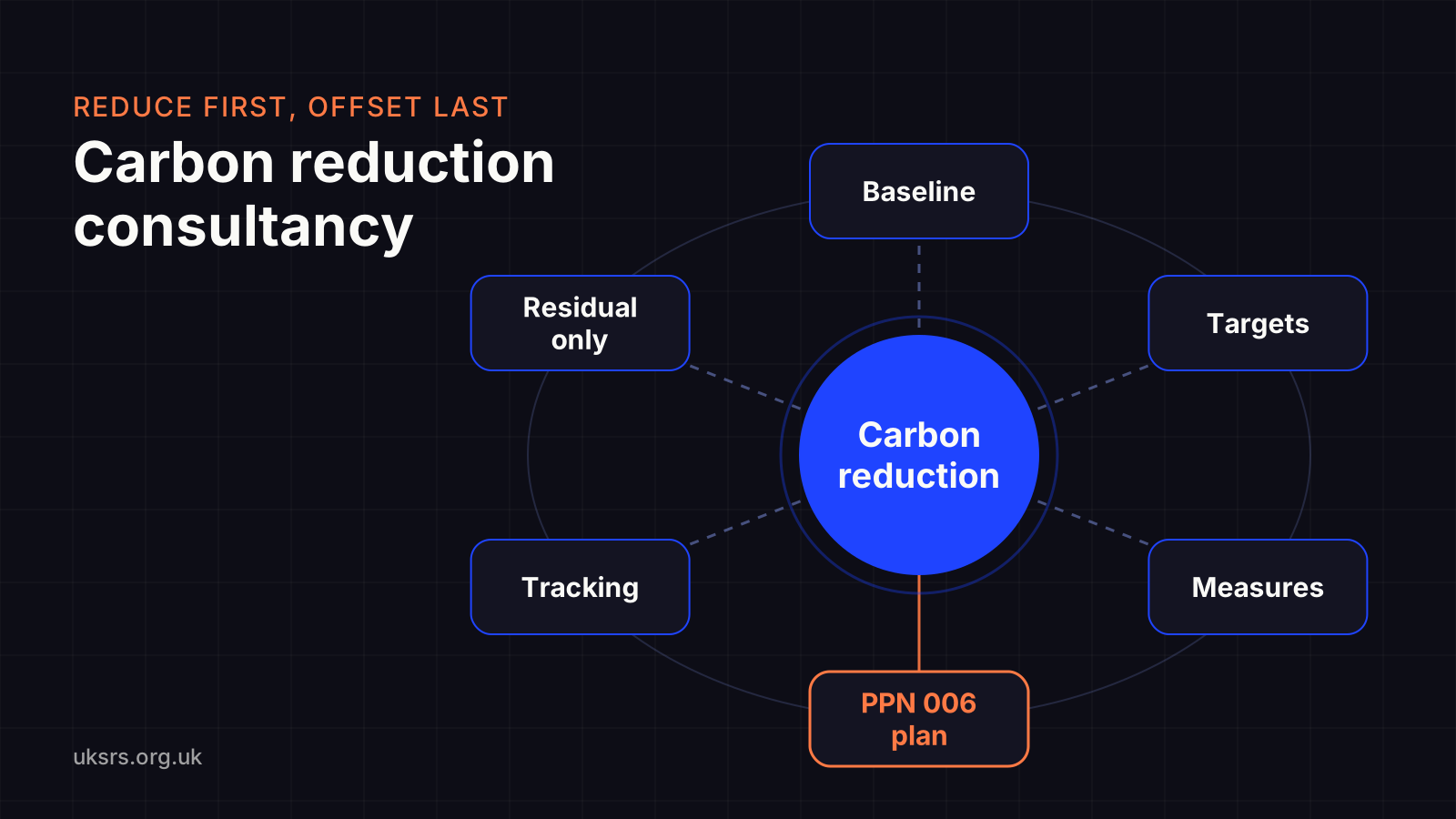
- 1
Procurement
The plan, approval and publication requirements.
- 2
Actions
Sized measures, dependencies and investment decisions.
- 3
Review
Owners, milestones and evidence of actual outcomes.
Each date has a different meaning
The relevant dates, in order
Check who the date applies to and whether it is publication, application, submission or a planned milestone.
- 11 June 202601
Corporate V2.0 published
Publication and validation opening are separate events. - 1 February 202702
V2.0 validation opens
General corporate submissions can use V1.3.1 or V2.0 during the transition. - 31 January 202803
V1.3.1 submissions close
Check company-specific commitment and review deadlines separately. - 1 February 202804
V2.0 for new submissions
These are the general corporate transition dates, not a single timetable for every route.
A suggested delivery sequence
From the brief to the handover
This is an editorial buying and preparation sequence, not a statutory timetable or a promise about how long the engagement takes.
- 01 / Baseline01
Baseline
Agree boundary, year and evidence. - 02 / Criteria02
Criteria
Check the applicable target route and submission version. - 03 / Actions03
Actions
Size reductions and operational dependencies. - 04 / Delivery04
Delivery
Assign resources, owners and milestones. - 05 / Review05
Review
Track outcomes and explain material changes.
Frequently asked
Carbon reduction consultants, answered
What does a carbon reduction consultant do?
A carbon reduction consultant turns a measured footprint into a plan to cut it: reduction measures with owners and dates, targets set against a baseline year, and the documents buyers and investors ask for, such as a PPN 006 Carbon Reduction Plan.
Measuring the footprint itself is a separate piece of work, and so is buying carbon credits.
Do I need a Carbon Reduction Plan?
Only if you bid for a contract where the buyer has applied PPN 006.
That means a central government department, executive agency or non-departmental public body, a contract worth more than £5 million a year including VAT averaged over its life, and a procurement that began on or after 24 February 2025.
There is no general legal duty on companies to hold one.
Does a Carbon Reduction Plan cover Scope 3?
Only five Scope 3 categories: upstream transportation and distribution, waste generated in operations, business travel, employee commuting, and downstream transportation and distribution.
Scope 1 and Scope 2 are covered in full.
Purchased goods and services, usually the largest category, is not required.
Does the NHS use PPN 006?
Not directly.
NHS England has its own instrument, version 3 of 11 December 2025, which says a Carbon Reduction Plan built to PPN 006 will be accepted.
Below £5 million a year it asks for a lighter Net Zero Commitment instead.
Can a consultant validate our science-based target?
No. The Science Based Targets initiative publishes the criteria and validation is done through SBTi Services.
A consultant can help you prepare a target that meets the criteria and assemble the submission.
Which SBTi standard should we use in 2026?
Corporate Net-Zero Standard V1.3.1 is the one in use now.
Version 2.0 was published on 11 June 2026 and validations under it open on 1 February 2027; companies may keep submitting under V1.3.1 until 31 January 2028.
Can carbon offsets count towards a reduction target?
Not under the SBTi criteria: credits must not be counted as emission reductions towards near-term or long-term targets, and may be used only to neutralise residual emissions or to finance mitigation beyond the target.
Under UK SRS S2 a net target must be disclosed together with its gross target.
Does UK SRS require reduction targets?
No. UK SRS S2 asks a company to disclose the targets it has set, and for each emissions target which gases and scopes it covers, whether it is gross or net, and whether a third party validated it.
For listed companies in UKLR 6, 14, 15, 16 and 22 the FCA applies UK SRS on a comply-or-explain basis for periods from 1 January 2027.
What is the difference between carbon reduction and decarbonisation consultancy?
The terms overlap, but they are usually bought differently.
Carbon reduction work is about the plan: baseline, targets, measures and the documents that record them.
Decarbonisation work is about delivering the operational change on site: energy efficiency, heat, electrification, fleet and power purchasing.
How much does carbon reduction consultancy cost?
This site publishes no prices and has assessed no firm.
Ask each provider for a written scope with days by grade, the deliverables named, and the second year priced in the same proposal.
Sources
Primary sources
Every figure, date and status on this page traces to the instrument’s owner.
Secondary commentary is never the source for a number.
Checked against 15 sources fromCabinet Office (GOV.UK)NHS EnglandScience Based Targets initiativeSBTi ServicesDepartment for Business and TradeFinancial Conduct Authority
- Cabinet Office (GOV.UK)PPN 006: Taking account of Carbon Reduction Plans in the procurement of major government contracts
Buyers in scope, the £5m-a-year including-VAT threshold, 24 February 2025, the template.
- Cabinet Office (GOV.UK)PPN 006 Technical Standard for Completion of Carbon Reduction Plans
¶11 six-month refresh; ¶15 five Scope 3 categories; ¶20 seven gases; ¶22 boundary.
- Cabinet Office (GOV.UK)PPN 006: Frequently asked questions (issued June 2025, published 10 July 2025)
The threshold is per contract and includes VAT.
- NHS EnglandCarbon reduction plan and net zero commitment requirements (v3, 11 December 2025)
A separate NHS instrument that accepts a plan built to PPN 006.
- Science Based Targets initiativeCorporate Near-Term Criteria V5.3.1, C4–C13
Boundary coverage, the 40% Scope 3 trigger, timeframes, and credits never counted as reductions.
- Science Based Targets initiativeCorporate Net-Zero Standard Criteria V1.3.1, C7, C12, C14
Long-term coverage, credits only for residual emissions, the definition of net zero.
- Science Based Targets initiativeCorporate Net-Zero Standard V2.0 Criteria, C5.4
Market instruments accounted for separately from the physical inventory, where applicable.
- SBTi ServicesGuide for companies in the transition to Corporate Net-Zero Standard V2.0, Table 1
Validations under V2.0 open 1 February 2027; V1.3.1 closes 31 January 2028.
- Department for Business and TradeUK SRS S2 Climate-related Disclosures (PDF), ¶¶14, 33–36
What a report says about targets, and about any transition plan the entity has.
- Financial Conduct AuthorityPS26/19: Aligning listed issuers’ sustainability disclosures with international standards
Comply or explain against UK SRS for periods from 1 January 2027.
- Financial Conduct AuthorityPS26/19 (PDF), ¶2.36
“UK SRS S2 does not require entities to have a climate-related transition plan.”
- Department for Energy Security and Net ZeroPrinciples for voluntary carbon and nature market integrity (15 November 2024)
Use credits in addition to ambitious value-chain action; guidance, not law.
- ISOISO 14068:2026, Climate change management — Carbon neutrality
Reductions and removals within the value chain take priority over offsetting.
- Department for Energy Security and Net ZeroTransition plan requirements: implementation routes
The consultation that closed on 17 September 2025; no response published.
- Greenhouse Gas ProtocolA Corporate Accounting and Reporting Standard (Revised Edition)
The baseline: boundary by equity share or control.
Continue reading
Read next
Procurement
PPN 006 plans in full
The template, the threshold and a worked plan.
Delivery
Decarbonisation consultancy
Energy, heat, fleet and power on site.
Targets
Science-based targets
What the SBTi asks, and when.
Management
Carbon management consultancy
Carbon run as a yearly cycle, with an in-house handover.
Measurement
Carbon footprint consultancy
Which footprint each rule asks for, and which claims to check.
Directory
Sustainability consulting firms
Selection criteria tied to the law, and an unranked A–Z directory.