Decarbonisation consultants · the operational transition
Decarbonisation consultancy UK
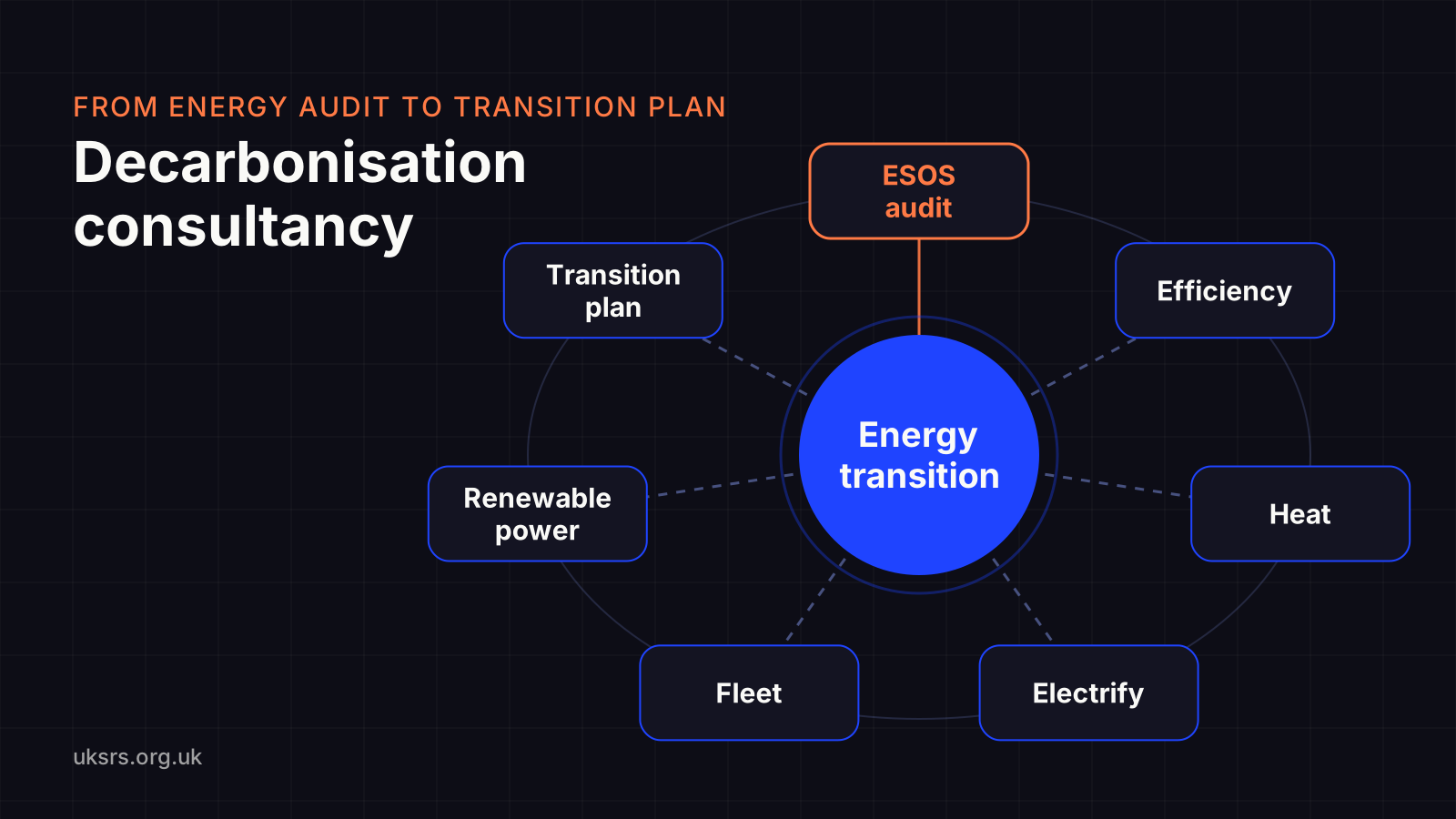
Start with the energy and emissions baseline. Assess efficiency, heat, fleet and power together, then sequence the investment around operational and infrastructure constraints.
UK SRS is an independent reference site. We have assessed no consultancy and publish no consultancy prices or rankings.
The work
What a decarbonisation consultant actually does
Baseline: Map energy use and the relevant emissions. Options: Assess technical and operational feasibility.
Read the detailed guidance and references
Decarbonisation consultancy is judged on what changes on site, which makes it closer to engineering than to reporting.
Targets, PPN 006 plans and SBTi submissions are usually bought separately as carbon reduction consultancy.
US-spelling searches for a decarbonization consultant describe the same work.
A decarbonisation consultant works on the physical system: buildings, plant, vehicles and the energy contracts behind them.
Module 01 / 04
Baseline
Module 02 / 04
Options
Module 03 / 04
Dependencies
Module 04 / 04
Delivery
ESOS
Start from the energy audit you already have
An organisation that qualifies for ESOS already has an audit listing energy-saving measures, and that list is the natural first draft of a decarbonisation programme.
An ESOS action plan sets out each measure the organisation proposes to implement, the date, and the estimated saving in kWh, under regulation 34A.
Read the detailed guidance and references
ESOS does not require any measure to be carried out, but Phase 4 adds a report of savings achieved and an explanation of planned measures that were not implemented.
Since 22 July 2026 the only routes are the energy audit and ISO 50001, under the 2026 amendment regulations.
The plan itself is explained on the ESOS action plan page, and the audit on the ESOS energy audit.
- 22 July 2026Phase 4 amendments in forceAudit or ISO 50001 only; DECs and Green Deal assessments removed as routes.SI 2026/701
- 30 July 2026Phase 4 guidance publishedThe Environment Agency’s compliance guidance.Environment Agency
- 5 December 2026Second progress update on Phase 3 action plansProgress against the measures you proposed last phase.Environment Agency
- 31 December 2026Phase 4 qualification dateYour size on this day decides whether Phase 4 applies.SI 2014/1643 reg 4
- 5 December 2027Compliance dateNotification, including savings achieved and the review of last phase’s plan.SI 2014/1643 reg 4
- 5 December 2028Phase 4 action plan dueMeasures, dates and estimated kWh savings for 6 December 2027 to 5 December 2031.Environment Agency §13.1
- 2029 to 2031Three annual progress updatesOwed even if the plan proposed no measures.Environment Agency §14
Module 01 / 04
Qualification
Module 02 / 04
Assessment
Module 03 / 04
Opportunities
Module 04 / 04
Delivery
Efficiency
Efficiency before new equipment
Cutting demand first means every later investment, from a heat pump to a charging point, can be sized for a smaller load.
The Environment Agency’s guidance quotes estimated annual savings across the ESOS population, with buildings the largest share.
Read the detailed guidance and references
Those are scheme-wide estimates and say nothing about your own sites, which is what the audit is for.
Ask a consultant to rank measures by saving and by cost, and to say which figures come from metering and which are estimates.
Module 01 / 04
Understand
Module 02 / 04
Reduce
Module 03 / 04
Control
Module 04 / 04
Measure
Heat and electrification
Heat and electrification, in that order
Gas or oil burned on site is Scope 1, so heat is often the largest single source a decarbonisation project can remove.
Electrifying heat moves those emissions into Scope 2, where they are calculated with the government’s grid factor for the year.
Read the detailed guidance and references
The consumed electricity factor fell from 0.19553 kgCO2e/kWh in the 2025 set to 0.14396 in the 2026 set, according to the DESNZ methodology papers.
The major changes report explains the movement, so quote the factor for your reporting year rather than a trend.
Fabric and controls come first, because a heat pump sized for a leaky building costs more to buy and to run.
The factors themselves are on GHG conversion factors.
Module 01 / 04
Demand
Module 02 / 04
Technology
Module 03 / 04
Infrastructure
Module 04 / 04
Operation
Fleet
Fleet: the fuel you are supplied with
For ESOS, transport is in scope where your organisation is supplied with the fuel for business purposes, according to the Environment Agency’s guidance at §4.3.4.
That includes company cars, fleet vehicles you operate, and personal or hire cars on business use, and it excludes haulage you subcontract.
Read the detailed guidance and references
Transport is one of four ESOS organisational purposes and carries its own energy intensity ratio.
A fleet plan is mostly about timing: replacement cycles, charging at depots and duty cycles decide which vehicles can switch first.
Module 01 / 04
Use
Module 02 / 04
Charging
Module 03 / 04
Cost
Module 04 / 04
Delivery
Renewable power
Buying renewable power without overclaiming
Ofgem issues one REGO certificate per MWh of eligible renewable output, and certificates can be traded with or without the electricity.
A REGO-backed tariff is therefore a market-based Scope 2 claim, and the GHG Protocol’s Scope 2 Guidance sets Quality Criteria the instruments must meet.
Read the detailed guidance and references
UK SRS S2 requires location-based Scope 2 and only permits market-based reporting (¶29(a)(v), B30–B31), so a tariff alone does not move the figure listed companies report.
The location-based figure falls with fewer kWh or a cleaner grid, which is why efficiency and on-site generation matter alongside purchasing.
The two methods are compared on Scope 2 emissions.
Module 01 / 04
Demand
Module 02 / 04
Connection
Module 03 / 04
Supply
Module 04 / 04
Reporting
Let property
Let buildings and the EPC floor
In England and Wales the minimum level for privately rented property is EPC band E, under regulation 22(b) of the 2015 Regulations.
For non-domestic property, continuing to let below that level has been prohibited since 1 April 2023, subject to registered exemptions.
Read the detailed guidance and references
The government’s interim response of 18 June 2026 proposes EPC B from 2031 for buildings over 1,000 square metres, where cost effective, and dropped the earlier 2027 EPC C milestone.
That is a proposal that needs secondary legislation, so a consultant who prices works against “EPC B law” is ahead of the law.
Module 01 / 04
Fabric
Module 02 / 04
Systems
Module 03 / 04
Occupancy
Module 04 / 04
Works
Transition plans
Transition plans: disclosure, not a duty
A transition plan is where the measures above are sequenced, owned and funded.
UK SRS S2 asks for information about “any climate-related transition plan the entity has”, including its key assumptions and dependencies, at ¶14(a)(iv).
Read the detailed guidance and references
The FCA’s PS26/19 states that UK SRS S2 does not require entities to have a transition plan.
Companies listed in UKLR 6, 16 and 22 must say whether they have published one and where, or why not, under UKLR 6.6.6R(8)(e).
The government’s consultation on transition plan requirements closed on 17 September 2025, and its page still read “We are analysing your feedback” on 8 October 2026.
The Transition Plan Taskforce disbanded in October 2024, and its Disclosure Framework is hosted by the IFRS Foundation with a notice that the Foundation is not responsible for its accuracy.
The IFRS Foundation’s own guidance of 23 June 2025 says it does not add to or change the requirements in IFRS S2.
The UK reporting side is on UK SRS transition plans, and writing one on the climate transition plan guide.
Module 01 / 04
Actions
Module 02 / 04
Finance
Module 03 / 04
Dependencies
Module 04 / 04
Governance
Before you call anyone
Briefing a decarbonisation consultancy
Brief a decarbonisation consultancy with your sites, your heating fuels, your fleet and how you buy power, because those decide the measures.
Answer the six questions and the panel lists the areas the work should cover, with the rule or source each one touches.
Read the detailed guidance and references
Attach your ESOS audit and action plan if you have them, so nobody is paid to rediscover the same measures.
Ask which recommendations come from metered data and which are estimates.
Which measures belong in your brief?
Your Phase 4 audit recommends measures; the action plan due by 5 December 2028 lists the ones you will implement, with dates and estimated kWh savings, and three annual progress updates follow.
ESOS Regulations 2014 reg 34A; Environment Agency Phase 4 guidance §§13–14
Burning gas on site is Scope 1, so heat is usually the largest change: fabric and controls first, then a low-carbon heat source sized to the reduced load.
GHG Protocol Corporate Standard; DESNZ conversion factors
Vehicles on business use where you are supplied with the fuel are in your footprint and, for ESOS, in the transport purpose with its own intensity ratio; plan replacement cycles and charging before vehicles.
Environment Agency Phase 4 guidance §4.3.4; ESOS reg 25C
If you move to a renewable tariff, check what instrument backs it and report it as a market-based figure beside the location-based one.
GHG Protocol Scope 2 Guidance, Table 7.1; Ofgem, REGO
No UK rule requires you to have one; a written plan is still the document that holds the measures above together.
UK SRS S2 ¶14(a)(iv); DESNZ transition plan consultation (no response published)
A scoping aid that gives no savings estimate and no legal advice.
Nothing you choose is stored or sent.
Module 01 / 04
Assets
Module 02 / 04
Inputs
Module 03 / 04
Outputs
Module 04 / 04
Exclusions
Which kind of help
Plans and targets, or projects on site?
Accounting: Measure the emissions. Strategy: Set direction and priorities.
Read the detailed guidance and references
| Carbon reduction consultancy | Decarbonisation consultancy | |
|---|---|---|
| Question | How far will we cut, and by when? | What do we change on site, and in what order? |
| Typical buyer | Bid team, finance, company secretary | Estates, operations, fleet, energy manager |
| Outputs | Targets, a PPN 006 plan, an SBTi submission | Audits, project cases, a transition plan |
| Rules most often met | PPN 006, SBTi criteria, UK SRS S2 ¶¶33–36 | ESOS, MEES, Scope 2 methods, UK SRS S2 ¶14(a)(iv) |
If you need the targets and the plan first, read the guide to carbon reduction consultants.
If you do not yet know your footprint, start with a footprint consultant.
Running the programme as a yearly cycle, with named owners and data systems, is the work of a carbon management consultant.
Decarbonisation consultancy and carbon reduction consultancy overlap, but they are usually bought by different people for different outputs.
Module 01 / 04
Accounting
Module 02 / 04
Strategy
Module 03 / 04
Engineering
Module 04 / 04
Implementation
Due diligence
What to ask before you appoint
Does the decarbonisation consultancy earn anything from the equipment, contractors or energy contracts it recommends?
Which savings figures are measured, which are modelled, and how will progress be checked after installation?
Read the detailed guidance and references
If ESOS applies, is the lead assessor on an approved register, and have you checked it yourself?
Who owns the models and the site data at the end?
Under the FCA’s PS26/19, UK SRS is comply or explain for companies in UKLR 6, 14, 15, 16 and 22 from 2027, so a proposal that calls it mandatory is overstating it.
The broader process is in choosing a sustainability consultant, and the ESOS assessor market on checking who you hire for ESOS.
It names no firm, quotes no price and estimates no savings for your sites.
Module 01 / 04
Assumptions
Module 02 / 04
Feasibility
Module 03 / 04
Dependencies
Module 04 / 04
Handover
Illustrative brief · no consultancy assessed
A worked brief: a site is considering electrifying its heat
Assess the heat demand, electrical connection and operating constraints together. Ask for the evidence behind feasibility, the investment sequence and the monitoring plan.
For the detailed requirements, see Scope 2 emissions.
View the workflow diagram
- 1
Demand
Temperature, load profile and opportunities to reduce it.
- 2
Dependencies
Connection capacity, equipment and planned downtime.
- 3
Delivery
Investment decisions, owners and performance monitoring.
Each date has a different meaning
The relevant dates, in order
Check who the date applies to and whether it is publication, application, submission or a planned milestone.
- 22 July 202601
- 5 December 202602
- 31 December 202603
- 5 December 202704
- 5 December 202805
A suggested delivery sequence
From the brief to the handover
This is an editorial buying and preparation sequence, not a statutory timetable or a promise about how long the engagement takes.
- 01 / Scope01
Scope
Identify the obligation, assets and operating boundary. - 02 / Assessment02
Assessment
Collect evidence and assess the technical options. - 03 / Decision03
Decision
Compare feasibility, investment and dependencies. - 04 / Delivery04
Delivery
Assign owners and sequence the chosen actions. - 05 / Review05
Review
Monitor outcomes and complete applicable reporting.
Frequently asked
Decarbonisation consultants, answered
What does a decarbonisation consultant do?
A decarbonisation consultant helps an organisation change how it uses energy: auditing sites, ranking efficiency measures, planning the move off fossil heat and fuel, advising on electricity purchasing, and writing the transition plan that sequences the work.
Setting targets and writing procurement plans is usually bought as carbon reduction consultancy.
Is decarbonisation the same as carbon reduction?
They overlap.
In practice carbon reduction consultancy is bought for the plan, the targets and documents such as a PPN 006 Carbon Reduction Plan, while decarbonisation consultancy is bought for the operational projects that deliver the cuts: energy, heat, fleet and power.
Does ESOS make us decarbonise?
No. ESOS requires qualifying organisations to audit their energy use and, since Phase 3, to submit an action plan of the measures they propose and report progress on it; it does not require any measure to be implemented.
Phase 4 adds a report of the savings achieved and an explanation of planned measures that were not carried out.
Do we have to have a transition plan?
No UK rule requires one.
UK SRS S2 asks for information about any transition plan an entity has, and the FCA asks companies listed in UKLR 6, 16 and 22 to say whether one is published and where, or why not.
The government consulted on transition plan requirements in 2025 and has not published its response.
Is the TPT framework still current?
The Transition Plan Taskforce disbanded in October 2024.
Its disclosure framework is hosted by the IFRS Foundation with a notice that the Foundation is not responsible for its accuracy, and it remains voluntary guidance, not a standard.
Does a renewable tariff make our Scope 2 zero?
Only under the market-based method, and only if the instruments meet the GHG Protocol Quality Criteria.
UK SRS S2 requires the location-based figure, which a REGO-backed tariff does not change.
What EPC rating does a commercial landlord need?
In England and Wales the legal minimum for privately rented property is EPC band E. The government has proposed EPC B from 2031 for buildings over 1,000 square metres, where cost effective, subject to secondary legislation, and dropped the earlier 2027 EPC C milestone.
How much does decarbonisation consultancy cost?
This site gives no prices and estimates no savings.
Ask each firm for days by grade, the deliverables named, and whether it earns anything from equipment, contractors or energy it recommends.
Sources
Primary sources
Every figure, date and status on this page traces to the instrument’s owner.
Secondary commentary is never the source for a number.
- Environment AgencyHow to comply with ESOS phase 4, §§4.3.4, 13–14
Transport scope; action plans due 5 December 2028; three progress updates.
- legislation.gov.ukThe ESOS Regulations 2014 (SI 2014/1643), Part 6A, regulation 34A
What an action plan contains: measures, dates and estimated savings in kWh.
- legislation.gov.ukSI 2014/1643 regulation 4
Phase 4: qualification date 31 December 2026, compliance date 5 December 2027.
- legislation.gov.ukThe ESOS (Amendment) Regulations 2026 (SI 2026/701)
In force 22 July 2026: audit or ISO 50001 only; savings achieved reported.
- Environment AgencyComplying with ESOS: phase 3, §1
Estimated annual savings across the ESOS population, from the post-implementation review.
- Department for Energy Security and Net Zero2026 GHG conversion factors: methodology paper, Table 9
UK electricity consumed: 0.14396 kgCO2e/kWh.
- Department for Energy Security and Net Zero2025 GHG conversion factors: methodology paper, Table 9
UK electricity consumed: 0.19553 kgCO2e/kWh.
- Department for Energy Security and Net Zero2026 GHG conversion factors: major changes report
The year-on-year change in the electricity factors.
- OfgemRenewable Energy Guarantees of Origin (REGO)
One certificate per MWh; tradeable with or without the electricity.
- Greenhouse Gas ProtocolScope 2 Guidance (2015), Tables 1.1 and 7.1
Dual reporting where contractual instruments exist; the Quality Criteria.
- Department for Business and TradeUK SRS S2 Climate-related Disclosures (PDF), ¶¶14(a)(iv), 29(a)(v), B30–B31
Any transition plan the entity has; location-based Scope 2 required.
- Financial Conduct AuthorityPS26/19 (PDF), ¶2.36 and the response to Questions 8–9
No duty to have a plan; a statement of whether one is published, for UKLR 6, 16 and 22.
- Financial Conduct AuthorityFCA Handbook, UKLR 6.6
The transition plan statement, UKLR 6.6.6R(8)(e).
- Department for Energy Security and Net ZeroClimate-related transition plan requirements (consultation)
Closed 17 September 2025; “We are analysing your feedback”.
- Transition Plan Taskforce (archived by the IFRS Foundation)TPT Disclosure Framework (October 2023)
Five Elements and three guiding principles; voluntary.
- IFRS FoundationDisclosing information about an entity’s climate-related transition… in accordance with IFRS S2 (23 June 2025)
Does not add to or change the requirements in IFRS S2.
- legislation.gov.ukThe Energy Efficiency (Private Rented Property) (England and Wales) Regulations 2015, Part 3
The minimum level is EPC band E (reg 22(b)).
- Department for Energy Security and Net ZeroMEES in the non-domestic private rented sector: interim response (18 June 2026)
EPC B from 2031 over 1,000 m², proposed; the 2027 EPC C milestone dropped.
Continue reading
Read next
Carbon reduction consultancy
Targets, PPN 006 plans and reducing before offsetting.
ESOS action plans
What the plan must list, and when.
UK SRS transition plans
What a report says about a plan you have.
Carbon management consultancy
Carbon run as a yearly cycle, with an in-house handover.
Carbon footprint consultancy
Which footprint each rule asks for, and which claims to check.
Sustainability consulting firms
Selection criteria tied to the law, and an unranked A–Z directory.