ESG consultancy services · the catalogue
ESG consulting services UK
Start with the decision your organisation needs to make. Then commission a defined output, with named inputs, ownership and an acceptance test.
UK SRS is an independent reference site. We have assessed no consultancy and publish no consultancy prices or rankings.
The catalogue
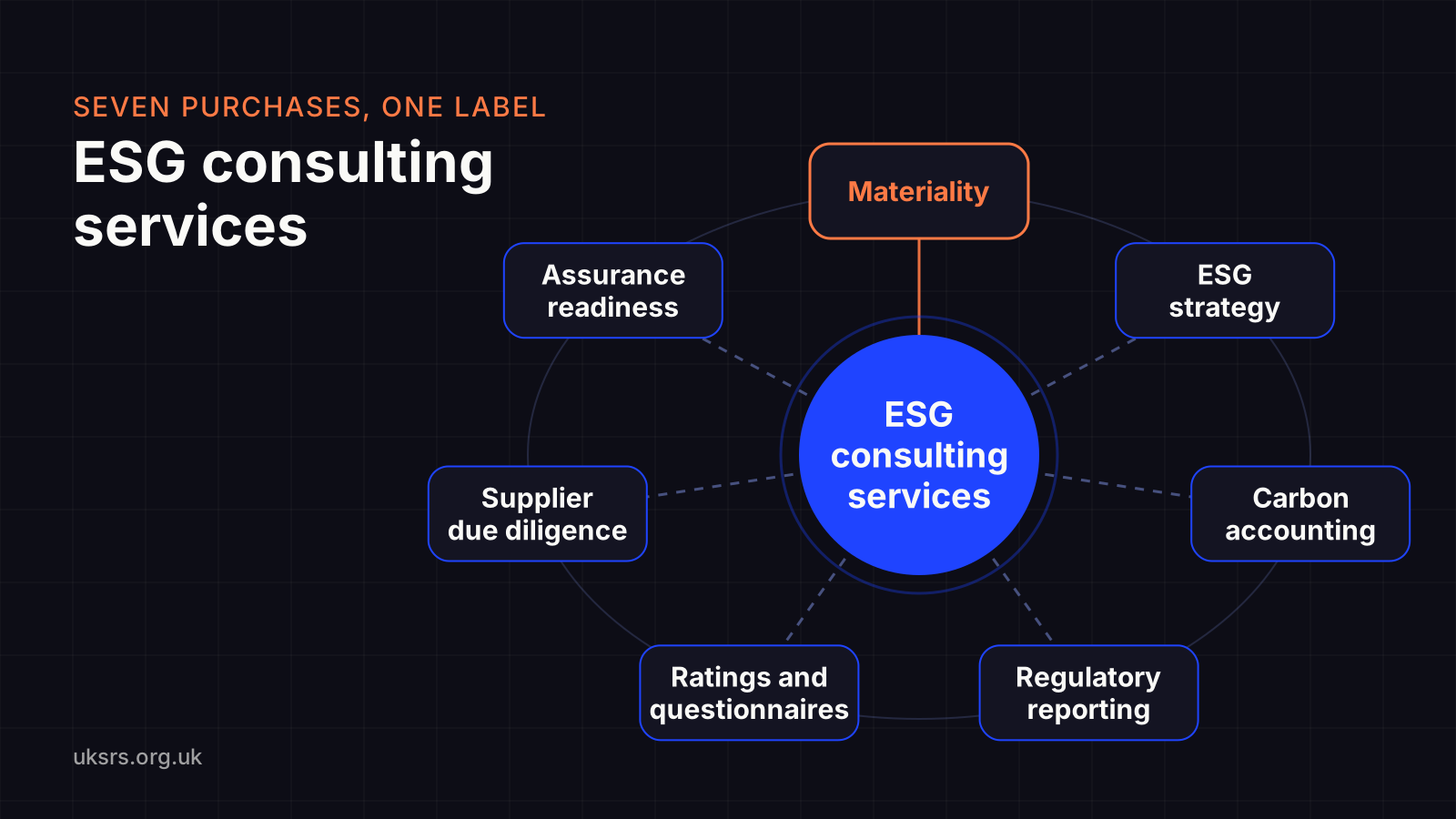
ESG consulting services as distinct purchases
Materiality: Document the topics and assessment method. Accounting: Deliver the inventory and calculation file.
Read the detailed guidance and references
- UK SRSpublished for voluntary use25 Feb 2026
- FCA PS26/19comply or explain, periods from1 Jan 2027
- CSRDscope after Omnibus I1,000 staff and €450m
- ISSA (UK) 5000effective for periods from15 Dec 2026
- Modern Slavery Actstatement threshold£36m turnover
- CSDDDscope after Omnibus I5,000 staff and €1.5bn
- UK Corporate Governance CodeProvision 29 applies from1 Jan 2026
| Service | You get | Usually bought by | You supply |
|---|---|---|---|
| Materiality or double materiality | Material topics, method and evidence, approved by the board | Head of sustainability, company secretary | Value chain map, risk register, stakeholder records |
| ESG strategy and targets | Priorities, targets and owners | Chief executive or finance director | Materiality result, baseline, budget limits |
| Carbon accounting | Scope 1, 2 and 3 inventory and calculation file | Finance or operations | Energy invoices, fleet and spend data |
| Regulatory reporting | Draft disclosures or the explanation | Company secretary and finance | Obligation tests, inventory, last annual report |
| Ratings and questionnaires | Responses and a reusable evidence pack | Sales, bids or sustainability | The questionnaire, policies, inventory |
| Supplier and due diligence | Risk screen, engagement plan, statement | Procurement or legal | Supplier list with spend and country |
| Governance and board training | Briefings, terms of reference, controls | Company secretary or chair | Terms of reference, risk framework |
| Assurance readiness | A review of the data trail and controls | Finance or audit committee | Draft disclosures and calculation files |
Buying ESG consulting services one line at a time is how you get proposals you can compare.
A proposal that bundles all eight under “ESG support” cannot be checked against anything, because it names no deliverable.
This page is the catalogue; the question of which firm suits your obligation is answered on the ESG consultant page, and the buying process on how to choose a sustainability consultant.
Read across a row and you have the outline of a scope: what you get, who inside the company normally buys it, and what you will have to hand over.
Module 01 / 04
Materiality
Module 02 / 04
Accounting
Module 03 / 04
Reporting
Module 04 / 04
Governance
Scope builder
Build the scope before anyone quotes
Tick the ESG consulting services you are considering and answer three questions about your position.
The panel puts the services in a working order, shows the deliverable and inputs for each, and flags anything bought out of sequence.
Read the detailed guidance and references
It also catches the one combination that causes the most trouble: the same firm preparing and assuring your disclosures.
Copy the result into an invitation and ask every provider to price the same lines.
Build your scope
Is the company listed in UKLR 6, 14, 15, 16 or 22?
Is the company quoted, or an unquoted company that does not meet two of SECR’s “not more than” conditions?
Is the group, or an EU subsidiary, above 1,000 employees and €450 million turnover?
Your scope, in order
1. Materiality or double materiality assessment
You get: A list of material sustainability topics, with the method, the evidence and the thresholds you chose, approved by the board or a committee.
Usually bought by: Head of sustainability or company secretary.
You supply: A value chain map, the risk register, stakeholder engagement records and, for the European standards, a list of impacts.
Good output: A record of which lens each topic passed: effect on cash flows, access to finance or cost of capital under UK SRS S1, plus impact under ESRS.
UK SRS S1 ¶¶3, 18, B19; ESRS 1 Chapter 3
2. Carbon accounting
You get: A Scope 1, 2 and 3 inventory for a stated year, with a written boundary, method and a calculation file you keep.
Usually bought by: Finance or operations.
You supply: Energy and fuel invoices, fleet and refrigerant records, and spend or activity data for the value chain.
Good output: A file another provider could repeat next year, using the government’s conversion factors for the year reported.
GHG Protocol Corporate Standard; DESNZ conversion factors
3. Regulatory reporting
You get: Draft disclosures, or the explanation, for the regime that applies: SECR, UK SRS under the FCA’s rules, or CSRD for an in-scope group.
Usually bought by: Company secretary and finance.
You supply: Your obligation tests, the inventory, governance documents and last year’s annual report.
Good output: Every disclosure mapped to its paragraph and, where you do not comply, a statement of what is missing, why, and the steps planned.
SI 2008/410 Sch 7 ¶20B; FCA PS26/19, UKLR 6.6.6R(7A)
Check your listing category first, because it decides whether UK SRS is comply or explain or voluntary for you (FCA PS26/19 ¶3.6).
An unquoted company is exempt if it meets two or more of: turnover not more than £36 million, balance sheet not more than £18 million, not more than 250 employees (SI 2008/410 Sch 7 ¶20B).
Test the group against both thresholds, cumulatively, before buying an ESRS-shaped assessment (Directive (EU) 2026/470).
A starting scope, not advice, that names no provider and prices nothing.
Nothing you choose is stored or sent.
Module 01 / 04
Decision
Module 02 / 04
Inputs
Module 03 / 04
Deliverable
Module 04 / 04
Acceptance
Materiality
Materiality: the purchase that sets the rest
Of all the ESG consulting services, a materiality assessment is the one that decides which topics every later piece of work will cover.
A weak one makes every later invoice larger.
Read the detailed guidance and references
Under UK SRS S1 ¶3, the test is whether a sustainability-related risk or opportunity could reasonably be expected to affect cash flows, access to finance or cost of capital.
The standard sets no materiality threshold (¶B19), so the method and the reasoning are the deliverable, not a score.
For a group in CSRD scope, the revised European standards in Delegated Regulation (EU) 2026/1563 add impact materiality, which makes the work a double materiality assessment.
The method, the scoring and who can ask you for one are set out in the double materiality assessment guide.
UK SRS S1 asks whether a topic could affect cash flows, access to finance or cost of capital.
The revised ESRS add the impact perspective: the company’s effect on people and the environment.
Buy the second only if the European standards reach you or your parent.
Module 01 / 03
Financial
Module 02 / 03
Impact
Module 03 / 03
Framework
Order of work
Strategy and carbon accounting, in the right order
Boundary: Fix the organisation and reporting period. Inventory: Establish the numbers and their working.
Read the detailed guidance and references
- sets the boundary
- gives the base year
- becomes disclosure
- is tested
An ESG strategy without a baseline produces targets nobody can measure against, and a baseline without materiality measures the wrong things.
Carbon accounting under the GHG Protocol Corporate Standard is the service most often bought alone, and the one most often redone when the boundary changes.
A good inventory file uses the government’s conversion factors for the year reported and can be repeated by a different provider.
What a UK strategy has to show, and to whom, is covered on ESG strategy, and the measurement itself on carbon accounting.
Most ESG consultancy services feed the next one, and buying them out of order means paying twice for the same data.
- 1
Boundary
Fix the organisation and reporting period.
- 2
Inventory
Establish the numbers and their working.
- 3
Strategy
Connect material topics to decisions.
- 4
Reporting
Explain the results with a traceable evidence trail.
Regulatory reporting
Reporting: three regimes, three deliverables
Regulatory reporting is three different jobs depending on the regime, and the deliverable changes with each.
For SECR, it is energy and carbon figures in the directors’ report; a quoted company reports at any size, and an unquoted company is caught when it fails to meet two or more of the “not more than” conditions on turnover, balance sheet and employees.
Read the detailed guidance and references
For UK SRS, the FCA’s final rules ask listed companies in UKLR 6, 14, 15, 16 and 22 to report or explain for periods beginning on or after 1 January 2027.
The explanation is itself a deliverable: what is missing, why, and what steps are planned.
A company can use a one-year Scope 3 relief and a two-year relief for non-climate topics, stating that it does so.
For CSRD after Omnibus I, the scope is undertakings above both 1,000 employees and €450 million turnover, and the deliverable is reporting in the European standards’ shape.
The rules are set out on UK SRS S1 and S2, the SECR reporting guide and the CSRD Omnibus page.
- 18 Mar 2026Omnibus I in forceCSRD narrowed to 1,000 employees and €450 million, cumulatively.Directive (EU) 2026/470
- 1 Jan 2027UK SRS periods beginListed companies in UKLR 6, 14, 15, 16 and 22; first reports in 2028.FCA PS26/19 ¶3.12
Module 01 / 03
SECR
Module 02 / 03
UK SRS
Module 03 / 03
CSRD
Ratings and questionnaires
Ratings and questionnaires: evidence, not polish
Questionnaire work is often the first ESG consultancy service a supplier buys, because a customer asked rather than a regulator.
CDP scores what is in the response, and says that neither it nor its scoring partners verify the information.
Read the detailed guidance and references
A CDP score has no regulatory status in the UK, so the value lies in what the response makes you assemble.
EcoVadis awards medals by percentile and says a medal is not a certification or product label.
The deliverable worth paying for is an evidence pack you own, so next year’s answers come from your files rather than the consultant’s memory.
What you must answer and what you can decline is set out in the ESG questionnaire guide.
Module 01 / 04
Request
Module 02 / 04
Evidence
Module 03 / 04
Submission
Module 04 / 04
Reuse
Supplier and due diligence
Supplier work bounded by what suppliers will tell you
Supplier and due diligence work covers a risk screen, an engagement plan and, where the law asks, a published statement.
Under section 54 of the Modern Slavery Act 2015, a commercial organisation that supplies goods or services must publish a slavery and human trafficking statement each year once it reaches the turnover threshold.
Read the detailed guidance and references
That threshold is £36 million total turnover, including subsidiaries, and it sits in SI 2015/1833, not in the Act.
The EU due diligence directive now reaches companies with more than 5,000 employees and more than €1.5 billion net worldwide turnover, according to the consolidated text.
Omnibus I also gave undertakings of 1,000 employees or fewer the right to decline value-chain requests that go beyond the voluntary standard, which narrows what a customer can demand.
Good output says which suppliers were asked what and why, because a supplier programme is limited by co-operation, not consultant effort.
The EU directive is covered on CSDDD, and value-chain emissions on Scope 3 emissions.
Module 01 / 04
Purpose
Module 02 / 04
Coverage
Module 03 / 04
Evidence
Module 04 / 04
Response
Governance and board training
Board training and governance a reader can see
Governance work changes who oversees what, and board training makes that oversight real.
UK SRS S1 ¶27 asks a reporting company to identify the body or individual responsible for oversight, and how responsibilities appear in terms of reference.
Read the detailed guidance and references
Directors already owe the section 172 duty, which includes regard to the impact of the company’s operations on the community and the environment.
For companies applying the UK Corporate Governance Code 2024, Provision 29 extends the board’s declaration on material controls to narrative and ESG reporting controls, for financial years beginning on or after 1 January 2026.
So a useful deliverable is a set of terms of reference and a controls map, not a slide deck.
The detail is on ESG governance.
Module 01 / 04
Board
Module 02 / 04
Management
Module 03 / 04
Data owners
Module 04 / 04
Reviewer
Assurance readiness
Assurance readiness is not assurance
Readiness work checks that every reported figure can be traced to its source before an assurer looks at it.
The FRC issued ISSA (UK) 5000 for voluntary use, effective for periods beginning on or after 15 December 2026.
Read the detailed guidance and references
The FCA’s rules do not require assurance; a listed company states whether it obtained any and, if so, names the provider, what was assured and to what level.
The IESBA standards bar an assurer from taking management responsibility, and generally prohibit self-review services for public interest entities.
So the firm that prepares your figures, or reviews them for readiness, is usually not the firm that assures them.
Levels, standards and independence are explained in the sustainability assurance guide.
Module 01 / 04
Preparation
Module 02 / 04
Management
Module 03 / 04
Assurer
Module 04 / 04
Report
Buying
How to buy ESG consulting one service at a time
Scope: Same boundary and deliverables for each bidder. Effort: Days and grades tied to the proposed work.
Read the detailed guidance and references
The same six steps work whether you buy ESG consulting services from a large firm or a specialist.
This site ranks no firm and has assessed none; the wider market is described on the sustainability consulting firms guide.
If strategy is the main purchase, the sustainability strategy consultancy guide sets out the phases.
Module 01 / 04
Scope
Module 02 / 04
Effort
Module 03 / 04
Handover
Module 04 / 04
Exclusions
Illustrative brief · no consultancy assessed
A worked brief: a supplier receives two questionnaires
Scope the response work before commissioning a wider strategy. Keep a single reusable evidence pack and record which answers need management approval.
For the detailed requirements, see ESG questionnaire.
View the workflow diagram
- 1
Request
Name each questionnaire and deadline.
- 2
Evidence
Reuse controlled calculations, policies and source records.
- 3
Handover
Retain approved answers and the evidence index.
Each date has a different meaning
The relevant dates, in order
Check who the date applies to and whether it is publication, application, submission or a planned milestone.
- 25 February 202601
UK SRS published
Available for voluntary use; publication alone does not create a universal company duty. - 30 September 202602
- Periods from 1 January 202703
Listed-company application
UKLR 6, 14, 15, 16 and 22 report against the standards or explain. - 2028 / for calendar-year companies04
First reports under the new rule
Other year ends have their own annual-report timetable.
A suggested delivery sequence
From the brief to the handover
This is an editorial buying and preparation sequence, not a statutory timetable or a promise about how long the engagement takes.
- 01 / Brief01
Brief
Name the duty or decision and the required output. - 02 / Evidence02
Evidence
Collect records, methods and assumptions. - 03 / Preparation03
Preparation
Draft the calculations, disclosures or action plan. - 04 / Review04
Review
Resolve gaps and assign the relevant approvals. - 05 / Handover05
Handover
Keep editable working, ownership and update guidance.
Frequently asked
ESG consulting services, answered
What are ESG consulting services?
ESG consulting services are the separate pieces of work sold under the ESG label: a materiality assessment, an ESG strategy, carbon accounting, regulatory reporting, ratings and questionnaire responses, supplier and due diligence work, governance and board training, and assurance readiness.
Each has its own deliverable, its own buyer inside the company and its own inputs.
What does an ESG consultant actually deliver?
It depends on which service you buy.
A materiality assessment delivers a list of material topics with its method; carbon accounting delivers an inventory and a calculation file; regulatory reporting delivers draft disclosures or the explanation; assurance readiness delivers a review of the data trail.
Ask for the deliverable in writing before you compare proposals.
How much do ESG consulting services cost in the UK?
This site publishes no prices and does not estimate them.
Ask each provider for days by grade against a written scope, and for year two priced in the same proposal, so proposals can be compared line by line.
What is the difference between ESG consulting services and an ESG consultancy?
The firm is the consultancy; the services are what you buy from it. This page lists the services and what each delivers.
The ESG consultancy guide on this site starts from your legal obligation and explains which kind of firm fits it.
Do I need a double materiality assessment?
Only if the European standards apply to you or to a parent or customer that asks for one.
UK SRS S1 uses a single, financial test: whether a topic could affect cash flows, access to finance or cost of capital.
CSRD, after Omnibus I, reaches undertakings above both 1,000 employees and €450 million turnover, and its standards add an impact perspective.
Is UK SRS reporting mandatory?
No. Under the FCA’s final rules, companies listed in UKLR 6, 14, 15, 16 and 22 report against UK SRS on a comply-or-explain basis for accounting periods beginning on or after 1 January 2027.
The listing rule does not impose a general UK SRS duty on other companies; separate legal, overseas and contractual requirements need their own checks.
Can the same firm prepare and assure our ESG report?
Not without independence problems.
The IESBA standards bar an assurance practitioner from taking management responsibility and generally prohibit self-review services for public interest entities.
Buy the preparation work and the assurance from different firms.
Do ESG consultants complete CDP and EcoVadis questionnaires?
Many offer it.
CDP scores what is in the response and does not verify it, and EcoVadis says its medal is not a certification.
The useful deliverable is an evidence pack you own and can reuse, not just a submitted form.
Which ESG consulting services does an SME need?
Usually fewer than it is offered.
An unquoted company that meets two of SECR’s “not more than” conditions has no SECR duty, so its needs are typically a carbon inventory and help answering customer questionnaires.
Buy those first and add services only when a customer, lender or rule asks.
Sources
Primary sources
Every figure, date and status on this page traces to the instrument’s owner.
Secondary commentary is never the source for a number.
- Department for Business and TradeUK SRS S1 (PDF), ¶¶3, 18, 27, B19
The materiality test, the governance disclosures and the absence of materiality thresholds.
- Department for Business and TradeUK SRS S2 (PDF), ¶¶14(a)(iv), 33–36
Transition plan disclosure and what each emissions target must state.
- Department for Business and TradeUK SRS S1 and UK SRS S2
Published 25 February 2026, available for voluntary use.
- Financial Conduct AuthorityPS26/19 (PDF), ¶¶1.2, 3.6, 3.12, 3.14, Appendix 1
Comply or explain for UKLR 6, 14, 15, 16 and 22 from 2027; reliefs; the assurance statement.
- Financial Conduct AuthorityPS26/19: Aligning listed issuers’ sustainability disclosures with international standards
Published 30 September 2026.
- legislation.gov.ukSI 2008/410 Schedule 7 paragraph 20B
SECR’s exemption: two or more “not more than” conditions.
- EUR-LexDirective (EU) 2026/470 (Omnibus I)
CSRD scope of 1,000 employees and €450 million, cumulative; the value-chain cap.
- EUR-LexDelegated Regulation (EU) 2026/1563 (revised ESRS), ESRS 1 Chapter 3
Impact and financial materiality.
- EUR-LexDirective (EU) 2024/1760 (CSDDD), consolidated 18 March 2026, Article 2
More than 5,000 employees and €1.5 billion net worldwide turnover.
- legislation.gov.ukModern Slavery Act 2015, section 54
The slavery and human trafficking statement.
- legislation.gov.ukSI 2015/1833, regulations 2 and 3
The £36 million total turnover threshold, including subsidiaries.
- CDPCDP scores
Scoring bands; CDP does not verify responses.
- EcoVadisEcoVadis Medals and Badges
Percentile medals; “not a certification or product label”.
- Financial Reporting CouncilUK Corporate Governance Code 2024
Provision 29 covers controls over narrative and ESG reporting from 1 January 2026.
- legislation.gov.ukCompanies Act 2006, section 172
Directors’ duty, including regard to the community and the environment.
- Financial Reporting CouncilISSA (UK) 5000 (PDF), ¶15
Effective for periods beginning on or after 15 December 2026; issued for voluntary use.
- Financial Reporting CouncilFRC takes steps to support quality in sustainability assurance (12 November 2025)
Issue of ISSA (UK) 5000.
- IESBAIESSA Technical Overview (January 2025)
Management responsibility and self-review.
- Greenhouse Gas ProtocolCorporate Standard
Inventory boundaries and method.
- Department for Energy Security and Net ZeroGreenhouse gas reporting: conversion factors 2026
The factors a UK inventory uses.
Continue reading
Read next
Which consultant you need
Start from the obligation, not the firm.
Double materiality assessment
The method under the revised ESRS.
Questionnaires from customers
What you must answer, and what you can decline.
Sustainability reporting consultancy
Which framework applies, then data, drafting and assurance readiness.
Sustainability strategy consultancy
Materiality, targets, transition plans and governance, phase by phase.
Sustainability consulting firms
Selection criteria tied to the law, and an unranked A–Z directory.