The consultant reads what you already do against ISO 14001:2026 and lists what is missing.
Ask for the gap list as a document you keep, with an owner beside each gap.
Ask direct questions about your own reporting — your thresholds, your dates, what you file and when.
Sign up free →The standards
Does it apply to you
Reporting under it
WHY REGISTER
Ask these pages about your own company.
Free · no card
Everything on this site stays open without an account.
Start here
Dates and penalties
Doing it
WHY REGISTER
Ask these pages about your own company.
Free · no card
Everything on this site stays open without an account.
What you must file
Doing it
WHY REGISTER
Ask these pages about your own company.
Free · no card
Everything on this site stays open without an account.
The UK duty
Doing it
WHY REGISTER
Ask these pages about your own company.
Free · no card
Everything on this site stays open without an account.
The baseline
Europe
Reporting more widely
WHY REGISTER
Ask these pages about your own company.
Free · no card
Everything on this site stays open without an account.
Carbon markets and trade
Packaging and net zero
Carbon accounting
WHY REGISTER
Ask these pages about your own company.
Free · no card
Everything on this site stays open without an account.
Choosing
Carbon
Compliance and offsets
WHY REGISTER
Ask these pages about your own company.
Free · no card
Everything on this site stays open without an account.
Software
Templates
Careers
WHY REGISTER
Ask these pages about your own company.
Free · no card
Everything on this site stays open without an account.
ASK ABOUT YOUR OWN REPORTING
Ask direct questions about your own reporting — your thresholds, your dates, what you file and when.
Sign up freeFree · one email · already registered? Log in
Everything on this site stays open without an account.
ISO 14001 consultancy · implementing an EMS
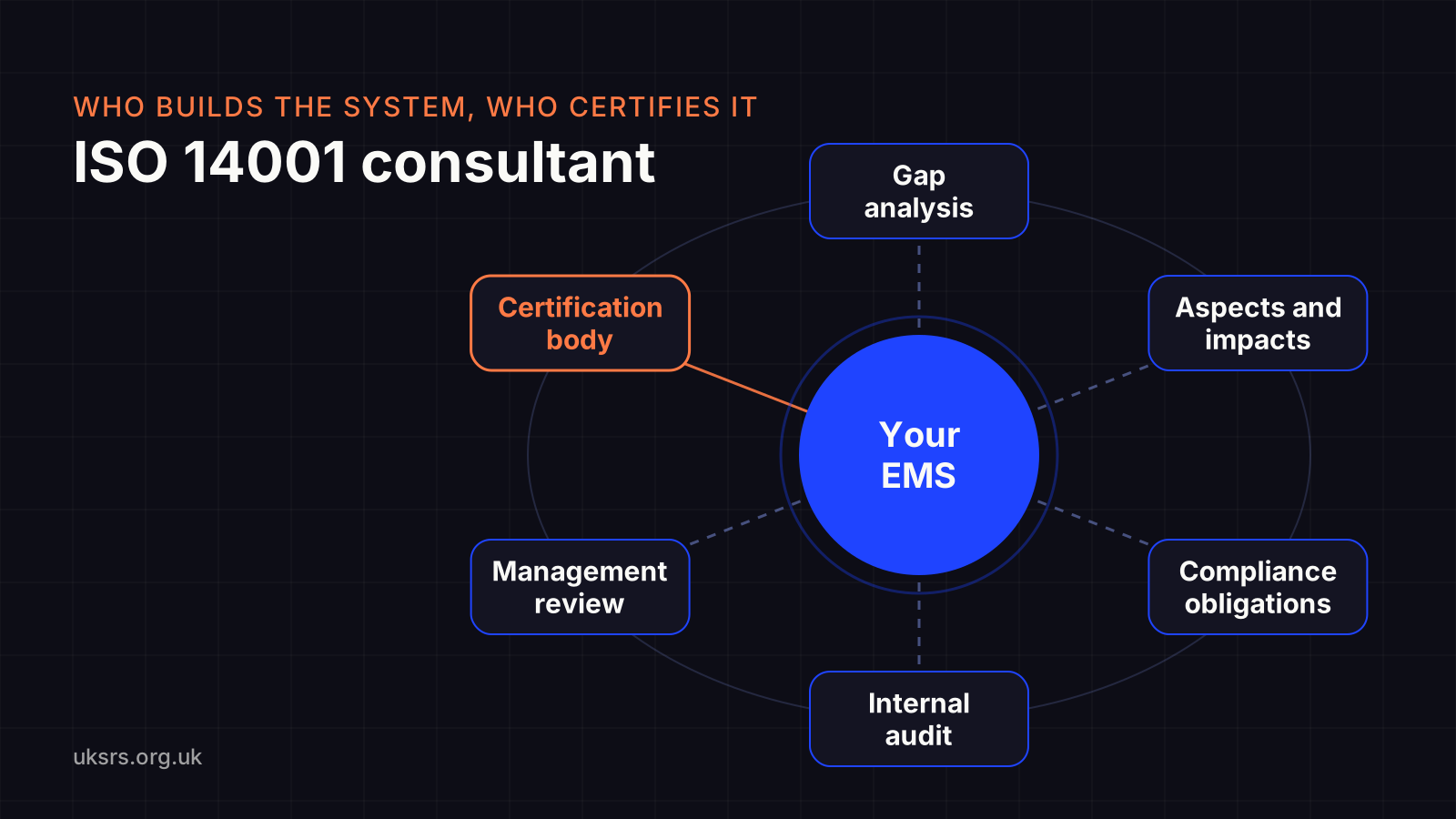
An ISO 14001 consultant helps build your environmental management system. A separate certification body audits it; your own management remains responsible for how the system works.
UK SRS is an independent reference site. We have assessed no consultancy and publish no consultancy prices or rankings.
The role
An ISO 14001 consultant helps you design, document and start running an environmental management system, then prepares you for an audit someone else will carry out.
The work is advice, drafting and training: a gap analysis, the procedures, the registers, and often the first internal audit.
The system remains yours, because the 2026 edition puts stronger accountability on top management.
A good ISO 14001 consultant leaves documents your own people can maintain, not a binder only the consultant understands.
The standard itself, its editions and what a certificate proves are set out on the ISO 14001 guide.
Module 01 / 04
Module 02 / 04
Module 03 / 04
Module 04 / 04
Independence
ISO/IEC 17021-1, the standard every accredited certification body works to, bars a certification body and its related entities from offering management system consultancy.
It also bars certification for two years after the body has provided internal audits to the client, or after a related body has consulted for it.
Those clauses sit behind ISO’s paywall, so this page summarises rather than quotes them.
In the UK, UKAS accredits EMS certification bodies against ISO/IEC 17021-1 with the ISO/IEC 17021-2 competence requirements.
UKAS is the national accreditation body under the Accreditation Regulations 2009, and its directory has no category for consultancies.
So an ISO 14001 consultancy can be good or poor, but it cannot be accredited, and a claim that it is should be checked.
The panel shows what each party may and may not put its name to; UKAS accreditation explains how to check a body.
Advises, or can sign?
May
May not
ISO/IEC 17021-1:2015 cl. 5.2.5–5.2.7; IESSA; SBTi
Module 01 / 04
Module 02 / 04
Module 03 / 04
Module 04 / 04
The edition
ISO published ISO 14001:2026 on 15 April 2026, and its Foreword says it cancels and replaces ISO 14001:2015 and the 2024 amendment.
ISO’s record for the 2015 edition now reads Withdrawn.
The UK dates come from the UKAS technical bulletin, and ISO itself sets no international end date.
UKAS says certification to the 2026 edition is accredited only after a body’s own positive UKAS decision, so ask any certification body for that date.
A consultant still working from the 2015 clause list is building to a withdrawn text.
The arithmetic behind the dates, and why some published deadlines are wrong, is on the ISO 14001:2026 page.
Module 01 / 04
Module 02 / 04
Module 03 / 04
Module 04 / 04
Implementation
Gap: Compare the current system with the requirements. Build: Create registers, controls and responsibilities.
The consultant reads what you already do against ISO 14001:2026 and lists what is missing.
Ask for the gap list as a document you keep, with an owner beside each gap.
The 2026 edition widens the context an organisation must understand to include climate change, biodiversity and ecosystem health.
The scope decides which sites and activities a certificate will name.
You identify how your activities, products and services affect the environment, and decide which effects are significant.
ISO says the 2026 edition reinforces the connection between aspects, compliance obligations and actions.
The system records the legal and other requirements that apply to you, often kept as a legal register, and how you meet each one.
This is where SECR and ESOS belong, if they apply, as obligations the system tracks rather than duties it discharges.
Top management sets environmental objectives aligned with the business’s direction, and the organisation plans how to reach them.
The 2026 edition adds Clause 6.1.4 on risks and opportunities and Clause 6.3 on planning changes, and covers externally provided processes, products and services.
A documented internal audit programme tests the system, and top management reviews the results.
ISO describes the 2026 edition as asking for rigorous internal audit and a more structured management review.
An accredited certification body, not your consultant, audits in two stages, and stage 2 takes place at your sites.
The certificate then runs a three-year cycle with surveillance audits in years one and two.
The order matters less than the evidence: an auditor reads what the system did, not what the manual says.
ISO describes the 2026 edition as asking for more evidence around external providers, documented internal audit programmes and management review.
That is why a gap analysis against the new edition is worth doing even for an organisation that already holds a 2015 certificate.
Most implementations follow the same seven stages, and the last one is the only one your consultant must stay out of.
Compare the current system with the requirements.
Create registers, controls and responsibilities.
Produce operating, audit and review evidence.
A separate body carries out certification.
Your plan
Tick what you already have, and the panel lists the stages left, in order, with who can do each.
Most stages are work an ISO 14001 consultant can do with you; objectives, operational control and management review are yours to own.
The audit is the certification body’s alone.
A shorter list is a smaller brief, and a smaller brief is easier to compare between firms.
Build your project plan
Your remaining plan: 9 stages
Read what you already do against the 2026 edition’s requirements and list the gaps.
An ISO 14001 consultant can do much of it with you.
ISO 14001:2026; UKAS bulletin, six areas of change
Set the system’s scope and record the issues and interested parties around it, including climate change.
An ISO 14001 consultant can do much of it with you.
ISO 14001:2026, Clauses 4.1 and 4.2
Identify the environmental aspects of your activities and decide which are significant.
An ISO 14001 consultant can do much of it with you.
ISO, what has changed
Keep a register of the legal and other requirements that apply, and how you meet them.
An ISO 14001 consultant can do much of it with you.
ISO, what has changed
Set environmental objectives in line with the business’s direction, and plan how to reach them.
Yours to run; a consultant can coach.
ISO, what has changed
Run the controls, including over externally provided processes, products and services.
Yours to run; a consultant can coach.
ISO, what has changed
Run a documented internal audit programme against the standard and your own rules.
An ISO 14001 consultant can do much of it with you.
ISO, what has changed
Top management reviews the system’s results and decides what changes.
Yours to run; a consultant can coach.
ISO, what has changed
An accredited certification body audits in two stages; stage 2 is at your sites.
Certification body only, never your consultant.
ISO/IEC 17021-1:2015 cl. 9.3.1
Build to ISO 14001:2026, not the 2015 edition: UKAS says certification bodies stop all new certificates to the old edition on 31 October 2027.
Sources: ISO 14001:2026 · ISO, what has changed · UKAS technical bulletin Revision 2 · ISO/IEC 17021-1:2015
Module 01 / 04
Module 02 / 04
Module 03 / 04
Module 04 / 04
ESOS
The Energy Savings Opportunity Scheme is the duty most often confused with ISO 14001, and the two do not overlap in law.
Since the 2026 amendment regulations came into force on 22 July 2026, ESOS Phase 4 has two compliance routes: an ESOS energy audit, or ISO 50001.
Where ISO 50001 certification covers total or significant energy consumption, the participant is treated as having met the lead assessor, audit and report duties, and still notifies compliance.
ISO 14001 is not a route, though the energy data an environmental management system collects can feed either one.
The Environment Agency’s Phase 4 guidance sets the qualification date at 31 December 2026 and the compliance date at 5 December 2027.
If ESOS is the deadline, the specialists are on ESOS consultants and assessors, and the comparison on ISO 50001 versus ESOS.
Module 01 / 04
Module 02 / 04
Module 03 / 04
Module 04 / 04
Carbon reporting
An environmental management system is a way of running things, while carbon reporting produces a number, and the UK’s duties ask for the number.
SECR is a disclosure in a qualifying company’s own annual report, and an ISO 14001 certificate does not discharge it.
For listed companies in scope, the FCA’s final rules ask for reporting against UK SRS on a comply-or-explain basis for periods beginning on or after 1 January 2027.
UK SRS S2 ¶29(a) asks for absolute gross greenhouse gas emissions by scope, which is an inventory, not a management system.
The inventory standard is ISO 14064-1 or the GHG Protocol, and the method is on carbon accounting.
Where the two meet is the compliance obligations register and the data controls: an EMS that tracks energy and fuel well makes the carbon figures easier to defend.
Which carbon duties apply to you in the first place is the starting point of carbon compliance consultancy.
If the report is the real deliverable, a sustainability reporting consultancy is the closer brief.
Module 01 / 04
Module 02 / 04
Module 03 / 04
Module 04 / 04
Hiring
Say which edition you want: ISO 14001:2026.
Say which sites and activities the certificate should cover, because the scope drives the work and the audit days.
Say which stages you want help with, using the plan above, and which you will run yourselves.
Ask who will do the work, what similar systems they have built, and who owns the documents at the end.
Ask the consultant to confirm in writing that it has no link to the certification body you intend to use.
This site names no firm, ranks none and quotes no price; the selection process is in how to choose a sustainability consultant, and the wider brief on ESG consultancy.
Module 01 / 04
Module 02 / 04
Module 03 / 04
Module 04 / 04
At the end
Organisation: Name the certified entity. Scope: Read the sites and activities covered.
A certificate should name the edition, the sites and activities in scope, the issuing body and its accreditation.
Check the body in the UKAS directory and the certificate in CertCheck.
ISO itself certifies no one, so a certificate “from ISO” is a red flag.
The government’s guidance recognises only UKAS accreditation of organisations operating in the UK.
Clause 1 of the standard says it does not state specific environmental performance criteria.
A certificate shows a working system, not falling emissions, so a buyer asking for performance needs a measured figure as well.
Module 01 / 04
Module 02 / 04
Module 03 / 04
Module 04 / 04
Illustrative brief · no consultancy assessed
Build against the 2026 edition and agree a separate certification contract. Check the certification body’s UKAS transition status before describing its new-edition certificate as accredited.
For the detailed requirements, see ISO 14001.
Registers, controls, responsibilities and operating evidence.
Internal audit and management review.
A separate body, relevant accreditation and scope.
Each date has a different meaning
Check who the date applies to and whether it is publication, application, submission or a planned milestone.
A suggested delivery sequence
This is an editorial buying and preparation sequence, not a statutory timetable or a promise about how long the engagement takes.
Frequently asked
An ISO 14001 consultant helps an organisation build and run an environmental management system that meets the standard: a gap analysis, the scope and context, the environmental aspects and compliance obligations, objectives, internal audit and preparation for certification.
The consultant does not certify the system; an accredited certification body does that, and it must be a different organisation.
No. ISO/IEC 17021-1, the standard certification bodies work to, bars a certification body from offering management system consultancy, and bars it from certifying a client for two years after providing internal audits or, through a related body, consultancy.
A firm offering both to implement and to certify your system is offering something those rules do not allow.
No. ISO 14001 certifies an organisation’s management system, and UKAS accredits certification bodies, not consultants.
A consultancy may hold ISO 14001 for its own system, and individuals may hold auditor training or professional membership, but neither makes the consultancy accredited.
ISO 14001:2026, the fourth edition, published on 15 April 2026.
It cancels and replaces ISO 14001:2015 and its 2024 amendment, and ISO lists the 2015 edition as withdrawn.
For UK-accredited certification, UKAS says bodies stop all new certifications to the previous version on 31 October 2027.
There is no published standard time, and this site does not estimate one.
What sets the length is how much of the system already exists, which a gap analysis shows, and the certification body’s audit dates.
The certification itself has a two-stage initial audit, then surveillance audits in years one and two and recertification in year three.
This site quotes no prices and has assessed no firm’s fees.
Ask each consultancy for a written scope that names the stages it will do, the days by grade, what you will do yourselves, and who owns the documents at the end.
The certification body’s audit fees are a separate contract with a separate organisation.
No. Since 22 July 2026 ESOS Phase 4 has two compliance routes, an ESOS energy audit or ISO 50001 certification covering total or significant energy consumption.
ISO 14001 is not one of them, though an environmental management system’s energy data can feed either route.
No. ISO 14001 is a voluntary standard and discharges no UK legal duty.
SECR is a disclosure in a qualifying company’s own annual report, and UK SRS S2 asks listed companies in scope for gross greenhouse gas emissions on a comply-or-explain basis from 2027.
An environmental management system can make that data more reliable, but it does not produce the disclosure.
Yes.
Nothing in the standard requires outside help, and section 0.5 even lets an organisation self-declare conformity without a certificate.
A consultant is most useful for the gap analysis, the compliance obligations register and the first internal audit, where an outside view saves time.
Sources
Every figure, date and status on this page traces to the instrument’s owner.
Secondary commentary is never the source for a number.
The current edition, published 15 April 2026; Foreword, Clause 1 and §§0.3 and 0.5.
The withdrawn edition, and ISO’s instruction to consult the certification body on transition.
Publication date and the 670,000 certified organisations figure.
Aspects and compliance obligations, documented internal audit programmes, management review, Clauses 6.1.4 and 6.3.
The UK transition dates and the rule that certificates issued before a body’s UKAS decision are unaccredited.
How EMS certification bodies are accredited.
The directory: certification, testing and inspection bodies, with no consultancy category.
Free verification of a UKAS-accredited certificate.
Certification and accreditation, defined by ISO.
Clauses 5.2.5–5.2.8 (no consultancy; two-year bars) and 9.1.3, 9.3.1 (the cycle and the two-stage audit).
UKAS appointed as the UK’s national accreditation body.
Government recognises only UKAS accreditation of organisations operating in the UK.
The standard with a defined role in ESOS.
Phase 4 routes: the ESOS energy audit or ISO 50001, from 22 July 2026.
Qualification date 31 December 2026; compliance date 5 December 2027.
SECR, which an ISO 14001 certificate does not discharge.
Absolute gross greenhouse gas emissions by scope.
The standard that produces an emissions number; ISO 14001 produces a system.
Comply or explain across UK SRS for UKLR 6, 14, 15, 16 and 22, periods from 1 January 2027.
Continue reading
Editions, transition dates and what a certificate proves.
How to check a certification body’s accreditation.
The lead assessor duty and the approved registers.
Which carbon duties apply, and who may do each piece of work.
What an SECR consultant does, and whether you need one.
Selection criteria tied to the law, and an unranked A–Z directory.