A UK guide · primary-source evidence
SBTi target examples
SBTi target examples from historical Tesco and AstraZeneca case studies. Read scopes, base years, deadlines and status without confusing ambition with achievement.
Explore a module, read its source and follow the dedicated guide when you need the detail.
Read the examples / 01
SBTi target examples: Tesco’s historical target
Read the complete primary source alongside the explanation and its limits.
Reading check 1
Scope and baselineKeep the source and qualification attached.Reading check 2
Value chainKeep the source and qualification attached.Reading check 3
Delivery planningKeep the source and qualification attached.Module 01 / 04
Scope and baseline
Module 02 / 04
Value chain
Module 03 / 04
Delivery planning
Module 04 / 04
Current status
Read the examples / 02
SBTi net-zero examples: AstraZeneca’s different horizons
Read the complete primary source alongside the explanation and its limits.
Reading check 1
OperationsKeep the source and qualification attached.Reading check 2
Value chainKeep the source and qualification attached.Reading check 3
Different basesKeep the source and qualification attached.Module 01 / 04
Operations
Module 02 / 04
Value chain
Module 03 / 04
Different bases
Module 04 / 04
Reading the example
Read the examples / 03
SBTi supplier engagement examples: the denominator matters
Read the complete primary source alongside the explanation and its limits.
Reading check 1
Spend coverageKeep the source and qualification attached.Reading check 2
Separate categoriesKeep the source and qualification attached.Reading check 3
Action and trackingKeep the source and qualification attached.Module 01 / 04
Spend coverage
Module 02 / 04
Separate categories
Module 03 / 04
Action and tracking
Module 04 / 04
Limit
Read the examples / 04
Read an SBTi target in four parts
Read the complete primary source alongside the explanation and its limits.
Continue with the Science-based targets criteria guide for the related question.
Reading check 1
MetricKeep the source and qualification attached.Reading check 2
Base yearKeep the source and qualification attached.Reading check 3
Target yearKeep the source and qualification attached.Module 01 / 04
Metric
Module 02 / 04
Base year
Module 03 / 04
Target year
Module 04 / 04
Boundary
Read the examples / 05
A worked reduction example, clearly illustrative
Read the complete primary source alongside the explanation and its limits.
Continue with the How to set science-based targets guide for the related question.
Reading check 1
Starting quantityKeep the source and qualification attached.Reading check 2
Illustrative reductionKeep the source and qualification attached.Reading check 3
What it omitsKeep the source and qualification attached.Module 01 / 04
Starting quantity
Module 02 / 04
Illustrative reduction
Module 03 / 04
What it omits
Module 04 / 04
Practical use
Read the examples / 06
Commitment, validation and progress are different evidence
Read the complete primary source alongside the explanation and its limits.
Continue with the SBTi hub guide for the related question.
Reading check 1
CommitmentKeep the source and qualification attached.Reading check 2
ValidationKeep the source and qualification attached.Reading check 3
PerformanceKeep the source and qualification attached.Module 01 / 04
Commitment
Module 02 / 04
Validation
Module 03 / 04
Performance
Module 04 / 04
Responsible quoting
Read the examples / 07
Turn an SBTi example into a better brief
Read the complete primary source alongside the explanation and its limits.
Continue with the SBTi consultancy guide for the related question.
Reading check 1
RouteKeep the source and qualification attached.Reading check 2
InventoryKeep the source and qualification attached.Reading check 3
ProgrammeKeep the source and qualification attached.Module 01 / 04
Route
Module 02 / 04
Inventory
Module 03 / 04
Programme
Module 04 / 04
Timing
A reading and preparation sequence
Science-based targets: from the question to the evidence
- Step 101
SBTi target examples: Tesco’s historical target
SBTi’s Tesco case study records targets approved in June 2017. This is an example of target wording and preparation, not a statement of Tesco’s current 2026 targets or achievements. - Step 202
SBTi net-zero examples: AstraZeneca’s different horizons
The SBTi case study illustrates why near-term operations and longer-term value-chain targets should be read separately. Its historical wording is not verified here as the current target record. - Step 303
SBTi supplier engagement examples: the denominator matters
A supplier-engagement target measures the share of suppliers meeting a condition. It is not the same metric as a percentage reduction in tonnes of emissions. - Step 404
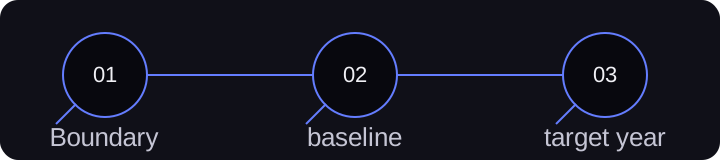
Read an SBTi target in four parts
A target is a bounded statement. Keep its metric, baseline, deadline and emissions boundary together whenever you quote it. - Step 505
A worked reduction example, clearly illustrative
This arithmetic example is fictional and teaches how an absolute percentage works. It is not an SBTi-approved target or a recommended ambition level.
Dates, with their status
The relevant dates, drawn in order
- 11 June 202601
V2.0 published
Publication is distinct from the opening of target validation. - 1 February 202702
General corporate V2.0 validation opens
Check financial-institution and sector-specific availability separately. The general corporate opening is not a promise that every route is available. - 31 January 202803
V1.3.1 submission window closes
The final date for submissions through the general V1.3.1 corporate transition window. - 1 February 202804
New corporate submissions use V2.0
Apply the relevant route and sector guidance; existing validated targets are not retrospectively invalidated by the transition.
Continue your research
Related reporting guides, one question at a time
Frequently asked
Questions people ask
What does SBTi stand for?
SBTi stands for the Science Based Targets initiative. It develops standards and guidance for science-based corporate target-setting.
SBTi Services assesses submissions through the applicable validation route.
Does SBTi validation mean a target has been achieved?
No. Validation assesses the target against the applicable criteria.
Progress and achievement need separate reported emissions and performance evidence.
Are the Tesco and AstraZeneca examples current targets?
This guide uses historical SBTi case studies to explain target wording and preparation.
It does not verify them as current 2026 targets or establish achievement.
Check the official dashboard and current company reporting.
Is SBTi mandatory for UK SRS reporting?
SBTi target-setting and UK SRS disclosure are separate frameworks.
UK SRS reporting obligations depend on the applicable rules; SBTi validation does not settle the company’s statutory scope or complete its disclosures.
When does corporate V2.0 validation open?
General corporate V2.0 validation opens on 1 February 2027.
V1.3.1 general corporate submissions close on 31 January 2028; from 1 February 2028 new corporate submissions use V2.0 under the applicable route.
Check financial-institution and sector-specific availability separately.
Sources
Primary sources
Every figure, date and status on this page traces to the instrument’s owner.
Secondary commentary is never the source for a number.
- SBTi / SBTi ServicesAbout SBTi
- SBTi / SBTi ServicesStandards and guidance
- SBTi / SBTi ServicesHow target-setting works
- SBTi / SBTi ServicesTarget Dashboard
- SBTi / SBTi ServicesCorporate Net-Zero Standard V2.0
- SBTi / SBTi ServicesSME validation route
- SBTi / SBTi ServicesFinancial institutions
- SBTi / SBTi ServicesForest, land and agriculture guidance
- SBTi ServicesCorporate V2.0 transition guide
- SBTi ServicesTarget Validation Service Offerings
- DBTUK Sustainability Reporting Standards
- SBTiHistorical Tesco case study
Historical wording and approach; current status and achievement must be checked separately.
- SBTiHistorical AstraZeneca net-zero case study
Historical wording and approach; current status and achievement must be checked separately.
- SBTiHistorical AstraZeneca supplier-engagement case study
Historical wording and approach; current status and achievement must be checked separately.