Risk and adaptation
Physical and transition risk, scenario analysis, resilience, adaptation plans, and the disclosures UK SRS S2, the Companies Act or the pension rules ask for.
UK SRS S2 ¶¶10, 22Ask direct questions about your own reporting — your thresholds, your dates, what you file and when.
Sign up free →The standards
Does it apply to you
Reporting under it
WHY REGISTER
Ask these pages about your own company.
Free · no card
Everything on this site stays open without an account.
Start here
Dates and penalties
Doing it
WHY REGISTER
Ask these pages about your own company.
Free · no card
Everything on this site stays open without an account.
What you must file
Doing it
WHY REGISTER
Ask these pages about your own company.
Free · no card
Everything on this site stays open without an account.
Start here
Setting targets
Who and where
WHY REGISTER
Ask these pages about your own company.
Free · no card
Everything on this site stays open without an account.
The UK duty
Doing it
WHY REGISTER
Ask these pages about your own company.
Free · no card
Everything on this site stays open without an account.
The baseline
Europe
Reporting more widely
WHY REGISTER
Ask these pages about your own company.
Free · no card
Everything on this site stays open without an account.
Carbon markets and trade
Packaging and net zero
Carbon accounting
WHY REGISTER
Ask these pages about your own company.
Free · no card
Everything on this site stays open without an account.
Choosing
Carbon
Compliance and offsets
WHY REGISTER
Ask these pages about your own company.
Free · no card
Everything on this site stays open without an account.
Software
Templates
Careers
WHY REGISTER
Ask these pages about your own company.
Free · no card
Everything on this site stays open without an account.
ASK ABOUT YOUR OWN REPORTING
Ask direct questions about your own reporting — your thresholds, your dates, what you file and when.
Sign up freeFree · one email · already registered? Log in
Everything on this site stays open without an account.
Climate consultants · risk, adaptation and transition
Climate change consultancy is two jobs: understanding the climate risks to the organisation, and planning its own transition to a lower-carbon economy.
UK SRS is an independent reference site. We have assessed no consultancy and publish no consultancy prices or rankings.
The work
A climate change consultancy answers two different questions, and a good brief says which one you are buying.
The first is what climate change, and the world’s response to it, could do to your organisation: climate risk, scenario analysis and adaptation.
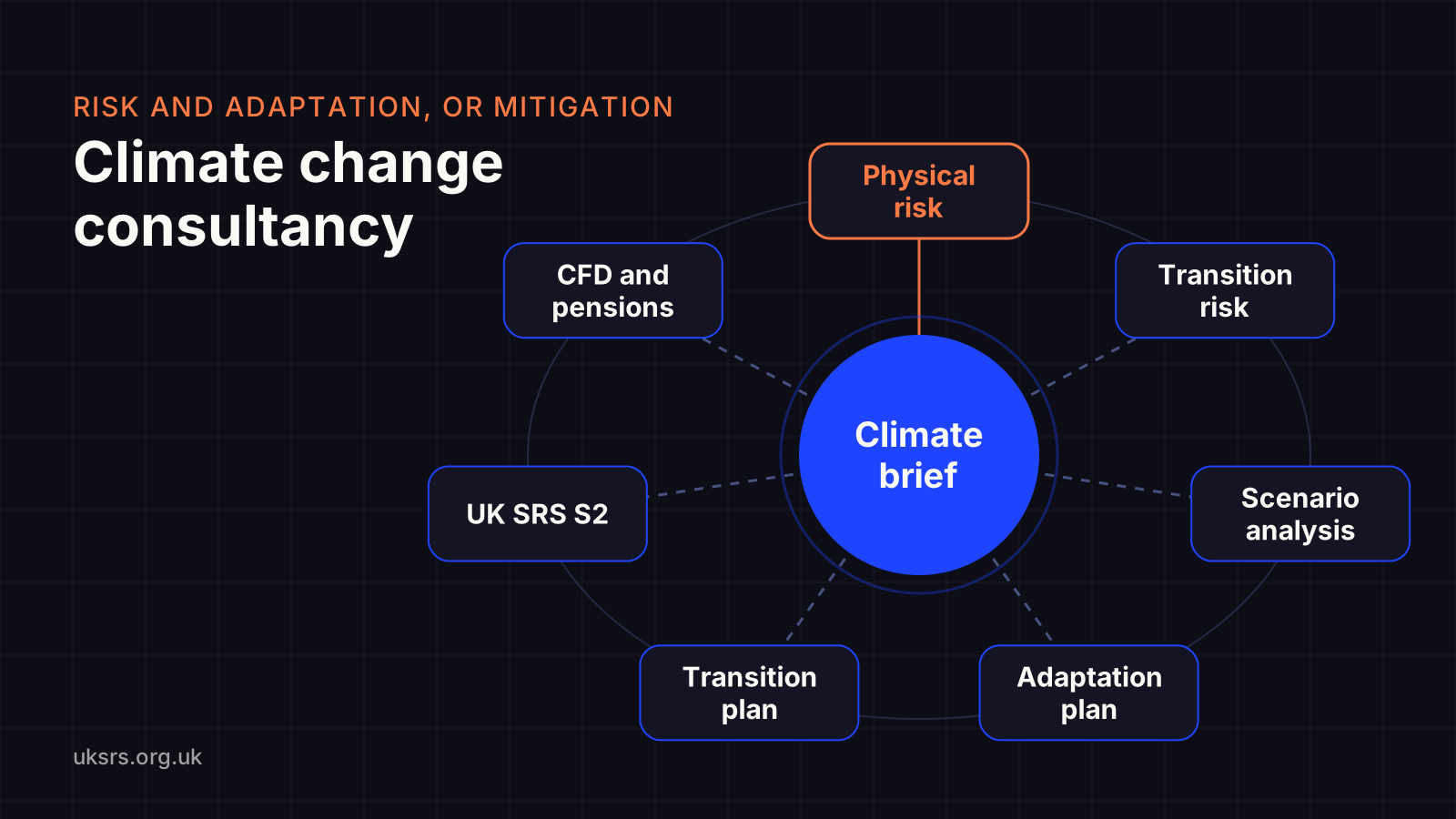
A climate brief
Physical and transition risk, scenario analysis, resilience, adaptation plans, and the disclosures UK SRS S2, the Companies Act or the pension rules ask for.
UK SRS S2 ¶¶10, 22The organisation’s own transition: targets, actions and resources set out in a transition plan, and the projects that deliver it.
UK SRS S2 ¶14(a)(iv), Appendix AThe second is what the organisation will do about its own emissions: mitigation, held together in a transition plan.
The same scenarios and emissions data feed both, which is why one climate consultancy often bids for both.
The on-site projects behind a plan, such as heat, fleet and power, are covered on decarbonisation consultancy, and targets on net zero consultancy.
Module 01 / 04
Module 02 / 04
Module 03 / 04
Module 04 / 04
Climate risk
UK SRS S2 asks for each climate-related risk to be classed as a physical risk or a transition risk, at paragraph 10(b).
It also asks over which time horizon each effect could occur, and how the entity defines short, medium and long term against its own planning horizons, at paragraph 10(c) and (d).
Those last two limbs are the ones climate risk work most often drops, so ask a consultant to show them in the risk register.
The metrics follow the same split: the amount and percentage of assets or business activities vulnerable to transition risks, and to physical risks, at paragraph 29(b) and (c).
Physical risk is usually local, so a climate risk consultancy should name its hazard data and the resolution it was run at.
The Met Office’s UKCP18 provides UK climate model projections, and the Environment Agency’s long-term flood risk service gives the risk of an area, not a specific property.
The full paragraph map is on the UK SRS S2 guide.
Module 01 / 04
Module 02 / 04
Module 03 / 04
Module 04 / 04
Scenario analysis
UK SRS S2 paragraph 22 reads: “The entity shall use climate-related scenario analysis to assess its climate resilience using an approach that is commensurate with the entity’s circumstances.”
What scales with the entity is the method, not the duty: an entity highly exposed to climate risk, and with the resources, is required to use a more advanced quantitative approach under ¶B17.
The analysis can follow a multi-year planning cycle, but ¶B18 says “an assessment of the entity’s resilience is required to be carried out annually”.
The disclosure asks which scenarios were used and their sources, the key assumptions, and the reporting period in which the analysis was carried out, at ¶22(b).
The TCFD’s 2020 guidance on scenario analysis is still the most-used method note, and it is guidance from a disbanded body, never a requirement.
For the UK, the Climate Change Committee’s technical report for CCRA4 used a central case reaching about 2°C of warming by 2050 and a high case reaching up to 4°C by 2100, which is a useful published pair to compare against, according to the CCRA4-IA Technical Report.
Ask a climate consultant which scenarios they propose, why those, and what the board is expected to decide differently as a result.
Module 01 / 04
Module 02 / 04
Module 03 / 04
Module 04 / 04
TCFD
The Task Force on Climate-related Financial Disclosures disbanded on 12 October 2023, and the FSB asked the IFRS Foundation to take over monitoring of companies’ climate disclosures, according to the Financial Stability Board.
Its 2017 Final Report set four recommendations and eleven recommended disclosures beneath them, at Figure 4.
That structure survives in three UK places: the Companies Act climate disclosures, the pension scheme regulations and UK SRS S2, which builds on it.
So a buyer looking for TCFD consultants today is usually buying one of those three, and the brief should name which.
The IFRS Foundation’s TCFD page describes the hand-over, and the recommendations remain online.
The framework itself is explained on the TCFD framework guide.
Module 01 / 04
Module 02 / 04
Module 03 / 04
Module 04 / 04
Who has to
Three UK regimes ask for TCFD-shaped climate work, and each reaches a different population.
For listed companies, the FCA’s PS26/19 sets comply-or-explain reporting against UK SRS S1 and S2 for UKLR 6, 14, 15, 16 and 22, for periods beginning on or after 1 January 2027.
| Regime | Who | What the climate work must produce | Basis |
|---|---|---|---|
| UK SRS via the Listing Rules | Companies in UKLR 6, 14, 15, 16 and 22 | UK SRS S1 and S2 disclosures, or an explanation of what is missing | FCA PS26/19; UKLR 6.6.6R(7A)–(7B) |
| Climate-related financial disclosures | UK companies with over 500 employees and over £500m turnover, and certain others | Eight disclosures, including resilience under different climate scenarios | CA 2006 s.414CB(2A)(a)–(h) |
| Pension scheme climate reporting | Trustees of schemes with £1bn or more, authorised master trusts and CDC schemes | Governance, scenario analysis, metrics, a target and a published report | SI 2021/839 |
| Adaptation reporting | Public bodies and statutory undertakers invited by Defra | A climate risk assessment and adaptation action plan | Climate Change Act 2008 s.62 |
The government has confirmed that UK SRS S2 is a national reporting framework for the Companies Act, so a company reporting under it need not duplicate its climate disclosures, according to the DBT consultation response.
Pension trustees must run scenario analysis in the first scheme year the duties apply and at least every three scheme years after, under DWP’s statutory guidance.
UK SRS is not “mandatory” for listed companies: the rule is disclose, or explain what is missing and why.
The company-law regime is on climate-related financial disclosures, and the trustee rules on pension scheme climate reporting.
Module 01 / 04
Module 02 / 04
Module 03 / 04
Module 04 / 04
Adaptation
Section 62 of the Climate Change Act 2008 lets the Secretary of State direct a reporting authority to report on “the current and predicted impact of climate change in relation to the authority’s functions” and its proposals for adapting, under section 62(1).
Defra says “The power was used in the first round of reporting but it has been voluntary since then”, in its fourth round guidance summary.
The fourth round closed on 31 December 2024, with invited reports from sectors including energy, water, telecoms, transport and finance, and a pilot with local government, according to the same guidance; the reports are published in the fourth round reports collection.
Defra expects the fifth round to start in late 2026 and run until late 2029.
Section 56 requires a UK climate change risk assessment every five years, and the third was published on 17 January 2022, according to Defra.
The Climate Change Committee published its independent assessment for the fourth on 20 May 2026, and says the government must lay its assessment before Parliament by January 2027, in A Well-Adapted UK.
The accompanying technical report identifies 41 risks and 2 opportunities across the four nations, so a climate adaptation consultancy citing the 2017 assessment is two cycles out of date.
Module 01 / 04
Module 02 / 04
Module 03 / 04
Module 04 / 04
Mitigation
UK SRS S2 asks for information about “any climate-related transition plan the entity has”, including key assumptions and dependencies, at ¶14(a)(iv).
The FCA’s PS26/19 states at ¶2.36 that UK SRS S2 does not require entities to have a climate-related transition plan.
Companies in UKLR 6, 16 and 22 must state whether they have published a plan and where, or why not, under UKLR 6.6.6R(8)(e).
The government’s consultation on transition plan requirements closed on 17 September 2025, and on 11 October 2026 its page still offered no outcome.
The Transition Plan Taskforce disbanded in October 2024, and its Disclosure Framework is hosted by the IFRS Foundation under a notice that the Foundation is not responsible for its accuracy.
The IFRS Foundation’s guidance of 23 June 2025 says it does not add to or change the requirements in IFRS S2.
The reporting side is on UK SRS transition plans, and the content of a plan on the climate transition plan guide.
Module 01 / 04
Module 02 / 04
Module 03 / 04
Module 04 / 04
Before you call anyone
Brief a climate change consultancy with the rule that reaches you, the assets you depend on and what you already have, because those decide the work.
Answer the four questions and the panel lists the workstreams, each with the rule or source behind it.
Attach any TCFD report, risk register or emissions inventory you already have, so nobody is paid to rebuild it.
Which climate work do you need?
From accounting periods beginning on or after 1 January 2027 you report against UK SRS S1 and S2 on a comply-or-explain basis: disclose, or say what is missing, why and what you are doing about it.
FCA PS26/19; UKLR 6.6.6R(7A)–(7B)
Paragraph 22 requires climate-related scenario analysis commensurate with your circumstances; it may follow your planning cycle, but the resilience assessment is annual.
UK SRS S2 ¶22, ¶B18
Map sites and suppliers against heat, flood and water hazards using UK projections, then decide which risks need an adaptation plan with owners and dates.
Met Office UKCP18; Environment Agency long-term flood risk service (area, not property)
No UK rule requires you to have one; the government consulted in 2025 and has published no outcome, so a plan written now is voluntary.
DESNZ transition plan consultation (closed 17 September 2025)
Start from it: TCFD’s four pillars and eleven recommended disclosures map onto UK SRS S2, which goes further on scenario analysis and metrics.
TCFD Final Report (2017), Figure 4; UK SRS S2
A scoping aid that gives no legal advice and names no firm.
Nothing you choose is stored or sent.
Module 01 / 04
Module 02 / 04
Module 03 / 04
Module 04 / 04
Which kind of help
Climate consultants, decarbonisation engineers and reporting advisers overlap, but they are bought for different outputs.
The table sets the question each one answers beside the output you should expect.
| Climate change consultancy | Decarbonisation consultancy | Sustainability reporting consultancy | |
|---|---|---|---|
| Question | What could climate change do to us, and what is our transition? | What do we change on site, and in what order? | What must the annual report say? |
| Typical buyer | Risk, strategy, company secretary, trustees | Estates, operations, energy manager | Finance, company secretary |
| Outputs | Risk register, scenario analysis, adaptation plan, transition plan | Audits, project cases, delivery sequence | Drafted disclosures and a data trail |
| Rules most often met | UK SRS S2 ¶¶10, 22, 14(a)(iv); s.414CB; SI 2021/839 | ESOS, MEES, Scope 2 methods | UK SRS, SECR, s.414CB |
If the annual report is the deliverable, read the guide to sustainability reporting consultants.
If you want firms listed alphabetically from their own descriptions, see the unranked directory of sustainability consulting firms.
Module 01 / 04
Module 02 / 04
Module 03 / 04
Module 04 / 04
Due diligence
Which scenarios and hazard datasets will the climate consultancy use, and why are they relevant to your sites and markets?
Which of the four regimes above is the work written for, and does the proposal describe it accurately?
A proposal that calls UK SRS mandatory, or says the TCFD still sets requirements, is overstating the law.
A proposal that says the UK requires a transition plan is describing an unanswered consultation, not a rule.
Who owns the scenario models, the hazard maps and the risk register at the end, and can your team rerun them next year?
The broader process is in choosing a sustainability consultant.
It names no firm, quotes no price, ranks nobody and describes no consultancy as assessed.
Module 01 / 04
Module 02 / 04
Module 03 / 04
Module 04 / 04
Illustrative brief · no consultancy assessed
A manufacturer in UKLR 6 with plants on two river floodplains wants help with its first UK SRS S2 report for 2027.
The brief asks for a risk register to ¶10, scenario analysis to ¶22, the ¶29(b)–(c) metrics, and a statement under UKLR 6.6.6R(8)(e) on whether a transition plan is published.
Classify each as physical or transition, with horizons tied to the planning cycle.
Two or more, with sources, assumptions and the period run.
Adaptation for material physical risk; describe any transition plan.
Each date has a different meaning
Check who each date applies to and whether it is a rule, a publication or an expected start.
A suggested delivery sequence
This is an editorial buying and preparation sequence, not a statutory timetable or a promise about how long the engagement takes.
Frequently asked
A climate change consultant helps an organisation understand how climate change affects it and how it affects the climate: identifying physical and transition risks, running scenario analysis, writing the climate disclosures a rule asks for, planning adaptation, and drafting a transition plan.
Decarbonisation projects on site are usually a separate engineering brief.
Climate risk work asks what climate change and the response to it could do to the organisation, which UK SRS S2 calls physical and transition risk.
Transition planning asks what the organisation will do to move towards a lower-carbon economy.
They share data and scenarios but answer different questions and are often bought from different teams.
The Task Force disbanded on 12 October 2023, and monitoring of climate disclosure moved to the IFRS Foundation from 2024.
Its structure survives in UK law in the Companies Act climate disclosures and the pension scheme regulations, and for listed companies the FCA has replaced the TCFD rule with comply-or-explain reporting against UK SRS from 2027.
Not as such.
Under FCA PS26/19, companies in UKLR 6, 14, 15, 16 and 22 report against UK SRS S1 and S2 on a comply-or-explain basis for periods beginning on or after 1 January 2027: they disclose, or say what is missing, why and what they are doing about it.
UK SRS S2 paragraph 22 requires scenario analysis to assess climate resilience, using an approach commensurate with the entity’s circumstances, and the resilience assessment is annual.
The Companies Act asks for an analysis of resilience taking different scenarios into consideration, and pension trustees must run it in the first scheme year and at least every three scheme years.
Section 62 of the Climate Change Act 2008 lets the Secretary of State direct a public body or statutory undertaker to report on climate impacts on its functions and its plans to adapt.
Defra says the power was used in the first round and reporting has been voluntary since then; the fifth round is expected to start in late 2026.
No UK rule requires one.
UK SRS S2 asks you to describe any transition plan you have, and companies in UKLR 6, 16 and 22 must say whether one is published and where.
The government consulted on transition plan requirements in 2025 and, as at 11 October 2026, had not published an outcome.
The Met Office’s UKCP18 projections are the UK’s climate model projections, and the Environment Agency’s long-term flood risk service gives the risk of an area, not a specific property.
UK SRS S2 names no dataset; it asks which scenarios and variables were used and why.
This site publishes no prices and has assessed no consultancy.
Ask each firm for days by grade, the deliverables named, which scenarios and data it will use, and who owns the models at the end.
Sources
Every figure, date and status on this page traces to the instrument’s owner.
Secondary commentary is never the source for a number.
Physical and transition risk; scenario analysis; an annual resilience assessment; any transition plan the entity has.
Comply or explain against UK SRS for UKLR 6, 14, 15, 16 and 22, periods from 1 January 2027.
“UK SRS S2 does not require entities to have a climate-related transition plan.”
The transition plan statement, UKLR 6.6.6R(8)(e).
Four recommendations and eleven recommended disclosures.
The TCFD’s final task; the Task Force disbanded.
Practice guidance from a disbanded body; never a requirement.
The eight climate-related financial disclosures, s.414CB(2A)(a)–(h).
UK SRS S2 is a national reporting framework for s.414CB(6).
Trustee duties for schemes of £1bn and more, master trusts and CDC schemes.
Scenario analysis in the first scheme year and at least every three scheme years.
Directions to reporting authorities to prepare adaptation reports.
The five-yearly report on the risks of climate change for the UK.
Voluntary since the first round; ARP4 closed 31 December 2024; ARP5 expected late 2026 to late 2029.
The third five-year assessment under the Climate Change Act.
Advice for CCRA4, which government must lay by January 2027.
41 risks and 2 opportunities across the four nations.
Climate model projections for the UK.
The risk of an area, not a specific property.
Closed 17 September 2025; no outcome published as at 11 October 2026.
Voluntary guidance; the Taskforce disbanded in October 2024.
Continue reading
The climate standard, paragraph by paragraph.
Four pillars, eleven disclosures, and where they live now.
The Companies Act’s eight climate disclosures.
Trustee duties under SI 2021/839.
What goes in a plan, and who asks for one.
The on-site projects behind a transition plan.