SBTi SME · from SBTi Services’ SME FAQs V6.2
SBTi SME route: who qualifies, what it asks, what it costs
The SBTi SME route lets a small company with under 10,000 tCO2e of Scope 1 and location-based Scope 2 emissions set validated near-term targets without a commitment stage or a Scope 3 target, for $1,250.
The Science Based Targets initiative SME route belongs to the current standard: from 2027 the Corporate Net-Zero Standard V2.0 replaces it with Category A and B companies.
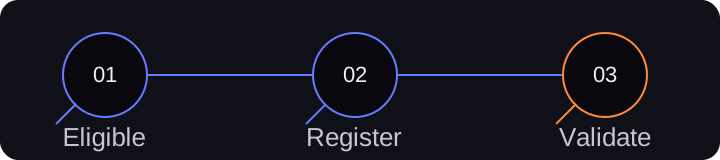
Eligibility
SBTi SME criteria: all four gates, then three of four tests
Every one of four gates must be met: under 10,000 tCO2e across Scope 1 and location-based Scope 2; not in the financial institutions or oil and gas sectors; not required to use sector-specific criteria; and not a subsidiary of a parent whose combined business falls into the corporate route.
Then three or more of four tests: fewer than 250 employees, turnover under €50 million, total assets under €25 million, and not in a mandatory FLAG sector.
The thresholds are strict (“fewer than”, “less than”), and SBTi Services confirms eligibility at registration from your financial statements.
The checker beside this applies Q6 literally and stores nothing; it is a reading aid, not SBTi’s decision.
SME route or corporate route · and the fee
All four gates are met and 4 of the four size and sector tests, so the SME route is likely to be open.
SBTi Services confirms it from your financial statements at registration, and you may still choose the corporate route.
SME Tier 2 (turnover of €5 million or more)
Near-term targets: £1,493
Net-zero targets (needs approved near-term): £1,493
Near-term and net-zero together: £2,612
Rules from the SBTi Services SME FAQs v6.2 (Q6) and Target Validation Service Offerings v6.1 (Tables 1 and 4, effective 5 January 2026). Pounds exclude 20% VAT and use the £1 = $1.34 rate SBTi Services states. Discounts are not modelled.
Nothing you enter is stored or sent.
What the route asks
What the Science Based Targets initiative SME route asks
- 1
No commitment stage
SMEs “move directly to setting near-term or net-zero science-based targets” (Q2).
- 2
Scope 1 and 2 targets
A near-term target of 5 to 10 years, or 2030, which Q38 says exempts it from the 5–10 year rule; base year no earlier than 2015 (Q32).
- 3
Scope 3: measure and reduce
No near-term Scope 3 target is required, but SMEs “must still commit to measuring and reducing them”; a voluntary one is not validated (Q46).
- 4
Minimum ambition
Q41: “Minimum value for absolute reduction target = 4.2% x (Target year - Base year)”, or a bespoke figure from the corporate tool.
- 5
Review every five years
Q42: SMEs “should review their targets at least every five years”.
Fees and timing
SBTi SME fees and timing
SMEs have paid for validation since 15 July 2024 (Q31), and V6.1 sets two tiers by turnover, either side of €5 million.
| SME service | Under €5m turnover | €5m or more |
|---|---|---|
| Near-term | $1,250 · £933 | $2,000 · £1,493 |
| Net-zero | $1,250 · £933 | $2,000 · £1,493 |
| Near-term and net-zero | $2,500 · £1,866 | $3,500 · £2,612 |
Timing varies by document: V6.1 gives SMEs “a tailored validation service without a specific timeframe”, the validation SOP estimates about 21 business days from the start, and Q30 about 60 business days from application to publication.
The other route
When an SME should use the standard route
Q6 allows it: “companies that are still classified as an SME may choose to set targets through the corporate validation route.”
It costs more, from $13,000 for near-term targets, but it is the route on which a Scope 3 target is validated, which matters if a large customer asks for one.
An SME that grows out of the route cannot use the cheaper update service: Q20 says such businesses “cannot update their previously validated SME targets via a ‘target update’”.
The corporate process is on the SBTi target setting guide, and each stage of a submission on the SBTi validation guide.
From 2027
The Science Based Targets initiative SME route after 2027
The Corporate Net-Zero Standard V2.0 replaces the route: its Main Changes document describes a “Transition from separate SME target-setting route to formal company categorization”.
A company is Category A with net turnover of €450 million or more or 1,000 or more FTE anywhere, or, in a high-income country such as the UK, with Scope 1 and 2 emissions of 10,000 tCO2e or more or two of a €25 million balance sheet, €50 million turnover and 250 FTE (§B.3 Table 2).
Everyone else is Category B, which must set separate Scope 1 and Scope 2 targets (C9.1) and may choose whether to set Scope 3 targets, unless it also sets a net-zero target (C17.1).
Category B companies validating only Scope 1 and 2 targets get a focused validation schedule of 24 to 30 business days.
V1.3.1 stays open for submissions, and SBTi says companies below the Category A thresholds may request SME status under it. Which version suits your submission date is on the SBTi net zero standard page.
UK SMEs
SBTi SME companies in the UK
SMEs are 874 of the 1,964 UK organisations on the SBTi dashboard, counted from its download on 11 October 2026; the SBTi hub links every guide in this series.
Frequently asked
SBTi SME, answered
What is the SBTi SME route?
A streamlined validation route for small and medium-sized companies under the SBTi’s current standard: no commitment stage, no near-term Scope 3 target, and a fee of $1,250 or $2,000 for near-term targets.
Eligibility is set by SME FAQs V6.2 Q6.
What are the SBTi SME criteria?
All four of: under 10,000 tCO2e across Scope 1 and location-based Scope 2; not a financial institution or oil and gas company; not required to use sector-specific criteria; not a subsidiary of a group in the corporate route.
Then three or more of: fewer than 250 employees; turnover under €50 million; total assets under €25 million; not in a mandatory FLAG sector.
Do SMEs need a Scope 3 target for SBTi?
No near-term Scope 3 target is required on the SME route, but SMEs must commit to measure and reduce Scope 3 emissions.
A Scope 3 target an SME sets voluntarily is not validated by SBTi Services.
Can an SME commit first and set targets later?
No. SMEs cannot make a commitment; they move straight to setting near-term or net-zero targets.
How much does SBTi cost for an SME?
Under Service Offerings V6.1, $1,250 for near-term targets with turnover under €5 million and $2,000 at €5 million or more; UK-registered companies pay £933 or £1,493, plus VAT.
Does the SBTi SME route still exist after 2027?
Not as a separate route under the Corporate Net-Zero Standard V2.0, which sorts companies into Category A and B instead.
Companies below the Category A thresholds may still request SME status under the current standard, which takes submissions until 31 January 2028.
Can an SME use the corporate route instead?
Yes.
SME FAQs Q6 says companies that are still classified as an SME may choose the corporate validation route, which costs more but validates Scope 3 targets.
Sources
Primary sources
Every figure, date and status on this page traces to the instrument’s owner.
Secondary commentary is never the source for a number.
- SBTi ServicesFAQs for SMEs V6.2 (July 2026)
Q2, Q6, Q20, Q30–Q32, Q38, Q41, Q42, Q46.
- SBTi ServicesSmall and medium-sized enterprises
The SME validation route.
- SBTi ServicesTarget Validation Service Offerings V6.1
SME tiers and fees, effective 5 January 2026.
- SBTi ServicesSOP for the Validation of SBTi Targets V1.2
SME validation: about 21 business days from start.
- Science Based Targets initiativeCorporate Near-Term Criteria V5.3.1
C13: 5–10 years, base year no earlier than 2015.
- Science Based Targets initiativeCorporate Net-Zero Standard V2.0
§B.3 Table 2: Category A and B.
- Science Based Targets initiativeCNZS V2.0 Criteria
C9.1, C14, C17.1: what Category B must and may do.
- Science Based Targets initiativeCNZS V2.0 Main Changes Document
“Transition from separate SME target-setting route to formal company categorization”.
- SBTi ServicesValidation Procedures for CNZS V2.0
The focused schedule for Category B Scope 1 and 2 targets.
- SBTi ServicesGuide for Companies in the Transition to CNZS V2.0
V1.3.1 closes 31 January 2028.
- Science Based Targets initiativeTarget Dashboard download (by company)
UK SME count, data of 8 October 2026, retrieved 11 October 2026.
- Science Based Targets initiativeForest, land and agriculture
The mandatory FLAG sectors in the SME test.