SBTi target setting · the process
SBTi target setting: how to set science-based targets, with the clocks and the fees
SBTi target setting, or Science Based Targets initiative target setting, works like this: a company registers with SBTi Services, builds a GHG Protocol inventory, models targets against the Near-Term Criteria V5.3.1, and pays for validation.
The SBTi’s own documents give each step a clock, and the Service Offerings publish the fees: from £933 plus VAT on the SME route and from £9,701 plus VAT for a corporate.
This page lays the process out in order, with the source for every interval and price.
Before you start
What SBTi targets are, and which rules apply now
SBTi targets are greenhouse gas reduction targets that SBTi Services has validated against the criteria of the Science Based Targets initiative.
There are two kinds: a near-term target over five to ten years, and a net-zero target that adds a long-term target for 2050 at the latest and needs approved near-term targets first.
The SBTi’s standards and guidance page lists the documents, and for a submission in 2026 they are the Near-Term Criteria V5.3.1 and the Corporate Net-Zero Standard V1.3.1.
What the SBTi is, what each criterion requires and how targets fit UK reporting are on our SBTi reference page; this page is the procedure.
What V2.0 will change for the next cycle is on our V2.0 change register.
The Corporate Net-Zero Standard V2.0 was published on 11 June 2026, but SBTi Services will not validate against it until 1 February 2027.
The SBTi tells companies with renewals due in 2026 or 2027 to use V1.3.1.
The six stages
Science Based Targets initiative target setting, from registration to annual disclosure
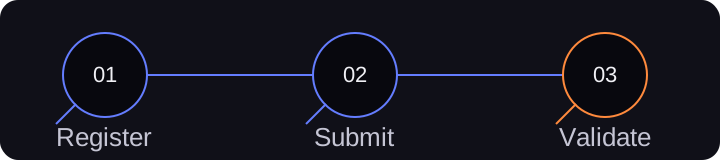
SBTi Services sets the process out as six stages: register, commit, develop, submit, communicate and disclose.
Each row gives the stage’s clock and where the SBTi says it.
| Stage | What happens | Clock | Source |
|---|---|---|---|
| 1. Register | Create a Validation Portal account and register the company; up to ten contacts, one of them executive-level | Typically 5 to 10 business days to approve | SBTi Services FAQ |
| 2. Commit (optional) | A public statement of intent to set targets; not available to SMEs | 24 months to submit; separate near-term or net-zero commitments only until 31 January 2027 | How-it-works; Transition Guide Table 4 |
| 3. Develop | Build the inventory and model targets with the latest tools | No fixed time; the 2026 most recent year must be 2024 or 2025 | Near-Term Criteria C7, C14 |
| 4. Submit | Choose a service, sign the terms, give invoice details; screening first | Start date given at least 10 business days ahead | SBTi Services FAQ |
| 5. Validate | Technical review, validation call, decision statement | 40 business days (Service Offerings); 30 near-term / 60 net-zero (FAQ); usually within 12 weeks (how-it-works) | Service Offerings §1.1; FAQ; how-it-works |
| 6. Communicate | Announce the targets; they appear on the Target Dashboard | Within 6 months of approval | Near-Term Criteria C28 |
| 7. Disclose | Report the inventory and progress publicly | Every year; review every target at least every 5 years | Near-Term Criteria C25, C26 |
Most of the elapsed time is in the develop stage, which is the company’s own work.
The SBTi’s how-it-works page notes that SBTi Services does not offer consultation services and that many businesses engage advisers for inventories, data quality and target development; our guide to choosing a net-zero adviser covers what to ask one.
A commitment that lapses is shown on the Target Dashboard as removed, so a missed deadline is public.
Timings
How long it takes, as dates
The SBTi publishes three different answers to how long validation takes, and they measure from different points.
The Service Offerings, the document a company signs, say corporate results arrive within 40 business days of the service start date, financial institutions within 60, and SMEs on no fixed timeframe.
The FAQ on the SBTi Services site says 30 business days for near-term targets and 60 for net-zero, also from the start date.
The how-it-works page says the assessment is usually finished within 12 weeks of submission.
The business-day figures assume the company passes screening, signs the contract and answers its analyst within two business days.
Treat 40 business days as the commitment and the others as indications, and plan board approval and the announcement on the latest date, then allow up to six months to announce.
The planner lays the dates out from a submission date you choose; it counts Monday to Friday and ignores bank holidays.
Plan the validation dates
Earliest validation start date: given at least 10 business days in advance, after screening.
SBTi Services FAQ
Decision due on the FAQ’s figure: 30 business days from the start date (near-term).
SBTi Services FAQ
Result due on the Service Offerings’ figure: 40 business days from the start date (corporate).
Service Offerings v6.1 §1.1
Twelve weeks after submission, the SBTi’s “usually finished within” figure.
SBTi how-it-works
If approved on the latest of those dates, the last day to announce the targets (six months).
Unannounced targets go through approval again.
Near-Term Criteria V5.3.1 C28
Business days count Monday to Friday and ignore bank holidays.
The dates assume you pass screening and answer the analyst within two business days.
Nothing you enter is stored or sent.
Stage 3 in detail
SBTi target setting: building the inventory and the targets
The inventory comes first, and the criteria are strict about it.
Companies must follow the GHG Protocol Corporate Standard, the Scope 2 Guidance and the Scope 3 Standard, and cover all seven gases: carbon dioxide, methane, nitrous oxide, HFCs, PFCs, sulphur hexafluoride and nitrogen trifluoride (C2).
The scope 3 inventory must cover every relevant source (C9), and emissions thought negligible must still be quantified or disclosed as an exclusion.
For a 2026 submission the most recent year must be 2024 or 2025, and applying one year’s data to another year is not permitted (C14, footnote 19).
The base year can be no earlier than 2015, and scope 1 and scope 2 must share it (C13).
The target year must be five to ten years from submission, unless the company chooses 2030, which R7 recommends and which exempts it from that window.
Targets are modelled with the latest SBTi tools (C7), and since 14 April 2026 those tools apply the revised absolute contraction approach in the Method Appendix; a target built on a superseded tool can only be submitted within six months of the new one.
The minimum cuts that method produces, with a calculator, are on our SBTi reference page, and the scope 2 choice the target must hold to is explained on scope 2 emissions.
The scope 3 categories and their data are covered in our scope 3 emissions guide.
Before you submit
The checks behind the near-term criteria
Each row is a criterion in the Near-Term Criteria V5.3.1 that a submission can fail on its own, and the evidence that answers it.
| Criterion | What it requires | What to have ready |
|---|---|---|
| C2 · Gases | All seven Kyoto gases: CO2, CH4, N2O, HFCs, PFCs, SF6 and NF3 | An inventory showing each gas, or why a gas does not arise |
| C9, footnote 9 · Completeness | Emissions thought “negligible” are not a reason to leave a source out | Every relevant scope 3 category quantified, or listed as an exclusion |
| C12 · Avoided emissions | Avoided emissions are a separate accounting system and do not count | Targets stated on the inventory alone, with any avoided-emissions claims kept apart |
| C13 · Base year | Scope 1 and scope 2 targets use the same base year, no earlier than 2015 | One base year across scope 1 and 2, with its data |
| C14, footnote 19 · Recent year | For 2026 submissions the most recent inventory is 2024 or 2025 | A 2024 or 2025 inventory, not one year’s data reused for another |
| C7 · Tools | Targets modelled on a superseded tool are accepted only within six months of the revision | Targets rebuilt on the April 2026 method if they predate it |
| R2 · Optional scope 3 | Optional scope 3 targets cannot count towards the 67% coverage in C6 | A coverage calculation that leaves optional targets out |
| C21 · Renewable electricity | Procurement of 80% renewable electricity by 2025 and 100% by 2030 can stand in for a scope 2 reduction target | Evidence of procurement against those two thresholds, if you take that route |
| C11 · Carbon credits | Credits are never counted as reductions toward near-term targets | Targets that reach their reductions without credits |
The table is a checklist of what the criteria say, not a list of what SBTi Services rejects most often, which it does not publish.
Three rows catch companies out because they cut against habits from other reporting.
SECR and many carbon reports cover carbon dioxide and a few other gases; the SBTi asks for all seven, and the inventory must show it.
A company that sells products which reduce other people’s emissions often wants to count that benefit; C12 keeps it out of the target arithmetic altogether.
And a target modelled in 2025 on the old contraction approach is not automatically still valid to submit: C7 gives six months from the revised method, which applied from 14 April 2026.
The renewable electricity route in C21 is an alternative to a scope 2 reduction target, not an addition to it, and it rests on procurement, which is why the scope 2 basis you report matters.
Running these checks before the start date matters because the SBTi Services timings assume the company answers its queries within two business days.
Routes and fees
SME route or corporate route, and what it costs
The SME route is shorter and cheaper, and eligibility is checked at registration from the company’s financial statements.
Question 6 of the SME FAQs sets four gates, all of which must be met, then four tests of which three must be met.
The test is not the UK’s: section 465 of the Companies Act 2006 treats a company as medium-sized if it meets two or more of turnover not more than £54 million, balance sheet total not more than £27 million and not more than 250 employees.
The SBTi counts employees as an annual average, often expressed as full-time equivalents, while the Companies Act counts persons, so the two headcounts can differ for the same company.
On the SME route there is no commitment stage, near-term targets cover scope 1 and 2 only, and the company commits to measure and reduce scope 3.
The SME FAQs let an SME pick its target year within five to ten years, use a financial or calendar base year, and choose 2015 as the earliest base year.
SME net-zero targets need a complete scope 1, 2 and 3 inventory, reductions of at least 90% across all three scopes by the target year, and neutralisation of what remains.
A company that qualifies as an SME may still choose the corporate route.
SME route or corporate route · and the fee
All four gates are met and 4 of the four size and sector tests, so the SME route is likely to be open.
SBTi Services confirms it from your financial statements at registration, and you may still choose the corporate route.
SME Tier 2 (turnover of €5 million or more)
Near-term targets: £1,493
Net-zero targets (needs approved near-term): £1,493
Near-term and net-zero together: £2,612
Rules from the SBTi Services SME FAQs v6.2 (Q6) and Target Validation Service Offerings v6.1 (Tables 1 and 4, effective 5 January 2026). Pounds exclude 20% VAT and use the £1 = $1.34 rate SBTi Services states. Discounts are not modelled.
Nothing you enter is stored or sent.
Published prices
Validation fees in pounds
From Table 4 of the Target Validation Service Offerings v6.1, effective 5 January 2026.
UK-registered companies are invoiced in pounds plus 20% VAT, converted at £1 = $1.34 and subject to change.
| Service (excl. VAT) | SME under €5m | SME €5m+ | Corporate under €250m | €250m–€1bn | €1bn–€10bn | €10bn+ |
|---|---|---|---|---|---|---|
| Near-term targets | £933 | £1,493 | £9,701 | £11,940 | £15,672 | £19,403 |
| Net-zero targets (needs approved near-term) | £933 | £1,493 | £8,209 | £8,955 | £11,194 | £13,433 |
| Near-term and net-zero together | £1,866 | £2,612 | £12,687 | £14,925 | £20,149 | £25,373 |
| Update of existing targets | — | — | £4,104 | £4,478 | £6,343 | £7,463 |
| FLAG and/or buildings add-on | — | — | £6,716 | £7,463 | £9,701 | £11,940 |
Dollar prices
Companies not registered in the UK are invoiced in dollars: corporate near-term targets from $13,000 to $26,000, SME near-term targets $1,250 or $2,000.
Financial institutions
FI near-term validation runs from £14,925 to £37,164 plus VAT, and FI net-zero is priced at an introductory rate matching it.
Land sector
SBTi FLAG targets: who, and what
Forest, Land and Agriculture targets cover land-based emissions and removals: deforestation, land conversion, fertiliser and manure, and carbon stored by restoring ecosystems.
Since 1 May 2023 companies have had to account for land-based emissions and set separate FLAG targets where relevant, according to the SBTi’s FLAG page.
FLAG validation is an add-on service, priced separately and submitted with another service.
The SBTi published FLAG Guidance version 1.2 in March 2026 and is revising it to fit Net-Zero Standard V2.0; its call for evidence was extended to 11 October 2026.
Existing FLAG guidance stays valid alongside V1.3.1 until the end of January 2028.
| FLAG rule | Detail |
|---|---|
| Who must | Food production, food and beverage processing, food and staples retailing, tobacco; or FLAG emissions over 20% of total |
| Near-term | 5–10 year FLAG reduction target |
| Long-term | At least 72% by 2050 at the latest |
| No-deforestation commitment | Mandatory, in line with the Accountability Framework initiative |
| Energy and industry | Targets still required for all scope 1, 2 and 3 |
After validation
Science Based Targets initiative target setting after validation: review and recalculation
Validation is the start of a cycle, not the end of one.
C25 requires the company-wide inventory and progress against targets to be reported publicly every year, and R12 recommends a standardised platform such as CDP’s climate questionnaire, though an annual report or website will do.
C26 requires every active target to be reviewed at least every five years against the latest criteria, and revalidated if it no longer meets them.
C27 lists the events that force a recalculation sooner: scope 3 rising to 40% or more of the total, a change of consolidation approach, significant changes in exclusions, acquisitions, divestments or mergers, and data or method changes that move base-year emissions significantly.
The significance threshold is 5% or less, and only the affected targets are recalculated.
The inventory side of recalculation is covered in our GHG Protocol reference.
Validated targets also feed other obligations: a supplier bidding for major government contracts needs a PPN 006 carbon reduction plan consistent with them, and a company reporting under UK SRS S2 discloses under ¶34(a) whether its targets were validated by a third party.
The move to V2.0
Renewals and the 2027–2028 window
The SBTi Services Transition Guide opens V2.0 validations on 1 February 2027 and keeps V1.3.1 submissions open until 31 January 2028.
A company with validated targets is not required to act immediately, and its re-validation falls due at the end of the year after its target year.
A renewal due in 2026 or 2027 should be prepared under V1.3.1.
A company that commits after 31 January 2027 makes a single commitment that can only be fulfilled under V2.0.
A company adopting V2.0 whose commitment falls due before validations open can email SBTi Services for an extension, which the dashboard then shows as extended.
For a first-time corporate in late 2026, the dates above mean a V1.3.1 submission, a validation result in early 2027, and a five-year review falling inside the V2.0 era.
That is our reading of the published dates, not an SBTi statement; you can book a free 15-minute call to talk it through, or test a case with the member agent after creating a free account.
Test yourself
Six process claims, true or false
The commonest process mistakes are about time: a stale inventory year, a missed announcement window, a commitment left to lapse.
The next commonest is assuming the UK size test opens the SME route.
Each answer names the criterion or FAQ that settles it.
SBTi process: true or false?
An SME can make a public commitment to set targets before submitting them.
A 2026 submission can use 2023 as its most recent year inventory.
Validated targets left unannounced for seven months stay validated.
A company medium-sized under the Companies Act automatically qualifies for the SBTi SME route.
An acquisition that changes base-year emissions by 6% triggers a target recalculation.
SBTi Services will build the inventory for you as part of validation.
0 of 6 answered.
Nothing you choose is stored or sent.
Frequently asked
SBTi target setting, answered
How do you set science-based targets?
SBTi Services sets out six stages: register the company on the Validation Portal, commit (optional, and not open to SMEs), develop the inventory and targets against the SBTi criteria, submit and pay for validation, communicate the validated targets, and disclose emissions and progress every year.
For a 2026 submission the criteria are the Near-Term Criteria V5.3.1 and the Corporate Net-Zero Standard V1.3.1.
How much does SBTi validation cost?
Under the Target Validation Service Offerings version 6.1, effective 5 January 2026, a UK-registered corporate pays from £9,701 plus VAT for near-term targets (turnover under €250 million) to £19,403 (€10 billion or more).
An SME pays £933 (turnover under €5 million) or £1,493 for near-term targets.
Prices for UK-registered companies are in pounds plus 20% VAT; others are invoiced in dollars.
How much does SBTi validation cost for SMEs?
A UK-registered SME pays £933 plus VAT for near-term validation with turnover under €5 million, and £1,493 above it.
Near-term and net-zero together cost £1,866 or £2,612.
In dollars the near-term prices are $1,250 and $2,000.
How long does SBTi validation take?
The SBTi’s own documents give three figures.
The Service Offerings say corporate results are delivered within 40 business days of the service start date; the SBTi Services FAQ says 30 business days for near-term and 60 for net-zero targets; the SBTi’s how-it-works page says assessment is usually finished within 12 weeks of submission.
Registration takes 5 to 10 business days before that, and SMEs have no fixed timeframe.
What qualifies as an SME for the SBTi?
Under SME FAQs version 6.2, a company must meet all four gates — under 10,000 tCO2e of scope 1 and location-based scope 2, not a financial institution or in oil and gas, not required to use sector-specific criteria, not a subsidiary of a parent in the corporate route — and three or more of: fewer than 250 employees, turnover under €50 million, total assets under €25 million, not in a mandatory FLAG sector.
What qualifies as an SME in the UK?
There is no single UK definition, and the SBTi does not use the UK’s.
For company accounts, section 465 of the Companies Act 2006 treats a company as medium-sized if it meets two or more of: turnover not more than £54 million, balance sheet total not more than £27 million, and not more than 250 employees, for financial years beginning on or after 6 April 2025.
Do I need an SBTi FLAG target?
Yes if you are in food production, food and beverage processing, food and staples retailing or tobacco, or if your forest, land and agriculture emissions exceed 20% of your total scope 1, 2 and 3 emissions.
FLAG targets sit alongside energy and industry targets, and a no-deforestation commitment is mandatory.
What is the SBTi target setting tool?
The SBTi publishes modelling tools for each method, and the Validation Portal’s updated tools apply the April 2026 absolute contraction method.
Criterion C7 requires targets to be modelled with the latest approved methods and tools; a target modelled on a superseded tool can be submitted only within six months of the revised one’s publication.
Do SBTi targets have to cover all seven greenhouse gases?
The inventory does.
Criterion C2 of the Near-Term Criteria lists the seven gases: carbon dioxide, methane, nitrous oxide, hydrofluorocarbons, perfluorocarbons, sulphur hexafluoride and nitrogen trifluoride.
A company whose operations produce no HFCs, for example, says so; it does not simply leave the gas out of the inventory.
Can renewable electricity procurement replace a scope 2 target?
Yes, as an alternative.
Criterion C21 accepts a target to procure 80% renewable electricity by 2025 and 100% by 2030 in place of a scope 2 emissions reduction target.
It does not change the scope 1 target, and it rests on procurement evidence, so the market-based scope 2 figures need to support it.
What if our emissions change significantly after validation?
The criteria require targets to be recalculated when certain triggers occur, including scope 3 rising to 40% or more of total emissions, a change in consolidation approach, or a structural change such as an acquisition, against a significance threshold of 5% or less, and only the affected targets are recalculated.
Separately, C26 requires every target to be reviewed at least every five years.
The detail is in criteria C26 and C27 of the Near-Term Criteria.
What happens after SBTi targets are validated?
The company announces the targets within six months of approval (C28), reports its inventory and progress publicly every year (C25), reviews every target at least every five years (C26), and recalculates when a significant change occurs, such as scope 3 reaching 40% of the total or an acquisition, using a 5% significance threshold (C27).
Should I use SBTi Net-Zero Standard V2.0 now?
Not for a submission before 1 February 2027, when V2.0 validations open.
The SBTi tells companies with commitments or renewals due in 2026 or 2027 to use Version 1.3.1.
V1.3.1 stays open until 31 January 2028; after that every new submission uses V2.0.
Sources
Primary sources
Every figure, date and status on this page traces to the instrument’s owner.
Secondary commentary is never the source for a number.
- SBTi ServicesSet a science-based target today: the six stages and the FAQs
Registration in 5–10 business days, start dates 10 business days ahead, 30 and 60 business-day decisions.
- SBTi ServicesTarget Validation Service Offerings, version 6.1 (effective 5 January 2026), §1.1 and Tables 1–4
40 business days for corporates; tiers; every fee on this page.
- SBTi ServicesSME FAQs, version 6.2 (July 2026), Q2–Q6, Q14, Q24–Q26
Eligibility and how the SME route works.
- SBTi ServicesTarget Validation Services for SMEs
The SME route’s own page.
- Science Based Targets initiativeCorporate Near-Term Criteria V5.3.1, C7, C13, C14, C25–C28, R7
Method validity, timeframe, the 2026 most-recent-year rule, and the duties after validation.
- Science Based Targets initiativeCNZS V1.3.1 Method Appendix (April 2026)
The revised absolute contraction approach the portal tools apply.
- Science Based Targets initiativeHow to set science-based targets
“Usually finished within 12 weeks”; 24 months from commitment; 6 months to announce.
- Science Based Targets initiativeForest, Land and Agriculture (FLAG)
Who must set FLAG targets, and the call for evidence closing 8 October 2026.
- Science Based Targets initiativeStandards and guidance
Which documents to build a 2026 submission on.
- SBTi ServicesGuide for Companies in the Transition to CNZS V2.0 (June 2026), Tables 1–4
Commitment options and V2.0 dates.
- Science Based Targets initiativeTarget Dashboard
Where validated targets, commitments and removals are published.
- legislation.gov.ukCompanies Act 2006, section 465
The UK medium-sized company test, for contrast with the SBTi’s SME test.
- Department for Business and TradeUK SRS S2, ¶34(a)
Disclosing whether a third party validated the target.
Continue your research