SBTi FLAG · forest, land and agriculture
SBTi FLAG targets: who must set them, and how
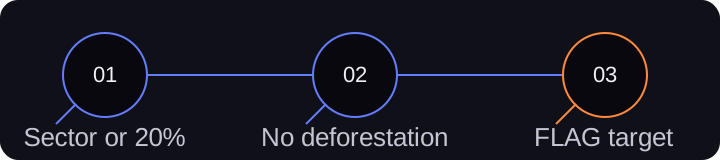
SBTi FLAG targets are required of companies in six land-based sectors and of any company whose forest, land and agriculture emissions are 20% or more of its total, and every FLAG target needs a public no-deforestation commitment.
The Science Based Targets initiative FLAG rules matter most in the UK to food producers, processors and retailers, and to anyone buying timber, paper or rubber.
Who
SBTi FLAG: who must set a target
| Limb | Test | Notes |
|---|---|---|
| i) Designated sector | Forest and Paper Products (forestry, timber, pulp and paper, rubber) · Food Production: Agricultural Production · Food Production: Animal Source · Food and Beverage Processing · Food and Staples Retailing · Tobacco | Required whatever the FLAG share |
| ii) The 20% test | FLAG-related emissions total 20% or more of overall emissions across Scopes 1, 2 and 3 | Gross, not net of removals, and including land-use change (§2.1) |
How
Science Based Targets initiative FLAG targets, step by step
- 1
Check both FLAG tests
Sector first, then measure FLAG emissions gross, including land-use change, against the 20% line.
- 2
Commit to no deforestation
A public commitment on primary deforestation-linked commodities, dated no later than two years after FLAG submission and never after 31 December 2030; cut-off date recommended no later than 2020 (FLAG-C4).
- 3
Set the FLAG target
Alongside your energy and industry targets; the FLAG page sets long-term FLAG targets of at least a 72% cut by 2050.
- 4
Submit with another service
The FLAG add-on cannot be submitted alone: $9,000 to $16,000 by tier, covering buildings targets too.
- 5
Publish the commitment
Within 12 months of validating the FLAG target, on your own website or policy documents (FLAG-C4).
Sources: FLAG Guidance V1.2, FLAG-C4 · SBTi FLAG page · Service Offerings V6.1. All fees are on the SBTi cost page.
Versions
SBTi FLAG guidance: V1.2 now, V2 being written
Version 1.2 was released and took effect on 19 March 2026, an “Urgent revision of FLAG criteria 1 and 4” outside the normal cycle.
A Version 2 aligned with the Corporate Net-Zero Standard V2.0 is in scoping; its call for evidence was extended to 11 October 2026, and the SBTi says the revision “will take more than 12 months to complete”.
Meanwhile companies under V1.2 can already use V2.0’s new absolute contraction approach and best-efforts framework, according to the SBTi’s July 2026 call for input, which also counts more than 400 companies with FLAG targets.
The timber and wood fibre pathway in the FLAG tool is temporarily suspended until a revised version is released.
The SBTi’s FLAG page says companies may use either the GHG Protocol’s draft land sector guidance or its new Land Sector and Removals Standard until that standard takes effect on 1 January 2027.
Existing targets
Science Based Targets initiative FLAG rules for companies that already have targets
FLAG-C1 is explicit: a company meeting either test that already has SBTi targets “shall set a FLAG target at the latest as part of their mandatory five-year review submission”.
The FLAG and/or buildings update service, $4,500 to $8,000, covers changes to approved FLAG targets later.
An SME in a mandatory FLAG sector fails one of the four tests on the SBTi SME route, which needs three of four.
How FLAG sits among the other sector routes is on the SBTi sector guidance page, and the SBTi hub links every guide.
Frequently asked
SBTi FLAG, answered
Who must set SBTi FLAG targets?
Companies in six FLAG-designated sectors (forest and paper products; agricultural production; animal-source food production; food and beverage processing; food and staples retailing; tobacco), and any company whose FLAG-related emissions are 20% or more of its total Scope 1, 2 and 3 emissions, measured gross (FLAG Guidance V1.2, FLAG-C1).
What is the SBTi no-deforestation commitment?
A public commitment to no-deforestation across a company’s primary deforestation-linked commodities, with a target date no later than two years after FLAG target submission and never later than 31 December 2030.
The SBTi says it is mandatory: without it a company cannot set a FLAG target.
How much does an SBTi FLAG target cost?
FLAG is an add-on to another validation service: $9,000 in corporate Tier 1 to $16,000 in Tier 4 under Service Offerings V6.1, and one fee covers FLAG and buildings targets together.
What long-term FLAG target does the SBTi expect?
The SBTi’s FLAG page says long-term FLAG targets reduce at least 72% of emissions by no later than 2050, set under the Corporate Net-Zero Standard.
Which version of the SBTi FLAG guidance applies?
Version 1.2, released and effective on 19 March 2026 as an urgent revision of criteria C1 and C4.
A Version 2 is being developed; its call for evidence was extended to 11 October 2026 and the revision will take more than 12 months.
We already have SBTi targets but no FLAG target. Do we need one?
If you meet either FLAG test, yes: FLAG-C1 says you shall set a FLAG target at the latest as part of your mandatory five-year review submission, and should set it as soon as possible.
Can an SME in a FLAG sector use the SBTi SME route?
Being in a mandatory FLAG sector fails one of the four size and sector tests on the SME route, which needs three of four, so it is still possible if the other three are met and the four gates are passed.
Sources
Primary sources
Every figure, date and status on this page traces to the instrument’s owner.
Secondary commentary is never the source for a number.
- Science Based Targets initiativeFLAG Science Based Target-Setting Guidance V1.2
Table 1: FLAG-C1 and C4; §2.1 gross emissions.
- Science Based Targets initiativeForest, land and agriculture sector page
The commitment is mandatory; 72% by 2050; the V2 call for evidence.
- Science Based Targets initiativeCall for input to revise the FLAG Standard (30 July 2026)
More than 400 companies have FLAG targets.
- Science Based Targets initiativeStandards and guidance: Technical Work Plan
FLAG revision for V2.0 in scoping.
- Science Based Targets initiativeSector Resources Summary
FLAG updated March 2026 (V1.2).
- SBTi ServicesTarget Validation Service Offerings V6.1
FLAG and/or buildings add-on and update fees.
- SBTi ServicesFAQs for SMEs V6.2
Q6, Q7: mandatory FLAG sectors in the SME test.
- Science Based Targets initiativeCorporate Near-Term Criteria V5.3.1
C26: the five-year review, when a missing FLAG target must be added.
- Science Based Targets initiativeCorporate Net-Zero Standard V1.3.1
Long-term targets alongside FLAG.
- Science Based Targets initiativeCorporate Net-Zero Standard V2.0 page
V2 innovations already open to FLAG target-setters.
- GHG ProtocolStandards and guidance
The Land Sector and Removals Standard, effective 1 January 2027.