SBTi net zero standard · Version 2.0
SBTi net zero standard V2.0: published, not yet usable
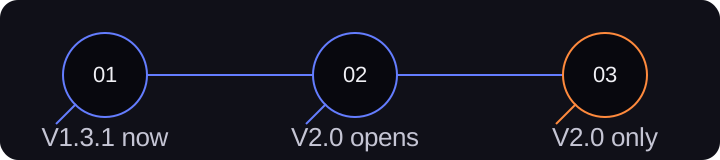
The SBTi net zero standard, the Science Based Targets initiative net zero standard, has a second version, published on 11 June 2026, that merges the near-term criteria and the net-zero standard into one text.
SBTi Services opens validations against it on 1 February 2027, and the Transition Guide keeps V1.3.1 open until 31 January 2028.
Existing validated targets stay valid; what changes is how the next set of targets is built.
The basics
What the SBTi net zero standard V2.0 is
Corporate Net-Zero Standard Version 2.0 is a full revision of the SBTi’s corporate rules.
It replaces both the Near-Term Criteria V5.3.1 and the Corporate Net-Zero Standard V1.3.1 with one standard covering near-term and long-term targets.
The SBTi’s Technical Council approved it on 8 May 2026 and its Board of Trustees adopted it on 21 May 2026, according to the Main Changes Document.
That document says the criteria were restructured under headline and sub-criteria, so a criterion-by-criterion mapping from V1.3.1 is not feasible.
The SBTi’s standards and guidance page tells companies setting targets now to use V1.3.1, and a page calling V2.0 “the current SBTi standard” is wrong until validations open.
The SBTi itself, its criteria and its place in UK reporting are covered in our guide to science based targets; this page is about the change.
The status, in one line
Final and published since 11 June 2026.
Not usable for validation until 1 February 2027.
Mandatory for new submissions from 1 February 2028.
Source: Transition Guide, Table 1
Timeline
SBTi net zero standard V2 dates, from adoption to mandatory use
The dates come from Table 1 of the Guide for Companies in the Transition to CNZS V2.0, which agrees with the Standard’s own version table.
Two January dates are easily confused.
31 January 2027 is the last day to make a separate near-term or net-zero commitment; from 1 February 2027 a new commitment is a single commitment, and Table 4 says it can only be fulfilled under V2.0.
31 January 2028 is the last day to submit targets under V1.3.1.
The SBTi’s own documents do not all agree: one gives an effective date a day earlier than the Standard, and one blog an earlier close for Version 1.
We follow the Standard and the Transition Guide, which agree with each other, and suggest confirming any date that matters to a submission with SBTi Services.
- 8 May 2026Technical Council approval
- 21 May 2026Board of Trustees adoption
- 11 Jun 2026Published
Standard, Criteria, Main Changes Document, Transition Guide.
- 1 Oct 2026SBTi Services validation resources
Due under Table 1 of the Transition Guide.
- 31 Jan 2027Separate commitments close
Table 4: separate near-term or net-zero commitments end.
- 1 Feb 2027V2.0 validations open
V1.3.1 or V2.0.
- 31 Jan 2028V1.3.1 validations close
- 1 Feb 2028V2.0 mandatory
For all submitting companies.
What changed
SBTi V2 against V1.3.1, row by row
Every row is from sections 3 to 5 of the Transition Guide, with the V2.0 criterion it cites.
Filter by theme or search a term; the full register is also printed beneath.
V1.3.1 against V2.0
Showing 20 of 20
| Topic | V1.3.1 (use today) | V2.0 (from 1 February 2027) |
|---|---|---|
| Company types | Corporate, SME or financial institution | Category A or Category B, by emissions, financials and geographic location |
| Validation model | Commitment, validation, mandatory five-year review, possible revalidation | Commitment, validation, possible spot and focus checks, end-of-cycle assessment, next validation |
| Transition plan | No explicit requirement | Required (C2); presence of required elements validated, not quality |
| Base year | No earlier than 2015 | Most recent year with comprehensive data, renewed each cycle (C4) |
| Exclusions | Up to 5% of scope 1 and 2, and up to 5% of scope 3 | None permitted (C5) |
| Scope 2 basis for targets | Location-based or market-based, used consistently | Physical inventory, so location-based (C9) |
| Market instruments | Credits not counted as near-term reductions | Reported separately from the physical inventory; integrity criteria apply (C5.4) |
| Disaggregation | By scope, scope 3 by category | Adds separate FLAG, bioenergy, biogenic and technological removals, and electricity consumption with its low-carbon share |
| Near-term timeframe | 5 to 10 years from submission | 5 years; less allowed at a first V2.0 validation to fit the reporting cycle |
| Scope 1 | 95% of scope 1 and 2 together; absolute contraction or sector approach | 100% of scope 1, separately; linear absolute, sector intensity or asset transition targets |
| Scope 2 | 95% of scope 1 and 2 together; reduction, sector approach or renewable electricity target | 100% of scope 2, separately; low-carbon electricity alignment or absolute reduction |
| Scope 3 | 40% trigger; 67% near-term and 90% long-term coverage | Every category at 5% or more of categories 1–14; practical-influence exclusions (C14) |
| Scope 3 methods | Absolute, sector, intensity and engagement | Overarching absolute or alignment targets, or category methods: supplier, customer, commodity, transport, use-phase, sector intensity, end-of-life |
| Beyond the value chain | A voluntary recommendation (R12) | Optional Ongoing Emissions Responsibility recognition; from 2035 Category A takes responsibility for at least 1% of ongoing emissions |
| Neutralisation | 100% of residual emissions at the net-zero year, with permanent removals | At least 1% of ongoing emissions in 2035, rising linearly to 100% of residual emissions at the net-zero year |
| Hourly matching | No provision | Optional scope 2 hourly matching recognition programme |
| Progress assessment | No formal mechanism | End-of-cycle assessment against targets (chapter 5) |
| Assurance | No third-party verification of base-year or recent data | Category A: limited assurance of base-year emissions, LCE calculations and target metrics; assurance of progress data (C7) |
| Claims | SBTi communication guidelines | The SBTi Claims System and its normative documents (B.5) |
| Annual reporting | Progress on all targets; scope 1, 2 and 3 emissions | Progress and barriers to progress; scope 1 and 2 emissions (C36) |
Source: SBTi Services, Guide for Companies in the Transition to CNZS V2.0 (June 2026).
The guide is a navigation aid: where it paraphrases the Standard, the Standard prevails.
The guide makes one point carefully: separate scope 1 and scope 2 targets change how targets are written, but the SBTi has always assessed the ambition of each scope separately, even when combined targets were allowed for communication.
The biggest practical changes for a UK company are the base year, which moves to the most recent complete year each cycle, the end of inventory exclusions, and the move to location-based scope 2 for targets.
For Category A companies, assurance of base-year emissions and target metrics is the new cost line.
Value chain
How V2.0 handles scope 3
Strengthening the approach to scope 3 was one of the stated purposes of the revision.
V1.3.1 uses fixed thresholds: a scope 3 target where scope 3 is 40% or more of the total, near-term coverage of at least 67%, long-term coverage of at least 90%.
V2.0 replaces them with significance: targets must cover every category that is 5% or more of total scope 3 categories 1 to 14, under C14.
A company may exclude emissions from activities over which it lacks practical influence, as the Standard defines that term.
Category A companies must also identify emissions-intensive activities in their value chain and treat as significant any that is 5% or more of total scope 3 on the physical inventory.
In the example, the covered set may end up the same under both versions, but for a different reason, and with no total to hit under V2.0.
The boundaries still follow the GHG Protocol Scope 3 Standard; UK SRS S2 ¶B32 asks a reporter to consider all fifteen categories and disclose which it includes, a third test again, explained on UK SRS scope 3 reporting.
| Category | Share of categories 1–14 | V2.0 status |
|---|---|---|
| 1 Purchased goods and services | 24,000 t (60.0%) | Significant |
| 4 Upstream transport | 3,500 t (8.75%) | Significant |
| 6 Business travel | 1,800 t (4.5%) | Not significant |
| All others | Under 2,000 t each | Not significant |
Credits and removals
Carbon credits in V2.0: criterion C5.4
The criterion that decides how credits are treated is C5.4 in the V2.0 Criteria document.
A shortened quote reads as a stronger duty than it is, so here it is in full.
“Companies shall account for and report a physical GHG inventory.
Where applicable, companies shall separately account for and report actions and market instruments that are not reflected in the physical GHG inventory, in accordance with relevant GHG accounting standards, where available.
All such actions and market instruments shall meet the integrity criteria set out in Section 4.2 of the Target Implementation chapter.”
Read it as three duties: report the physical inventory always; report market instruments separately where there are any and an accounting standard exists; and make sure they meet the section 4.2 integrity criteria.
There is no sentence in V2.0 banning credits from counting towards targets.
The result is structural: ambition is measured against the physical inventory, and anything outside it is reported beside it, not netted off.
The SBTi’s V2.0 page describes high-integrity credits as “a complement and not a substitute” to cutting emissions, recognised through a voluntary programme.
The accounting for market instruments is itself being reworked by the GHG Protocol, whose development plan estimates a revised standard in the fourth quarter of 2028, so the SBTi has said it will issue interim guidance.
Worked example
One manufacturer’s numbers under each version
| Item | Under V1.3.1 | Under V2.0 |
|---|---|---|
| Scope 2 target basis | May track market-based: 500 t, so certificates show as progress | Physical inventory: 4,000 t; certificates reported beside it |
| 1,000 t of retired credits | Do not reduce the target figure (Near-Term C11) | Reported separately under C5.4; integrity criteria apply |
| Emissions the targets are set against | 6,000 t scope 1, plus 500 or 4,000 t scope 2 depending on basis | 6,000 t scope 1 and 4,000 t scope 2, as separate targets |
| What moves the target figure | Physical cuts, or certificates if market-based was chosen | Physical cuts only |
| Assurance of base-year data | Not required | Limited assurance if Category A |
The certificates are not wasted under V2.0.
Companies report total electricity consumption and the share of low-carbon electricity consumed or matched through market instruments, and can set a low-carbon electricity alignment target for scope 2.
What changes is that certificates no longer shrink the number a scope 2 reduction target is set against.
After 2035
Neutralisation and ongoing emissions responsibility
V1.3.1 asks companies to neutralise 100% of residual emissions at the net-zero target year with permanent removals, and treats action beyond the value chain as a voluntary recommendation.
V2.0 phases the duty in.
Under chapter 6 companies can join an optional Ongoing Emissions Responsibility recognition programme, which recognises climate contributions beyond their validated targets.
From 2035, Category A companies must take responsibility for at least 1% of their ongoing emissions, including a defined and increasing share of long-lived removals, rising linearly to 100% of residual emissions at the net-zero year.
Residual long-lived greenhouse gases are neutralised with long-lived removals; short-lived gases may use long-lived or short-lived removals.
The SBTi’s blog says companies with existing targets will be eligible to join the programme when it launches in 2027.
A neutralisation duty is not a carbon neutrality claim: the difference is set out in our page on PAS 2060 and ISO 14068.
| Year | Category A minimum |
|---|---|
| Before 2035 | Optional recognition only |
| 2035 | Responsibility for at least 1% of ongoing emissions |
| 2035 to the net-zero year | Rising linearly |
| Net-zero target year | 100% of residual emissions neutralised |
UK angle
How the Science Based Targets initiative net zero standard fits UK reporting
The SBTi is voluntary, and nothing in UK law requires a science-based target.
It meets UK reporting in four places, and V2.0 moves closer to UK practice in each.
| Topic | SBTi V2.0 | UK SRS S2 |
|---|---|---|
| Scope 2 | Targets on the location-based inventory | Location-based required; market-based permitted (¶29(a)(v), ¶B30) |
| Transition plan | Required; elements validated (C2) | Disclose any plan the entity has; the FCA rules ask UKLR 6, 16 and 22 companies whether they have one and where it is |
| Carbon credits | Reported separately from the physical inventory (C5.4) | Planned use disclosed for any net target (¶36(e)) |
| Scope 3 | Every category at 5% or more of categories 1–14 | Consider all 15; disclose those included (¶B32) |
| Validation | SBTi Services, with an end-of-cycle assessment | Disclose whether a third party validated the target (¶34(a)) |
The scope 2 change is the one to notice.
UK SRS S2 already requires location-based scope 2, so a UK company that built its SBTi target on market-based figures will rebuild the baseline at its next cycle, and the two disclosures will then agree.
Listed companies report against UK SRS on a comply-or-explain basis for periods beginning on or after 1 January 2027 under the FCA’s PS26/19, and for companies in UKLR 6, 16 and 22 the final rules ask whether they have a transition plan and where it can be found, without requiring one.
A V2.0 company will have one anyway, and our guide to the climate transition plan sets out what a full one contains.
In the first report after new targets are validated, a UK SRS S2 reporter explains the new base year and the separate scope 1 and 2 targets as a revision under ¶34(d); the field-by-field map is on UK SRS S2.
Your position
Which Science Based Targets initiative net zero standard version applies to you
The answer depends on where a company is in the SBTi system and on the date.
A company with validated targets that are not yet due keeps them, and plans the V2.0 baseline for the next cycle; re-validation is due by the end of the year after the target year.
A company renewing in 2026 or 2027 is told by the SBTi to use V1.3.1, and some V2.0 innovations — the implementation hierarchy, the best-efforts approach and SME status for Category B companies — are open to V1 users.
A company with an active commitment uses Table 3 of the Transition Guide: a deadline before validations open means V1.3.1, unless it asks SBTi Services for an extension to adopt V2.0.
Sector guidance has not been withdrawn: aviation, shipping, cement, steel, chemicals, buildings and FLAG guidance stay valid alongside V1.3.1 until the end of January 2028.
The steps from inventory to announcement are on how to set science-based targets.
If you want outside help with the reduction work behind the targets, the guide to choosing a carbon reduction consultant sets out what one does.
A resolver reads the dates you give it and nothing else; you can book a free 15-minute call, or put a harder case to the member agent after creating a free account.
Which SBTi version applies
V2.0 validations open on 1 February 2027, so a submission on this date uses Corporate Net-Zero Standard V1.3.1 with the Near-Term Criteria V5.3.1.
SBTi Services, Guide for Companies in the Transition to CNZS V2.0 (June 2026), Tables 1, 3 and 4.
Existing validated targets stay valid through their cycle; nothing here requires them to be reset.
Nothing you enter is stored or sent.
Still to come
What the SBTi has not yet published
The SBTi’s launch blog sets out what follows the Standard.
A renewal policy, expected in the fourth quarter of 2026, will say how V2.0’s implementation, end-of-cycle and ongoing-responsibility elements reach companies already in the system.
Final target-setting methods and pathways, after feedback that closed on 31 July 2026, are expected for use in the fourth quarter of 2026.
Preliminary interim accounting guidance on market instruments is expected in the fourth quarter of 2026, for consultation and testing.
A claims policy is expected from the first quarter of 2027, and the Transition Guide names an SBTi Assurance Manual as forthcoming.
Until those exist, the V2.0 Standard and its Criteria are the text, and the Transition Guide says the Standard prevails wherever the guide paraphrases it.
Test yourself
Six V2.0 claims, true or false
The commonest V2.0 mistake is tense: describing a published standard as one in force.
The second is reading C5.4 as a ban, which it is not.
Each answer names the table or criterion that settles it, and the near-term rules that apply today are listed criterion by criterion in the Near-Term Criteria V5.3.1.
SBTi V2.0: true or false?
A company can be validated under SBTi V2.0 in December 2026.
V2.0 contains a sentence banning carbon credits from counting towards targets.
Under V2.0 a company can set its scope 2 target on market-based figures.
A commitment made on 15 February 2027 can still be met with V1.3.1 targets.
V2.0 validates the quality of a company’s transition plan.
Existing V1 sector guidance stays valid alongside V1.3.1 until the end of January 2028.
0 of 6 answered.
Nothing you choose is stored or sent.
Frequently asked
SBTi net zero standard V2, answered
What is the SBTi Corporate Net-Zero Standard V2.0?
It is the second full version of the Science Based Targets initiative’s framework for corporate net-zero targets, published on 11 June 2026.
It consolidates the Near-Term Criteria and the Corporate Net-Zero Standard V1.3.1 into one standard covering near-term and long-term targets.
It is published but not yet usable: validations against it open on 1 February 2027.
When does SBTi V2 become mandatory?
From 1 February 2028, for every new submission.
Validations under V2.0 open on 1 February 2027, and between then and 31 January 2028 a company may submit under either V1.3.1 or V2.0.
Before 1 February 2027 only V1.3.1 can be used.
Do companies with existing SBTi targets need to reset them?
No. The SBTi says companies with existing validated targets do not need to set new ones, and those targets remain valid through their target cycle, subject to the five-year review.
V2.0 applies when a company next sets or renews targets; re-validation is due at the end of the year after the target year.
Does SBTi V2 ban carbon credits?
There is no single sentence in V2.0 that bans credits.
The effect is structural: criterion C5.4 requires a physical GHG inventory and, where applicable, separate accounting and reporting of actions and market instruments not reflected in it, which must meet the integrity criteria in section 4.2 of the Target Implementation chapter.
Targets are set against the physical inventory.
What are Category A and Category B in SBTi V2?
They replace V1.3.1’s corporate, SME and financial institution routes.
Companies are classified by emissions, financials and geographic location, and the category decides which requirements apply.
Category A companies carry extra duties, including limited assurance of base-year emissions and target-setting metrics and, from 2035, responsibility for at least 1% of ongoing emissions.
How does SBTi V2 treat scope 3?
It replaces V1.3.1’s 40% trigger and 67% and 90% coverage thresholds with significance: scope 3 targets must cover every category that is 5% or more of total scope 3 categories 1 to 14, and a company may exclude emissions from activities over which it lacks practical influence, as the Standard defines them.
Can a company use market-based scope 2 for an SBTi V2 target?
No. V2.0 requires targets to be modelled on the physical inventory, which means location-based scope 2.
Companies still report total electricity consumption and the share of low-carbon electricity consumed or matched through market instruments, and may set a low-carbon electricity alignment target.
Does SBTi V2 require a transition plan?
Yes.
Criterion C2 requires companies to develop and maintain a transition plan.
The SBTi validates that the plan exists and contains the required elements; it does not assess the plan’s quality, completeness or feasibility.
What is the SBTi’s definition of net zero?
Under V1.3.1, criterion C14: reducing scope 1, 2 and 3 emissions to zero or a residual level consistent with reaching net zero in eligible 1.5°C scenarios or sector pathways, and neutralising any residual emissions at the net-zero target date.
V2.0 keeps the end state and phases neutralisation in from at least 1% of ongoing emissions in 2035 to 100% of residual emissions at the net-zero year.
Can a small company use SBTi V2.0?
V2.0 replaces the SME route with two categories: companies are classified as Category A or Category B by emissions, financials and geographic location, and V2.0 validations open on 1 February 2027.
Under the current standard, the SBTi says companies that meet the Category B classification may request SME status.
An SME planning a first submission in 2026 uses V1.3.1 and the Near-Term Criteria V5.3.1.
Does SBTi V2 require third-party assurance?
For Category A companies, yes.
The SBTi Services transition guide says Category A companies are required to have third-party limited assurance of base-year emissions, low-carbon electricity calculations and target-setting metrics.
Under V1.3.1 no third-party verification of base-year or most recent year data is required.
What is still to come from the SBTi for V2.0?
The SBTi’s launch blog lists a renewal policy expected in the fourth quarter of 2026, final methods and pathways for use in the fourth quarter of 2026, preliminary interim accounting guidance on market instruments in the fourth quarter of 2026, and a claims policy expected from the first quarter of 2027.
Sources
Primary sources
Every figure, date and status on this page traces to the instrument’s owner.
Secondary commentary is never the source for a number.
- Science Based Targets initiativeCorporate Net-Zero Standard Version 2.0 (June 2026)
The Standard itself; its version table gives release 11 June 2026 and effect 1 February 2027.
- Science Based Targets initiativeCorporate Net-Zero Standard V2 Criteria, criterion CNZS-C5.4
The inventory accounting approach, quoted in full.
- Science Based Targets initiativeCorporate Net-Zero Standard V2 Main Changes Document
Approval on 8 May 2026 and adoption on 21 May 2026; the criteria regrouped so a one-to-one mapping is not feasible.
- SBTi ServicesGuide for Companies in the Transition to CNZS V2.0, version 1.0 (June 2026), sections 2–5
Tables 1, 3 and 4 and every V1.3.1-to-V2.0 row in the change register.
- Science Based Targets initiativeThe new Corporate Net-Zero Standard Version 2.0
Credits as a complement, not a substitute, through a voluntary recognition programme.
- Science Based Targets initiativeThe Corporate Net-Zero Standard V2.0 is here: what comes next (11 June 2026)
Existing targets stay valid; the documents still to come and when.
- Science Based Targets initiativeCNZS V2.0, chapter 6: Ongoing emissions responsibility
The optional recognition programme and the 2035 requirement for Category A.
- Science Based Targets initiativeStandards and guidance
Which documents to use today.
- Science Based Targets initiativeThe Corporate Net-Zero Standard Version 1.3.1
The version in use until V2.0 opens.
- Science Based Targets initiativeCorporate Net-Zero Standard V1.3.1 (PDF)
The V1.3.1 definition of net zero and the 90% long-term cut.
- Science Based Targets initiativeCorporate Net-Zero Standard Criteria V1.3.1
C7 coverage, C12 credits, C14 net zero.
- Department for Business and TradeUK SRS S2 Climate-related Disclosures, ¶¶29, 33–36, B32
Location-based scope 2, all 15 categories considered, target and credit disclosures.
- GHG ProtocolCorporate Value Chain (Scope 3) Standard
The category boundaries both SBTi versions use.
- GHG ProtocolConsolidated Corporate Standard — Standard Development Plan v2.0 (29 July 2026)
The accounting revision V2.0’s interim guidance waits on.
Continue your research