The Science Based Targets initiative
Writes the criteria and standards a target is measured against.
SBTi: standards and guidanceAsk direct questions about your own reporting — your thresholds, your dates, what you file and when.
Sign up free →The standards
Does it apply to you
Reporting under it
WHY REGISTER
Ask these pages about your own company.
Free · no card
Everything on this site stays open without an account.
Start here
Dates and penalties
Doing it
WHY REGISTER
Ask these pages about your own company.
Free · no card
Everything on this site stays open without an account.
What you must file
Doing it
WHY REGISTER
Ask these pages about your own company.
Free · no card
Everything on this site stays open without an account.
Start here
Setting targets
Who and where
WHY REGISTER
Ask these pages about your own company.
Free · no card
Everything on this site stays open without an account.
The UK duty
Doing it
WHY REGISTER
Ask these pages about your own company.
Free · no card
Everything on this site stays open without an account.
The baseline
Europe
Reporting more widely
WHY REGISTER
Ask these pages about your own company.
Free · no card
Everything on this site stays open without an account.
Carbon markets and trade
Packaging and net zero
Carbon accounting
WHY REGISTER
Ask these pages about your own company.
Free · no card
Everything on this site stays open without an account.
Choosing
Carbon
Compliance and offsets
WHY REGISTER
Ask these pages about your own company.
Free · no card
Everything on this site stays open without an account.
Software
Templates
Careers
WHY REGISTER
Ask these pages about your own company.
Free · no card
Everything on this site stays open without an account.
ASK ABOUT YOUR OWN REPORTING
Ask direct questions about your own reporting — your thresholds, your dates, what you file and when.
Sign up freeFree · one email · already registered? Log in
Everything on this site stays open without an account.
SBTi · a UK guide from primary sources
SBTi is the Science Based Targets initiative, the voluntary body whose criteria companies use to set greenhouse gas reduction targets, and whose subsidiary checks those targets.
No UK law requires an SBTi target, but customers, investors and UK disclosure rules all ask about targets, so the Science Based Targets initiative is where many UK companies start.
Before the detail
The Science Based Targets initiative writes criteria for corporate emissions targets: a near-term target of five to ten years, and optionally a long-term net-zero target.
It is a registered charity in England and Wales (1205768), and SBTI Services Limited, its wholly owned subsidiary, runs validation.
It was founded as a collaboration between CDP, the United Nations Global Compact, the We Mean Business Coalition, the World Resources Institute and the World Wide Fund for Nature.
A near-term target must cover at least 95% of Scope 1 and 2 emissions, must include Scope 3 where relevant Scope 3 is 40% or more of the total, and runs five to ten years from submission (criteria C4, C5 and C13).
Carbon credits never count as reductions toward it (C11).
The SBTi guides
Is SBTi mandatory?: No. Where UK SRS, the FCA, PPN 006 and customers ask about targets, rule by rule.
SBTi cost: Every validation fee by tier, in dollars and pounds, with a tool to find yours.
SBTi validation: Registration to decision, the timelines SBTi’s documents give, and why it is not certification.
SBTi SME route: Who qualifies, what it asks, what it costs, and what replaces it from 2027.
SBTi companies: UK organisations with SBTi targets by status and sector, counted from SBTi’s own download.
SBTi target setting: Registration to announcement: the stages, the validation clock, the SME route and the fees.
SBTi criteria: Every near-term criterion, the minimum-cut calculator and how a target fills the UK SRS S2 fields.
SBTi net zero standard: Version 2.0 against V1.3.1, row by row, and which version applies to your submission date.
SBTi target examples: How to read a published target: metric, base year, deadline and boundary, from historical case studies.
SBTi Scope 3: The 40% trigger and 67% coverage today, the 5% category test from 2027, with a worked example.
SBTi carbon credits: Why credits never count as cuts, neutralisation, the OER levels and the April 2024 statement.
SBTi FLAG: Who must set forest, land and agriculture targets, and the no-deforestation commitment.
SBTi financial institutions: FINZ and the near-term criteria, both open with no end date since 8 October 2026.
SBTi sector guidance: Every sector’s resource and status on 11 October 2026, with its source.
SBTi near-term targets: The five-to-ten-year window, the 4.2% floor and the April 2026 method update.
SBTi recalculation: The 5% trigger, when a rebaseline needs no resubmission, and what an update costs.
SBTi target setting tool: The SBTi’s Excel tools, their versions, inputs and limits; V2.0’s is still a beta.
SBTi dashboard: How to search, download and read the Target Dashboard after the September 2026 change.
SBTi updates: Every SBTi change in 2026, dated and sourced, and what comes next.
SBTi training: The SBTi Academy and the $1,500 certification, and what it does not allow.
SBTi and nature: Why nature targets come from SBTN, a separate body, and how they meet the TNFD.
SBTi consultancy: What consultants prepare, what SBTi Services decides, and how to brief a provider.
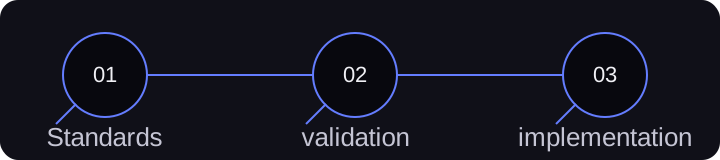
Who does what
Writes the criteria and standards a target is measured against.
SBTi: standards and guidanceChecks a submitted target against those criteria and publishes the outcome.
SBTi Services: service offeringsBuilds the inventory, sets the target, delivers the cuts and reports progress.
SBTi: how it worksDates
| Document | Status on 11 October 2026 | Source |
|---|---|---|
| Corporate Near-Term Criteria V5.3.1 | In effect since 14 April 2026 | Version table |
| Corporate Net-Zero Standard V1.3.1 | In effect; corporate submissions close 31 January 2028 | Criteria V1.3.1 |
| Corporate Net-Zero Standard V2.0 | Published 11 June 2026; validations open 1 February 2027 | Transition guide, Table 1 |
| V2.0 as the only option | From 1 February 2028, for new general corporate submissions | Transition guide, Table 1 |
| Financial institutions | Outside the February 2027 corporate V2.0 launch | Validation procedures, s1 fn 1 |
The detail, row by row, is on the SBTi net zero standard guide.
UK rules
SBTi validation is voluntary: no UK statute or rule requires a company to hold a target validated by the Science Based Targets initiative, as the is SBTi mandatory? guide sets out rule by rule.
UK SRS S2 asks a reporting company to say whether a target and its method were validated by a third party (¶34(a)), and for each emissions target whether it is gross or net and how carbon credits are planned (¶36).
For listed companies the FCA’s PS26/19 applies UK SRS on a comply-or-explain basis for accounting periods beginning on or after 1 January 2027, so the question is how targets are disclosed, not whether SBTi checked them.
Suppliers bidding for in-scope central government contracts above £5 million a year are asked under PPN 006 for a Carbon Reduction Plan committing to net zero by 2050; an SBTi target is not required for it.
UK SRS is an independent reference site; we do not validate, certify or partner with the SBTi.
Fees
SBTi Services charges by organisation type and annual turnover under its Target Validation Service Offerings V6.1, effective 5 January 2026: for example, a corporate near-term validation is $13,000 in Tier 1 (turnover under €250m) and an SME near-term validation is $1,250 in SME Tier 1 (turnover under €5m).
Every fee, in dollars and pounds, with a tool to find your tier, is on the SBTi cost page.
Frequently asked
SBTi is the Science Based Targets initiative, a charity registered in England and Wales that writes the criteria companies use to set greenhouse gas reduction targets in line with climate science.
Its wholly owned subsidiary, SBTi Services, checks submitted targets against those criteria.
No. The Science Based Targets initiative is a voluntary standard-setter.
No UK law requires a company to have SBTi-validated targets; UK rules ask about targets in other ways, for example UK SRS S2 asks whether a target was validated by a third party.
SBTi says it was founded as a collaboration between CDP, the United Nations Global Compact, the We Mean Business Coalition, the World Resources Institute and the World Wide Fund for Nature.
For corporate submissions on 11 October 2026, the Corporate Near-Term Criteria V5.3.1 and the Corporate Net-Zero Standard V1.3.1.
Version 2.0 was published on 11 June 2026; general corporate validations against it open on 1 February 2027, and it becomes the only option for submissions from 1 February 2028.
No. Validation checks a target against the criteria at the time of submission.
Whether a company is cutting its emissions is a separate question, answered by its reported emissions over time.
Not as reductions.
Near-Term Criteria C11 says carbon credits must not be counted as emission reductions toward near-term targets, and the V1.3.1 net-zero criteria allow credits only to neutralise residual emissions or to finance mitigation beyond the target.
No. The Science Based Targets Network develops targets for nature, such as freshwater and land, and is a separate body.
The SBTi’s targets are for greenhouse gas emissions.
Sources
Every figure, date and status on this page traces to the instrument’s owner.
Secondary commentary is never the source for a number.
The founding partners and the initiative’s role.
Corporate, sector and financial-institution documents.
Target setting, submission and validation.
C4–C28: coverage, timeframe, credits, review.
The net-zero text in force until V2.0 is usable.
Published 11 June 2026.
Table 1: the key dates.
Section 1, footnote 1: financial institutions are outside the February 2027 launch.
Fees and tiers, effective 5 January 2026.
Q6: who may use the SME route.
Commitment and target status, company by company.
¶¶33–37: targets, including whether a third party validated them.
Comply or explain for listed companies, periods from 1 January 2027.
A procurement condition, not a duty to hold a plan.