SBTi carbon credits · from the criteria themselves
SBTi carbon credits: what counts, and what never does
SBTi carbon credits never count as emission cuts toward a target: Near-Term Criteria C11 rules it out today, and V2.0 keeps credits outside target delivery from 2027.
Where the Science Based Targets initiative carbon credits rules do give credits a role is neutralising residual emissions at net zero, and a voluntary recognition programme that V2.0 adds.
Today
SBTi carbon credits rules today
C12 of the Net-Zero Criteria V1.3.1 extends it to long-term targets and gives credits two uses: neutralising residual emissions, or financing “additional climate mitigation beyond their science-based emission reduction targets”.
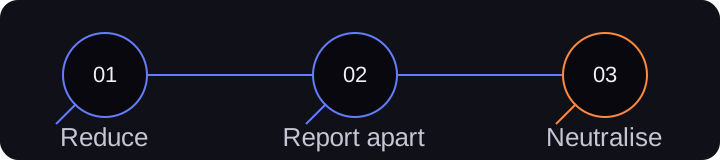
Net zero itself is reduction first: C14 defines it as cutting Scope 1, 2 and 3 to zero or a residual level, then neutralising only the residual at the target date.
From 2027
Science Based Targets initiative carbon credits under V2.0
V2.0 has no single “ban” sentence; it gets the same result structurally, starting with C5.4, which requires a physical inventory and, “Where applicable”, separate accounting for market instruments not reflected in it.
C26.2 then excludes from target implementation “Emissions reductions or removals, including GHG credits, used for the SBTi’s Ongoing Emissions Responsibility program”, credits sold on, and reductions estimated before they happen.
Emissions reduction claims rest on the physical inventory alone (C37.10), and removals bought after a missed target “shall not be counted toward target progress” (R37.2).
At the net-zero year every residual tonne is neutralised with eligible removals, long-lived gases with long-lived removals (C46).
Recognition
SBTi carbon credits and Ongoing Emissions Responsibility
| OER level | Coverage | How it is delivered |
|---|---|---|
| Engaged | At least 1% of ongoing Scope 1, 2 and 3 emissions | Verified mitigation outcomes, or a contribution budget |
| Advanced | 100% of Scope 1 and 2, and at least 10% in total | Verified outcomes, or a budget of $20 per tCO2e |
| Leadership | 100% of Scope 1, 2 and 3 | A budget of $80 per tCO2e and verified outcomes equal in volume |
C45 asks Category A companies to support removals of at least 1% of ongoing emissions from 2035, rising to 100% by the net-zero year. The Standard calls this an illustrative requirement to be reviewed in Version 3.
The 2024 row
Science Based Targets initiative carbon credits: the April 2024 statement
On 9 April 2024 the SBTi Board said it “has decided to extend their use for the purpose of abatement of Scope 3 related emissions beyond the current limits”, referring to environmental attribute certificates.
Three days later, on the same page: “No change has been made to SBTi current standards.”
Press reports at the time, such as Reuters, described objections from SBTi staff and advisers; those letters were not SBTi publications.
On 30 July 2024 the SBTi said “guidance remains unchanged until process is complete”, and V2.0 in June 2026 did not let credits abate Scope 3 targets.
UK reporting
SBTi carbon credits in UK reporting
UK SRS S2 ¶36 asks, for each emissions target, whether it is gross or net, and “the entity’s planned use of carbon credits to offset greenhouse gas emissions to achieve any net greenhouse gas emissions target”; a net target must be disclosed with its gross target.
A carbon neutral claim is a different thing again, covered on PAS 2060 and ISO 14068, and buying credits well is on the carbon offset strategy guide.
The wider rules are on the SBTi net zero standard page and the SBTi Scope 3 page; the SBTi hub links every guide.
Frequently asked
SBTi carbon credits, answered
Can carbon credits count toward an SBTi target?
No. Near-Term Criteria C11 says carbon credits must not be counted as emission reductions toward near-term targets, and Net-Zero Criteria V1.3.1 C12 says the same for long-term targets.
V2.0 keeps the result: credits used for its recognition programme are excluded from target implementation (C26.2).
What can carbon credits be used for under the SBTi?
Under V1.3.1, only to neutralise residual emissions at the net-zero target date or to finance climate mitigation beyond the company’s targets.
Under V2.0, for neutralising residual emissions with eligible removals (C46) and in the voluntary Ongoing Emissions Responsibility programme (C38–C44).
What is SBTi Ongoing Emissions Responsibility?
A voluntary recognition programme in V2.0 for companies that pay for mitigation of their ongoing emissions, at three levels: Engaged (at least 1% of emissions), Advanced (10%, or $20 a tonne) and Leadership ($80 a tonne).
The SBTi says it launches in 2027; no date is published.
Did the SBTi allow offsets for Scope 3 in 2024?
No standard changed.
The SBTi Board said on 9 April 2024 that it would extend the use of environmental attribute certificates for Scope 3; on 12 April it clarified that “no change has been made to SBTi current standards”, and V2.0 does not let credits abate Scope 3 targets.
What is beyond value chain mitigation?
A voluntary recommendation in Net-Zero Standard V1.3.1 (R12) to invest in climate projects outside the value chain.
V2.0 folds it into the Ongoing Emissions Responsibility recognition programme.
Does V2.0 require carbon removals?
At the net-zero target year all residual emissions must be neutralised with eligible removals (C46).
From 2035 Category A companies are to support removals equal to at least 1% of ongoing emissions, rising to 100% by the net-zero year (C45), which the Standard calls illustrative and will review in Version 3.
How do UK SRS rules treat carbon credits in targets?
UK SRS S2 ¶36 asks whether a target is gross or net; a net target must be disclosed with its gross target, and the company must disclose its planned use of carbon credits to achieve it.
Sources
Primary sources
Every figure, date and status on this page traces to the instrument’s owner.
Secondary commentary is never the source for a number.
- Science Based Targets initiativeCorporate Near-Term Criteria V5.3.1
C11: credits never count as reductions.
- Science Based Targets initiativeCorporate Net-Zero Standard Criteria V1.3.1
C12 credits; C14 net zero = reduce, then neutralise residuals.
- Science Based Targets initiativeCorporate Net-Zero Standard V2.0 Criteria
C5.4, C26.2, C38–C46, R37.2.
- Science Based Targets initiativeCorporate Net-Zero Standard V2.0
OER is voluntary and creates no legal liability; C45 is illustrative.
- Science Based Targets initiativeCNZS V2.0 Main Changes Document
BVCM becomes the OER recognition framework.
- Science Based Targets initiativeCorporate Net-Zero Standard V2.0 page
Credits are “a complement and not a substitute”.
- Science Based Targets initiativeThe Corporate Net-Zero Standard V2.0 is here: what comes next (11 June 2026)
The OER framework launches in 2027.
- Science Based Targets initiativeBoard of Trustees statement, 9 April 2024, and clarification of 12 April 2024
“No change has been made to SBTi current standards.”
- Science Based Targets initiativeTechnical publications release, 30 July 2024
“Guidance remains unchanged until process is complete.”
- Reuters (press)Companies get green light to use offsets for supply chain emissions, 10 April 2024
Press report of the reaction; not an SBTi publication.
- Department for Business and TradeUK SRS S2
¶36(c) gross or net; ¶36(e) planned use of carbon credits.
- SBTi ServicesGuide for Companies in the Transition to CNZS V2.0
BVCM under V1.3.1 against OER under V2.0.