Energy management
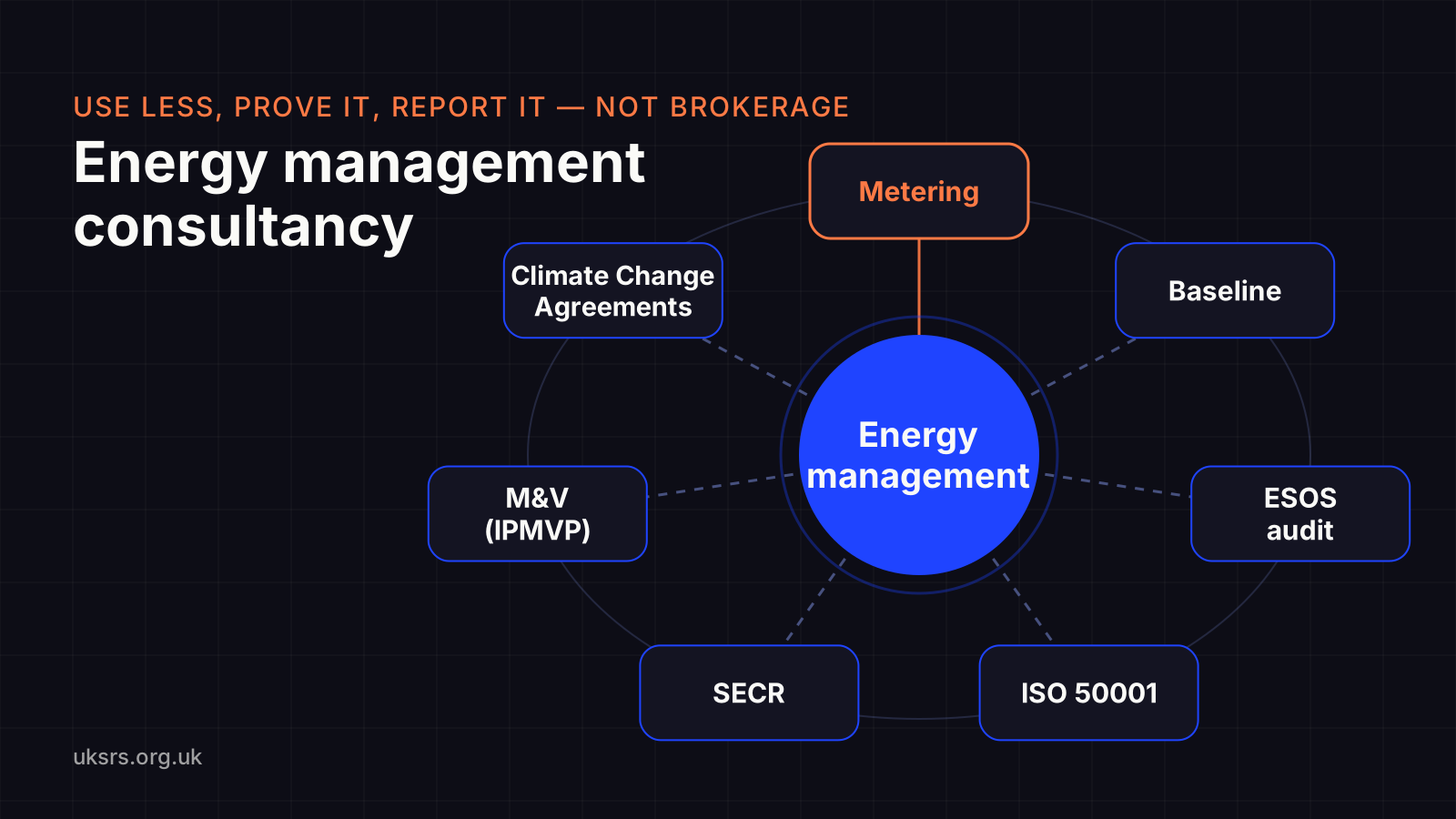
Metering, audits, ESOS, ISO 50001, SECR energy reporting, measurement and verification, and a yearly plan of measures.
Environment Agency, ESOS Phase 4Ask direct questions about your own reporting — your thresholds, your dates, what you file and when.
Sign up free →The standards
Does it apply to you
Reporting under it
WHY REGISTER
Ask these pages about your own company.
Free · no card
Everything on this site stays open without an account.
Start here
Dates and penalties
Doing it
WHY REGISTER
Ask these pages about your own company.
Free · no card
Everything on this site stays open without an account.
What you must file
Doing it
WHY REGISTER
Ask these pages about your own company.
Free · no card
Everything on this site stays open without an account.
Start here
Setting targets
Who and where
WHY REGISTER
Ask these pages about your own company.
Free · no card
Everything on this site stays open without an account.
The UK duty
Doing it
WHY REGISTER
Ask these pages about your own company.
Free · no card
Everything on this site stays open without an account.
The baseline
Europe
Reporting more widely
WHY REGISTER
Ask these pages about your own company.
Free · no card
Everything on this site stays open without an account.
Carbon markets and trade
Packaging and net zero
Carbon accounting
WHY REGISTER
Ask these pages about your own company.
Free · no card
Everything on this site stays open without an account.
Choosing
Carbon
Compliance and offsets
WHY REGISTER
Ask these pages about your own company.
Free · no card
Everything on this site stays open without an account.
Software
Templates
Careers
WHY REGISTER
Ask these pages about your own company.
Free · no card
Everything on this site stays open without an account.
ASK ABOUT YOUR OWN REPORTING
Ask direct questions about your own reporting — your thresholds, your dates, what you file and when.
Sign up freeFree · one email · already registered? Log in
Everything on this site stays open without an account.
Energy consultants · management, audit and reporting
Energy management consultancy is paid to measure, reduce and report energy use, which is a different job from buying energy, and the two are often sold under the same name.
UK SRS is an independent reference site. We have assessed no consultancy and publish no consultancy prices or rankings.
The work
An energy management consultancy works on how much energy you use; an energy broker works on what you pay for each unit.
Both call themselves energy consultants, so the first question in any brief is which of the two you are buying.
An “energy consultant”
Metering, audits, ESOS, ISO 50001, SECR energy reporting, measurement and verification, and a yearly plan of measures.
Environment Agency, ESOS Phase 4Tendering supply contracts and arranging the switch, often paid by a commission added to the energy bill.
Ofgem, Third Party IntermediariesEnergy management advice is judged in kWh saved and duties met; procurement is judged on the unit rate and the contract terms.
The heat, fleet and power transition that follows an audit is covered on decarbonisation consultancy, and this page stays with ongoing energy management and audit.
Searches for an energy and carbon consultancy, an energy efficiency consultant or energy audit consultants are usually after the management side.
Module 01 / 04
Module 02 / 04
Module 03 / 04
Module 04 / 04
Brokers
Ofgem calls brokers third party intermediaries and says a broker is paid either by a direct charge or indirectly, by a payment from the supplier “which is added to your bill”, in its guidance for microbusinesses.
Where the payment goes through the bill, “Information on TPI costs that will be included in the bill the supplier sends you must be provided to all businesses via the Principal Terms and upon request”.
The same page says “Ofgem do not regulate energy brokers” and “Ofgem does not license TPIs”, so the rules bite on the supplier, not the broker.
Since 1 December 2022 suppliers have had to work only with brokers signed up to a qualifying dispute scheme for microbusiness contracts, under Ofgem’s Microbusiness Strategic Review decision.
Ofgem’s 2024 non-domestic market review extended that rule to small business consumers and required suppliers to be transparent about broker commissions paid through the bill.
The government said on 23 October 2025 that it intends to appoint Ofgem as regulator of brokers, with an authorisation regime, when parliamentary time allows, in its consultation response.
Ofgem opened a market review of brokers on 4 June 2026 to gather evidence ahead of that regulation, so broker regulation is a plan, not yet law.
None of this applies to an energy management consultancy paid a fee for audits and advice, which is one more reason to know which you are hiring.
| Energy management consultancy | Energy broker (TPI) | |
|---|---|---|
| Paid for | Advice, audits, reporting | Arranging a supply contract |
| Usually paid by | A fee from you | A fee, or commission added to the bill |
| Judged on | kWh saved, duties met | Unit rate and contract terms |
| Ofgem rules | None specific | Through supplier licence conditions; direct regulation planned |
Module 01 / 04
Module 02 / 04
Module 03 / 04
Module 04 / 04
The cycle
ISO describes ISO 50001:2018 as a framework “for establishing, implementing, maintaining, and improving an Energy Management System”, built on the Plan-Do-Check-Act model, on its catalogue page.
It tracks improvement with energy performance indicators and energy baselines, and ISO says it is technology-neutral.
An energy management consultancy that leaves you with a report and no baseline, indicators or owner has done an audit, not energy management.
ISO 50001:2018 was last reviewed and confirmed in 2024 and remains current, so a proposal to “transition to a new ISO 50001” is confusing it with ISO 14001, which was revised in 2026.
Module 01 / 04
Module 02 / 04
Module 03 / 04
Module 04 / 04
ESOS Phase 4
ESOS Phase 4 applies to an organisation with 250 or more employees, or with both turnover over £44 million and a balance sheet over £38 million, on the qualification date of 31 December 2026, under regulation 4 and Schedule 1.
The compliance date is 5 December 2027, and since 22 July 2026 the only routes are the ESOS energy audit and ISO 50001, under the 2026 amendment regulations.
Phase 4 adds a report of the energy savings actually achieved, measure by measure in kWh, and an explanation of planned measures that were not carried out.
The action plan lists the measures you propose, with dates and estimated savings in kWh, under regulation 34A, and is due by 5 December 2028 for 6 December 2027 to 5 December 2031.
Three annual progress updates follow, owed even if the plan proposed no measures, according to the Environment Agency’s guidance at §§13–14.
ESOS does not require any measure to be implemented, but the savings-achieved report makes an unimplemented plan visible.
The audit itself is explained on the ESOS energy audit, and the assessor market on ESOS consultants.
Module 01 / 04
Module 02 / 04
Module 03 / 04
Module 04 / 04
ISO 50001
Where ISO 50001 certification covers an organisation’s total or significant energy consumption, it is deemed to have appointed a lead assessor, carried out the ESOS audit and produced the ESOS report.
It must still notify compliance, and it still owes the action plan and progress updates.
Where certification covers only part of consumption, the deeming applies only to the certified part, and the rest must be audited by a lead assessor, according to the Environment Agency’s guidance.
An ISO 50001 consultant typically builds the energy review, the baseline and indicators, the procedures and the internal audit; a separate certification body certifies.
Ask which certification body is proposed, check its accreditation yourself, and ask whether it has any link to the consultancy that built the system.
The comparison between the two routes is on ISO 50001 versus ESOS.
Module 01 / 04
Module 02 / 04
Module 03 / 04
Module 04 / 04
SECR
A quoted company reports emissions, an aggregate energy figure in kWh and a description of its principal energy-efficiency measures, under Schedule 7 Part 7, ¶15.
An unquoted company is in scope only if it exceeds two of £36 million turnover, £18 million balance sheet and 250 employees, because ¶20B(2) exempts a company that meets two or more of turnover “not more than £36 million”, balance sheet “not more than £18 million” and “not more than 250” employees.
The directors’ report must state at least one ratio that expresses annual emissions against a quantifiable factor the company chooses, so there is no statutory energy-intensity ratio.
A company that consumed 40,000 kWh or less can leave the information out, if the report says that is why.
The emissions are calculated with the government’s conversion factors, and the UK electricity consumed factor is 0.14396 kgCO2e/kWh in the 2026 set and 0.19553 in the 2025 set, according to the DESNZ methodology papers.
That fall is mostly a cleaner grid, so an energy consultancy should report kWh beside tonnes, or a lower carbon figure can hide flat energy use.
The disclosure is set out on SECR requirements, and the advice market on SECR consultants.
Module 01 / 04
Module 02 / 04
Module 03 / 04
Module 04 / 04
Climate Change Agreements
A Climate Change Agreement is voluntary: a facility covered by one pays a reduced rate of Climate Change Levy, under Finance Act 2000 Schedule 6, paragraph 44.
The current scheme has three target periods: calendar 2026, 2027 to 2028, and 2029 to 2030, under SI 2025/813.
DESNZ says the scheme is administered through to 31 March 2033 and that all three periods are set against a 2022 base year, in its 2026 statutory guidance.
From target period 7 the buy-out price is a formula, and DESNZ’s Technical Annex works it to £37 per tonne of CO2 equivalent.
Energy management for a CCA facility is about meeting a target each period, which is why metering at the facility boundary matters.
The scheme is explained on Climate Change Agreements.
Module 01 / 04
Module 02 / 04
Module 03 / 04
Module 04 / 04
Metering and M&V
The International Performance Measurement and Verification Protocol, from the Efficiency Valuation Organization, sets four options for showing an energy saving.
Options A and B draw the measurement boundary round the equipment changed, Option C uses the meters for the whole facility, and Option D uses a calibrated simulation where baseline or reporting data are unreliable or unavailable.
Choosing the option before the work starts is what makes a later savings figure checkable.
Phase 4 now asks for the savings achieved in kWh, so an ESOS participant needs a way to show them, and an M&V plan is that way.
| IPMVP option | Boundary | Typical use |
|---|---|---|
| A — Retrofit isolation: key parameter measurement | The equipment changed | A lighting change where power is measured and hours are estimated |
| B — Retrofit isolation: all parameter measurement | The equipment changed | A variable speed drive with its own meter |
| C — Whole facility | The whole site | Several measures across a building, read from utility meters |
| D — Calibrated simulation | Part or all of the site | No reliable baseline meter data, such as new construction |
Module 01 / 04
Module 02 / 04
Module 03 / 04
Module 04 / 04
Let property
In England and Wales the minimum level for privately rented property is EPC band E, under regulation 22(b) of the 2015 Regulations.
The government’s interim response of 18 June 2026 proposes EPC B from 2031 for non-domestic buildings over 1,000 square metres, where cost effective, and dropped the earlier 2027 EPC C milestone.
That is a proposal that needs secondary legislation, so an energy management consultancy pricing works against “EPC B law” is ahead of the law.
For a landlord, the audit and the EPC are different documents, and an energy consultant should say which improvements move the rating and which only cut bills.
Module 01 / 04
Module 02 / 04
Module 03 / 04
Module 04 / 04
Before you call anyone
Brief an energy management consultancy with your size, your reporting status, your sites and how you buy energy, because those decide the duties.
Answer the six questions and the panel lists the duties and schemes the work should cover, with the provision each comes from.
Attach your last ESOS report, SECR disclosure and half-hourly data, so nobody is paid to collect them twice.
Which energy duties apply to you?
Your size on 31 December 2026 decides Phase 4; the audit route needs a lead assessor and a notification by 5 December 2027, then an action plan of measures, dates and kWh savings by 5 December 2028.
ESOS Regulations 2014 regs 4 and 34A; Environment Agency Phase 4 guidance
An unquoted company that exceeds two of £36m turnover, £18m balance sheet and 250 employees reports UK energy use in kWh, the emissions from it, an intensity ratio and efficiency measures; a company using 40,000 kWh or less in the UK can say so instead.
SI 2008/410 Sch 7 Part 7A, ¶¶20B, 20D(7)(a), 20G
Optional: an energy management system to ISO 50001 is a way to run the work every year, and since 22 July 2026 it is the only alternative to the ESOS audit.
ISO 50001:2018; SI 2026/701
If a broker is paid through your bill, the supplier must show the broker’s costs in the principal terms, and for micro and small businesses the broker should belong to a dispute scheme; Ofgem does not yet license brokers.
Ofgem, Third Party Intermediaries guidance; supply licence conditions 7A and 20.5A
A scoping aid that gives no legal advice, no savings estimate and no supplier or firm recommendation.
Nothing you choose is stored or sent.
Module 01 / 04
Module 02 / 04
Module 03 / 04
Module 04 / 04
Due diligence
Is the energy consultancy paid a fee by you, or does it earn commission on energy contracts, equipment or contractors it recommends?
Which savings figures will be measured, with which IPMVP option, and which are estimates?
If ESOS applies, is the lead assessor on an approved register, and have you checked it yourself?
Who owns the meter data, the baseline model and the action plan at the end?
The ESOS assessor market is covered on checking who you hire for ESOS, and the wider process in choosing a sustainability consultant.
It names no firm, quotes no price, ranks nobody, estimates no savings and describes no consultancy as assessed.
Module 01 / 04
Module 02 / 04
Module 03 / 04
Module 04 / 04
Illustrative brief · no consultancy assessed
A group with 600 staff across twelve sites, which bought its energy through a broker last year, wants energy management support before its Phase 4 notification.
The brief separates the energy management consultancy work, paid by fee, from the energy contract, and asks for the route decision, the audit or ISO 50001 scope, an M&V plan and the action plan.
Meter and invoice data by site and by purpose.
Audit or ISO 50001, decided before the qualification date.
An M&V plan so savings achieved can be shown in kWh.
Each date has a different meaning
Check who each date applies to and whether it is a rule, a deadline or a proposal.
A suggested delivery sequence
This is an editorial buying and preparation sequence, not a statutory timetable or a promise about how long the engagement takes.
Frequently asked
An energy management consultant helps an organisation measure where its energy goes, find and rank savings, meet the energy duties that apply to it, such as ESOS and SECR, set up metering and verification, and run the work as a yearly cycle, often to ISO 50001.
Buying energy at the best price is a different service, usually sold by a broker.
Often not.
Many firms that call themselves energy consultants are brokers, or third party intermediaries, that arrange supply contracts and are paid by commission through the bill.
An energy management consultancy is paid to reduce and report energy use.
Some firms do both, so ask how each service is paid for.
Either by a direct fee or by a commission the supplier adds to the energy bill.
Where the commission goes through the bill, Ofgem’s rules require the supplier to show the broker’s costs in the principal terms of the contract and on request.
Ofgem does not currently license or regulate brokers themselves, and the government intends to make it their regulator.
ESOS applies to an organisation that, on 31 December 2026, has 250 or more employees, or has both turnover over £44 million and a balance sheet over £38 million, with group aggregation.
The compliance date is 5 December 2027 and the action plan is due by 5 December 2028.
Yes, where certification covers your total or significant energy consumption: you are then deemed to have appointed a lead assessor, carried out the audit and produced the ESOS report.
You still notify compliance and owe the action plan.
Since 22 July 2026 the audit and ISO 50001 are the only Phase 4 routes.
A quoted company reports global emissions, an energy figure in kWh, at least one intensity ratio and the principal energy-efficiency measures taken.
An unquoted company in scope reports its UK energy use, the emissions from it, an intensity ratio and its measures.
A company using 40,000 kWh or less can say so instead of disclosing.
Measurement and verification is how savings are shown rather than assumed.
The IPMVP, from the Efficiency Valuation Organization, sets four options: two isolate the equipment changed, one uses whole-facility meters, and one uses a calibrated simulation where data are missing.
No. A Climate Change Agreement is a voluntary scheme in which an eligible facility agrees energy or carbon targets in return for a lower Climate Change Levy rate.
ESOS is a mandatory audit duty and SECR a mandatory disclosure; one does not satisfy the others.
This site publishes no prices and has assessed no consultancy.
Ask for days by grade, the deliverables named, which savings will be measured and how, and whether the firm earns anything from energy contracts, equipment or contractors it recommends.
Sources
Every figure, date and status on this page traces to the instrument’s owner.
Secondary commentary is never the source for a number.
Broker costs in the principal terms; “Ofgem do not regulate energy brokers”.
Suppliers to work only with brokers in a qualifying dispute scheme, from 1 December 2022.
Broker redress extended to small business consumers.
Ofgem to be appointed regulator when parliamentary time allows.
Evidence gathering ahead of regulation; closed July 2026.
Phase 4: qualification date 31 December 2026, compliance date 5 December 2027.
In force 22 July 2026: audit or ISO 50001 only; savings achieved reported.
What an action plan contains: measures, dates and estimated savings in kWh.
Action plans due 5 December 2028; three progress updates.
Last reviewed and confirmed in 2024; one amendment.
Options A to D for measuring energy savings.
Emissions, an energy figure in kWh and efficiency measures, ¶15.
In scope above two of £36m turnover, £18m balance sheet and 250 employees.
The reduced-rate Climate Change Levy for a facility under an agreement.
2026; 2027 to 2028; 2029 to 2030.
Scheme administered through to 31 March 2033.
The TP7 buy-out price worked to £37 per tonne CO2e.
UK electricity consumed: 0.14396 kgCO2e/kWh.
The minimum level is EPC band E (reg 22(b)).
EPC B from 2031 over 1,000 m², proposed.
Continue reading
What the audit must cover and who signs it.
Checking who you hire for ESOS.
When certification replaces the audit.
Energy, emissions and the intensity ratio.
The levy discount and its target periods.
Heat, fleet and power after the audit.