Net zero strategy consultants · target to roadmap
Net zero strategy consultancy: from target to roadmap
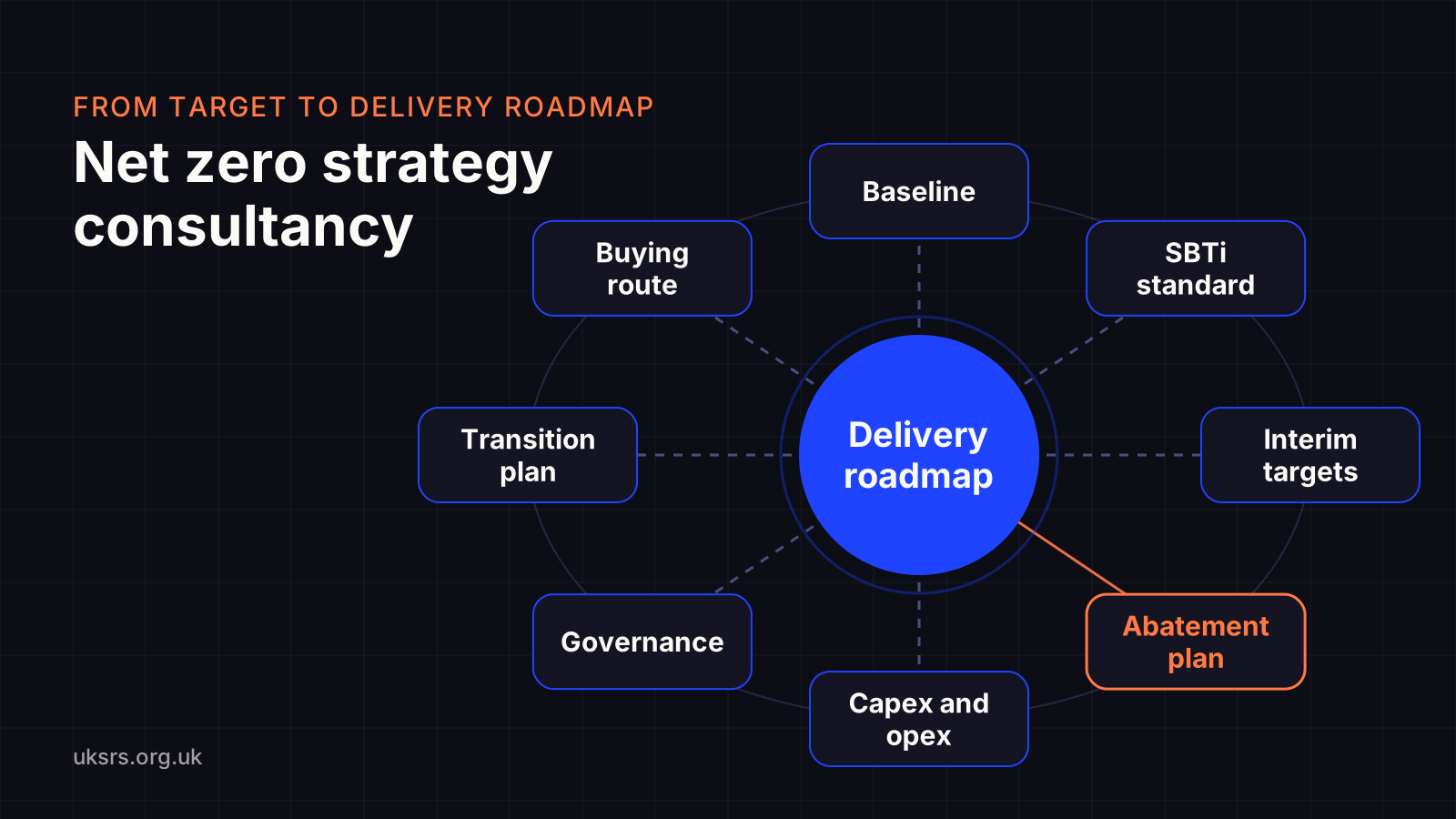
Net zero strategy consultancy starts where the target ends, turning a baseline and a date into interim targets, sized measures, sequenced spending and named owners.
UK SRS is an independent reference site. We have assessed no consultancy and publish no consultancy prices or rankings.
The work
What net zero strategy consultancy adds after the target
A target says where and when; a net zero strategy says what changes each year, who pays for it and who answers for it.
Net zero strategy consultants are usually hired once a baseline exists, which is why the work starts by checking it rather than rebuilding it.
Read the detailed guidance and references
- choose
- pace
- size
- fund
- own
- write
What a net zero consultancy is, the services it sells and the firms in the market are on the net zero consultancy page, and this page does not repeat them.
Preparing a target for validation is its own job, covered on SBTi consultancy.
The engineering of each measure, from heat to fleet, belongs to decarbonisation consultants.
Module 01 / 04
Baseline
Module 02 / 04
Interim
Module 03 / 04
Abatement
Module 04 / 04
Money
Baseline
Fix the baseline before the dates
Under the SBTi’s current near-term criteria a target covers at least 95% of Scope 1 and 2 emissions and, where Scope 3 is required, at least 67% of Scope 3.
A significant change, such as an acquisition or a change of method, triggers recalculation under criterion C27.
Read the detailed guidance and references
The base year can be no earlier than 2015 under the near-term criteria, and the SBTi does not allow rolling base years.
Under V2.0 the inventory allows no exclusions, and Category A companies need base-year assurance to at least limited assurance by an accredited third party.
Ask the consultant which recalculation triggers they have tested your baseline against before any target is modelled.
How Scope 3 is measured is on Scope 3 emissions.
Module 01 / 04
Coverage
Module 02 / 04
Year
Module 03 / 04
Triggers
Module 04 / 04
Assurance
Which standard
The SBTi version your strategy is built on
The SBTi published Corporate Net-Zero Standard V2.0 on 11 June 2026, and general corporate validation against it opens on 1 February 2027, according to the SBTi Services transition guide.
A strategy written in 2026 should say which version its targets will be submitted under, because the rules differ.
Read the detailed guidance and references
- 31 January 2027Last day for separate commitmentsAfter this, one “SBTi Commitment” option for all categories.SBTi transition guide, pp.8–9
- 1 February 2027V2.0 validations openGeneral corporate submissions may use V1.3.1 or V2.0.SBTi transition guide, Table 1
- 31 January 2028V1.3.1 window closesLast submissions under the current standard.SBTi transition guide, Table 1
- 1 February 2028V2.0 for new general corporate submissionsSector and financial-institution routes checked separately.SBTi transition guide, Table 1
| V2.0 category | Who it covers | What changes |
|---|---|---|
| Category A | Net turnover of €450 million or more, or 1,000 or more FTE; or, in high-income countries, Scope 1 and 2 of 10,000 tCO2e or more, or two of €25m balance sheet, €50m turnover and 250 FTE | Separate Scope 1, 2 and 3 targets; base-year assurance; publish the transition plan within 15 months |
| Category B | Every company below the Category A tests | Separate Scope 1 and 2 targets; Scope 3 targets optional unless a net zero target is set |
V2.0 has no separate SME route; a small company is Category B, and the SME route survives only under V1.3.1.
Financial institutions sit outside the February 2027 corporate launch and keep their own criteria with no end date, as the SBTi announced on 8 October 2026.
The standard itself is explained on the SBTi Net-Zero Standard page.
Module 01 / 04
Today
Module 02 / 04
From February 2027
Module 03 / 04
To January 2028
Module 04 / 04
From February 2028
Interim targets
Interim targets: the pace of the roadmap
Under V1.3.1 a near-term target runs for 5 to 10 years from submission, and V2.0 changes that to exactly five years from the start of the latest reporting period, under criterion C9.2.
V2.0 replaces the five-year review with an End-of-cycle Assessment, so the roadmap is re-set every cycle rather than drawn once to 2050.
Read the detailed guidance and references
The SBTi describes a typical long-term target as at least a 90% absolute cut by 2050 or sooner for many companies, with residual emissions neutralised at the net zero date.
An interim target is also what a reader of an annual report looks for: UK SRS S2 ¶33(f) asks for “any milestones and interim targets” for each target, and ¶34(a) whether a third party has validated it.
How targets are built is on SBTi target setting.
Module 01 / 04
V1.3.1
Module 02 / 04
V2.0
Module 03 / 04
Rates
Module 04 / 04
End point
Abatement plan
The abatement plan: measures sized against the gap
UK SRS S2 ¶14(a) asks how an entity plans to achieve its targets through changes to its business model, direct mitigation and indirect mitigation through customers and supply chains, in the standard’s own words.
Those three limbs are a useful skeleton for an abatement plan even for a company that does not report under UK SRS.
Read the detailed guidance and references
The SBTi says carbon credits “must not be counted as emission reductions toward the progress of companies’ near-term or long-term science-based targets”, under criterion C12.
V2.0 keeps that line: credits used for its Ongoing Emissions Responsibility programme are not eligible for target implementation and are never netted from the inventory.
Ask for every measure with its estimated tonnes, its owner, its date and whether the estimate comes from metering or a model.
Sizing the measures on site is the work of carbon reduction consultancy.
Module 01 / 04
Business model
Module 02 / 04
Direct
Module 03 / 04
Indirect
Module 04 / 04
Not credits
Capex and opex
Capex and opex: sequencing the money
UK SRS S2 asks “how the entity is resourcing, and plans to resource” the actions in its plan, at ¶14(b), and for progress against plans disclosed in earlier years at ¶14(c).
A net zero strategy that lists measures without saying when each is funded will not answer either question.
Read the detailed guidance and references
| UK SRS S2 | What it asks | What the roadmap should hold |
|---|---|---|
| ¶14(b) | How the entity is resourcing, and plans to resource, its actions | A funding line against each measure |
| ¶14(c) | Progress of plans disclosed in previous periods | A baseline of commitments to report against next year |
| ¶16(c) | Investment and disposal plans, including those not contractually committed, and planned sources of funding | Capex in delivery order, with the source of money |
| ¶29(e) | Capital expenditure, financing or investment deployed towards climate-related risks and opportunities | Actual spend tracked against the plan |
| ¶29(f) | Whether and how a carbon price is applied in decision-making, and the price per tonne | The internal carbon price, if one ranks the measures |
Many roadmaps time each measure to the replacement date of the asset it changes.
That is a planning choice for your own assets, not a rule, and this site gives no cost or savings estimate.
How the disclosures fit together is on UK SRS S2.
Module 01 / 04
Resourcing
Module 02 / 04
Investment
Module 03 / 04
Deployed
Module 04 / 04
Carbon price
Governance
Governance: who owns the roadmap
Under V2.0 “the company’s highest governing body (i.e., Board of Directors or equivalent) shall agree to assume overall accountability for SBTi targets”, under criterion C1.1.
UK SRS S2 ¶6(a)(v) asks how the governance body oversees the setting of targets and monitors progress, including whether related metrics are in remuneration policies.
Read the detailed guidance and references
V2.0 requires every company to develop and maintain a transition plan showing how it will implement its targets, under criterion C2.
Category A companies must publish it within 15 months of target validation, and every plan is reviewed at least every five years.
The SBTi says it validates the presence of a transition plan and does not assess or endorse its quality, completeness or feasibility.
A useful brief asks for a decision calendar: which committee approves each stage, and when the plan returns to the board.
Module 01 / 04
Board
Module 02 / 04
Management
Module 03 / 04
Pay
Module 04 / 04
Review
The transition plan
The transition plan: disclosure, statement, framework
UK SRS S2 asks for information about “any climate-related transition plan the entity has”, including key assumptions and dependencies, at ¶14(a)(iv).
The FCA’s PS26/19 states that UK SRS S2 does not require entities to have a transition plan.
Read the detailed guidance and references
PS26/19 applies UK SRS on a comply-or-explain basis to companies in UKLR 6, 14, 15, 16 and 22, for accounting periods beginning on or after 1 January 2027.
Companies in UKLR 6, 16 and 22 also state whether they have published a transition plan and where, or why not, under UKLR 6.6.6R(8)(e).
The government’s consultation on transition plan requirements ran from 25 June to 17 September 2025, and its page still offered no outcome when we read it on 11 October 2026.
The Transition Plan Taskforce disbanded in October 2024, and its framework is hosted by the IFRS Foundation with a notice that the Foundation is not responsible for its accuracy.
The UK reporting side is on UK SRS transition plans, and writing one on the climate transition plan guide.
Module 01 / 04
UK SRS S2
Module 02 / 04
FCA statement
Module 03 / 04
TPT framework
Module 04 / 04
Consultation
Public-sector buying
Buying net zero strategy consultancy through a framework
ESPO framework 500_23, Consultancy for Decarbonisation / Net Zero Strategies, splits its two lots at £50,000 of assessed consultancy value, according to the Find a Tender award notice.
ESPO lists the routes as direct award or further competition, and listed the framework as Active when we read its page on 11 October 2026.
Read the detailed guidance and references
The notice gives an estimated total value of £200 million excluding VAT, including an option to extend the framework by up to 24 months.
Public notices for the framework give different contract dates, so confirm the current end date with ESPO before calling off.
The framework was procured under the Public Contracts Regulations 2015 and is open to the public bodies and classes of user listed in ESPO’s notice.
Suppliers bidding for government contracts face a separate requirement: a Carbon Reduction Plan under PPN 006 for contracts above £5 million a year.
Module 01 / 04
Lot 1
Module 02 / 04
Lot 2
Module 03 / 04
Route
Module 04 / 04
Check
Before you call anyone
Briefing net zero strategy consultancy: your sequence
Brief net zero strategy consultants with your target status, your size, your listing and how you buy, because those decide the order of the roadmap.
Answer five questions and the sequencer lists the steps in order, with the rule behind each one.
Open the roadmap sequencer
In what order should your roadmap be built?
- 01 · Check the baseline
Confirm coverage (at least 95% of Scope 1 and 2; 67% of Scope 3 where required) and a base year no earlier than 2015 before any target is modelled.
SBTi Near-Term Criteria V5.3.1, C5–C6
- 02 · Choose the standard
Submitting between 1 February 2027 and 31 January 2028, you may use V1.3.1 or V2.0; decide before modelling, because the target periods and Scope 3 rules differ.
SBTi Services transition guide, Table 1
- 03 · Set interim targets
Under V2.0 each near-term target covers exactly five years, with separate Scope 1, 2 and 3 targets for a Category A company.
SBTi CNZS V2.0, C9.1–C9.2
- 04 · Size the abatement plan
List each measure with estimated tonnes, owner and date; carbon credits never count as reductions towards the targets.
SBTi Net-Zero Standard V1.3.1, C12; CNZS V2.0, C26.2
- 05 · Sequence the money
Attach a funding source and year to each measure, so the plan can answer how it is resourced.
UK SRS S2 ¶14(b), ¶16(c)
- 06 · Give the board the targets
Board accountability for the targets is a V2.0 criterion, and every company keeps a transition plan; a Category A company publishes it within 15 months of validation.
SBTi CNZS V2.0, C1.1, C2, C2.4
- 07 · Submit for validation
SBTi Services validates targets and does not offer consultation services; a consultant prepares the submission.
SBTi Services, Target Validation Service Offerings V6.1
- 08 · Describe the plan where asked
No UK rule requires an unlisted company to have a transition plan; if a customer or lender asks, describe the plan you have, with its assumptions and dependencies.
UK SRS S2 ¶14(a)(iv); DESNZ consultation (no outcome published)
A scoping aid that gives no emissions, cost or savings estimate and no legal advice; SBTi categories are self-assessed against the V2.0 tests.
Nothing you choose is stored or sent.
Module 01 / 04
Status
Module 02 / 04
Version
Module 03 / 04
Duty
Module 04 / 04
Buyer
Due diligence
What to ask net zero strategy consultants
Which SBTi version will the targets be submitted under, and what changes if submission slips past 1 February 2028?
Which measures are sized from metered data and which from models, and who owns each one?
Read the detailed guidance and references
How will the roadmap answer UK SRS S2 ¶14(b) on resourcing, if you report under UK SRS?
Does the proposal treat any carbon credit as a reduction?
SBTi Services validates targets and, on its own account, “does not offer consultation services”, so a firm promising validation is promising something it cannot give.
Under PS26/19 UK SRS is comply or explain, so a proposal that calls it mandatory is overstating it.
The general process is in choosing a sustainability consultant.
It names no firm, quotes no price and estimates no one’s emissions or savings.
Module 01 / 04
Version
Module 02 / 04
Sizing
Module 03 / 04
Money
Module 04 / 04
Owners
Illustrative brief · no consultancy assessed
A worked brief: a listed manufacturer with a 2050 target
An illustrative manufacturer listed in UKLR 6 has a 2050 net zero commitment and no interim targets.
Its brief should ask for a baseline check, a decision on the SBTi version, five-year targets, a sized and funded abatement plan, a board decision calendar and the transition plan statement it will make under UKLR 6.6.6R(8)(e).
View the workflow diagram
- 1
Version
Submit under V1.3.1 before February 2028, or wait for V2.0.
- 2
Roadmap
Five-year targets, sized measures and funded capex.
- 3
Statement
UKLR 6 transition plan statement and UK SRS S2 ¶14.
Each date means something different
The dates a net zero strategy must respect
Check whether each date is a publication, a deadline or the start of a rule.
- 25 June 202501
Transition plan consultation opens
Closed 17 September 2025; no response published. - 11 June 202602
- 1 January 202703
UK SRS comply or explain
Accounting periods from this date, UKLR 6, 14, 15, 16 and 22. - 1 February 202704
- 31 January 202805
SBTi V1.3.1 closes
V2.0 for new general corporate submissions from 1 February 2028.
A suggested delivery sequence
From the brief to the board-approved roadmap
This is an editorial sequence for buying the work, not a statutory timetable or a promise about how long it takes.
- 01 / Check01
Test the baseline
Coverage, base year and recalculation triggers. - 02 / Choose02
Fix the standard
SBTi version and company category. - 03 / Pace03
Set interim targets
Five-year steps towards the long-term date. - 04 / Size04
Build the abatement plan
Measures with tonnes, owners and dates. - 05 / Fund05
Sequence capex and opex
Funding source and timing for each measure. - 06 / Own06
Approve and publish
Board accountability, transition plan and review dates.
Frequently asked
Net zero strategy consultants, answered
What does a net zero strategy consultant do?
A net zero strategy consultant turns a net zero target into a delivery roadmap: a checked baseline, the target-setting standard and its version, five-year interim targets, an abatement plan of sized measures, the order of capital and operating spend, the governance that owns it, and the transition plan that describes it.
Is a net zero strategy different from a net zero consultancy engagement?
It is the forward-looking part of one.
A net zero consultancy engagement usually includes measurement and reporting; a net zero strategy engagement starts from an agreed baseline and ends with a funded, owned sequence of actions.
Which SBTi standard should our net zero strategy use?
Version 1.3.1 governs today.
V2.0 was published on 11 June 2026 and opens for general corporate validation on 1 February 2027; V1.3.1 remains an option for submissions before 1 February 2028.
Financial institutions follow their own routes.
What are interim net zero targets?
They are the near-term targets on the way to the long-term date.
Under V1.3.1 they cover 5 to 10 years, at a minimum linear rate of 4.2% a year for Scope 1 and 2.
Under V2.0 each near-term target covers exactly five years, and the cycle repeats.
Do we need a transition plan to set SBTi targets?
Under V2.0, yes: every company must develop and maintain a transition plan showing how it will implement its targets, and Category A companies must publish it within 15 months of validation.
The SBTi checks that a plan exists; it does not assess its quality.
Do UK listed companies have to publish a transition plan?
No UK rule requires one.
UK SRS S2 asks for information about any plan an entity has, and companies in UKLR 6, 16 and 22 must say whether they have published one and where, or why not.
The government consulted on transition plan requirements in 2025 and has not published its response.
How does a public body buy net zero strategy consultancy?
One route is ESPO framework 500_23, Consultancy for Decarbonisation / Net Zero Strategies, with a lot for requirements under £50,000 and a lot for £50,000 and over, by direct award or further competition.
Check the framework’s current term and eligibility with ESPO before calling off.
Can carbon credits be part of a net zero strategy?
Not as reductions.
SBTi never counts credits towards its targets; under V1.3.1 they can neutralise residual emissions at the net zero date or fund mitigation beyond the value chain.
UK SRS S2 reporting stays gross.
Can a consultant validate our net zero targets?
No. SBTi Services validates targets and says it does not offer consultation services.
A consultant prepares the baseline, the targets and the evidence for submission.
How much does net zero strategy consultancy cost?
This site publishes no prices and has assessed no consultancy.
Ask for a scope priced by stage, with the baseline check, target modelling, abatement plan and transition plan as separate deliverables.
Sources
Primary sources
Every figure, date and status on this page traces to the instrument’s owner.
Secondary commentary is never the source for a number.
- SBTi ServicesGuide for companies in the transition to Corporate Net-Zero Standard V2.0, Table 1
V2.0 validations open 1 February 2027; V1.3.1 eligible for submissions before 1 February 2028.
- Science Based Targets initiativeCorporate Net-Zero Standard V2.0 Criteria (June 2026)
C1, C2, C7, C9, C14, C26 and C43: board accountability, transition plan, five-year targets, credits.
- Science Based Targets initiativeCorporate Near-Term Criteria V5.3.1
Near-term boundaries, timeframes and the recalculation triggers in C27.
- Science Based Targets initiativeNet-Zero Standard Criteria V1.3.1
Minimum annual reduction rates; credits never count as reductions.
- SBTi ServicesTarget Validation Service Offerings V6.1
What validation includes; a limited-assurance check of targets.
- Science Based Targets initiativeFinancial Institutions Near-Term Criteria to continue without end date (8 October 2026)
Financial institutions sit outside the corporate V2.0 launch.
- Science Based Targets initiativeHow to set science-based targets
SBTi Services validates targets and does not offer consultation services.
- Department for Business and TradeUK SRS S2 Climate-related Disclosures (PDF), ¶¶6, 14, 16, 29
Governance of targets, the transition plan, resourcing, investment plans, capital deployment, carbon prices.
- Financial Conduct AuthorityPS26/19
Comply or explain across UK SRS for UKLR 6, 14, 15, 16 and 22, periods from 1 January 2027.
- Financial Conduct AuthorityPS26/19 (PDF), ¶2.36 and Appendix 1
UK SRS S2 does not require a transition plan.
- Financial Conduct AuthorityFCA Handbook, UKLR 6.6
The transition plan statement, UKLR 6.6.6R(8)(e).
- Department for Energy Security and Net ZeroClimate-related transition plan requirements (consultation)
Ran 25 June to 17 September 2025; no government response published.
- Transition Plan Taskforce (archived by the IFRS Foundation)TPT Disclosure Framework (October 2023)
Five Elements and three guiding principles; voluntary.
- IFRS FoundationDisclosing information about an entity’s climate-related transition… in accordance with IFRS S2 (23 June 2025)
Does not add to or change the requirements in IFRS S2.
- ESPOConsultancy for Decarbonisation / Net Zero Strategies (500_23)
Two lots split at £50,000; listed as Active on 11 October 2026.
- Find a Tender500_23 contract award notice, 2024/S 000-004225
£200m including a 24-month option; 44 and 42 suppliers; award weightings.
- Cabinet OfficePPN 006: Carbon Reduction Plans
Contracts above £5 million a year; net zero by 2050 in the UK.
Continue reading
Read next
Net zero consultancy
What net zero consultants do, what UK rules ask, and an unranked directory.
SBTi consultancy
Preparing targets for validation.
UK SRS transition plans
What a report says about a plan you have.
Climate transition plans
Writing the plan itself.
Decarbonisation consultancy
The operational measures on site.
PPN 006 Carbon Reduction Plans
What suppliers to government must publish.