SBTi: climate targets
Greenhouse gas targets, validated by SBTi Services; FLAG covers land-sector emissions.
SBTi standardsAsk direct questions about your own reporting — your thresholds, your dates, what you file and when.
Sign up free →The standards
Does it apply to you
Reporting under it
WHY REGISTER
Ask these pages about your own company.
Free · no card
Everything on this site stays open without an account.
Start here
Dates and penalties
Doing it
WHY REGISTER
Ask these pages about your own company.
Free · no card
Everything on this site stays open without an account.
What you must file
Doing it
WHY REGISTER
Ask these pages about your own company.
Free · no card
Everything on this site stays open without an account.
Start here
Setting targets
Who and where
WHY REGISTER
Ask these pages about your own company.
Free · no card
Everything on this site stays open without an account.
The UK duty
Doing it
WHY REGISTER
Ask these pages about your own company.
Free · no card
Everything on this site stays open without an account.
The baseline
Europe
Reporting more widely
WHY REGISTER
Ask these pages about your own company.
Free · no card
Everything on this site stays open without an account.
Carbon markets and trade
Packaging and net zero
Carbon accounting
WHY REGISTER
Ask these pages about your own company.
Free · no card
Everything on this site stays open without an account.
Choosing
Carbon
Compliance and offsets
WHY REGISTER
Ask these pages about your own company.
Free · no card
Everything on this site stays open without an account.
Software
Templates
Careers
WHY REGISTER
Ask these pages about your own company.
Free · no card
Everything on this site stays open without an account.
ASK ABOUT YOUR OWN REPORTING
Ask direct questions about your own reporting — your thresholds, your dates, what you file and when.
Sign up freeFree · one email · already registered? Log in
Everything on this site stays open without an account.
SBTi nature · science-based targets for nature
The SBTi sets climate targets only; science-based targets for nature come from the Science Based Targets Network (SBTN), a separate organisation that shares four of the SBTi’s founding partners.
Asking about SBTi nature targets usually means one of three things, and the Science Based Targets initiative nature link is closest in its FLAG rules for land-sector emissions.
Who does what
Greenhouse gas targets, validated by SBTi Services; FLAG covers land-sector emissions.
SBTi standardsFreshwater, land and ocean targets, validated by the Accountability Accelerator; climate targets go to the SBTi.
SBTN: take actionNature-related reporting; recommends SBTN methods for setting nature targets.
TNFD and SBTN guidance v1.0SBTN
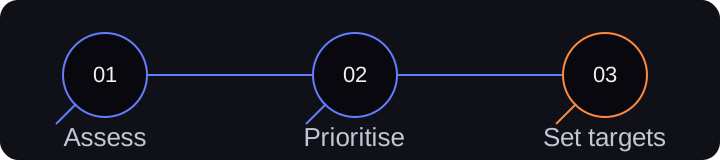
SBTN uses five steps: “Assess, Prioritize, Set targets, Act and Track”.
Its validation is run by a separate host: “Validation services are available now for land and freshwater targets, with ocean target validation coming soon”, through the Accountability Accelerator, open since 20 February 2025.
Where climate impacts are material, SBTN sends companies to the SBTi: climate targets “are set via our partner organization, the Science Based Targets initiative.”
| SBTN method | Version |
|---|---|
| Steps 1 and 2 (assess and prioritise) | Technical Guidance V1.1, with a V1.2 update |
| Freshwater | V1.1 |
| Land | V1.0 |
| Ocean (seafood) | V1 |
Coming
SBTN says its updated guidance is “coming on October 13 2026”, and that “Version 2 expands freshwater target-setting to include groundwater and pesticide-related impacts.”
Its land footprint reduction target becomes a broader working land regeneration and restoration target.
Current versions stay open for validation for six months after Version 2, and validated work stays applicable for five years.
On 11 October 2026 SBTN 2.0 had not been released. This page will be revisited after 13 October.
The SBTi’s land rules
The SBTi’s nearest rules are its SBTi FLAG targets: climate targets for forest, land and agriculture emissions, with a mandatory public no-deforestation commitment dated no later than 31 December 2030.
Nature disclosure is on the TNFD page; the climate standards are on the SBTi sector guidance page, and the SBTi hub links every guide.
Frequently asked
No. The SBTi’s targets are for greenhouse gas emissions.
Science-based targets for nature, such as freshwater, land and ocean, come from the Science Based Targets Network, a separate organisation.
SBTN, founded in 2019, sets methods for nature targets and validates them through its host, the Accountability Accelerator; the SBTi sets climate target criteria and SBTi Services validates them.
SBTN says the SBTi is “a separate but related initiative” and sends companies to it for climate targets.
SBTN says its founding partners are CDP, the World Resources Institute, WWF and the UN Global Compact, which also founded the SBTi, plus Conservation International, UNEP-WCMC and the World Economic Forum.
The TNFD recommends that companies setting nature targets use SBTN’s methods, in guidance the two published together in September 2023.
The TNFD is about disclosure; SBTN about targets.
SBTN says Science-Based Targets for Nature 2.0 is coming on 13 October 2026, expanding freshwater targets to groundwater and pesticides and broadening its land target.
Until it is published, the current versions apply, and SBTN says they stay open for validation for six months after Version 2.
They are climate targets for forest, land and agriculture emissions, with a mandatory no-deforestation commitment.
SBTN’s land targets are a separate, nature-focused set.
Sources
Every figure, date and status on this page traces to the instrument’s owner.
Secondary commentary is never the source for a number.
“SBTi is a separate but related initiative”.
Five steps; validation by the Accountability Accelerator.
Announced for 13 October 2026.
Method versions: freshwater, land, ocean.
The TNFD recommends SBTN methods.
The SBTi’s founding partners.
The SBTi’s own land-sector climate targets.
The no-deforestation commitment.
Climate targets only.
Greenhouse gas targets.