UKLR 6, 14, 15, 16 or 22
Comply or explain across UK SRS for periods beginning on or after 1 January 2027.
FCA PS26/19 ¶¶3.6, 3.12Ask direct questions about your own reporting — your thresholds, your dates, what you file and when.
Sign up free →The standards
Does it apply to you
Reporting under it
WHY REGISTER
Ask these pages about your own company.
Free · no card
Everything on this site stays open without an account.
Start here
Dates and penalties
Doing it
WHY REGISTER
Ask these pages about your own company.
Free · no card
Everything on this site stays open without an account.
What you must file
Doing it
WHY REGISTER
Ask these pages about your own company.
Free · no card
Everything on this site stays open without an account.
Start here
Setting targets
Who and where
WHY REGISTER
Ask these pages about your own company.
Free · no card
Everything on this site stays open without an account.
The UK duty
Doing it
WHY REGISTER
Ask these pages about your own company.
Free · no card
Everything on this site stays open without an account.
The baseline
Europe
Reporting more widely
WHY REGISTER
Ask these pages about your own company.
Free · no card
Everything on this site stays open without an account.
Carbon markets and trade
Packaging and net zero
Carbon accounting
WHY REGISTER
Ask these pages about your own company.
Free · no card
Everything on this site stays open without an account.
Choosing
Carbon
Compliance and offsets
WHY REGISTER
Ask these pages about your own company.
Free · no card
Everything on this site stays open without an account.
Software
Templates
Careers
WHY REGISTER
Ask these pages about your own company.
Free · no card
Everything on this site stays open without an account.
ASK ABOUT YOUR OWN REPORTING
Ask direct questions about your own reporting — your thresholds, your dates, what you file and when.
Sign up freeFree · one email · already registered? Log in
Everything on this site stays open without an account.
UK SRS consultants · the implementation engagement
UK SRS consultancy is the work of getting a company ready to report against UK SRS S1 and S2, or to explain where it cannot.
It starts from the FCA’s final rules and the UK versions of the standards, not from a generic ISSB template.
UK SRS is an independent reference site. We have assessed no consultancy and publish no consultancy prices or rankings.
The engagement
A UK SRS consultancy engagement is bought to produce one thing: disclosures in the annual financial report that meet UK SRS S1 and S2, or say clearly where they do not.
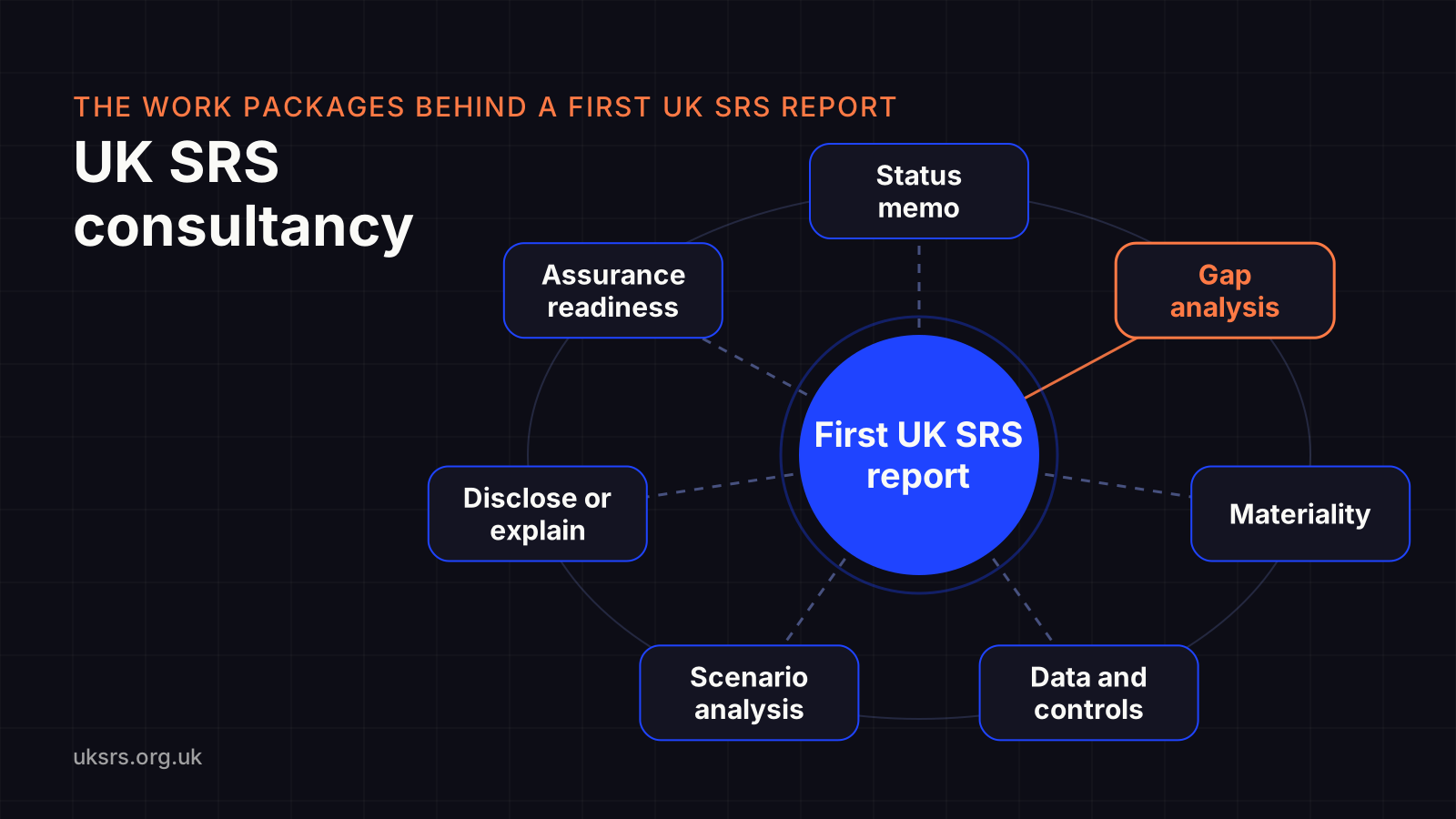
The work runs in seven packages, from a status memo to an evidence file an assurer could test.
UK SRS consultants who start at drafting have skipped the two packages that decide whether the draft is right: status and the gap analysis.
Searches for UK SRS sustainability consultants or UK SRS implementation support describe the same engagement.
The standards themselves are on UK SRS S1 and UK SRS S2, and getting a report out under any framework is on sustainability reporting consultancy.
Module 01 / 04
Module 02 / 04
Module 03 / 04
Module 04 / 04
First package
On 30 September 2026 the FCA published PS26/19: listed companies in UKLR 6, 14, 15, 16 and 22 report against UK SRS on a comply-or-explain basis for accounting periods beginning on or after 1 January 2027.
The FCA consulted on mandatory climate reporting under UK SRS S2 and did not adopt it, so a proposal that calls UK SRS mandatory is overstating the rules.
Disclosures sit in the annual financial report, which DTR 4.1.3R requires to be public at the latest four months after year end.
AIM securities are not admitted to the Official List, according to the AIM Rules for Companies, so the listing categories PS26/19 amends do not cover them.
For every other entity the standards are available for voluntary use, as the government’s guidance puts it.
The government’s Modernising corporate reporting consultation, open until 30 November 2026, says only that it will consider how UK SRS should be reflected in the Companies Act.
The Companies Act climate-related financial disclosure under s.414CA still applies to companies over its tests, all of which carry a floor of more than 500 employees.
The government has confirmed that UK SRS S2 is a national reporting framework for s.414CB(6), so a company reporting under S2 need not duplicate those disclosures.
The status test is worked through on the UK SRS scope checker, and the FCA rules on UK SRS and the FCA.
Comply or explain across UK SRS for periods beginning on or after 1 January 2027.
FCA PS26/19 ¶¶3.6, 3.12UK SRS is voluntary; check the Companies Act climate disclosure separately.
GOV.UK guidanceUK SRS and IFRS
UK SRS is built on IFRS S1 and S2, but it is not the same text, and Annex A of the government response lists every difference.
An ISSB consultancy or IFRS S2 consultancy brings most of the technical skill, but the UK-specific parts are where first reports go wrong.
| Topic | IFRS S1 and S2 | UK SRS S1 and S2 |
|---|---|---|
| Effective date | Annual periods beginning on or after 1 January 2024, where adopted | Removed; application is set by the FCA or legislation (S1 ¶E5, S2 ¶C6) |
| SASB and industry guidance | An entity “shall” refer to and consider it | An entity “may” refer to and consider it (S1 ¶¶55(a), 58(a); S2 ¶¶12, 23, 32) |
| Climate-first relief | First annual reporting period only | No time limit in the standard (S1 ¶E3); the FCA sets two years |
| Scope 3 relief | First annual reporting period only | No time limit in the standard (S2 ¶C4); the FCA sets one year |
| GHG method relief | First annual reporting period | Kept to the first annual reporting period (S2 ¶C3) |
| Reporting after the financial statements | Permitted in the first year (IFRS S1 ¶E4) | Removed |
| Compliance statement with climate-first | No equivalent paragraph | No assertion of compliance with S1; S2 compliance may still be asserted (S1 ¶73A) |
| Financed emissions | Prior-period estimate permitted | Also explain why, the method and the plan (S2 ¶B59A) |
The December 2025 ISSB amendments to IFRS S2 on greenhouse gas emissions are the ISSB’s, absorbed into UK SRS S2 before it was issued, not UK amendments.
The time limits were removed from the reliefs by design: the government’s letter to the FCA of 5 January 2026 said their timing would be set in regulations or FCA rules.
The FRC’s FAQs add that new or amended ISSB standards would not apply in the UK automatically.
So IFRS ESG consulting experience from another jurisdiction is a good start, provided the firm can show it has read PS26/19 and Annex A.
The full mapping is on UK SRS amendments, and the ISSB’s side on the ISSB framework, IFRS S1 and IFRS S2.
Module 01 / 04
Module 02 / 04
Module 03 / 04
Module 04 / 04
Reliefs
The FCA’s rules give two reliefs from initial application: Scope 3 for one year, and climate-first reporting for non-climate S1 matters for two years, under PS26/19 ¶3.14.
A company using a relief states it in its annual financial report, and the FCA says that use of a relief does not engage its explain rules (¶3.20).
For a UKLR 6 company the Scope 3 relief is UKLR TP 16.4R(2)(a), and the statement names both that provision and UK SRS S2 ¶C4, according to the made rules in Appendix 1.
No comparative information is needed for the first period of disclosure, under UKLR TP 16.6G(2).
A company whose period begins before 1 January 2027 can keep the TCFD-aligned rules or adopt UK SRS early, and an early adopter keeps the same reliefs (¶3.19).
When a relief expires the disclosure moves to comply or explain, which ¶¶3.23 and 3.24 state for periods beginning in 2028 and 2029.
A company using the climate-first relief may not assert compliance with UK SRS S1, although it may still assert compliance with S2, under UK SRS S1 ¶73A.
The practical point for a UK SRS consultancy brief is that Scope 3 data work should start in the first year, because the relief ends before most supplier data programmes do.
Scope 3 is set out on UK SRS Scope 3 reporting, and moving from TCFD on TCFD to UK SRS migration.
Second package
A gap analysis reads each requirement of UK SRS S1 and S2 against what the company can evidence today, across the four core content areas set out at S1 ¶25.
Under comply or explain its output is also the first draft of the explanations, so the two should be written together.
The explain limbs differ by standard: for S2 a summary of the requirements not met, and for S1 the undisclosed risks or opportunities, each with reasons and planned steps, under UKLR 6.6.6R(7A) and (7B).
The FCA’s draft Technical Note 803.1, open for feedback until 28 October 2026, proposes guidance on what an explanation should contain.
A company that already makes TCFD-aligned disclosures has a narrower gap, because UK SRS S2 builds on the same four areas.
The structured self-check is on the UK SRS readiness assessment, and the disclosure list on UK SRS reporting.
Module 01 / 04
Module 02 / 04
Module 03 / 04
Module 04 / 04
Materiality and connectivity
UK SRS uses single (financial) materiality: information is material if omitting, misstating or obscuring it could reasonably be expected to influence the decisions of primary users, under S1 ¶18.
The risks and opportunities in scope are those that could reasonably be expected to affect the entity’s cash flows, its access to finance or cost of capital, at S1 ¶3.
The standard sets no thresholds for materiality (¶B19), information that is not material need not be disclosed even where a standard lists it (¶B25), and judgements are reassessed at each reporting date (¶B28).
Connected information means the disclosures cover the same reporting entity as the related financial statements (¶20), identify those statements (¶22) and use consistent data and assumptions (¶23).
They are reported at the same time as the financial statements and for the same period (¶64), which rules out a standalone sustainability report published later in the year.
This is not the double materiality of the EU’s ESRS, which adds an impact lens; the contrast is on CSRD and UK SRS compared.
Module 01 / 04
Module 02 / 04
Module 03 / 04
Module 04 / 04
Data, controls and governance
UK SRS S2 ¶29(a) asks for absolute gross greenhouse gas emissions by scope, so the data work is an inventory with a documented boundary, method and owner for every figure.
For Scope 3 the entity shall consider all 15 categories and disclose which are included, under S2 ¶B32, which is not the same as reporting all fifteen.
Governance disclosures name the body or individual responsible and describe management’s role and controls, under S1 ¶¶26–27.
Disclosures go in the annual financial report, with cross-reference to another report permitted under S1 ¶¶B45–B47 and the location stated under UKLR 6.6.6R(8)(c).
The government has confirmed in its consultation response that section 463’s protection applies to UK SRS disclosure placed in the strategic report, so where the words sit is a governance decision.
The method is on carbon accounting for UK SRS.
Module 01 / 04
Module 02 / 04
Module 03 / 04
Module 04 / 04
Scenario analysis
UK SRS S2 ¶22 says the entity shall use climate-related scenario analysis to assess its climate resilience, using an approach commensurate with its circumstances.
Paragraph B8 sets the proportionality test, considering reasonable and supportable information available without undue cost or effort, so the depth scales but the obligation does not.
The disclosure covers the inputs, the key assumptions and the reporting period in which the analysis was carried out, under ¶22(b).
A consultant who sells a fully quantified model as the only compliant approach, or who says scenario analysis is optional for smaller companies, has misread ¶¶22 and B8.
Under comply or explain, a company that cannot yet do it explains why and what it plans, as it would for any other requirement.
The S2 requirements are set out on UK SRS S2.
Which scenarios, their sources and time horizons (¶22(b)(i)).
The key assumptions used (¶22(b)(ii)).
Implications for strategy and capacity to adjust (¶22(a)).
Transition plans
Companies in UKLR 6, 16 and 22 state whether they have published a climate-related transition plan and where, or why not, under UKLR 6.6.6R(8)(e).
The FCA states in PS26/19 ¶2.36 that UK SRS S2 does not require entities to have a climate-related transition plan.
If a company has a plan, UK SRS S2 ¶14(a)(iv) asks for information about it, including its key assumptions and dependencies.
The statement does not apply to UKLR 14 or 15, where the FCA kept the consulted scope.
The government’s consultation on transition plan requirements closed on 17 September 2025 and no response has been published.
The disclosure is on UK SRS transition plans, and writing one on the climate transition plan guide.
Module 01 / 04
Module 02 / 04
Module 03 / 04
Module 04 / 04
Assurance readiness
No UK rule requires a company to obtain sustainability assurance; a listed company states whether it did, and if so the provider, scope, level and standards, under UKLR 6.6.6R(8)(d).
The FRC issued ISSA (UK) 5000 for voluntary use, effective for periods beginning on or after 15 December 2026.
The FCA said it is not requiring explanations where assurance is not sought, and that it will keep the case for mandating assurance under review.
The government’s oversight response set out a voluntary, opt-in register run by the FRC, which had not opened on the latest record this site holds.
The IESBA standards bar an assurance practitioner from assuming management responsibility for a client and generally prohibit services that create a self-review threat for public interest entities.
So decide early whether you want assurance, appoint the assurer, and brief the UK SRS consultancy around that choice.
The standards are set out on sustainability assurance.
Module 01 / 04
Module 02 / 04
Module 03 / 04
Module 04 / 04
Before you call anyone
Brief UK SRS consultants with your listing category, your first period, what you already report and whether you want assurance, because those four facts decide the work.
Answer the six questions and the panel lists the work packages your brief should name, with the provision each comes from.
Ask each firm which disclosures you could reasonably explain rather than make in the first year, and why.
Ask whether the proposal treats the reliefs as statements you make, which is what the rules say, rather than as gaps to close.
Ask whether the firm, or anyone in its network, would also be your assurance provider.
Ask for days by grade, the second year priced in the same proposal, and who owns the workings at the end.
A proposal that calls UK SRS mandatory, says reliefs end in “mandatory” reporting, or quotes a count of companies that “must comply” is working from the consultation, not the final rules.
The wider process is in how to choose a sustainability consultant, and an unranked directory is on sustainability consulting firms.
It names no firm, quotes no price and gives no day count.
Which work packages belong in your brief?
The panel below starts from a UKLR 6 company with a 2027 first period; change any answer and it updates.
Your category reports against UK SRS S1 and S2 on a comply-or-explain basis: disclose, or say what is missing, why, and what you plan to do.
Nothing in the rules makes UK SRS mandatory.
FCA PS26/19 ¶¶1.2, 3.6; UKLR 6.6.6R(7A), (7B) and the equivalents for UKLR 14, 15, 16 and 22
Your first period runs under both reliefs: Scope 3 for one year and climate-first for non-climate S1 matters for two.
Using a relief is stated in the annual financial report, citing the transitional provision and the UK SRS paragraph, and needs no further explanation.
FCA PS26/19 ¶¶3.14, 3.20; UKLR TP 16.4R(2) (UKLR 6); UK SRS S2 ¶C4, S1 ¶E3
Start from your TCFD-aligned disclosures and read them against UK SRS S1 and S2 paragraph by paragraph; the gaps that remain at the first period become explanations, not failures.
UK SRS S1 ¶25 core content; S2 ¶29; UKLR 6.6.6R(7A)(b), (7B)(b)
A financial materiality judgement for primary users (no thresholds are set), with the same reporting entity, period and assumptions as the financial statements.
UK SRS S1 ¶¶18, 20–23, 64, B19
Scope 1 and 2 first, then a Scope 3 screen of all 15 categories; the relief buys time for the disclosure, not for the data work.
UK SRS S2 ¶¶29(a), B32–B33, C3; FCA PS26/19 ¶3.22
Scenario analysis is required, with an approach commensurate with your circumstances; the depth scales, the obligation does not.
UK SRS S2 ¶¶22(a)–(b), B8
State whether you have published a climate-related transition plan and where, or why not.
No rule requires you to have one.
UKLR 6.6.6R(8)(e); FCA PS26/19 ¶2.36
Decide early: assurance is not required, but the decision changes who can help draft the report and how the evidence is kept.
UKLR 6.6.6R(8)(d); IESSA independence standards
The workings, the gap list and the explanation drafts stay with you, so year two does not repeat year one.
Editorial buying advice; no rule sets this
A scoping aid that gives no legal advice, no price and no day count.
Nothing you choose is stored or sent.
Module 01 / 04
Module 02 / 04
Module 03 / 04
Module 04 / 04
Illustrative brief · no consultancy assessed
This illustrative company already reports under the TCFD-aligned rules and does not measure Scope 3.
Its UK SRS consultancy brief names the status memo, the gap analysis, a Scope 3 screen started in 2027, scenario analysis, the transition-plan statement and the decision on assurance.
For the detailed requirements, see UK SRS S1 and S2.
UKLR 6, first period from 1 January 2027, both reliefs available.
S1 and S2 read against the existing TCFD disclosures.
Disclosures, explanations and relief statements by 30 April 2028.
Each date has a different meaning
Check whether each date is a publication, a period start, a deadline or the end of a relief.
A suggested delivery sequence
This is an editorial buying and preparation sequence, not a statutory timetable or a promise about how long the engagement takes.
Frequently asked
A UK SRS consultant helps a company prepare disclosures under UK SRS S1 and S2: a status memo, a gap analysis against both standards, the materiality judgement, the greenhouse gas data and controls, scenario analysis, the draft disclosures and explanations, and an evidence trail an assurer could test.
The company, not the consultant, is responsible for the report.
Under the FCA’s final rules (PS26/19), companies listed in UKLR 6, 14, 15, 16 and 22 report against UK SRS on a comply-or-explain basis for accounting periods beginning on or after 1 January 2027, with first reports in 2028.
For every other entity UK SRS is available for voluntary use.
No. The FCA consulted on mandatory UK SRS S2 and did not adopt it; the final rules are comply or explain across both standards.
When a relief expires the disclosure moves to comply or explain, not to a mandatory requirement.
No rule requires it.
The government’s Modernising corporate reporting consultation, open until 30 November 2026, says only that it will consider how UK SRS should be reflected in the Companies Act.
A private company that meets the s.414CA tests still makes the climate-related financial disclosure, which UK SRS S2 can discharge.
The UK removed the effective dates, made the SASB references “may” rather than “shall”, removed the time limits from the Scope 3 and climate-first reliefs (the FCA sets them instead), removed IFRS S1’s first-year late-reporting relief and added an explain duty for financed emissions at UK SRS S2 ¶B59A.
Annex A of the government response lists every difference.
The technical work overlaps, because UK SRS is built on IFRS S1 and S2.
The UK-specific parts are the FCA’s comply-or-explain rules, the relief statements, the transition-plan statement and the UK amendments, so ask an ISSB or IFRS S2 consultancy to show it has read PS26/19 and Annex A.
UK SRS S2 ¶22 requires an entity to use climate-related scenario analysis to assess its climate resilience, with an approach commensurate with its circumstances.
Paragraph B8 scales the depth to the information available without undue cost or effort; it does not make the analysis optional.
No UK rule requires it.
Under UKLR 6.6.6R(8)(d) a listed company states whether it obtained third-party assurance and, if so, the provider, scope, level and standards; the FCA asks for no reason where none was sought.
ISSA (UK) 5000 is available for voluntary use from periods beginning on or after 15 December 2026.
Be careful.
The IESBA ethics standards for sustainability assurance bar a practitioner from assuming management responsibility for a client and generally prohibit services that create a self-review threat for public interest entities.
Choose the assurer first, then brief the preparation work around it.
This site publishes no prices and has assessed no firm.
Ask each firm for a written scope by work package, the days by grade, what your team supplies, and the second year priced in the same proposal.
Sources
Every figure, date and status on this page traces to the instrument’s owner.
Secondary commentary is never the source for a number.
Comply or explain across UK SRS for UKLR 6, 14, 15, 16 and 22, periods beginning on or after 1 January 2027.
Scope, timing, reliefs, early adopters and the made rule text.
The disclose-or-explain limbs and the location, assurance and transition-plan statements.
Proposed guidance on explanations; feedback by 28 October 2026.
DTR 4.1.3R: public at the latest four months after year end.
Published 25 February 2026.
Available for voluntary use by any entity that chooses to do so.
Materiality, connected information, governance and the climate-first relief.
Transition plans, scenario analysis, emissions and the reliefs.
Every difference from IFRS S1 and S2; s.414CB(6).
Section 463 applies to UK SRS disclosure placed in the strategic report.
Why the relief periods were removed from the standards.
The government will consider how UK SRS should be reflected in the Companies Act; closes 30 November 2026.
Who makes a climate-related financial disclosure; the 500-employee floor.
The eight disclosures at (2A) and national reporting frameworks at (6).
AIM securities are not admitted to the Official List.
The ISSB baseline UK SRS S1 is built on.
Effective 1 January 2024 where adopted; December 2025 amendments effective 1 January 2027.
Effective for periods beginning on or after 15 December 2026; voluntary use.
Issue of ISSA (UK) 5000.
A voluntary, opt-in register run by the FRC.
No management responsibility; self-review limits for public interest entities.
Closed 17 September 2025; no government response published.
New ISSB standards do not apply automatically in the UK.
Continue reading
Could you make each disclosure today, or what would you say instead?
General requirements, materiality and the climate-first relief.
Climate disclosures, scenarios and emissions.
For groups that may meet both regimes.
The board behind IFRS S1 and S2.
Getting any report out: framework, calendar, data and drafting.