Carbon neutral consultants · ISO 14068 after PAS 2060
Carbon neutral consultancy after PAS 2060
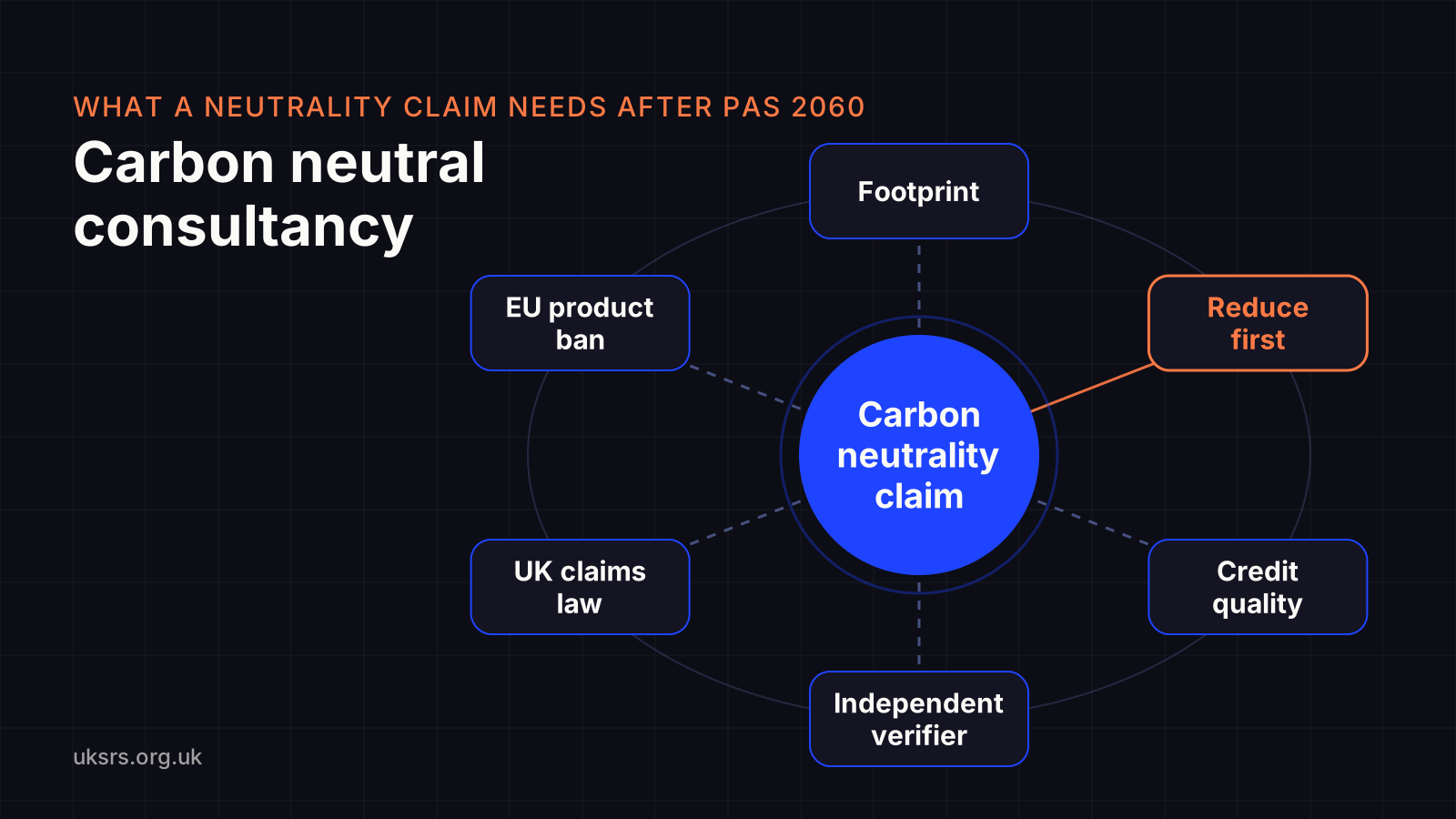
Carbon neutral consultancy now prepares a claim for ISO 14068, where measured reductions come before offsets and an independent body verifies the result.
UK SRS is an independent reference site. We have assessed no consultancy and publish no consultancy prices or rankings.
The work
What carbon neutral consultancy covers now
A carbon neutral consultancy prepares the evidence for a claim; it does not make the claim true by certifying it.
ISO 14068 describes carbon neutrality as achieved through “the quantification, reduction and offsetting of the carbon footprint”, in the words of ISO’s own abstract.
Read the detailed guidance and references
- commit
- cut first
- cover the rest
- check
- say it
The standard applies to organisations and to products, and it is “not intended to be used for territories”.
Carbon neutral consultants are usually asked for four outputs: the footprint, the management plan, the credit sourcing and the claim wording.
Whether to offset at all, and how much, is a strategy question covered by carbon offset strategy consultancy.
Buying and screening the credits themselves is the job described on the carbon offset consultant page.
Module 01 / 04
Footprint
Module 02 / 04
Reduce
Module 03 / 04
Offset
Module 04 / 04
Claim
PAS 2060 to ISO 14068
The standard moved twice in two years
BSI stopped delivering the PAS 2060 scheme from 1 January 2025, and the last opinions were issued by 31 December 2025, according to BSI.
ISO 14068-1:2023 was withdrawn on 11 September 2026 and is being replaced by ISO 14068:2026 (Carbon neutrality), on ISO’s catalogue record.
Read the detailed guidance and references
The successor’s own record still read “Under publication” at stage 60.00 when we re-read it on 11 October 2026, so we print no publication day.
The new designation drops both the part number and the words “Transition to net zero” from the title.
BSI says opinions issued against PAS 2060 remain valid for the historical period they covered, so a 2023 opinion is not wrong about 2023.
It is simply not a current credential, and “PAS 2060 certified” in the present tense is out of date.
- November 2023ISO 14068-1:2023 publishedThe first international carbon neutrality standard.ISO record 43279
- 1 March 2024BSI’s ISO 14068-1 verification scheme availableBSI’s own statement about its own scheme.BSI
- 31 December 2025Last PAS 2060 opinions; UKAS migration deadlinePAS 2060 comes off UKAS schedules.BSI; UKAS
- 11 September 2026ISO 14068-1:2023 withdrawnISO names ISO 14068:2026 as the revision.ISO record 43279
- 11 October 2026ISO 14068 still “under publication”Stage 60.00 on ISO’s own record when we re-read it.ISO record 94470
The full history and the clause map are on PAS 2060 and ISO 14068.
Module 01 / 04
PAS 2060:2014
Module 02 / 04
ISO 14068-1:2023
Module 03 / 04
ISO 14068:2026
Module 04 / 04
Old opinions
Reduction first
Reduction first: evidence, not intention
ISO 14068 “establishes a hierarchy for carbon neutrality where GHG emission reductions (direct and indirect) and GHG removal enhancements within the value chain take priority over offsetting”.
UKAS told verification bodies that “the first application for carbon neutrality cannot be based entirely on offsets”, in its migration bulletin of 30 July 2024.
Read the detailed guidance and references
The same bulletin says actual evidence of a reduction is a prerequisite for every reporting cycle, including the first, and that “merely stating a future intention is not sufficient”.
Those bulletin points describe ISO 14068-1:2023, the edition UKAS was migrating bodies onto, so ask your verifier how it treats them under the 2026 edition.
| Point in the UKAS bulletin | What a carbon neutral consultant has to produce |
|---|---|
| First claim cannot be based entirely on offsets | A reduction already achieved before the first claim |
| Actual evidence of a reduction in every cycle | Year-on-year evidence, not a plan to reduce later |
| ISO 14064-1 for organisations, ISO 14067 for products | A footprint built to the named method |
| ISO 14064-3 is normative | Records a verifier can test against that standard |
| A clear hierarchy before offsetting | A management plan showing reductions and removals first |
The deeper cuts behind a net zero target are a different exercise, set out on net zero consultancy.
Module 01 / 04
Reduce
Module 02 / 04
Remove
Module 03 / 04
Offset
Module 04 / 04
Repeat
Offset quality
Offset quality: ICVCM, VCMI and the UK principles
An ICVCM Core Carbon Principles label attaches to a programme or a methodology, never to the actual performance of a single credit, according to the ICVCM.
A credit from a CCP-Eligible programme is therefore not automatically a CCP-Approved credit.
Read the detailed guidance and references
The ICVCM rejected eight renewable energy methodologies on 6 August 2024, finding them insufficiently rigorous on whether projects would have gone ahead anyway.
The VCMI Claims Code measures how far a company covers its remaining emissions with credits, but it says those credits “are not counted as internal emission reductions”.
The UK government’s six principles of 15 November 2024 say credits should be used in addition to value-chain action, and they are guidance rather than law.
Module 01 / 04
Programme
Module 02 / 04
Methodology
Module 03 / 04
Retirement
Module 04 / 04
Disclosure
UK law
Carbon neutral claims in UK law
No UK law bans an offset-based carbon neutral claim outright, because Schedule 20 to the DMCC Act 2024 lists 32 banned practices and none concerns carbon.
A claim that misleads is still an unfair commercial practice under sections 225 to 227 of the Act.
Read the detailed guidance and references
The CMA can impose those penalties itself, because its direct enforcement powers began on 6 April 2025.
The Green Claims Code, published on 20 September 2021, sets six principles: truthful and accurate, clear and unambiguous, nothing important omitted, fair comparisons, the full life cycle, and substantiated.
CAP Code rule 11.1 says “the basis of environmental claims must be clear” and that unqualified claims could mislead.
Financial firms carry one more layer, explained on the FCA anti-greenwashing rule.
Module 01 / 04
Law
Module 02 / 04
Guidance
Module 03 / 04
Self-regulation
Module 04 / 04
Enforcement
The ASA
What the ASA has ruled
CAP advises marketers to “avoid using unqualified ‘carbon neutral’ or ‘net zero’ claims”, in its AdviceOnline note of 17 June 2026.
In BrewDog’s case the ASA found a link to offsetting information on a website was not enough, because the basis was not in the ad itself.
Read the detailed guidance and references
- 8 July 2020Shell UK: “Drive carbon-neutral”Complaint upheld; the claim was misleading.ASA ruling, cited by CAP
- 20 December 2023Charles Tyrwhitt: “Carbon Neutral business”No qualifying information about the basis of the claim.ASA ruling, cited by CAP
- 20 December 2023BrewDog: “carbon negative”A website link was not enough; the basis had to be in the ad.ASA ruling, cited by CAP
- 6 April 2025DMCC Act consumer provisions in forceThe CMA can enforce consumer law directly.SI 2025/272
- 17 June 2026CAP advice on offsetting claimsAvoid unqualified “carbon neutral” or “net zero” claims.CAP AdviceOnline
An ASA ruling is not law, but the CMA’s January 2026 guidance says it is likely to treat a practice as egregious where there have been clear decisions from bodies such as the ASA.
A consultant who drafts the claim should show you the qualifying text and where in each advertisement it will appear.
Module 01 / 04
Qualify
Module 02 / 04
Locate
Module 03 / 04
Name
Module 04 / 04
Future
EU consumers
The EU ban on offset-based product claims
Directive (EU) 2024/825 adds to the EU blacklist “claiming, based on the offsetting of greenhouse gas emissions, that a product has a neutral, reduced or positive impact on the environment in terms of greenhouse gas emissions”.
Member States had to adopt their measures by 27 March 2026 and apply them from 27 September 2026, under Article 4(1).
Read the detailed guidance and references
Point 4c is worded around products, so an organisation-level claim based on offsets sits outside its literal text.
The UK has no equivalent provision, so a pan-European product campaign needs a different claim in each market.
Product footprints and their standards are explained on life cycle assessment and product standards.
Module 01 / 04
EU product claim
Module 02 / 04
EU timing
Module 03 / 04
UK
Module 04 / 04
Campaigns
Two different jobs
Carbon neutral consultants and verifiers
UKAS accredits conformity assessment bodies, and its scope has no category for consultancy, so a consultant cannot be “UKAS accredited” for carbon neutrality.
Validation and verification bodies are accredited under ISO/IEC 17029, with ISO 14065 as the environmental information application.
Read the detailed guidance and references
| Carbon neutral consultant | Validation and verification body | |
|---|---|---|
| Job | Prepares the footprint, management plan, credits and wording | Checks the claim against ISO 14068 and gives an opinion |
| Standard it works to | ISO 14064-1 or ISO 14067, and ISO 14068 | ISO 14064-3, as an ISO/IEC 17029 body applying ISO 14065 |
| Accreditation | None exists for consultancy | UKAS accreditation, with a published schedule |
| What to ask for | A written method and the calculation file | The UKAS schedule number and its scope |
Bodies on the older ISO 14065:2013 route had to move to ISO/IEC 17029 by 30 June 2024, so an older accreditation claim may be out of date.
Keep the firm that builds your numbers separate from the body that verifies them.
How verification works in practice is on GHG verification standards.
Module 01 / 04
Consultant
Module 02 / 04
Verifier
Module 03 / 04
UKAS
Module 04 / 04
ISO
Before you call anyone
Briefing a carbon neutral consultancy
Brief a carbon neutral consultancy with what you already have, so the work starts at the first missing rung rather than at the beginning.
Answer seven questions and the ladder marks each rung as in place or missing, with the provision behind it.
Open the claim ladder
Which rungs of the claim are in place?
5 of 7 rungs need work before a claim
A footprint for the claim period exists; check it is built to ISO 14064-1, the method UKAS named for organisations.
UKAS Technical Bulletin, 30 July 2024
A plan to reduce later is not enough: UKAS says “merely stating a future intention is not sufficient”, and the first claim cannot rest entirely on offsets.
UKAS Technical Bulletin; ISO 14068 abstract
Check each credit’s programme and methodology version: a CCP-Eligible programme does not make every credit from it CCP-Approved.
ICVCM assessment status
Nobody has verified the claim; ISO certifies nobody, so appoint an accredited validation and verification body.
UKAS Technical Bulletin (ISO 14064-3 normative); UKAS directory
PAS 2060 was withdrawn by BSI at the end of 2025; an old opinion describes its own period, but “PAS 2060 certified” in the present tense is out of date.
BSI; UKAS migration deadline 31 December 2025
Draft the basis of the claim into each advertisement: what was measured, what was reduced and which credits were used.
A website link alone did not save BrewDog’s claim.
CAP Code 11.1; CAP AdviceOnline, 17 June 2026; ASA ruling, 20 December 2023
UK audience only: the UK has no equivalent of the EU blacklist entry, though a misleading claim is still unlawful.
DMCC Act 2024 Sch 20 and ss.225–227
A scoping aid, not a verification and not legal advice.
Nothing you choose is stored or sent.
Module 01 / 04
Measure
Module 02 / 04
Cut
Module 03 / 04
Cover
Module 04 / 04
Say
Due diligence
What to ask carbon neutral consultants
Which standard, with its edition and year, will the claim be made against, and who will verify it?
Does the consultancy earn anything from the credits, the registry or the verifier it recommends?
Read the detailed guidance and references
What reduction has already happened, and what evidence of it will the verifier see?
Which methodology, and which version of it, sits behind each credit, and is it CCP-Approved?
Where in each advertisement will the basis of the claim appear?
Will an EU product claim be dropped or reworded for EU consumers?
The general process is in choosing a sustainability consultant.
It names no firm, quotes no price and checks no claim on anyone’s behalf.
Module 01 / 04
Edition
Module 02 / 04
Reductions
Module 03 / 04
Credits
Module 04 / 04
Verifier
Illustrative brief · no consultancy assessed
A worked brief: a retailer wants to call itself carbon neutral
An illustrative retailer asks carbon neutral consultants for a claim in time for a spring campaign in the UK and Ireland.
The brief should ask for the footprint, evidence of a reduction, the credits for the remainder, a separate verifier and two wordings: one for UK ads and one that avoids an offset-based product claim for Ireland.
View the workflow diagram
- 1
Evidence
Footprint for the period and the reductions already achieved.
- 2
Credits
Methodology, version and retirement against the period.
- 3
Claim
Verified by an accredited body, worded with its basis in each ad.
Each date means something different
The dates behind a carbon neutral claim
Check whether each date is a withdrawal, a deadline or the day a rule began to apply.
- 1 January 202501
- 6 April 202502
DMCC Act consumer provisions in force
The CMA can fine for misleading claims directly. - 31 December 202503
- 17 June 202604
- 11 September 202605
- 27 September 202606
EU blacklist applies
Offset-based product neutrality claims banned for EU consumers.
A suggested delivery sequence
From the brief to the verified claim
This is an editorial sequence for buying the work, not a statutory timetable or a promise about how long it takes.
- 01 / Scope01
Name the subject and period
An organisation or a product, and the claim period. - 02 / Measure02
Build the footprint
ISO 14064-1 or ISO 14067, with a written method. - 03 / Reduce03
Evidence the cuts
Show reductions achieved, not only planned. - 04 / Cover04
Source and retire credits
Methodology and version recorded for each credit. - 05 / Verify05
Appoint a separate body
An accredited validation and verification body checks the claim. - 06 / Word06
Draft each market’s claim
Basis in the ad for the UK; no offset-based product claim in the EU.
Frequently asked
Carbon neutral consultants, answered
What does a carbon neutral consultancy do?
It prepares an organisation or product for a carbon neutrality claim: the footprint for the claim period, a commitment and management plan, evidence of actual reductions, the choice and retirement of any credits, and claim wording that survives UK and EU consumer law.
It does not verify the claim; an independent validation and verification body does that.
Can we still get PAS 2060 certification?
No. BSI stopped delivering the PAS 2060 scheme from 1 January 2025, the last verification opinions were issued by 31 December 2025, and BSI withdrew the specification at the end of 2025.
An opinion issued for a past period stays valid for that period, but no new one can be obtained.
What replaced PAS 2060?
ISO 14068-1:2023 was the successor, and ISO withdrew that edition on 11 September 2026.
It is being replaced by ISO 14068:2026, Climate change management — Carbon neutrality, whose catalogue record still showed it as under publication when we checked on 11 October 2026.
Is ISO 14068 a certification?
ISO certifies nobody.
An organisation or product is verified against ISO 14068 by a third-party validation and verification body, and in the UK UKAS accredits those bodies, not consultants.
Can a carbon neutral claim be based on offsets alone?
Not under ISO 14068 as UKAS describes it: the first claim cannot be based entirely on offsets, and evidence of an actual reduction is a prerequisite for every reporting cycle.
ISO 14068 puts reductions and removals within the value chain ahead of offsetting.
Is it legal to say carbon neutral in the UK?
Yes, if the claim is true, clear and substantiated.
The DMCC Act blacklist contains nothing about carbon or offsetting, but a misleading claim is unlawful and the CMA can fine up to 10% of worldwide turnover.
The ASA treats an unqualified carbon neutral claim as likely to mislead.
Does the EU ban carbon neutral claims?
Directive (EU) 2024/825 blacklists a claim, based on offsetting, that a product has a neutral, reduced or positive greenhouse gas impact.
Member States had to apply it from 27 September 2026. It is worded around products; the UK has no equivalent rule.
Which carbon credits should a carbon neutral claim use?
The standards leave the choice to you, so ask for the programme, the methodology and its version, and whether the methodology is CCP-Approved by the ICVCM.
A CCP label attaches to a programme or methodology, not to the performance of one credit.
Is carbon neutral the same as net zero?
No. A carbon neutrality claim covers a footprint for a period, reduced and then offset.
A science-based net zero target needs deep cuts in the physical inventory, with credits never counted as reductions and used only for residual emissions or for mitigation beyond the value chain.
How much does carbon neutral consultancy cost?
This site publishes no prices and has assessed no consultancy.
Ask for a written scope that prices the footprint, the management plan, the credit sourcing and the claim review separately, and ask whether the adviser earns anything from the credits it recommends.
Sources
Primary sources
Every figure, date and status on this page traces to the instrument’s owner.
Secondary commentary is never the source for a number.
- BSI KnowledgeBS ISO 14068-1:2023 product record
The 24-month period after which PAS 2060:2014 was withdrawn.
- BSI KnowledgePAS 2060:2014 product record
Specification for the demonstration of carbon neutrality; withdrawn.
- UKASTechnical Bulletin: ISO 14068-1:2023 migration from PAS 2060 (30 July 2024)
What changed for verification bodies; migration deadline 31 December 2025.
- ISOISO 14068-1:2023 catalogue record
Withdrawn 11 September 2026 (stage 95.99).
- ISOISO 14068 (Climate change management — Carbon neutrality) catalogue record
Will replace ISO 14068-1:2023; stage 60.00, under publication, when read on 11 October 2026.
- ISOISO 14064-1:2018 catalogue record
Organisation-level quantification and reporting.
- ISOISO 14064-3:2019 catalogue record
Verification and validation of greenhouse gas statements.
- ISOISO 14065:2020 catalogue record
Requirements for bodies validating and verifying environmental information.
- UKASFind an accredited organisation
The directory lists accredited bodies; there is no consultancy category.
- ICVCMAssessment status
44 CCP-Approved methodologies, table last updated 12 August 2026.
- ICVCMThe Core Carbon Principles
Ten principles in three groups.
- VCMIClaims Code of Practice v3.1 (15 August 2025)
Silver, Gold and Platinum thresholds; credits are not internal reductions.
- Department for Energy Security and Net ZeroPrinciples for voluntary carbon and nature market integrity (15 November 2024)
Six non-binding principles.
- Competition and Markets AuthorityGreen Claims Code (CMA146), 20 September 2021
Six principles; the CMA’s view of the law.
- legislation.gov.ukDigital Markets, Competition and Consumers Act 2024, Part 4 and Schedule 20
Misleading actions and omissions; the blacklist says nothing about carbon.
- legislation.gov.ukDigital Markets, Competition and Consumers Act 2024, section 182
CMA penalty: up to £300,000 or 10% of worldwide turnover, whichever is higher.
- ASA / CAPCAP Code section 11, environmental claims
Rule 11.1: the basis of an environmental claim must be clear.
- ASA / CAPAdviceOnline: carbon offsetting and carbon neutral (17 June 2026)
Avoid unqualified “carbon neutral” or “net zero” claims.
- EUR-LexDirective (EU) 2024/825, Annex I point 4c and Article 4(1)
Offset-based product neutrality claims blacklisted; applied from 27 September 2026.
- Science Based Targets initiativeNet-Zero Standard Criteria V1.3.1, C12
Credits are not counted as reductions towards targets.
Continue reading
Read next
PAS 2060 and ISO 14068
The withdrawn standard, its successor and UK law on claims.
Carbon offset strategy consultancy
Whether, when and how much to offset.
Carbon offset consultants
Screening and buying credits.
GHG verification standards
ISO 14064-3, ISO 14065 and who verifies what.
Carbon footprint consultancy
The footprint a claim is built on.
Net zero consultancy
Targets, pathways and transition plans.