GRI Standards
Impact materiality: the organisation’s most significant impacts on the economy, environment and people.
A stakeholder-facing report or content index.Ask direct questions about your own reporting — your thresholds, your dates, what you file and when.
Sign up free →The standards
Does it apply to you
Reporting under it
WHY REGISTER
Ask these pages about your own company.
Free · no card
Everything on this site stays open without an account.
Start here
Dates and penalties
Doing it
WHY REGISTER
Ask these pages about your own company.
Free · no card
Everything on this site stays open without an account.
What you must file
Doing it
WHY REGISTER
Ask these pages about your own company.
Free · no card
Everything on this site stays open without an account.
Start here
Setting targets
Who and where
WHY REGISTER
Ask these pages about your own company.
Free · no card
Everything on this site stays open without an account.
The UK duty
Doing it
WHY REGISTER
Ask these pages about your own company.
Free · no card
Everything on this site stays open without an account.
The baseline
Europe
Reporting more widely
WHY REGISTER
Ask these pages about your own company.
Free · no card
Everything on this site stays open without an account.
Carbon markets and trade
Packaging and net zero
Carbon accounting
WHY REGISTER
Ask these pages about your own company.
Free · no card
Everything on this site stays open without an account.
Choosing
Carbon
Compliance and offsets
WHY REGISTER
Ask these pages about your own company.
Free · no card
Everything on this site stays open without an account.
Software
Templates
Careers
WHY REGISTER
Ask these pages about your own company.
Free · no card
Everything on this site stays open without an account.
ASK ABOUT YOUR OWN REPORTING
Ask direct questions about your own reporting — your thresholds, your dates, what you file and when.
Sign up freeFree · one email · already registered? Log in
Everything on this site stays open without an account.
ESG reporting consultants · report production and compliance
ESG reporting consultancy is bought for the report itself, so the brief must name each framework, the data behind every figure and whether an assurance provider will read it.
UK SRS is an independent reference site. We have assessed no consultancy and publish no consultancy prices or rankings.
The deliverable
ESG reporting consultancy is bought to produce reports that comply with named frameworks, and it is judged on whether each disclosure is present, supported and correctly placed.
Most companies issue more than one ESG report, so the first deliverable is an inventory of them all.
Every statutory, voluntary and customer-driven ESG report the company issues, with its framework and date.
Each required disclosure mapped to a data owner and a source system.
Calculations, assumptions and approvals kept so a reviewer can re-perform them.
Text written against the framework, placed where the rule says it goes.
Every requirement disclosed, or explained where the rule allows an explanation.
Which kind of adviser fits your obligation is answered on the ESG consultancy guide, and the menu of separate services on ESG consulting services.
Getting a first standards-based report out, worked back from the publication deadline, is covered by sustainability reporting consultants.
This page covers the production and compliance of the ESG reports themselves, across every framework a company meets.
Module 01 / 04
Module 02 / 04
Module 03 / 04
Module 04 / 04
Name the framework
No UK instrument creates a document called an ESG report, so every brief has to name the framework each report is prepared against.
The table sets out who each one reaches and its status, with the source for each row.
| Framework | Who it reaches | Status | Where it sits |
|---|---|---|---|
| UK SRS S1 and S2 | Listed companies in UKLR 6, 14, 15, 16 and 22; anyone else by choice | Comply or explain for periods from 1 January 2027; voluntary otherwise | Annual financial report |
| Climate-related financial disclosure | Companies within s.414CA with more than 500 employees | In force; UK SRS S2 can discharge it | Strategic report |
| SECR | Quoted companies; unquoted companies and LLPs not meeting two of the “not more than” conditions | In force since 2019 | Directors’ report |
| CSRD and ESRS | EU undertakings over 1,000 employees and €450 million net turnover; some non-EU groups under Article 40a | In force in the EU, as amended by Omnibus I | Management report |
| IFRS S1 and S2 (ISSB) | Wherever a jurisdiction adopts them | Effective 1 January 2024 where adopted | General purpose financial reports |
| GRI Standards | Any organisation that chooses them | Voluntary; GRI 102 effective 1 January 2027 | A sustainability report or content index |
| CDP | Companies asked by investors, customers or authorities | A questionnaire with no regulatory status | CDP’s platform |
| EcoVadis | Suppliers asked by customers | A rating, “not a certification or product label” | EcoVadis’s platform |
The rule-by-rule list is on ESG reporting requirements in the UK, and the frameworks are compared on UK ESG frameworks.
Module 01 / 04
Module 02 / 04
Module 03 / 04
Module 04 / 04
UK reports
Under the FCA’s PS26/19, published on 30 September 2026, listed companies in UKLR 6, 14, 15, 16 and 22 report against UK SRS on a comply-or-explain basis for accounting periods beginning on or after 1 January 2027, with first reporting in 2028.
A company that does not disclose against UK SRS S2 must summarise what is missing, why, and what it is doing about it, under UKLR 6.6.6R(7A).
The reliefs in PS26/19 ¶3.14 allow two years of climate-first reporting under UK SRS S1 and one year without Scope 3 under UK SRS S2, and a company using them states that it does.
The FCA’s draft Technical Note 803.1 on explanations is open for feedback until 28 October 2026.
The government has confirmed UK SRS S2 as a national reporting framework for section 414CB(6) of the Companies Act, according to its consultation response, so a company reporting under S2 need not duplicate its climate disclosure.
The climate-related financial disclosure itself applies to companies within section 414CA with more than 500 employees, and section 414CB(2A) lists eight disclosures.
SECR applies to quoted companies at any size, and to unquoted companies and LLPs unless they meet two of the three “not more than” conditions in paragraph 20B.
For everyone outside the FCA’s five categories, UK SRS is available for voluntary use, from its publication on 25 February 2026.
The standards are set out on UK SRS S1 and S2, the climate duty on climate-related financial disclosures, and SECR on the SECR guide.
Module 01 / 04
Module 02 / 04
Module 03 / 04
Module 04 / 04
EU reports
Since Directive (EU) 2026/470 entered into force on 18 March 2026, CSRD reaches undertakings that exceed both 1,000 employees and €450 million net turnover, according to the Omnibus I directive.
The revised ESRS were published in the Official Journal on 21 September 2026 as Delegated Regulation (EU) 2026/1563 and enter into force on 10 November 2026.
The narrowed scope applies to financial years beginning on or after 1 January 2027.
Non-EU groups are caught through Article 40a, with a €450 million EU turnover test and a €200 million threshold for an EU subsidiary or branch.
Undertakings of 1,000 employees or fewer may decline value-chain requests that go beyond the voluntary standards, which matters when a customer’s questionnaire overreaches.
ESRS reporting uses double materiality, which UK SRS does not, so an ESG reporting brief for an EU entity needs European reporting experience.
The directive is covered on the CSRD guide, the simplification on the CSRD Omnibus page, and the standards on ESRS.
Module 01 / 04
Module 02 / 04
Module 03 / 04
Module 04 / 04
Voluntary frameworks
The GRI Universal Standards came into effect for reporting on 1 January 2023, and GRI 102: Climate Change 2025 takes effect on 1 January 2027, according to GRI.
Reporting “in accordance with” the GRI Standards requires applying all eight reporting principles in GRI 1: Foundation 2021.
Impact materiality: the organisation’s most significant impacts on the economy, environment and people.
A stakeholder-facing report or content index.Financial materiality: risks and opportunities that could affect the entity’s prospects.
Investor-facing, in the general purpose financial reports.The one published equivalence between GRI and the ISSB covers greenhouse gas emissions: a company reporting under both can use its IFRS S2 Scope 1, 2 and 3 disclosures to meet GRI 102.
No disclosure-level mapping between the two had been published when checked on 10 September 2026, so treat any claim of full interoperability with care.
IFRS S2 is effective for periods beginning on or after 1 January 2024 where a jurisdiction adopts it, while UK SRS carries no effective date of its own.
The standards are explained on GRI Standards and the ISSB framework.
Module 01 / 04
Module 02 / 04
Module 03 / 04
Module 04 / 04
Questionnaires
A CDP score has no regulatory status anywhere, and CDP scores what is in the response without verifying it.
EcoVadis says its medal “is not a certification or product label”, on its medals and badges page.
CDP’s 2026 scores go to disclosers in the week of 30 November 2026, according to CDP.
CDP’s published 2026 admin fee for UK organisations is £5,985 for Enhanced and £2,450 for Foundation, a scheme fee set by CDP and listed in its FAQs as a guide.
EcoVadis awards medals by percentile of the companies it assessed in the previous twelve months, with a minimum score of 30 in each of its four themes.
An ESG reporting consultancy adds most value here by answering from the same evidence file as the statutory reports, so the numbers agree.
What you must answer and what you can decline is on the ESG questionnaire guide.
Module 01 / 04
Module 02 / 04
Module 03 / 04
Module 04 / 04
Which reports apply?
Answer six questions about listing, size, EU footprint and the requests you receive, and the panel lists the ESG reports a consultancy would need to produce, each with its status and source.
A default answer set is shown so the inventory is visible before you choose anything.
Which ESG reports apply to us?
Report against UK SRS for accounting periods beginning on or after 1 January 2027, with first reporting in 2028; where a disclosure is not made, say what is missing, why, and what you plan to do.
Climate-first and Scope 3 reliefs are available at the start.
FCA PS26/19 ¶¶3.12, 3.14; UKLR 6.6.6R(7A), (7B)
Eight disclosures in the strategic report; reporting in accordance with UK SRS S2 can discharge them without duplication.
CA 2006 ss.414CA, 414CB(2A), 414CB(6); DBT consultation response
A quoted company reports energy and emissions in the directors’ report, at any size.
SI 2008/410 Sch 7 Part 7A; ¶20B
A questionnaire with no regulatory status; CDP scores what is in the response without verifying it, and the 2026 scores go to disclosers in the week of 30 November 2026.
CDP, Scores and Full Corporate Scoring Introduction 2026
Optional and stakeholder-facing; claiming “in accordance with” GRI means applying all eight reporting principles, and GRI 102: Climate Change takes effect on 1 January 2027.
GRI 1: Foundation 2021 §4; GRI Standards
A scoping aid, not legal advice; group structures, LLPs and overseas rules need their own check.
Nothing you choose is stored or sent.
Module 01 / 04
Module 02 / 04
Module 03 / 04
Module 04 / 04
Data and controls
UK SRS disclosures form part of the general purpose financial reports and are published at the same time as the financial statements, under UK SRS S1 ¶¶60 and 64.
That timetable means ESG data needs the same discipline as financial data: owners, sources, calculations and review.
The government’s response also confirms that the section 463 safe harbour applies to UK SRS disclosure placed in the strategic report.
Data systems are compared on ESG data management.
Module 01 / 04
Module 02 / 04
Module 03 / 04
Module 04 / 04
Assurance readiness
No UK law requires sustainability assurance, but a listed company that obtains it discloses whether it has, and the provider, scope, level and standards applied, under the FCA’s rules.
ISSA 5000 is effective for periods beginning on or after 15 December 2026, according to the IAASB.
The IAASB announced on 8 May 2025 that the withdrawal of ISAE 3410, for greenhouse gas statements, takes effect from ISSA 5000’s effective date, according to its announcement.
ISAE 3000 (Revised) remains in place for other assurance engagements.
The FRC issued ISSA (UK) 5000 on 12 November 2025 for voluntary use.
The IESBA standards bar an assurance practitioner from assuming management responsibility for a client and generally prohibit self-review services for public interest entities, according to the IESSA overview.
So the firm that drafts the ESG report is usually not the firm that assures it, and the assurer is best chosen first.
The levels and standards are explained on sustainability assurance.
Module 01 / 04
Module 02 / 04
Module 03 / 04
Module 04 / 04
Which kind of help
ESG reporting consultants disclose what the company has and does, while strategy consultants decide what it should do and software collects the data.
A report can say that no target exists, so reporting and strategy are often bought separately.
| ESG reporting consultancy | ESG strategy consultancy | ESG reporting software | |
|---|---|---|---|
| Question it answers | Is each required disclosure present and supported? | What should we prioritise and commit to? | Where is the data, and what does it add up to? |
| Deliverable | Reports, explanations and an evidence file | Materiality, targets and a plan | A data platform and calculations |
| Judged by | The framework and, if appointed, the assurer | The board | Data quality and audit trail |
| Typical buyer | Company secretary, finance, investor relations | Board and executive team | Sustainability and finance teams |
Strategy is covered on ESG strategy, and software on the ESG software comparison.
Module 01 / 04
Module 02 / 04
Module 03 / 04
Module 04 / 04
Due diligence
Which named framework will each report be prepared against, and which paragraphs are out of scope?
Who owns the calculation files, the disclosure map and the evidence at the end of the engagement?
If an assurance provider is appointed, has the consultancy agreed the evidence format with them?
Does the proposal call UK SRS mandatory, or say that assurance is required, when the FCA’s rules do neither?
Which parts will your own team run in year two, and is that priced in the same proposal?
The general selection process is in how to choose a sustainability consultant.
It names no firm, ranks none, quotes no consultancy price and claims no credential for this site.
Module 01 / 04
Module 02 / 04
Module 03 / 04
Module 04 / 04
Illustrative brief · no consultancy assessed
An illustrative group listed in UKLR 6, with an EU subsidiary and investor and customer questionnaires, needs one report inventory and one evidence file feeding every report.
Brief the ESG reporting consultancy on all of them together, so the numbers agree wherever they appear.
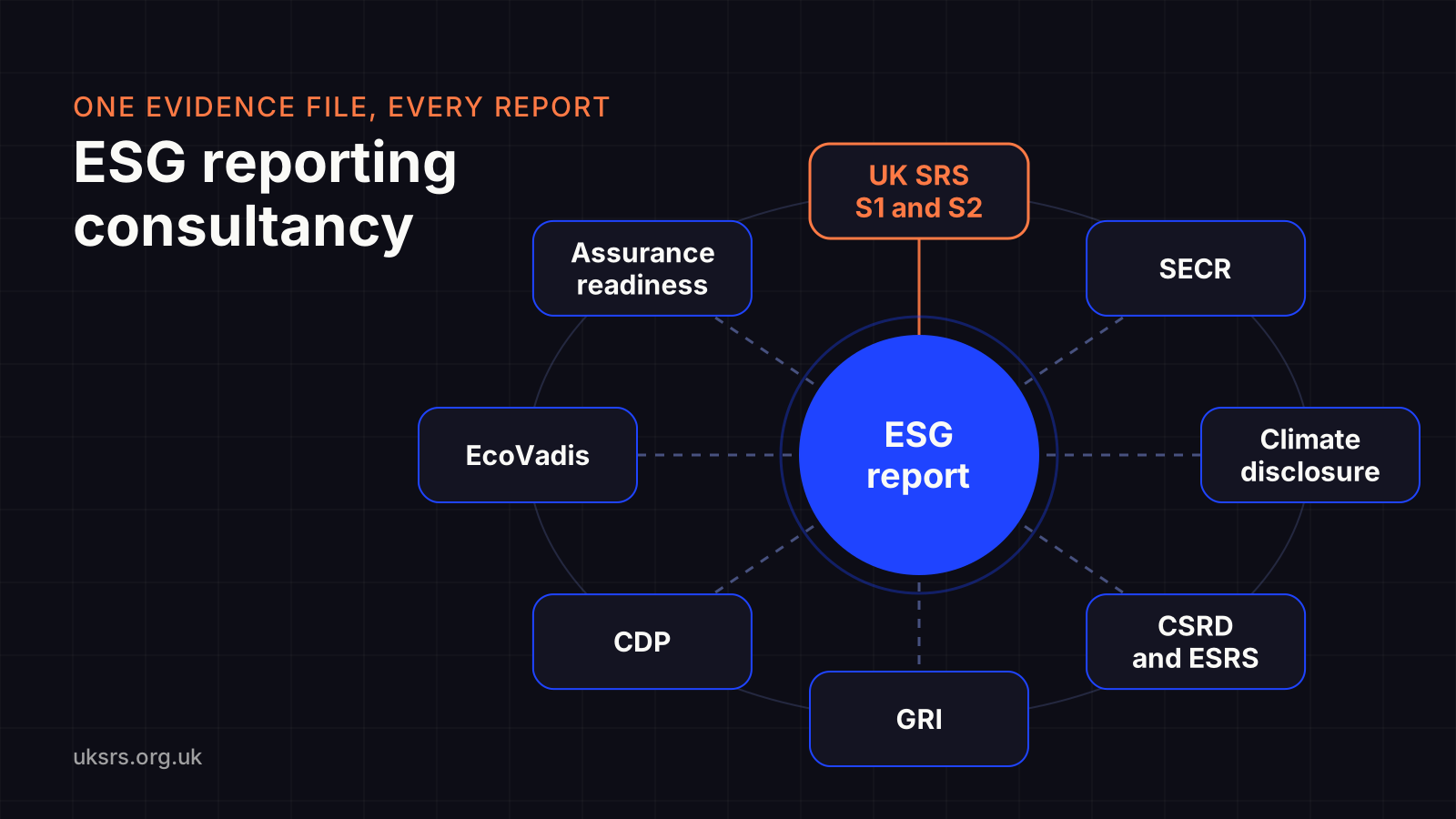
SECR, the climate disclosure and UK SRS comply or explain from 2027.
Whether the subsidiary exceeds both CSRD thresholds.
A CDP request from investors and an EcoVadis request from a customer.
Each date has a different meaning
Check who each date applies to and whether it is a publication, an application date, a deadline or a score release.
A suggested delivery sequence
This is an editorial buying and preparation sequence, not a statutory timetable or a promise about how long the work takes.
Frequently asked
An ESG reporting consultancy produces or supports the reports themselves: it confirms which frameworks apply, maps each disclosure to its data owner, builds the calculations and the evidence file, drafts the text, checks it against the framework, and prepares it for an assurance provider if one is appointed.
It depends on what you are.
Listed companies in UKLR 6, 14, 15, 16 and 22 report against UK SRS on a comply-or-explain basis for periods beginning on or after 1 January 2027.
SECR and the Companies Act climate disclosure have their own tests, CSRD reaches EU undertakings over 1,000 employees and €450 million net turnover, and GRI, CDP and EcoVadis are voluntary or customer-driven.
No. Under the FCA’s final rules in PS26/19, listed companies in UKLR 6, 14, 15, 16 and 22 report against UK SRS on a comply-or-explain basis for accounting periods beginning on or after 1 January 2027, with first reporting in 2028.
For everyone else the standards are available for voluntary use.
Usually the checking half of ESG reporting: confirming which rules apply, testing each required disclosure is present or properly explained, and keeping the evidence.
Ask which named rule the consultant is checking against, because ESG is a label, not a standard.
Neither is a statutory report.
A CDP score has no regulatory status, and EcoVadis says a medal is not a certification or product label.
Both are customer- or investor-driven questionnaires, and the useful deliverable is an evidence pack you own and can reuse.
No UK law requires sustainability assurance.
If a listed company obtains it, the FCA’s rules ask it to say so, with the provider, scope, level and standards.
ISSA 5000 is effective for periods beginning on or after 15 December 2026, and ISAE 3410 is withdrawn from that date.
Usually not.
The IESBA ethics standards for sustainability assurance bar a practitioner from assuming management responsibility for a client and generally prohibit self-review services for public interest entities, so appoint the assurance provider first.
Software collects and calculates; a consultancy decides scope, method and wording.
Most companies reporting under a named framework for the first time need both: software for the data and judgement for the gap analysis and the explanations.
Strategy consultancy decides priorities, targets and plans; reporting consultancy discloses what the company has and does under a named framework.
A report can disclose that no target exists, so the two are often bought separately.
This site publishes no prices and has assessed no firm’s fees.
Ask for days by grade against each named report, what your team supplies, and the second year priced in the same proposal.
CDP’s own published participation fee is separate and is set by CDP.
Sources
Every figure, date and status on this page traces to the instrument’s owner.
Secondary commentary is never the source for a number.
Comply or explain across UK SRS for UKLR 6, 14, 15, 16 and 22, periods beginning on or after 1 January 2027.
First reporting in 2028; the reliefs; disclosure of any assurance obtained.
UKLR 6.6.6R(7A), (7B) and (8): disclose, or explain what is missing and why.
Proposed comply-or-explain guidance; feedback by 28 October 2026.
DTR 4.1.3R: the annual financial report within four months of year end.
Published 25 February 2026; available for voluntary use.
Disclosures in the general purpose financial reports, at the same time as the financial statements.
UK SRS S2 is a national framework for s.414CB(6); the s.463 safe harbour.
Which companies make the climate-related financial disclosure.
The eight disclosures at (2A).
The SECR energy and carbon disclosure.
The “not more than” conditions for unquoted companies.
In force 18 March 2026: more than 1,000 employees and €450 million net turnover.
The revised ESRS, OJ 21 September 2026, in force 10 November 2026.
Effective 1 January 2024 where a jurisdiction adopts it.
Universal Standards effective 2023; GRI 102 Climate Change effective 1 January 2027.
The eight reporting principles.
2026 scores to disclosers in the week of 30 November 2026.
2026, UK: Enhanced £5,985, Foundation £2,450.
Medals by percentile; “not a certification or product label”.
Effective for periods beginning on or after 15 December 2026.
Withdrawal takes effect from ISSA 5000’s effective date.
Issued 12 November 2025 for voluntary use.
The issue of ISSA (UK) 5000.
Management responsibility and self-review.
Continue reading
Which kind of ESG adviser fits, starting from the obligation.
Each service as a distinct purchase, with its deliverable.
A first standards-based report, worked back from the deadline.
Every UK rule that asks for ESG information, with its test.
What to answer, and what you may decline.
Levels, standards and independence.