Equity share
Count your share of each operation’s emissions.
Corporate Standard ch 3Ask direct questions about your own reporting — your thresholds, your dates, what you file and when.
Sign up free →The standards
Does it apply to you
Reporting under it
WHY REGISTER
Ask these pages about your own company.
Free · no card
Everything on this site stays open without an account.
Start here
Dates and penalties
Doing it
WHY REGISTER
Ask these pages about your own company.
Free · no card
Everything on this site stays open without an account.
What you must file
Doing it
WHY REGISTER
Ask these pages about your own company.
Free · no card
Everything on this site stays open without an account.
Start here
Setting targets
Who and where
WHY REGISTER
Ask these pages about your own company.
Free · no card
Everything on this site stays open without an account.
The UK duty
Doing it
WHY REGISTER
Ask these pages about your own company.
Free · no card
Everything on this site stays open without an account.
The baseline
Europe
Reporting more widely
WHY REGISTER
Ask these pages about your own company.
Free · no card
Everything on this site stays open without an account.
Carbon markets and trade
Packaging and net zero
Carbon accounting
WHY REGISTER
Ask these pages about your own company.
Free · no card
Everything on this site stays open without an account.
Choosing
Carbon
Compliance and offsets
WHY REGISTER
Ask these pages about your own company.
Free · no card
Everything on this site stays open without an account.
Software
Templates
Careers
WHY REGISTER
Ask these pages about your own company.
Free · no card
Everything on this site stays open without an account.
ASK ABOUT YOUR OWN REPORTING
Ask direct questions about your own reporting — your thresholds, your dates, what you file and when.
Sign up freeFree · one email · already registered? Log in
Everything on this site stays open without an account.
Greenhouse gas consultants · the organisational inventory
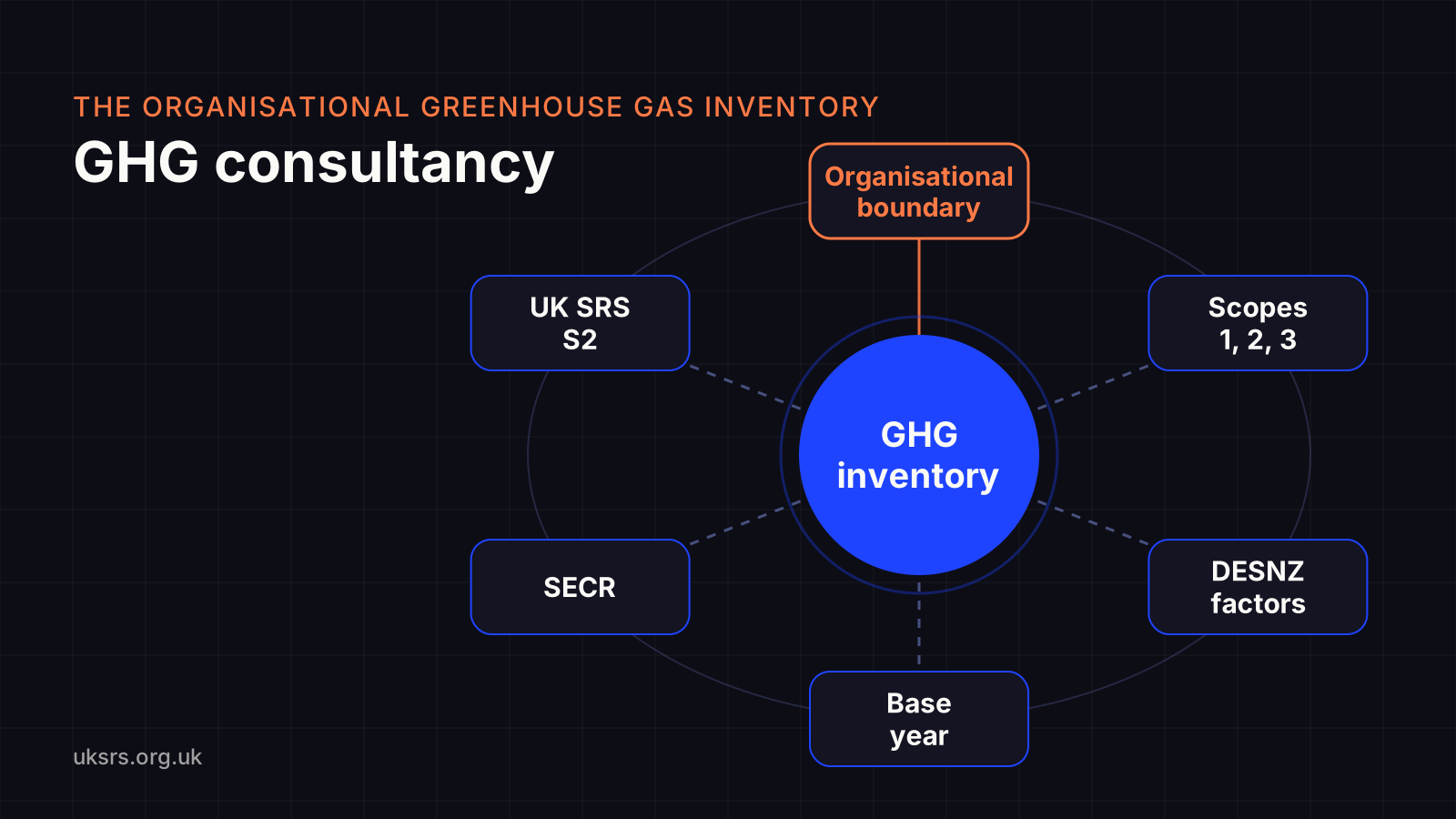
GHG consultancy builds the organisational greenhouse gas inventory that SECR, UK SRS and customer reports all draw on.
UK SRS is an independent reference site. We have assessed no consultancy and publish no consultancy prices or rankings.
The work
A GHG consultancy designs the organisational inventory: the boundary, the scopes, the data, the factors, the base year and the method note behind every figure.
Greenhouse gas consultants are judged on whether the inventory can be rerun next year and traced to evidence by someone else.
Measuring a footprint for a particular claim or a product is a different brief, covered on carbon footprint consultancy.
Searches for a carbon emissions consultancy, an emissions consultant or a carbon accounting consultant usually describe this inventory work.
A GHG emission reduction consultant works from the finished inventory, which is the subject of carbon reduction consultancy.
Module 01 / 04
Module 02 / 04
Module 03 / 04
Module 04 / 04
The standards
The GHG Protocol’s Corporate Standard bases accounting on five principles: relevance, completeness, consistency, transparency and accuracy.
ISO 14064-1:2018 sets organisation-level requirements for quantifying and reporting emissions and removals, and is GHG programme neutral.
ISO records ISO 14064-1:2018 as confirmed in 2024 and, separately, as an International Standard to be revised.
No revised GHG Protocol Corporate Standard exists yet, and the existing standards stay in effect.
The GHG Protocol’s development plan describes a single co-branded corporate standard with ISO, with a public consultation planned for the second quarter of 2027.
The Corporate Standard itself is explained on the GHG Protocol page.
| GHG Protocol Corporate Standard | ISO 14064-1:2018 | |
|---|---|---|
| Consolidation | Equity share, or control (operational or financial) | Control (financial or operational) or equity share |
| What is counted | Scopes 1 and 2 at a minimum; Scope 3 optional | Direct emissions and five categories of indirect emissions |
| Name for the second boundary | Operational boundary | Reporting boundary (renamed in 2018) |
| Relationship to other rules | UK SRS S2 ¶29(a)(ii) names the 2004 edition | Programme neutral: a GHG programme’s own requirements come first |
Module 01 / 04
Module 02 / 04
Module 03 / 04
Module 04 / 04
Organisational boundary
The Corporate Standard requires a company to consolidate by equity share or by control, choosing operational or financial control, and to apply the choice at every level.
ISO 14064-1 offers the same two approaches and says the consolidation approach must be consistent with the intended use of the inventory.
If you wholly own every operation, both approaches give the same boundary.
Joint ventures, franchises and leased assets are where the choice moves the totals.
The government’s SECR guidance says a lessee decides whether it has responsibility or operational control over an emission source, and may estimate or explain an exclusion where it cannot get the data.
UK SRS S2 ¶29(a)(iv) asks a reporting entity to split Scope 1 and 2 between its consolidated accounting group and other investees.
How a boundary is drawn in practice is on carbon accounting.
Count your share of each operation’s emissions.
Corporate Standard ch 3Count all emissions where you have operational or financial control.
ISO 14064-1:2018 5.1Operational boundary
The Corporate Standard says companies shall separately account for and report Scopes 1 and 2 at a minimum, and it treats Scope 3 as optional.
UK SRS S2 asks for all three scopes, tells a company to consider all 15 Scope 3 categories, and gives a Scope 3 relief with no time limit.
SECR asks unquoted companies for nothing in Scope 3 beyond transport fuel, and quoted companies for no Scope 3 at all.
ISO 14064-1:2018 replaced “other indirect emissions” with five categories of indirect emissions, according to its foreword.
The scopes themselves are explained on Scope 1, 2 and 3 emissions, and Scope 3 methods on Scope 3 emissions.
Module 01 / 04
Module 02 / 04
Module 03 / 04
Module 04 / 04
Conversion factors
DESNZ says the 2026 conversion factors are for use with activity data that falls entirely or mostly within 2026, in ¶1.10 of its methodology paper.
Table 9 of that paper gives UK electricity consumed as 0.14396 kgCO2e/kWh in the 2026 set, against 0.19553 in the 2025 set.
The consumed figure is generation of 0.13096 plus transmission and distribution losses of 0.01299, and DESNZ prints the total as 0.14396 because it adds the unrounded components.
DESNZ attributes most of the fall to the grid mix, with part of it from a change in method, as its major changes report explains.
UK SRS S2 ¶B29 prescribes no factors and asks for those that best represent the activity.
So a 2026 inventory reported in spring 2027 uses the 2026 set, not the set published that year.
The full set is explained on GHG conversion factors.
Module 01 / 04
Module 02 / 04
Module 03 / 04
Module 04 / 04
Scope 2
UK SRS S2 requires location-based Scope 2 and only permits market-based reporting, at ¶29(a)(v) and ¶¶B30–B31.
The GHG Protocol’s Scope 2 Guidance asks for both figures where a company operates in markets with contractual instruments.
The 2019 SECR guidance calls dual reporting its preferred approach and encourages location-based reporting for those who do not dual report.
So build both figures if you buy a renewable tariff, and label which one each report uses.
The methods are compared on Scope 2 emissions.
Module 01 / 04
Module 02 / 04
Module 03 / 04
Module 04 / 04
Base year
The Corporate Standard requires a company to choose and report a base year for which verifiable emissions data are available, and to say why it chose that year.
It also requires a written recalculation policy, with any significance threshold the company applies.
Significant structural changes, methodology changes and significant errors trigger recalculation, and the policy applies to increases and decreases alike.
The GHG Protocol sets no figure for “significant”, and its 2019 handbook says a company should set its own.
The SBTi’s near-term criteria use a 5% change in base-year emissions to trigger target recalculation.
UK SRS S2 ¶B34 asks for a reassessment of which Scope 3 categories to include after a significant event, which is not the same as recalculating a base year.
Module 01 / 04
Module 02 / 04
Module 03 / 04
Module 04 / 04
SECR
A quoted company reports under SECR at any size, while an unquoted company is exempt where it meets two or more of: turnover not more than £36 million, balance sheet total not more than £18 million, and not more than 250 employees.
So an unquoted company is in scope only when it exceeds two of those limits, under Schedule 7 ¶20B(2).
| SECR duty | Quoted company (Part 7) | Large unquoted company (Part 7A) |
|---|---|---|
| Emissions | Global: fuel combustion, facilities, purchased electricity, heat, steam and cooling | UK: gas, purchased electricity and transport fuel |
| Share or energy | UK and offshore share; energy in kWh | UK energy use in kWh |
| Ratio | At least one emissions intensity ratio (¶17) | At least one emissions intensity ratio (¶20G) |
| Method and comparatives | ¶16; ¶¶18 and 18A | ¶20F; ¶20H |
| Assurance | Not required | Not required |
The SECR size test did not move when the Companies Act size limits rose in April 2025, because ¶20B(2) writes its own figures.
The whole regime is on the SECR reporting guide, and the advisers who prepare it on SECR consultancy.
Module 01 / 04
Module 02 / 04
Module 03 / 04
Module 04 / 04
UK SRS S2
UK SRS S2 ¶29(a) asks for absolute gross Scope 1, 2 and 3 emissions, measured in accordance with the 2004 GHG Protocol Corporate Standard unless another method is required.
The FCA’s PS26/19 applies UK SRS to companies in UKLR 6, 14, 15, 16 and 22 on a comply-or-explain basis for periods from 1 January 2027.
¶29(a)(iii) asks for the measurement approach, inputs and assumptions, and any changes to them with the reasons.
¶C3 allows a different measurement method in the first reporting period only, and ¶C4 gives the Scope 3 relief.
UK SRS is not mandatory: it is comply or explain for those listing categories, and nobody else is required to report against it.
The paragraph is read in full on UK SRS S2, and the accounting link on carbon accounting for UK SRS.
Module 01 / 04
Module 02 / 04
Module 03 / 04
Module 04 / 04
Before you call anyone
Brief a GHG consultancy with the reports the inventory must feed, your group structure, your energy sources and any acquisitions since your base year.
Answer the six questions and the panel lists what your inventory should contain, with the provision behind each line.
Send last year’s methodology note and data files, so nobody is paid to rebuild what already works.
Ask for the calculation model in a form your own team can rerun.
Inventory scope builder
If you wholly own every operation, equity share and control give the same boundary, but still state the approach and list the entities.
GHG Protocol Corporate Standard ch 3
Decide whether you have operational control of each leased space; where you are responsible but lack meter data, estimate or state the exclusion and why.
Environmental Reporting Guidelines (2019); GHG Protocol Corporate Standard ch 4
Scope 1 and Scope 2 at a minimum; Scope 3 is optional under the Corporate Standard alone, so record which categories you include and why.
GHG Protocol Corporate Standard ch 4
Owned or controlled vehicles are Scope 1; for an unquoted SECR company the transport limb covers fuel consumed for transport, and the government guidance counts only fuel the organisation is responsible for buying.
SI 2008/410 Sch 7 ¶20D(1)(b) and ¶20K; Environmental Reporting Guidelines (2019)
Use the DESNZ set for the year your activity data falls in: the 2026 set for 2026 data, where UK electricity consumed is 0.14396 kgCO2e/kWh.
DESNZ 2026 methodology paper ¶1.10 and Table 9
Report location-based Scope 2 using the grid factor for the year.
UK SRS S2 ¶29(a)(v), ¶B30
Choose a base year with verifiable data, state why, and write a recalculation policy with its own significance threshold before you need it.
GHG Protocol Corporate Standard ch 5
UK energy in kWh, emissions from gas, purchased electricity and transport fuel, a methodology, at least one intensity ratio, comparatives and energy efficiency action; in scope only if you exceed two of £36m turnover, £18m balance sheet and 250 employees.
SI 2008/410 Sch 7 Part 7A ¶¶20B(2), 20D, 20F–20H
A scoping aid as at 11 October 2026 that estimates no emissions and gives no legal advice.
Nothing you choose is stored or sent.
Module 01 / 04
Module 02 / 04
Module 03 / 04
Module 04 / 04
Which kind of help
GHG consultancy builds the organisation’s own inventory for regulated and voluntary reporting, while carbon footprint consultancy usually measures for a claim or a product.
Verification is a third job, done by a body that did not build the figures.
| GHG consultancy | Carbon footprint consultancy | GHG verification | |
|---|---|---|---|
| Question | What are our emissions, by scope, each year? | What is the footprint behind this claim or product? | Is this statement materially correct? |
| Standards met most often | GHG Protocol, ISO 14064-1 | ISO 14067, ISO 14068:2026 | ISO 14064-3 |
| Typical reader | Directors’ report, UK SRS, tenders | Customers, marketing, product teams | Investors, regulators, the SBTi |
For a claim or product footprint, read the guide to carbon footprint consultants.
To have the finished inventory checked, read GHG verification consultancy.
To run it as a yearly cycle with an in-house handover, read carbon management consultancy.
It names no firm, quotes no price and estimates no emissions for your organisation.
Module 01 / 04
Module 02 / 04
Module 03 / 04
Module 04 / 04
Illustrative brief · no consultancy assessed
A listed group with a joint venture and leased offices wants one inventory that serves its SECR disclosure and its first UK SRS report.
It asks for a boundary decision paper first, then the 2026 inventory, then a model its own team can rerun in 2027.
For the reports it feeds, see UK carbon reporting requirements.
Operational control, entities listed, joint venture treatment stated.
Scopes 1 and 2 in full, Scope 3 screened, 2026 DESNZ factors.
An SECR table, a UK SRS ¶29 note and a base-year policy.
Each date has a different meaning
Check whether each date is a publication, an application date or a planned milestone that may move.
A suggested delivery sequence
This is an editorial buying and preparation sequence, not a statutory timetable or a promise about how long the engagement takes.
Frequently asked
A greenhouse gas consultant designs and builds an organisation’s emissions inventory: the boundary, the scopes, the data collection, the conversion factors, the calculations and the methodology note.
A good one also leaves a process your own team can repeat each year.
On this site, GHG consultancy means the organisational inventory that regulated and voluntary reports draw on.
Carbon footprint consultancy covers measurement for a particular claim or a product footprint.
The work overlaps, but the brief, the boundary and the reader differ.
Either can define the inventory, and their boundaries map closely.
UK SRS S2 asks for measurement in accordance with the 2004 GHG Protocol Corporate Standard unless another method is required, so listed companies usually start there.
Not by the Corporate Standard alone, which requires Scopes 1 and 2 at a minimum.
UK SRS S2 asks for Scope 3 but gives a relief with no time limit, and SECR asks only for transport fuel beyond Scopes 1 and 2 for unquoted companies.
The DESNZ 2026 set is for activity data that falls entirely or mostly within 2026, and its UK electricity consumed factor is 0.14396 kgCO2e/kWh.
The 2025 set’s figure was 0.19553.
The Corporate Standard requires recalculation for significant structural changes, methodology changes and errors, against a significance threshold the company sets and discloses.
The GHG Protocol sets no figure; the SBTi uses 5% for target recalculation.
Quoted companies report under SECR at any size.
A large unquoted company is in scope only if it exceeds two of: £36 million turnover, £18 million balance sheet total and 250 employees, because the exemption is written as “not more than” each limit.
No accreditation exists for consultants.
UKAS accredits verification bodies, and training courses in ISO 14064 are offered commercially, so check what a certificate actually attests.
This site publishes no prices and has assessed no consultancy.
Ask each firm for days by grade, the named deliverables, who owns the model and data afterwards, and whether it earns anything from software or credits it recommends.
Sources
Every figure, date and status on this page traces to the instrument’s owner.
Secondary commentary is never the source for a number.
Principles, consolidation, Scopes 1 and 2 at a minimum, base year and recalculation.
Location-based and market-based methods; dual reporting where instruments exist.
No set definition of “significant”; a company sets its own threshold.
A single co-branded standard with ISO; consultation planned for Q2 2027.
Organisation-level quantification and reporting; confirmed in 2024 and to be revised.
Organisational boundaries; “operational boundaries” renamed “reporting boundaries”.
Published 11 June 2026.
For 2026 activity data; UK electricity consumed 0.14396 kgCO2e/kWh.
UK electricity consumed 0.19553 kgCO2e/kWh.
Why the electricity factor moved.
Scopes 1, 2 and 3; the 2004 Corporate Standard; location-based Scope 2.
UK SRS on a comply-or-explain basis for UKLR 6, 14, 15, 16 and 22 from 2027.
Global emissions, UK share, energy, ratio and comparatives.
The “not more than” size test in ¶20B(2), and ¶¶20D–20H.
Lessees, transport fuel, and no statutory audit.
A 5% change in base-year emissions triggers target recalculation.
UK emissions, boundary approaches and no audit requirement.
Continue reading
Measurement for a claim or a product footprint.
An independent opinion on the inventory, and when one is required.
The Corporate Standard, its principles and the planned revision.
How a GHG inventory is built, step by step.
The directors’ report disclosure and who prepares it.
Carbon run as a yearly cycle, with an in-house handover.