Reasonable
A high but not absolute level, given as a positive opinion.
ISO 14064-3, 3.6.6Ask direct questions about your own reporting — your thresholds, your dates, what you file and when.
Sign up free →The standards
Does it apply to you
Reporting under it
WHY REGISTER
Ask these pages about your own company.
Free · no card
Everything on this site stays open without an account.
Start here
Dates and penalties
Doing it
WHY REGISTER
Ask these pages about your own company.
Free · no card
Everything on this site stays open without an account.
What you must file
Doing it
WHY REGISTER
Ask these pages about your own company.
Free · no card
Everything on this site stays open without an account.
Start here
Setting targets
Who and where
WHY REGISTER
Ask these pages about your own company.
Free · no card
Everything on this site stays open without an account.
The UK duty
Doing it
WHY REGISTER
Ask these pages about your own company.
Free · no card
Everything on this site stays open without an account.
The baseline
Europe
Reporting more widely
WHY REGISTER
Ask these pages about your own company.
Free · no card
Everything on this site stays open without an account.
Carbon markets and trade
Packaging and net zero
Carbon accounting
WHY REGISTER
Ask these pages about your own company.
Free · no card
Everything on this site stays open without an account.
Choosing
Carbon
Compliance and offsets
WHY REGISTER
Ask these pages about your own company.
Free · no card
Everything on this site stays open without an account.
Software
Templates
Careers
WHY REGISTER
Ask these pages about your own company.
Free · no card
Everything on this site stays open without an account.
ASK ABOUT YOUR OWN REPORTING
Ask direct questions about your own reporting — your thresholds, your dates, what you file and when.
Sign up freeFree · one email · already registered? Log in
Everything on this site stays open without an account.
GHG verification consultants · verification is not advice
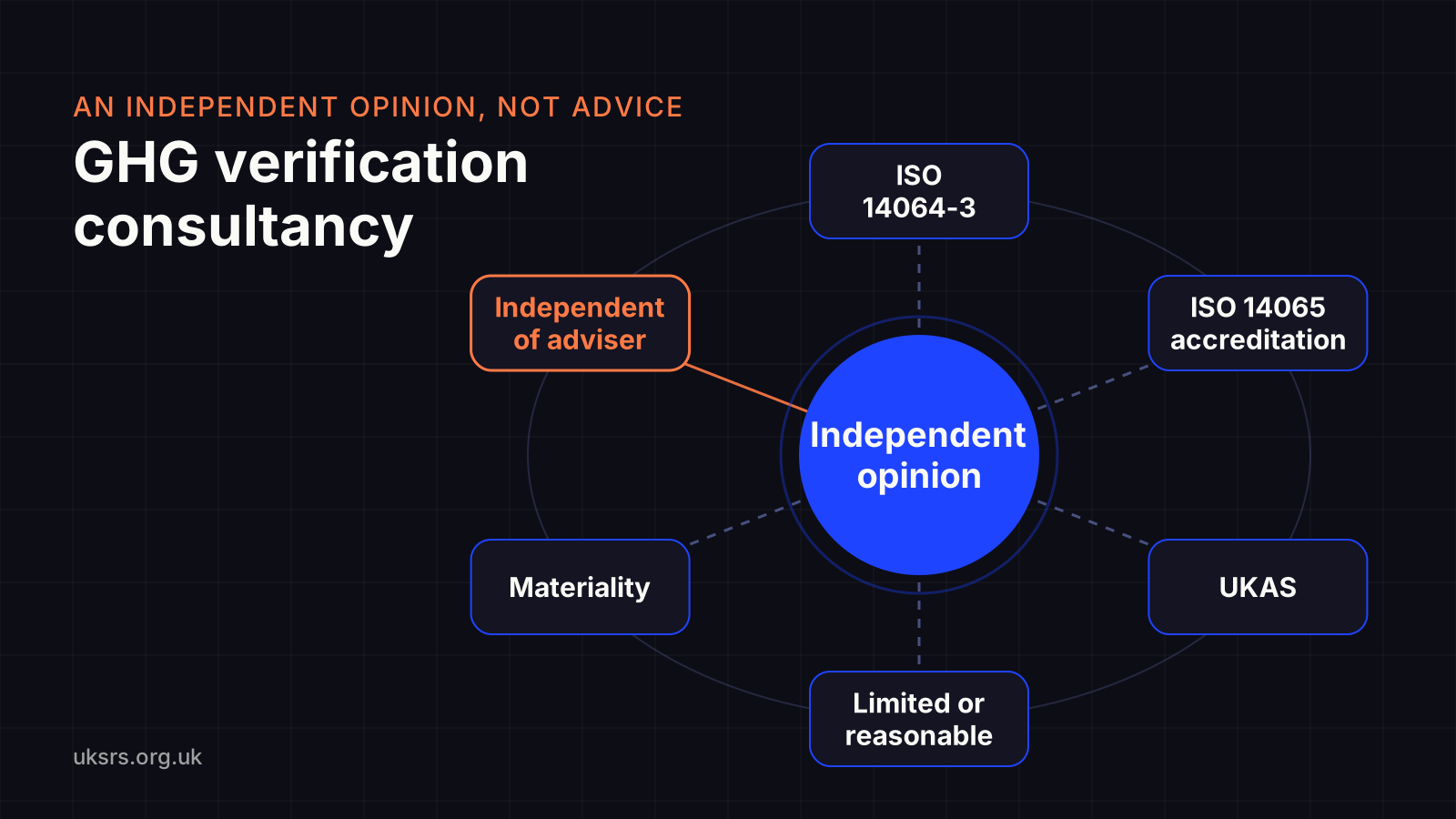
GHG verification consultancy is the independent check of an emissions statement, which is a different job from helping you prepare it.
UK SRS is an independent reference site. We have assessed no consultancy and publish no consultancy prices or rankings.
The work
ISO 14064-3 defines verification as a process for evaluating a statement of historical data to determine whether it is materially correct and conforms to criteria.
So a GHG verification consultancy does not build your inventory: it tests one you have already built and gives an opinion on it.
Validation is the forward-looking twin: it assesses the assumptions and methods behind a statement about future outcomes, such as a project’s expected reductions.
An agreed-upon procedures engagement reports what was checked but gives no opinion, so it is not verification.
Building the inventory is the job of a GHG consultancy, and measuring a footprint for a claim is covered on carbon footprint consultancy.
Searches for a carbon verification consultant or greenhouse gas emissions verification consultants describe the same service.
Module 01 / 04
Module 02 / 04
Module 03 / 04
Module 04 / 04
The standards
ISO 14064-3:2019 is the method a verifier applies to an organisation, project or product GHG statement, and ISO records it as confirmed and current.
ISO 14065:2020 sets requirements for the bodies that validate and verify environmental information, and ISO describes it as a sector application of ISO/IEC 17029:2019.
UKAS required greenhouse gas verification bodies accredited to ISO 14065 to transition to ISO/IEC 17029 by 30 June 2024, according to its validation and verification page.
So a certificate citing ISO 14065:2013 alone is not a current UK credential.
ISO 14066:2023 sets the competence requirements for the teams that do the work.
The standards are compared clause by clause on GHG verification standards.
Module 01 / 04
Module 02 / 04
Module 03 / 04
Module 04 / 04
Accreditation
UKAS is appointed as the UK national accreditation body by regulation 3 of the Accreditation Regulations 2009.
Its memorandum with the government says UKAS will not accredit outside the activities listed in Appendix 1, and consultancy is not one of them.
One of those activities is “the accreditation of greenhouse gas validation and verification bodies” to ISO 14065, according to the DBT–UKAS Memorandum of Understanding.
So “UKAS-accredited consultant” describes something that does not exist.
UKAS can accredit a body that certifies persons under ISO/IEC 17024, which accredits the certifying body, not the person.
The check is one search in the UKAS directory: name the body, open its schedule and read what it covers.
How to read a schedule is explained on UKAS accreditation.
Module 01 / 04
Module 02 / 04
Module 03 / 04
Module 04 / 04
Levels of assurance
ISO 14064-3 defines reasonable assurance as a high but not absolute level of assurance, and limited assurance as a reduced level.
Under clause 5.1.3 the verifier and client agree the level before the work starts, and the verifier may not change it part-way through.
The body of ISO 14064-3 is written for reasonable assurance, and a limited assurance verification must also meet the requirements in its Annex A.
Under ISSA (UK) 5000, a limited assurance conclusion says that no matter has come to the practitioner’s attention that causes it to believe the information is materially misstated.
That double negative is not a statement that the figures are correct, so do not describe it as one.
The materiality threshold is agreed or set at the start too, under clause 5.1.7, and it belongs in your brief.
The broader assurance market is explained on sustainability assurance.
A high but not absolute level, given as a positive opinion.
ISO 14064-3, 3.6.6A reduced level, given as “nothing has come to our attention”.
ISO 14064-3, 3.6.7 and Annex AIndependence
ISO 14064-3 says it can be used by first-, second- and third-party verifiers, so the standard alone does not make a verification independent.
An independent opinion comes from a third party that did not prepare the statement it is checking.
ISO/IEC 17029, the framework beneath ISO 14065, also covers first-, second- and third-party activity, so accreditation alone does not show a body is independent of you.
The GHG Protocol’s Corporate Standard gives the company the job of setting its base-year recalculation threshold and the verifier the job of confirming the company followed it.
The IESBA’s ethics standards for sustainability assurance, effective from 15 December 2026, bar practitioners from assuming management responsibility for a client.
For a public interest entity, its technical overview describes a general prohibition on a non-assurance service where it might create a self-review threat.
So if a firm helped build your inventory, appoint a different body to verify it, and ask every bidder to declare what it has done for you before.
Module 01 / 04
Module 02 / 04
Module 03 / 04
Module 04 / 04
What is actually asked for
The UK ETS is the only UK regime that requires accredited GHG verification by law, and CSRD requires limited assurance for undertakings in its scope.
Most other requests for verification come from a standard you chose, a customer or your own board.
| Regime | What it asks for | Source |
|---|---|---|
| UK ETS | A verifier accredited by UKAS to ISO 14065 and the Verification Regulation, scoped to the regulated activity | GOV.UK, how to comply |
| SECR | Nothing: no statutory requirement to audit or assure; assurance recommended as best practice | Environmental Reporting Guidelines (2019) |
| UK SRS (FCA) | No duty to obtain assurance; say whether you did, and the provider, scope, level and standards | FCA PS26/19 |
| CSRD and ESRS | Limited assurance of the sustainability statement for in-scope undertakings | Directive (EU) 2026/470 |
| SBTi V2.0 | Category A: base-year inventory assured to at least limited assurance by an accredited independent third party | CNZS V2.0 Criteria C7 |
| ISO 14068 claims | Follow ISO 14068:2026; ISO 14068-1:2023 was withdrawn on 11 September 2026 | ISO catalogue |
| PAS 2060 | Withdrawn on 1 December 2025; no new verification available | BSI Knowledge |
| PPN 006 | No requirement to have the footprint audited | Technical Standard ¶18 |
The UK ETS duty is set out on the UK ETS page, and the SECR position on the SECR reporting guide.
Module 01 / 04
Module 02 / 04
Module 03 / 04
Module 04 / 04
Listed companies
The FCA’s PS26/19 requires companies in UKLR 6, 14, 15, 16 and 22 to report against UK SRS on a comply-or-explain basis for periods beginning on or after 1 January 2027.
The FCA said disclosing whether assurance was obtained, and the provider, scope, level and standards applied, gives investors decision-useful information, and it did not mandate assurance.
The FRC issued ISSA (UK) 5000 on 12 November 2025 for voluntary use, effective for periods beginning on or after 15 December 2026.
The IAASB’s withdrawal of ISAE 3410, the older greenhouse gas assurance standard, takes effect from ISSA 5000’s effective date.
The government’s response on assurance oversight chose a voluntary regime, with the FRC tasked with an interim register.
So a proposal that calls UK SRS assurance mandatory is overstating the rules.
The reporting side is on UK SRS S2, and the FCA rules on UK SRS and the FCA.
Module 01 / 04
Module 02 / 04
Module 03 / 04
Module 04 / 04
Targets, claims and customers
The SBTi says that neither it nor any recognised validation body independently verifies the emissions data a company submits.
Under its Corporate Net-Zero Standard V2.0, a Category A company needs its base-year inventory assured to at least limited assurance by an accredited independent third party.
V2.0 validations open on 1 February 2027, so that requirement does not apply to targets validated under the current criteria.
ISO 14068-1:2023 was withdrawn on 11 September 2026 and is being replaced by ISO 14068:2026, and ISO itself certifies nobody.
PAS 2060 was withdrawn on 1 December 2025, so a new “PAS 2060 verified” claim is not available.
The PPN 006 Technical Standard says there is no requirement to have a Carbon Reduction Plan footprint audited.
CDP says neither it nor its scoring partners verify the information in a response, according to its scores page.
The claim standards are compared on PAS 2060 and ISO 14068, and target validation on SBTi validation.
Module 01 / 04
Module 02 / 04
Module 03 / 04
Module 04 / 04
Before you call anyone
Brief a GHG verification consultancy with the statement to be verified, the criteria it was prepared against, the level of assurance and who will rely on the opinion.
Answer the seven questions and the panel lists what each destination of your figures actually asks for, with the provision behind it.
Send the inventory, the methodology note and the base-year recalculation policy with the request, so the quote reflects the real work.
State the materiality threshold you need, or ask the verifier to propose one and explain it.
Which assurance does my report actually need?
No legal duty: the government’s guidance says there is no statutory requirement to have the information audited, though it recommends assurance as best practice.
Environmental Reporting Guidelines (2019), Ch. 1 Action iv and Ch. 2 §9; SI 2008/410 Sch 7 Parts 7 and 7A
Outside UKLR 6, 14, 15, 16 and 22 nothing requires UK SRS reporting, and no UK rule requires sustainability assurance.
FCA PS26/19; FRC FAQ; DBT assurance response ¶1.8 (a voluntary oversight regime)
A Carbon Reduction Plan needs no audited footprint, and CDP says neither it nor its scoring partners verify responses; a customer’s contract can still ask for more, so read it.
PPN 006 Technical Standard ¶18; CDP scores page
UKAS accredits verification bodies, never consultants or individuals, so look up the body’s schedule and confirm it covers greenhouse gas verification.
SI 2009/3155 reg 3; DBT–UKAS MoU ¶3.1 and Appendix 1; UKAS directory
A scoping aid as at 11 October 2026, not legal advice, and it assesses no provider.
Nothing you choose is stored or sent.
Module 01 / 04
Module 02 / 04
Module 03 / 04
Module 04 / 04
Due diligence
Ask for the verification body’s accreditation schedule, look it up yourself, and confirm it covers greenhouse gas verification.
Ask whether the body, or anyone in its group, has prepared any part of the figures it would verify.
For the UK ETS, confirm the accreditation scope covers your regulated activity, because GOV.UK makes that a condition.
Ask who is on the team, how their competence is assessed against ISO 14066, and who carries out the independent review.
Ask for a specimen opinion at the level you are buying, so you know what you will be able to publish.
Ask how findings are raised and corrected before the opinion, and whether a qualified opinion is possible.
The wider buying process is set out in choosing a sustainability consultant.
It names no verification body, quotes no price, and verifies, assures or accredits nothing.
Module 01 / 04
Module 02 / 04
Module 03 / 04
Module 04 / 04
Which kind of help
A GHG consultant builds the inventory, a verifier tests it to ISO 14064-3, and an assurance practitioner concludes on it under ISSA (UK) 5000 or a similar standard.
Your organisation owns the statement in every case, and the opinion never transfers that responsibility.
| GHG consultancy | GHG verification body | Sustainability assurance practitioner | |
|---|---|---|---|
| Job | Build the inventory and report | Give an opinion on a GHG statement | Give a conclusion on sustainability information |
| Usual standard | GHG Protocol, ISO 14064-1 | ISO 14064-3 | ISSA (UK) 5000 or ISSA 5000 |
| Accreditation | None exists for consultants | UKAS, to ISO 14065 or ISO/IEC 17029 | No UKAS accreditation; FRC oversight voluntary |
| Required by law | Never | UK ETS | Not in the UK; CSRD in the EU |
If the inventory is not ready, start with a greenhouse gas consultant and verify the following year.
Running the inventory as a yearly cycle is the work of a carbon management consultant.
Module 01 / 04
Module 02 / 04
Module 03 / 04
Module 04 / 04
Illustrative brief · no consultancy assessed
A listed company plans its first UK SRS report for 2027 and wants its Scope 1 and 2 figures verified at limited assurance.
It asks two verification bodies to quote, neither of which helped build the inventory, and checks both schedules in the UKAS directory.
For the reporting duties behind it, see UK carbon reporting requirements.
Boundary, method note and data trail ready for a verifier.
Level, criteria, materiality and scope agreed in writing.
Findings corrected, opinion issued and the FCA statement drafted.
Each date has a different meaning
Check whether each date is a publication, an effective date or a deadline, and who it applies to.
A suggested delivery sequence
This is an editorial buying sequence, not a statutory timetable or a promise about how long a verification takes.
Frequently asked
A GHG verifier is a person or body that evaluates a greenhouse gas statement prepared by someone else and gives an opinion on whether it is materially correct and conforms to the criteria it claims.
ISO 14064-3 sets out how the work is done, and in the UK a verification body can be accredited by UKAS for greenhouse gas verification under ISO 14065 and ISO/IEC 17029.
A consultant helps you build the inventory: the boundary, the data, the factors and the report.
A verifier tests what you built and signs an opinion on it.
The same firm should not do both for the same statement, because it would be checking its own work.
Anyone can offer a review, but UKAS accredits verification bodies, never consultants or individuals, and a firm that prepared your figures is not independent of them.
For the UK ETS the verifier must be UKAS-accredited to ISO 14065 and the Verification Regulation.
No. The government’s Environmental Reporting Guidelines say there is no statutory requirement to have the information audited, and the statutory auditor is not required to audit it.
They recommend independent assurance as best practice.
No. Under the FCA’s PS26/19, companies in UKLR 6, 14, 15, 16 and 22 report against UK SRS on a comply-or-explain basis for periods from 1 January 2027, and say whether they obtained assurance and from whom; they are not required to obtain it.
Reasonable assurance is a high but not absolute level, expressed as a positive opinion that the statement is fairly presented.
Limited assurance is a reduced level, expressed as a conclusion that nothing has come to the verifier’s attention to suggest a material misstatement.
The level is agreed before the work starts and is not changed part-way through.
Verifiers work within a verification body, and the body, not the person, is what UKAS accredits.
ISO 14066 sets the competence requirements for verification teams, and training courses in ISO 14064 are offered commercially; check what any course certificate actually attests.
Carbon verification usually means verifying a GHG statement: an organisation’s inventory, a project’s emission reductions or a product footprint.
Carbon credits are a separate job, done by validation and verification bodies approved under each crediting programme’s own rules.
This site publishes no prices and has assessed no provider.
Ask each verification body for its days by grade, the level of assurance quoted, the materiality threshold, whether site visits are included, and its accreditation schedule.
Sources
Every figure, date and status on this page traces to the instrument’s owner.
Secondary commentary is never the source for a number.
Principles and requirements for verifying and validating GHG statements; confirmed and current.
A sector application of ISO/IEC 17029:2019; reviewed and confirmed in 2026.
Covers first-, second- and third-party activity.
What the people on the team must be able to do.
Transition from ISO 14065 to ISO/IEC 17029 by 30 June 2024.
UKAS appointed as the UK national accreditation body.
Sixteen accreditation activities, including ISO 14065; no consultancy category.
The directory that shows a body’s accreditation and its scope.
The verifier must be accredited by UKAS to ISO 14065 and the Verification Regulation.
No statutory requirement to have environmental information audited.
Comply or explain from 2027; a statement of whether assurance was obtained.
Issued 12 November 2025 for voluntary use; effective 15 December 2026.
Deals with both reasonable and limited assurance engagements.
Takes effect from the effective date of ISSA 5000.
Effective 15 December 2026; independence for sustainability assurance practitioners.
A voluntary oversight regime, ¶¶1.8, 1.13 and 1.15.
Limited assurance standards by 1 July 2027; the reasonable-assurance path removed.
Base-year assurance for Category A at a minimum of limited assurance.
Replaces ISO 14068-1:2023, withdrawn on 11 September 2026.
Withdrawn 1 December 2025.
No requirement to have the carbon footprint audited.
The verifier confirms the company’s adherence to its recalculation policy.
Continue reading
ISO 14064-3, ISO 14065 and the UK ETS duty, side by side.
How to read a schedule and check a body yourself.
Building the organisational inventory a verifier will test.
ISSA (UK) 5000, levels of assurance and who provides it.
Which footprint each rule asks for, and which claims to check.
The UK duties, and who each one requires you to appoint.