Yes: no submission
Same base year, ambition, method and target year: the company is simply updating its base-year emissions.
SBTi FAQAsk direct questions about your own reporting — your thresholds, your dates, what you file and when.
Sign up free →The standards
Does it apply to you
Reporting under it
WHY REGISTER
Ask these pages about your own company.
Free · no card
Everything on this site stays open without an account.
Start here
Dates and penalties
Doing it
WHY REGISTER
Ask these pages about your own company.
Free · no card
Everything on this site stays open without an account.
What you must file
Doing it
WHY REGISTER
Ask these pages about your own company.
Free · no card
Everything on this site stays open without an account.
Start here
Setting targets
Who and where
WHY REGISTER
Ask these pages about your own company.
Free · no card
Everything on this site stays open without an account.
The UK duty
Doing it
WHY REGISTER
Ask these pages about your own company.
Free · no card
Everything on this site stays open without an account.
The baseline
Europe
Reporting more widely
WHY REGISTER
Ask these pages about your own company.
Free · no card
Everything on this site stays open without an account.
Carbon markets and trade
Packaging and net zero
Carbon accounting
WHY REGISTER
Ask these pages about your own company.
Free · no card
Everything on this site stays open without an account.
Choosing
Carbon
Compliance and offsets
WHY REGISTER
Ask these pages about your own company.
Free · no card
Everything on this site stays open without an account.
Software
Templates
Careers
WHY REGISTER
Ask these pages about your own company.
Free · no card
Everything on this site stays open without an account.
ASK ABOUT YOUR OWN REPORTING
Ask direct questions about your own reporting — your thresholds, your dates, what you file and when.
Sign up freeFree · one email · already registered? Log in
Everything on this site stays open without an account.
SBTi recalculation · rebaselining and updates
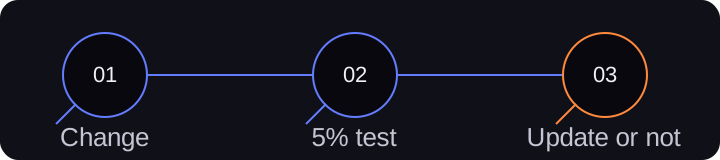
SBTi recalculation is triggered when a significant change, 5% or more of the base-year emissions inside a target, could compromise a validated target; if the recalculated target still meets the criteria, nothing needs resubmitting.
The Science Based Targets initiative recalculation rules sit in Near-Term Criteria C26 and C27, and an update, when needed, is a paid service.
Triggers
| Trigger | Example |
|---|---|
| Scope 3 becomes 40% or more of total emissions | Growth in purchased goods makes Scope 3 relevant |
| A change in the consolidation approach | Moving from operational control to equity share |
| Exclusions change significantly | An excluded site grows |
| Significant changes in structure or activities | An acquisition, divestiture, merger, insourcing or outsourcing |
| Data or method changes with a significant effect | Discovering significant errors in the base year |
| Other significant changes to projections or assumptions | Growth assumptions behind an intensity target |
The decision
Same base year, ambition, method and target year: the company is simply updating its base-year emissions.
SBTi FAQUpdate the affected targets and book a target update, assessed against the criteria in force at submission.
SBTi FAQA full target validation, not an update.
Validation SOP V1.2The SBTi does not allow rolling base years. Only the affected targets are reassessed: “Non-affected active targets are exempt from resubmission”.
Five-year review
C26 requires every active target to be reviewed at least every five years against the latest criteria, and updated if it no longer meets them.
The SBTi stressed on 8 October 2026 that “A mandatory five-year review does not necessarily mean that a company needs to update its targets.”
Targets left unattended can now be marked Expired, for instance “At least one year has passed since the target year without new targets submitted for validation.”
Under V2.0, from 2027, the five-year review is retired because every target runs exactly five years, followed by an End-of-cycle Assessment.
The GHG Protocol sets no significance threshold for base-year recalculation; a company sets its own policy. The 5% here is the SBTi’s threshold for target recalculation.
Cost
A corporate near-term and/or net-zero update costs $5,500 to $10,000 by tier, one fee for both, and a FLAG or buildings update $4,500 to $8,000 (V6.1, Table 4).
An SME that has grown out of the SME route cannot use the update service (SME FAQs Q20).
Every fee is on the SBTi cost page; the inventory side of rebaselining is on the GHG Protocol page, and the target rules on the SBTi near-term targets page. The SBTi hub links every guide.
Frequently asked
When a significant change could compromise it: Scope 3 reaching 40% of the total, a change of consolidation approach, significant changes to exclusions, company structure or activities, data or methods, or projections (Near-Term Criteria C27).
The significance threshold is 5% or less.
No. The SBTi’s FAQ says that if, after recalculating base-year emissions, the target still meets the criteria with the same base year, ambition, method and target year, the company is simply updating its base-year emissions and need not submit a formal update.
Under Service Offerings V6.1 a corporate near-term and/or net-zero update costs $5,500 in Tier 1 to $10,000 in Tier 4, and a FLAG or buildings update $4,500 to $8,000.
SBTi Services’ validation SOP says a change of base year or methodology needs a full target validation, not an update.
The SBTi’s.
The GHG Protocol leaves the significance threshold for base-year recalculation to the company; the SBTi sets 5% or less for target recalculation.
Under the status document in force since October 2026, a target can be marked Expired, for example when a year has passed after its target year without new targets, or when a five-year review deadline is missed.
Sources
Every figure, date and status on this page traces to the instrument’s owner.
Secondary commentary is never the source for a number.
C26 review; C27 triggered recalculation; C28 validity.
When a recalculation needs no formal update.
Target update, five-year review and triggered recalculation validations.
Definition of a target update.
Update fees.
The Expired status.
A five-year review does not always mean an update.
Five-year targets and the End-of-cycle Assessment.
The five-year review retired.
Q20: no update service after leaving the SME route.
Base-year recalculation policy; no fixed threshold.