SBTi near-term targets · the interim step
SBTi near-term targets: the window, the ambition, the 2026 changes
SBTi near-term targets are the interim targets every SBTi company sets: five to ten years from submission, from a base year no earlier than 2015, cutting Scope 1 and 2 emissions by at least 4.2% a year under the absolute contraction approach.
The Science Based Targets initiative near-term targets method changed on 29 April 2026, and V2.0 fixes the window at five years from 2027.
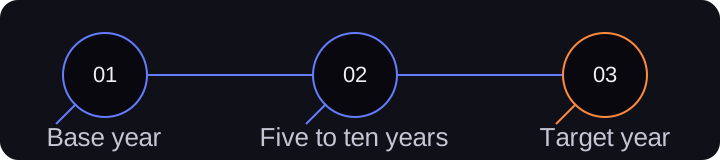
The shape
SBTi near-term targets in one table
| Element | Rule today | Criterion |
|---|---|---|
| Window | 5 to 10 years from submission; 2030 recommended | C13, R7 |
| Base year | No earlier than 2015 | C13 |
| Scope 1 and 2 coverage | At least 95% | C5, fn 7 |
| Scope 3 | Needed if relevant Scope 3 is 40% or more; cover at least 67% | C4, C6 |
| Ambition | 1.5°C for Scope 1 and 2; well-below 2°C for Scope 3 | C15, C18 |
| Minimum rate (absolute contraction) | 4.2% a year Scope 1 and 2; 2.5% Scope 3 | Net-Zero Standard V1.3.1 |
| Carbon credits | Never count as reductions | C11 |
| Review | At least every 5 years | C26 |
April 2026
Science Based Targets initiative near-term targets after the April 2026 update
On 29 April 2026 the SBTi changed how the absolute contraction approach calculates near-term cuts: “adjusting the annual reduction rates based on the time a company has to reach net-zero from its chosen base year.”
The floor stayed: “the minimum annual reduction rate floor of 4.2% between the base year and target year” is unchanged, as is net zero by 2050.
Companies whose emissions rose before their most recent year must compensate for the increase.
It took effect immediately for targets set in 2026 and 2027, energy, industry and FLAG alike; previously validated targets are untouched and no criteria changed.
The arithmetic is in the Method Appendix and built into the Corporate Near-Term Tool v2.5; use the tool, not a rate from a secondary source. The tool is explained on the SBTi target setting tool page.
From 2027
SBTi near-term targets under V2.0
V2.0 replaces the window with a fixed period: “Near-term targets shall cover a five-year period beginning at the start of the most recent reporting period at the time of submission for validation.”
It also splits Scope 1 and Scope 2 into separate targets, each covering 100% of its scope, and retires the five-year review because every target runs five years.
The full comparison is on the SBTi net zero standard page.
Disclosure
Science Based Targets initiative near-term targets in UK reporting
UK SRS S2 asks a reporting company to disclose each climate target, its period and base period, any interim targets, and whether the target was validated by a third party; an SBTi near-term target fills those fields, but none is required.
Whether you need one at all is on is SBTi mandatory?; recalculating one after an acquisition is on the SBTi recalculation page, and the SBTi hub links every guide.
Frequently asked
SBTi near-term targets, answered
What is an SBTi near-term target?
A science-based emissions target covering five to ten years from the date it is submitted for validation, with a base year no earlier than 2015 (Near-Term Criteria C13).
It is the interim step every SBTi company sets, with or without a long-term net-zero target.
Is 2030 a valid SBTi near-term target year?
Yes: the criteria recommend 2030 (R7), and SBTi Services’ SME FAQs say choosing 2030 exempts a target from the five-to-ten-year rule.
What is the minimum SBTi near-term reduction?
Under the absolute contraction approach the floor is 4.2% a year for Scope 1 and 2 and 2.5% a year for Scope 3; the April 2026 update phases the rate by base year and net-zero year without lowering the 4.2% floor.
What changed in April 2026?
On 29 April 2026 the SBTi updated the absolute contraction approach, effective immediately for targets set in 2026 and 2027: rates now depend on the time from base year to net zero, and increases in emissions before the most recent year must be compensated.
Validated targets are not affected, and no criteria changed.
How long are near-term targets under V2.0?
Exactly five years, starting from the most recent reporting period at submission (V2.0 criterion C9.2), instead of five to ten.
Do interim targets have to be disclosed in the UK?
Only where a framework asks: UK SRS S2 asks a reporting company to disclose its climate targets, including interim ones, and their progress; it does not require an SBTi target.
Sources
Primary sources
Every figure, date and status on this page traces to the instrument’s owner.
Secondary commentary is never the source for a number.
- Science Based Targets initiativeCorporate Near-Term Criteria V5.3.1
C4–C28; effective 14 April 2026.
- Science Based Targets initiativeCorporate Net-Zero Standard V1.3.1
The 4.2% and 2.5% minimum rates.
- Science Based Targets initiativeThe SBTi updates the Absolute Contraction Approach (29 April 2026)
Effective immediately; no criteria changed.
- Science Based Targets initiativeCNZS V1.3.1 Method Appendix
The ACA calculations.
- Science Based Targets initiativeCorporate Near-Term Tool v2.5
Base years to 2025, target years to 2036.
- Science Based Targets initiativeCorporate Net-Zero Standard V2.0 Criteria
C9.2: exactly five years.
- SBTi ServicesFAQs for SMEs V6.2
Q38 the 2030 option; Q41 the SME minimum.
- SBTi ServicesGuide for Companies in the Transition to CNZS V2.0
Which version a renewal uses.
- Science Based Targets initiativeTarget Dashboard
Published near-term targets.
- Department for Business and TradeUK SRS S2
¶33–36: disclosing interim targets.