SBTi target setting tool · the official workbooks
SBTi target setting tool: versions, inputs and limits
The SBTi target setting tool is a free Excel workbook, the Corporate Near-Term Tool, now version 2.5, that calculates the minimum cut a near-term target must meet under each method.
The Science Based Targets initiative target setting tool is one of several: there are net-zero, FINZ and sector tools, and V2.0’s is still a beta.
The tools
SBTi target setting tool versions, October 2026
| Tool | Version and date | What it calculates | File |
|---|---|---|---|
| Corporate Near-Term Tool | v2.5, 14 April 2026 | Minimum near-term ambition for Scope 1, 2 and 3, by method, with the April 2026 ACA adjustments | Excel |
| Corporate Net-Zero Tool | v1.2.1, 15 December 2025 | Long-term targets under the Net-Zero Standard; its financial-institution row is out of date | Excel |
| FINZ Target-Setting Tool | v1.1, 18 September 2026 | Portfolio climate-alignment targets for financial institutions; power and automotive targets paused | Excel |
| V2.0 Target-Setting Tool | Beta, 11 June 2026 | Not operational; the first operational version comes before V2.0 validation opens | SBTi Services note |
| Sector tools | Various | SDA transport, maritime, buildings, FLAG and aviation | Resources page |
How to use one
Using the Science Based Targets initiative target setting tool
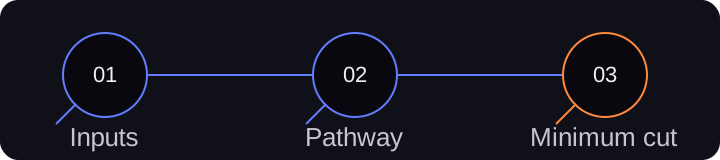
- 1
Enter the inventory
Base year, most recent year and Scope 1, 2 and 3 emissions, from a GHG Protocol inventory.
- 2
Choose the method
The absolute contraction approach, or a sector pathway (SDA) where one applies.
- 3
Set the target year
Within the tool’s limits: base years to 2025, target years to 2036.
- 4
Read the minimum
The tool gives the minimum ambition; your target can be more ambitious, not less.
- 5
Submit with care
The output does not override the criteria; SBTi Services may still ask for adjustment.
The SBTi’s FAQ: “The tool output does not override target assessment criteria, and the validation team may consequently request target adjustment.”
SMEs
The SBTi target setting tool for SMEs
SMEs can skip it: SME FAQs Q41 gives “Minimum value for absolute reduction target = 4.2% x (Target year - Base year)”, or a bespoke minimum from the corporate tool, uploaded with the submission.
For a 2020 base year and a 2030 target, that formula gives 4.2% × 10 = 42%; this is our arithmetic on the formula, not a figure SBTi publishes.
The SME route itself is on the SBTi SME page.
On this site
Science Based Targets initiative target setting tool, or ours?
The SBTi criteria page carries a calculator of our own for the minimum near-term cut; it is a reading aid, built on the Method Appendix, and not the SBTi’s tool or a validation.
For a submission, use the SBTi’s workbook; the method behind it is on the SBTi near-term targets page, and the SBTi hub links every guide.
Frequently asked
SBTi target setting tool, answered
What is the SBTi target setting tool?
The Corporate Near-Term Tool, an Excel workbook from the SBTi that calculates the minimum ambition for near-term targets under each method.
The current version is 2.5, which applies the April 2026 absolute contraction update.
Is the SBTi target setting tool free?
Yes.
The SBTi publishes its tools as free Excel downloads on its website; validation is the part SBTi Services charges for.
Does the tool’s output guarantee validation?
No. The SBTi’s FAQ says the tool output does not override the criteria, and the validation team may treat an output as erroneous and ask for the target to be adjusted.
Which base and target years does the tool accept?
Version 2.4.1 extended base-year eligibility through 2025 and target-year eligibility through 2036, and version 2.5 keeps those limits.
Is there a tool for SBTi V2.0?
Only a beta, published on 11 June 2026, which SBTi Services says should not be used as an indication of the final data required.
It says the first operational version will be published before V2.0 validation opens.
Do SMEs need the target setting tool?
No. SME FAQs Q41 gives a formula, 4.2% × (target year − base year), and recommends the corporate tool for a bespoke minimum, uploaded with the submission.
Sources
Primary sources
Every figure, date and status on this page traces to the instrument’s owner.
Secondary commentary is never the source for a number.
- Science Based Targets initiativeCorporate Near-Term Tool v2.5 (Excel)
README: ACA adjustments; base years to 2025, target years to 2036.
- Science Based Targets initiativeCorporate Net-Zero Tool v1.2.1 (Excel)
Released 15 December 2025.
- Science Based Targets initiativeFINZ Target-Setting Tool v1.1 (Excel)
Dated 18 September 2026.
- SBTi ServicesPreliminary Data Points for the Target-Setting Tool, CNZS V2.0
The June 2026 beta is not the operational tool.
- Science Based Targets initiativeResources
Sector tools: SDA transport, maritime, buildings, FLAG, aviation.
- Science Based Targets initiativeFAQs
“The tool output does not override target assessment criteria.”
- Science Based Targets initiativeThe SBTi updates the Absolute Contraction Approach (29 April 2026)
Built into tool v2.5.
- Science Based Targets initiativeCNZS V1.3.1 Method Appendix
The equations behind the tool.
- Science Based Targets initiativeCorporate Net-Zero Standard V1.3.1
4.2% and 2.5% minimum rates.
- SBTi ServicesFAQs for SMEs V6.2
Q41: the SME formula, or upload the corporate tool.
- SBTi ServicesSOP for the Validation of SBTi Targets V1.2
The Validation Portal’s built-in calculator.