From FY2027
Exceed €450m net turnover and an average of 1,000 employees, both.
Directive 2013/34/EU Art 19a(1)Ask direct questions about your own reporting — your thresholds, your dates, what you file and when.
Sign up free →The standards
Does it apply to you
Reporting under it
WHY REGISTER
Ask these pages about your own company.
Free · no card
Everything on this site stays open without an account.
Start here
Dates and penalties
Doing it
WHY REGISTER
Ask these pages about your own company.
Free · no card
Everything on this site stays open without an account.
What you must file
Doing it
WHY REGISTER
Ask these pages about your own company.
Free · no card
Everything on this site stays open without an account.
Start here
Setting targets
Who and where
WHY REGISTER
Ask these pages about your own company.
Free · no card
Everything on this site stays open without an account.
The UK duty
Doing it
WHY REGISTER
Ask these pages about your own company.
Free · no card
Everything on this site stays open without an account.
The baseline
Europe
Reporting more widely
WHY REGISTER
Ask these pages about your own company.
Free · no card
Everything on this site stays open without an account.
Carbon markets and trade
Packaging and net zero
Carbon accounting
WHY REGISTER
Ask these pages about your own company.
Free · no card
Everything on this site stays open without an account.
Choosing
Carbon
Compliance and offsets
WHY REGISTER
Ask these pages about your own company.
Free · no card
Everything on this site stays open without an account.
Software
Templates
Careers
WHY REGISTER
Ask these pages about your own company.
Free · no card
Everything on this site stays open without an account.
ASK ABOUT YOUR OWN REPORTING
Ask direct questions about your own reporting — your thresholds, your dates, what you file and when.
Sign up freeFree · one email · already registered? Log in
Everything on this site stays open without an account.
CSRD consultants · after Omnibus I
CSRD consultancy is worth buying only once you know which entity in your group reports, because Omnibus I took most companies out of scope.
Start with a scope memo, then brief the work the revised ESRS and limited assurance actually require.
UK SRS is an independent reference site. We have assessed no consultancy and publish no consultancy prices or rankings.
The first question
CSRD consultancy answers a narrower question for a UK group than it did before Omnibus I: which, if any, of our entities reports, from which year, and against which standards.
A UK group meets CSRD through an EU subsidiary, an EU parent, Article 40a for non-EU groups, or as a supplier, and only the first three create a reporting duty.
Choose the route that matches your group and the checker below says who files, using the thresholds in the consolidated Accounting Directive.
If no route applies, you do not need CSRD consultants; you may still need help answering customer questionnaires, which is a different purchase.
The UK picture is set out on CSRD reporting for UK companies, and the regime itself on the CSRD guide.
CSRD · which route are you in?
Pick the position that fits.
A UK group can stand in more than one: test each EU subsidiary on its own figures and the whole group under Article 40a.
Rules: Directive 2013/34/EU Arts 19a, 29a and 40a and Directive (EU) 2022/2464 Art 5, as amended by Directive (EU) 2026/470.
“Exceed” is strict and both limbs are needed.
Nothing you enter leaves your browser.
A provisional reading, not advice on your group perimeter.
Module 01 / 04
Module 02 / 04
Module 03 / 04
Module 04 / 04
Scope after Omnibus I
Directive (EU) 2026/470, in force since 18 March 2026, limits CSRD from financial year 2027 to undertakings that exceed a net turnover of €450 million and an average of 1,000 employees.
The test is cumulative, so an undertaking over one limb and under the other is out of scope.
Wave one is limited to financial years 2024 to 2026, so a company that reported early stays in only if it meets the new test, according to recital (31) of the Official Journal text.
For financial years 2025 and 2026, Member States may exempt undertakings that do not exceed €450 million or 1,000 employees, which is wider than the scope test and differs country by country.
A “1,750 employees” threshold circulated between the political agreement and the adopted text, and it does not appear in the act.
The Commission’s staff working document SWD(2026) 500 estimates that 6,753 companies remain in scope and that the change removes about 85% of the original scope.
That population counts only companies that remain subject to CSRD after Omnibus I, not every company a UK group might meet in its value chain.
Before the Omnibus the stop-the-clock Directive (EU) 2025/794 had moved wave two to FY2027 and wave three to FY2028; the history is on the CSRD Omnibus page.
Exceed €450m net turnover and an average of 1,000 employees, both.
Directive 2013/34/EU Art 19a(1)Two of €25m balance sheet, €50m turnover and 250 employees.
Art 3(4): still the “large” size classNon-EU parents
A UK-parented group with large EU sales can be caught by Article 40a, which applies where the group generated net turnover in the Union of more than €450 million in each of the last two consecutive financial years.
The report is then published through an EU subsidiary with more than €200 million of net turnover, or a branch over €200 million where there is no such subsidiary.
There is no employee test at either limb of Article 40a(1).
Reporting under Article 40a begins with the 2028 financial year, with first reports in 2029, according to EFRAG.
The standards for it are an EFRAG exposure draft covering impacts only, with consultation open until 31 October 2026 and technical advice expected in January 2027, as set out in its Basis for Conclusions.
Where the third-country undertaking is a financial holding undertaking whose subsidiaries are independent of one another, Member States must let the subsidiaries and branches decide not to publish.
An EU subsidiary can be exempt from its own report where it is included in a consolidated report of its third-country parent prepared under the ESRS or an equivalent, under Article 19a(9).
The draft standard is on ESRS-40a.
Article 40a · scope check · € millions
No answer without the EU-generated turnover figures
Limb 1 is the whole of the first question: net turnover generated in the Union, at group level, for each of the last two financial years.
Most consolidated accounts do not present that number, because "EMEA" or "Europe" is not the Union.
Producing it is the first piece of work.
Rule: Directive 2013/34/EU Art 40a(1), as amended by Directive (EU) 2026/470 Art 2(13).
“Exceeding” is strict: €450.0m is not over the line.
A provisional reading of published thresholds, not a determination for your group.
Module 01 / 04
Module 02 / 04
Module 03 / 04
Module 04 / 04
The standards
The revised ESRS are Delegated Regulation (EU) 2026/1563, published on 21 September 2026, in force on 10 November 2026 and applying to financial years beginning on or after 1 January 2027, under its Article 3.
For FY2026 an undertaking may use the 2023 ESRS, the 2023 ESRS with eight listed reliefs, or the revised ESRS, and must state which (Article 2).
The Commission said on 3 July 2026 that the revision cuts mandatory datapoints by over 60%.
Under the revised ESRS 1, an undertaking shall not disclose information required by a disclosure requirement or datapoint if it is not material (¶24), and may reach top-down conclusions on materiality (¶27).
The voluntary standard for undertakings protected by the value-chain cap is Delegated Regulation (EU) 2026/1560, in force since 24 September 2026.
Paragraph numbers changed between versions, so a gap analysis or template built on the 2023 ESRS needs re-mapping before it is used for FY2027.
The standards are set out on ESRS, and the voluntary standard on VSME.
Module 01 / 04
Module 02 / 04
Module 03 / 04
Module 04 / 04
Double materiality
ESRS reporting rests on double materiality, so the assessment is the first substantive package a CSRD consultancy delivers and it decides every disclosure that follows.
The revised ESRS 1 says that in general the starting point is the assessment of impacts (¶36), with engagement with affected stakeholders in ongoing due diligence a key input (¶42).
Severity is assessed on scale, scope and irremediable character (¶40), and the materiality of risks and opportunities on likelihood and the potential magnitude of financial effects (¶50).
UK SRS uses single (financial) materiality, asking what could reasonably be expected to affect cash flows, access to finance or cost of capital, at UK SRS S1 ¶3.
The concept is explained on double materiality, and running one on the double materiality assessment guide.
“In general, the starting point is the assessment of impacts” (ESRS 1 ¶36).
Scale, scope and irremediable character (¶40).
Likelihood and potential magnitude of financial effects (¶50).
Assurance and independence
CSRD assurance is limited assurance: Omnibus I removed the empowerment to adopt reasonable assurance standards (recital 5), and the Commission must adopt limited assurance standards by 1 July 2027.
The statutory auditor gives the opinion by default, and each Member State may allow a different auditor or an independent assurance services provider, under Article 34 of the consolidated Accounting Directive.
The opinion covers compliance with the ESRS, the process used to identify the information reported and the Taxonomy Article 8 disclosures, so those are inside the assurance perimeter.
For a public-interest entity, the audit rules list preparing sustainability reporting among the prohibited non-audit services, in Article 5(1)(c) of Regulation (EU) No 537/2014 as amended by the CSRD.
Directive 2006/43/EC Article 25c, inserted by the CSRD, applies that prohibition to the auditor carrying out the assurance of a public-interest entity’s sustainability reporting and to its network.
So if your auditor will assure the report, your CSRD adviser has to be someone else, and that choice should come first.
The UK side of assurance is on sustainability assurance.
Module 01 / 04
Module 02 / 04
Module 03 / 04
Module 04 / 04
National law
Member States must bring Articles 1 to 3 of Omnibus I into national law by 19 March 2027, under its Article 5(1).
On 11 October 2026 the EUR-Lex transposition listing showed notified measures from four Member States: Belgium, Croatia, Poland and Finland.
The deadline has not passed, so a Member State with nothing notified is not late.
A notified measure is not necessarily a complete transposition, and the listing states that Member States bear sole responsibility for the information.
The delegated regulations that set the ESRS need no transposition, because a regulation applies directly.
A CSRD consultant should name the Member State whose law applies to each reporting entity, and say where that law is not yet final.
Module 01 / 04
Module 02 / 04
Module 03 / 04
Module 04 / 04
Interoperability
The ESRS–ISSB interoperability guidance says the definition of financial materiality in ESRS is aligned with IFRS S1, on which UK SRS S1 is built, while ESRS also covers the impact materiality lens.
The same guidance says almost all the climate disclosures in ISSB Standards are included in ESRS, which is not the same as saying the reverse.
The guidance dates from 2 May 2024 and maps the 2023 ESRS, so its paragraph tables need re-reading against the revised ESRS.
A UK-listed group in UKLR 6, 14, 15, 16 or 22 reports against UK SRS on a comply-or-explain basis from periods beginning on or after 1 January 2027, under the FCA’s PS26/19.
A group in both regimes is best served by one data model mapped to each, rather than two parallel programmes and two assurance files.
The comparison is on CSRD and UK SRS compared, and UK-side help on UK SRS consultancy.
Module 01 / 04
Module 02 / 04
Module 03 / 04
Module 04 / 04
The engagement
A CSRD engagement for an in-scope entity runs in six packages, from perimeter mapping to an evidence file for limited assurance.
Each one rests on a named provision, which is the test of whether a proposal is scoped to the law as it now stands.
Requests to suppliers sit inside the value-chain cap, which lets undertakings of up to 1,000 employees decline requests beyond the voluntary standard.
The Commission said on 6 May 2026 that the cap does not impose or imply any obligation on companies in the value chain to provide sustainability information.
Until rules on marking up sustainability reporting are adopted, undertakings should not be required to mark it up, according to recital (24) of Omnibus I.
Searches for an ESRS consultant, CSRD reporting consultant or CSRD advisory firms describe the same engagement.
Module 01 / 04
Module 02 / 04
Module 03 / 04
Module 04 / 04
Before you call anyone
Brief a CSRD consultancy with the entities, their turnover and headcount, the first reporting year, the Member State and who will assure the report, because those facts decide the work.
Answer the questions and the panel says whether you need a CSRD adviser at all, lists the work packages, and flags the claims that describe superseded law.
Ask each firm to state the scope test it applied, entity by entity, with the figures.
Ask which ESRS version the work is built on, and whether templates from the 2023 ESRS have been re-mapped.
Ask whether the firm, or anyone in its network, is or would be your statutory auditor or assurance provider.
Ask for days by grade, perimeter mapping priced separately from drafting, and who owns the workings at the end.
Proposals that use the 250-employee test, a 1,750-employee threshold or reasonable assurance from 2028 are working from law that has changed.
The wider process is in how to choose a sustainability consultant, and an unranked directory is on sustainability consulting firms.
It names no firm, quotes no price and decides no entity’s scope.
Do you need a CSRD adviser, and for what?
The panel below starts from a UK group with an EU subsidiary; change any answer and it updates.
Test each EU subsidiary, or the EU sub-group, against both limbs: more than €450 million net turnover and an average of more than 1,000 employees, from financial year 2027.
Directive 2013/34/EU Arts 19a(1), 29a(1)
An in-scope undertaking reports for financial years beginning on or after 1 January 2027 under the revised ESRS, with the first reports in 2028.
DR (EU) 2026/1563 Art 3; Directive 2022/2464 Art 5(2), as amended
A double materiality assessment under the revised ESRS 1 is the first substantive package, and it decides every disclosure that follows.
DR (EU) 2026/1563 Annex I, ESRS 1 Chapter 3
Map the existing SECR and climate data to the revised ESRS, and plan value-chain requests within the cap.
Directive 2013/34/EU Art 19a(3), as amended; Directive (EU) 2026/470 recital (12)
Assurance is limited assurance.
If your statutory auditor will assure a public-interest entity’s sustainability reporting, it and its network may not also prepare that reporting, so the CSRD adviser must be someone else.
Directive 2013/34/EU Art 34(1); Regulation (EU) No 537/2014 Art 5(1)(c); Directive 2006/43/EC Art 25c
Scope written as two of €25 million, €50 million and 250 employees; a “1,750 employees” threshold; reasonable assurance phasing in; or a national deadline stated as final before your Member State has transposed. Each describes law that has changed.
Directive 2013/34/EU Art 3(4); Directive (EU) 2026/470 Art 2(4)(a), recital (5), Art 5(1)
A briefing aid that decides no scope and gives no legal advice; national law may add to it.
Nothing you choose is stored or sent.
Module 01 / 04
Module 02 / 04
Module 03 / 04
Module 04 / 04
Illustrative brief · no consultancy assessed
This illustrative group owns a German subsidiary that exceeds both thresholds and is not a wave-one reporter.
Its CSRD consultancy brief names the scope memo, a double materiality assessment under the revised ESRS for FY2027, a data gap analysis, the sustainability statement and assurance readiness, with the auditor excluded from preparation.
For the detailed requirements, see CSRD reporting for UK companies.
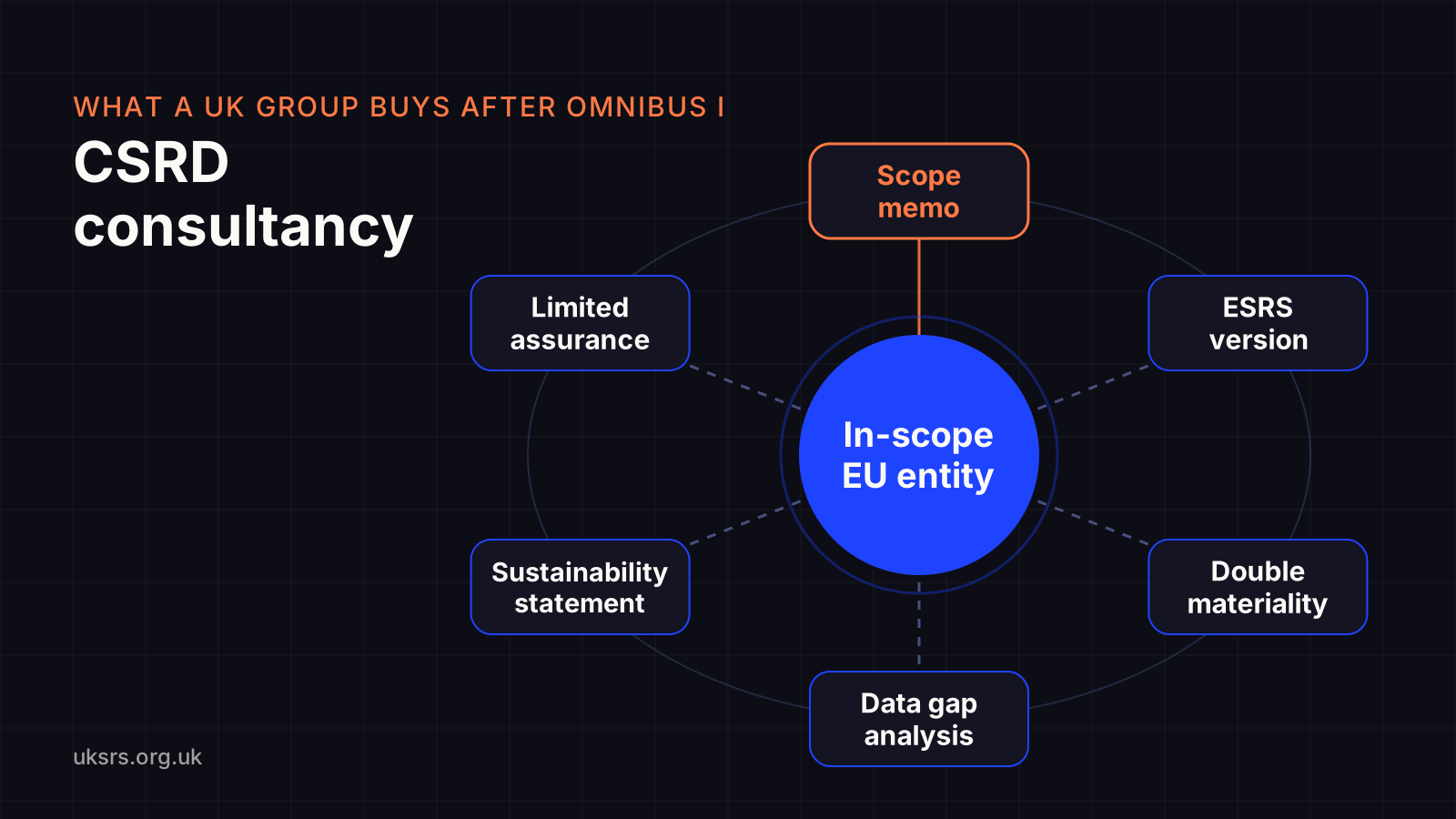
The EU subsidiary is tested against both limbs on its own figures.
A double materiality assessment under the revised ESRS.
Limited assurance from a provider that did not prepare it.
Each date has a different meaning
Check whether each date is a publication, an entry into force, an application date or a deadline for Member States.
A suggested delivery sequence
This is an editorial buying and preparation sequence, not a statutory timetable or a promise about how long the engagement takes.
Frequently asked
Not directly to a UK company as such.
CSRD reaches a UK group through an EU subsidiary or EU sub-group that exceeds both €450 million net turnover and an average of 1,000 employees, through an EU parent that does, or, from financial year 2028, through Article 40a where the group has more than €450 million of EU turnover in each of the last two years and an EU subsidiary or branch over €200 million.
A CSRD consultant maps which entities in the group report, runs or supports the double materiality assessment under the revised ESRS, analyses gaps in data and controls, helps draft the sustainability statement and prepares the evidence for limited assurance.
The undertaking remains responsible for its report.
Only if an entity in your group is still in scope or you supply data to one that is.
Omnibus I narrowed scope from financial year 2027 to undertakings exceeding both 1,000 employees and €450 million net turnover, and the Commission estimates the change removes about 85% of companies from the original scope.
An undertaking reports if it exceeds a net turnover of €450 million and an average of 1,000 employees during the financial year, both together.
The 250-employee, €50 million and €25 million test is the Accounting Directive’s definition of a large undertaking and no longer defines CSRD scope; a “1,750 employees” figure that circulated is not in the adopted text.
The revised ESRS in Delegated Regulation (EU) 2026/1563 apply to financial years beginning on or after 1 January 2027.
For FY2026 an undertaking may use the 2023 ESRS, the 2023 ESRS with eight listed reliefs, or the revised ESRS, and must state which.
Limited.
Omnibus I removed the empowerment to adopt reasonable assurance standards, and the Commission must adopt limited assurance standards by 1 July 2027.
Member States decide whether a different auditor or an independent assurance services provider may give the opinion.
Not for a public-interest entity whose sustainability reporting it assures.
The audit rules list preparing sustainability reporting among the prohibited non-audit services, and Directive 2006/43/EC Article 25c applies the prohibition to the auditor carrying out the assurance and its network.
Other entities are subject to the general independence rules.
Usually not.
The value-chain cap lets undertakings of up to 1,000 employees decline requests beyond the voluntary standard, and the Commission has said the cap does not impose or imply any obligation on companies in the value chain to provide information.
Yes, if it can show both.
The financial-materiality definition in ESRS is aligned with IFRS S1, on which UK SRS is built, but ESRS adds impact materiality and more climate datapoints, while UK SRS is comply or explain for listed companies from 2027.
This site publishes no prices and has assessed no firm.
Ask for a sterling day rate by grade, a scope by work package, perimeter mapping priced separately from ESRS drafting, and the second year priced in the same proposal.
Sources
Every figure, date and status on this page traces to the instrument’s owner.
Secondary commentary is never the source for a number.
In force 18 March 2026; transposition by 19 March 2027 (Art 5(1)); reasonable-assurance empowerment removed (recital 5).
Recitals (12), (24), (31); Arts 2(13), 3(2), 6.
The 1,000-employee and €450m test, Article 40a and the assurance provider options.
The original directive and its amendments to the audit legislation.
Moved wave two to FY2027 and wave three to FY2028.
In force 10 November 2026; applies to financial years beginning on or after 1 January 2027.
In force 24 September 2026; the value-chain cap datapoints.
The first set, still available for FY2026.
Over 60% fewer mandatory datapoints.
The cap does not impose or imply any obligation on companies in the value chain.
6,753 companies remain in scope; about 85% fewer than the original scope.
Re-read 11 October 2026.
Preparing sustainability reporting is a prohibited non-audit service.
Exposure draft; consultation closes 31 October 2026.
Impacts only; first reports for FY2028.
Financial-materiality definition aligned; ESRS adds the impact lens.
UK SRS on a comply-or-explain basis for listed companies from 2027.
Single (financial) materiality.
Continue reading
The directive after Omnibus I.
What changed, and when.
Which UK groups report, and what.
For groups that may meet both regimes.
Impact and financial materiality, explained.
The standards, revised for FY2027.