Corporate
Reporting, carbon accounting, targets and ESG.
National rules; location matters little.Ask direct questions about your own reporting — your thresholds, your dates, what you file and when.
Sign up free →The standards
Does it apply to you
Reporting under it
WHY REGISTER
Ask these pages about your own company.
Free · no card
Everything on this site stays open without an account.
Start here
Dates and penalties
Doing it
WHY REGISTER
Ask these pages about your own company.
Free · no card
Everything on this site stays open without an account.
What you must file
Doing it
WHY REGISTER
Ask these pages about your own company.
Free · no card
Everything on this site stays open without an account.
Start here
Setting targets
Who and where
WHY REGISTER
Ask these pages about your own company.
Free · no card
Everything on this site stays open without an account.
The UK duty
Doing it
WHY REGISTER
Ask these pages about your own company.
Free · no card
Everything on this site stays open without an account.
The baseline
Europe
Reporting more widely
WHY REGISTER
Ask these pages about your own company.
Free · no card
Everything on this site stays open without an account.
Carbon markets and trade
Packaging and net zero
Carbon accounting
WHY REGISTER
Ask these pages about your own company.
Free · no card
Everything on this site stays open without an account.
Choosing
Carbon
Compliance and offsets
WHY REGISTER
Ask these pages about your own company.
Free · no card
Everything on this site stays open without an account.
Software
Templates
Careers
WHY REGISTER
Ask these pages about your own company.
Free · no card
Everything on this site stays open without an account.
ASK ABOUT YOUR OWN REPORTING
Ask direct questions about your own reporting — your thresholds, your dates, what you file and when.
Sign up freeFree · one email · already registered? Log in
Everything on this site stays open without an account.
Sustainability consultants in London · firms and the London rules
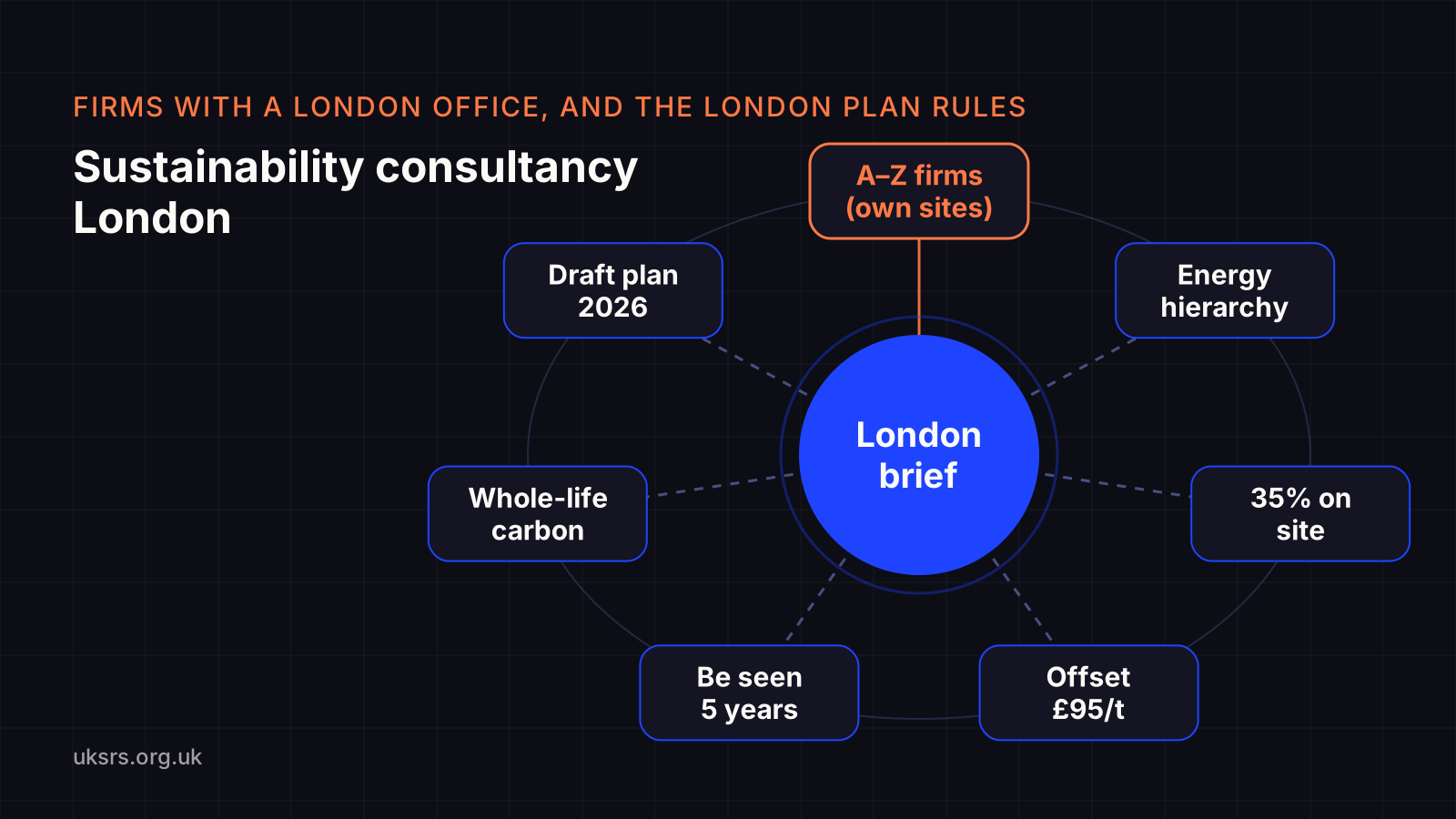
Sustainability consultancy in London is bought for two different jobs: corporate reporting and carbon work, and the energy and carbon documents London planning policy asks of new buildings.
UK SRS is an independent reference site. We have assessed no consultancy and publish no consultancy prices or rankings.
Two markets
Most corporate sustainability work in London follows national rules, so the city matters mainly for meetings and site visits.
What is genuinely London-specific is planning: the London Plan asks major and referable schemes for energy, carbon and circular economy documents that a consultant usually prepares.
Searches for an environmental consultancy in London also find ecology, contaminated land and impact assessment firms, which is different work from sustainability consultancy.
For the national rules behind corporate briefs, start with how to choose a sustainability consultant.
The ESG version of the brief is on the ESG consultancy guide, and carbon on the carbon consultant guide.
Reporting, carbon accounting, targets and ESG.
National rules; location matters little.Energy strategy, offset, be seen, whole-life carbon and circular economy.
London Plan 2021, Policies SI 2 and SI 7.The directory, A–Z
These are the firms from this site’s national directory whose own website showed a London office when we checked on 11 October 2026.
They are in alphabetical order, described only in their own words, and none has been assessed by this site.
Firms with a London office, in alphabetical order
18 of 18 firms shown.
Alphabetical; the order means nothing.
In its own words, summarised: A sustainability consulting group that describes guiding clients through an end-to-end sustainability journey.
In its own words, summarised: Planning, design and engineering of the built environment and infrastructure.
In its own words, summarised: Engineering and project delivery across how people are housed, connected, powered and protected.
In its own words, summarised: Testing, inspection and certification, with sustainability listed among its key services.
In its own words, summarised: Climate transition work with businesses, governments, financial institutions and philanthropies, across and within sectors.
In its own words, summarised: A platform for carbon accounting across Scopes 1 to 3, reports for SBTi and CSRD, climate projects and climate labels, with advisory support.
In its own words, summarised: ESG advisory services: working with businesses on innovation, emissions reduction, resilience and trust.
In its own words, summarised: Sustainability consulting and advisory: corporate sustainability, net zero and climate change, and renewable energy.
In its own words, summarised: EY-Parthenon sustainability and ESG strategy consulting: strategy, M&A, capital allocation and portfolio work.
In its own words, summarised: Energy buying and management alongside sustainability reporting and compliance support.
In its own words, summarised: Sustainability reporting and disclosure services across SECR, TCFD, ISSB and UK SRS and CSRD, carbon accounting and assurance readiness.
In its own words, summarised: An employee-owned engineering, management and development consultancy across transport, energy, water, buildings and infrastructure.
In its own words, summarised: A carbon accounting platform for Scope 1, 2 and 3 emissions, with a named climate strategy adviser on each account.
In its own words, summarised: A sustainability services page within its UK advisory offer.
In its own words, summarised: An engineering, architecture and consultancy company working on sustainable solutions for governments and companies.
In its own words, summarised: Engineering consultancy in propulsion, driveline and energy systems.
In its own words, summarised: Sustainability advisory, digital and technical services, from corporate sustainability strategy and energy transition to climate resilience.
In its own words, summarised: An engineering and professional services firm combining engineering, advisory and science-based work.
Each description was read on the firm’s own site on 1 October 2026.
This site has assessed none of these firms, has no commercial relationship with any of them, and lists them in no order of merit.
| Firm | Where its own site shows the London office |
|---|---|
| Anthesis Group | Farringdon; says its global headquarters is in London |
| Arup | Fitzroy Street, W1 |
| AtkinsRéalis | Nova North, Victoria |
| Bureau Veritas UK | Prescot Street, E1 |
| Carbon Trust | Blackfriars Road, SE1 |
| ClimatePartner | Borough High Street, SE1 |
| Deloitte UK | New Street Square, EC4 |
| ERM | Lists London among its UK offices |
| EY UK | A London office location page |
| Inspired | St Dunstan’s Hill, EC3 |
| KPMG UK | Canada Square, E14 |
| Mott MacDonald | Registered office, Fleet Place, EC4 |
| Normative | St Thomas Street, SE1 |
| PwC UK | Embankment Place, WC2 |
| Ramboll UK | Blackfriars Road, SE1; its UK head office |
| Ricardo | A London location page |
| SLR Consulting | Red Lion Square, WC1 |
| WSP UK | Chancery Lane, WC2 |
The national list, with the selection criteria tied to the law, is on the sustainability consulting firms page.
Module 01 / 04
Module 02 / 04
Module 03 / 04
Module 04 / 04
London Plan Policy SI 2
London Plan Policy SI 2 says “Major development should be net zero-carbon”, following an energy hierarchy, according to Chapter 9 of the London Plan 2021.
Major development proposals should include a detailed energy strategy showing how the zero-carbon target will be met, under SI 2 B.
The energy strategy is what many London sustainability consultancies are hired to write, and the GLA’s energy planning guidance sets out how.
SI 2 E adds that major development should calculate and minimise unregulated emissions, from plant and equipment Building Regulations do not cover.
The Plan frames this as part of London becoming “a zero-carbon city by 2050”, in paragraph 9.2.1.
Module 01 / 04
Module 02 / 04
Module 03 / 04
Module 04 / 04
Targets and payments
SI 2 C requires an on-site reduction of at least 35% beyond Building Regulations for major development, with 10% for homes and 15% for non-residential space from energy efficiency alone.
Any shortfall against zero carbon goes into the borough’s carbon offset fund, or is met off-site where delivery is certain, by agreement with the borough.
The GLA’s recommended price is £95 per tonne of carbon dioxide, and the contribution is counted over 30 years, according to its Carbon Offset Funds Guidance.
Boroughs may instead set their own price on local viability evidence, the Energy Assessment Guidance says, so check the borough’s figure.
The GLA describes major development as generally 10 or more homes or over 1,000 square metres of non-domestic floorspace.
The GLA’s worked figure, not a quote for any scheme; boroughs may set their own price.
Module 01 / 04
Module 02 / 04
Module 03 / 04
Module 04 / 04
Monitoring
The fourth step requires major developments to report actual operational energy performance for at least five years through the Mayor’s portal, according to the be seen guidance.
Reporting runs in three stages, planning, as built and in use, and responsibility sits with whoever legally owns the development at each stage.
A building bought or let after completion can therefore carry a reporting duty, which the GLA prefers to secure by a section 106 obligation, and a buyer’s adviser should pick it up.
Paragraph 9.2.10 of the Plan gives the same five-year period and mentions a Display Energy Certificate as one way to report.
Estimated performance as the design develops.
Updated estimates when construction is complete.
Actual energy data, yearly, for at least five years.
Referable applications
Development referable to the Mayor should calculate whole life-cycle carbon emissions and show actions taken to reduce them, under Policy SI 2 F.
Referable applications should also submit a Circular Economy Statement under Policy SI 7 B, covering demolition materials, design for disassembly and waste.
The GLA’s whole life-cycle carbon guidance asks for an assessment at pre-application where relevant, at application and after construction, and encourages one on non-referable major schemes.
Both guidance documents were adopted in March 2022 by Mayoral Decision MD2962.
The GLA template still follows the first edition of the RICS methodology, although the second edition has been in effect since 1 July 2024, according to the GLA guidance page.
This is planning policy for London applications; nationally there is no legal requirement in England to assess whole-life carbon, as the carbon footprint consultancy guide explains.
Building Regulations energy changes from 2027 are on the Future Homes Standard page.
Module 01 / 04
Module 02 / 04
Module 03 / 04
Module 04 / 04
Before you call anyone
Answer three questions and the panel lists the London Plan documents that apply, with the policy or GLA guidance behind each line.
It opens on a major non-residential scheme that is not referable, so the answers show before you choose anything.
Does my London scheme need carbon statements?
Major development should be net zero-carbon, and the application should include a detailed energy strategy showing how, through be lean, be clean, be green and be seen.
London Plan 2021, Policy SI 2 A and B
At least 35 per cent beyond Building Regulations on site, of which 15 per cent should come from energy efficiency alone.
London Plan 2021, Policy SI 2 C
Any shortfall against zero carbon is paid into the borough’s carbon offset fund, or met off-site by agreement; the GLA’s recommended price is £95 a tonne of CO2, counted over 30 years, unless the borough sets its own.
Policy SI 2 C–D; GLA Carbon Offset Funds Guidance 2022 ¶¶2.7–2.8
Report energy performance at planning, as-built and in-use stages, and in use for at least five years through the Mayor’s portal.
London Plan ¶9.2.10; Be Seen Energy Monitoring guidance ¶1.2.2
Calculate and minimise emissions from plant and equipment that Building Regulations do not cover.
London Plan 2021, Policy SI 2 E
Required only for referable applications, but the GLA encourages an assessment on non-referable major development.
GLA Whole Life-Cycle Carbon Assessments guidance (March 2022), summary
The London Plan 2021 is the adopted plan; a draft replacement was out to consultation from 16 July to 15 October 2026, with adoption expected in early 2028.
GLA, draft London Plan announcement
Covers London Plan 2021 Policies SI 2 and SI 7 and GLA guidance only, as read on 11 October 2026; it is not planning advice.
Nothing you choose is stored or sent.
Module 01 / 03
Module 02 / 03
Module 03 / 03
Status
The Mayor published a draft new London Plan on 16 July 2026 and consulted on it until 15 October 2026, according to the Mayor’s announcement.
The GLA expects adoption in early 2028 after an Examination in Public, so the 2021 policies above remain the adopted ones until then.
The announcement says the draft sets “a consistent approach across London in several key areas, such as energy efficiency”, so expect the targets to change.
Ask a consultant which version of the policy its advice assumes, and whether a long project could be decided under the new plan.
Module 01 / 04
Module 02 / 04
Module 03 / 04
Module 04 / 04
London public bodies
London boroughs and other public bodies often buy sustainability advice through a framework rather than a full tender.
The London Borough of Merton, for example, published a call-off under ESPO’s 500_23 framework in 2025 for a plan to decarbonise its procured services.
The frameworks, their lots and who may use them are compared on the sustainability consultancy framework guide.
Suppliers to central government may also need a plan under PPN 006.
Module 01 / 04
Module 02 / 04
Module 03 / 04
Module 04 / 04
Due diligence
For a planning brief, ask which London Plan version and which borough offset price the advice assumes, and who will report “be seen” data after handover.
For a corporate brief, ask what will actually be done in London and what can be done anywhere.
Ask whether the firm earns anything from equipment, energy or offsets it recommends.
Under the FCA’s PS26/19, UK SRS is comply or explain for companies in UKLR 6, 14, 15, 16 and 22 from 2027, so a London proposal that calls it mandatory overstates it.
It ranks no firm, quotes no price, gives no planning advice, and does not present uksrs.org.uk as a London consultancy.
Module 01 / 04
Module 02 / 04
Module 03 / 04
Module 04 / 04
Illustrative brief · no consultancy assessed
Establish whether the scheme is major and whether it is referable, then brief one consultant for the energy strategy and, if needed, the whole-life carbon and circular economy statements.
For the measurement side, see carbon footprint consultancy.
Major, and referable or not.
Energy strategy, then WLC and circular economy if referable.
Who reports be seen data for five years.
Each date has a different meaning
Check whether each date is a publication, an adoption, a consultation or the GLA’s expectation.
A suggested delivery sequence
This is an editorial buying sequence, not a statutory timetable or a promise about how long the work takes.
Frequently asked
Start from what you need, because London buyers usually want one of two things: corporate work such as reporting and carbon accounting, or planning work on a building, such as an energy strategy or whole life-cycle carbon assessment.
The A–Z list on this page shows firms whose own website shows a London office, described only in their own words.
Location matters for site work and planning work, where someone attends meetings with the borough or the GLA or visits buildings.
It matters much less for reporting, where the data comes from your systems.
Policy SI 2 says major development should be net zero-carbon and should include a detailed energy strategy showing how, following the energy hierarchy: be lean, be clean, be green and be seen.
Where a major development cannot reach zero carbon on site after at least a 35% on-site reduction, the shortfall is paid into the borough’s carbon offset fund or met off-site.
The GLA recommends £95 per tonne of CO2, counted over 30 years, unless the borough has set its own price.
The fourth step of the energy hierarchy: major developments report energy performance at planning, as-built and in-use stages, and in use for at least five years, through the Mayor’s portal.
Applications referable to the Mayor, under London Plan Policy SI 2 F, using the GLA template; the GLA encourages it on other major applications.
There is no national legal requirement in England to assess whole-life carbon.
A document required from referable applications under London Plan Policy SI 7 B, showing how demolition materials will be reused or recycled, how the design reduces material demand and enables disassembly, and how waste will be managed.
A draft replacement London Plan was published on 16 July 2026 and consulted on until 15 October 2026; the GLA expects adoption in early 2028 after an Examination in Public.
Until then the London Plan 2021 is the adopted plan.
No. Under the FCA’s PS26/19, UK SRS applies on a comply or explain basis to companies listed in UKLR 6, 14, 15, 16 and 22, for periods beginning on or after 1 January 2027, wherever they are based.
No. UK SRS is an independent reference site with no consultants, no clients and no prices; it has assessed none of the firms listed and ranks none of them.
Sources
Every figure, date and status on this page traces to the instrument’s owner.
Secondary commentary is never the source for a number.
Net zero-carbon major development, the energy hierarchy, 35% on site, offset funds, whole life-cycle carbon and circular economy statements.
The GLA’s index of energy, offset, be seen and whole-life carbon guidance.
The cash-in-lieu calculation and the recommended offset price.
£95 per tonne, over 30 years: £2,850 per tonne to be offset.
Monitoring and reporting for at least five years, in three stages.
Referable applications; RICS first-edition methodology for the GLA template.
Pre-application, application and post-construction stages.
Both guidance documents adopted in March 2022.
Consultation 16 July to 15 October 2026; adoption expected in early 2028.
The review timetable.
In effect from 1 July 2024.
A London borough buying through a framework, 2025.
UK SRS comply or explain for UKLR 6, 14, 15, 16 and 22 from 1 January 2027.
Read 11 October 2026 to confirm a London office; not an assessment.
Read 11 October 2026 to confirm a London office; not an assessment.
Read 11 October 2026 to confirm a London office; not an assessment.
Read 11 October 2026 to confirm a London office; not an assessment.
Read 11 October 2026 to confirm a London office; not an assessment.
Read 11 October 2026 to confirm a London office; not an assessment.
Read 11 October 2026 to confirm a London office; not an assessment.
Read 11 October 2026 to confirm a London office; not an assessment.
Read 11 October 2026 to confirm a London office; not an assessment.
Read 11 October 2026 to confirm a London office; not an assessment.
Read 11 October 2026 to confirm a London office; not an assessment.
Read 11 October 2026 to confirm a London office; not an assessment.
Read 11 October 2026 to confirm a London office; not an assessment.
Read 11 October 2026 to confirm a London office; not an assessment.
Read 11 October 2026 to confirm a London office; not an assessment.
Read 11 October 2026 to confirm a London office; not an assessment.
Read 11 October 2026 to confirm a London office; not an assessment.
Read 11 October 2026 to confirm a London office; not an assessment.
Continue reading
Selection criteria tied to the law, and the national A–Z directory.
The process, the brief and the questions.
How public bodies buy through ESPO, GCA and NEPO frameworks.
Which footprint each rule asks for, including whole-life carbon.
Part L for new work in England from 24 March 2027.
Governance and social subjects, with their own advisers.